A familiar chassis with a tracker on top
I read Densho's ceiling as a counting problem. What a screen can pay depends first on how many Densho symbols expand into Multiplier Reels and only then on what those reels are worth, because the multiplier ladder climbs ten times higher than the 10,000× cap can use while the paytable underneath reaches a fiftieth of it. The part Densho puts on top of a well-worn format, the progression tracker, lifts exactly the multipliers the rest of the return depends on, but it gets ten spins and small retriggers to do it. That makes a clean, honestly priced game with a single gear, and I put it at 6.6 for that reason.
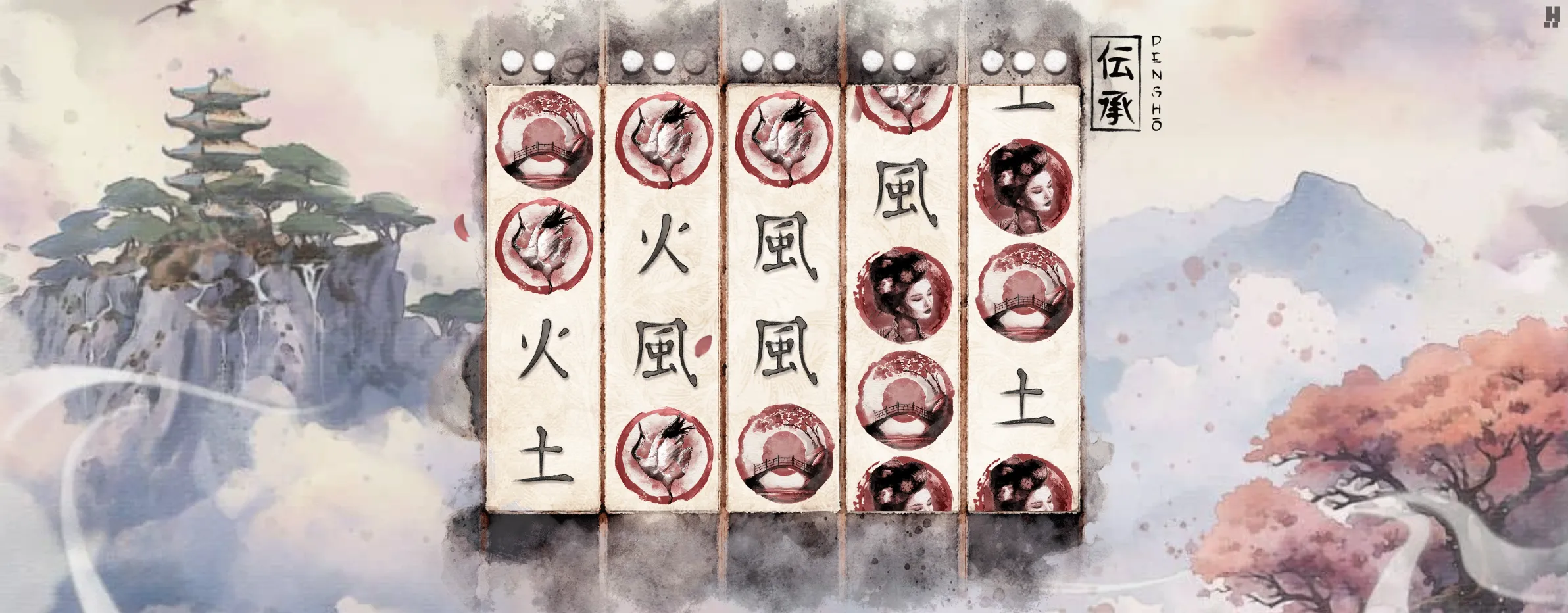
Almost every rule in Densho also runs in another Hacksaw Gaming game. Undead Fortune and Gladiator Legends share its 5×4 grid, its ten fixed lines, reel-filling wilds whose multipliers add on a shared line, and the same 10,000× cap. Shadows Inc has the rule that a reel wild expands only when it would join a win, along with retriggers of 2 and 4 spins. Dork Unit sorts its wild multipliers into Common, Rare and Epic tiers that add on a shared line, and keeps a FeatureSpins mode running until it is disabled. Densho assembles those parts under an ink-painting skin and adds a tracker above each reel in the bonus. I judge it on whether that tracker earns another pass through a crowded format.
The cap runs out long before the ladder does
I work from a hard bound that the additive rule sets. No line pays more than 20× the bet before multipliers, since five Samurai and five Wilds are the top awards, and no line can be multiplied by more than the total of the Multiplier Reels on screen. Ten lines at 20× times that total means no single spin pays more than 200 times the sum of its Multiplier Reels. The cap needs the sum to reach 50, which on a full screen of five reels is an average of 10× a reel.
Ten is the top of the Common range, one of the Rare values and the Legendary floor. Five Common reels at their highest value reach the cap, and so do five Legendary reels at their lowest. Five Legendary reels at 100× would total 500, ten times the 50 the cap needs. The Rare values from 15× to 50× and the Legendary values from 15× to 100× do their real work on screens with fewer reels, where two or three multipliers have to make up the sum: two Rare reels at their 5× floor bound their spin at 2,000×, and a single Common reel at 2× bounds it at 400×.
The cap barely touches the return. Reaching 10,000× at odds of 1 in 12,000,000 adds 10,000 ÷ 12,000,000 of a stake per spin, about 0.08%, less than a thousandth of the 96.40%. The other 96.3 points are paid below the cap, by line wins and by Multiplier Reels at ordinary values, and that is the part of Densho I think is worth judging.
Between Densho symbols the lines are filler
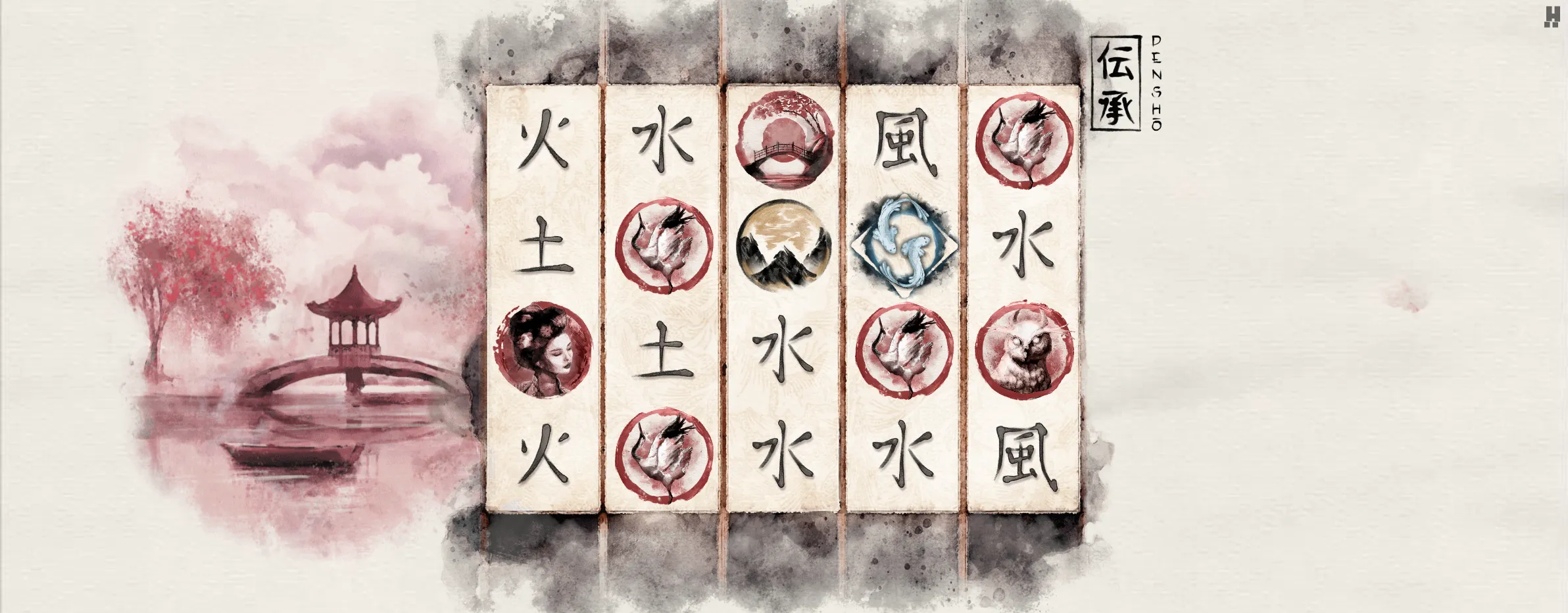
On its own the paytable reaches 200×, and only if all ten lines pay 20× together. A single line of five Samurai pays 20×, a five-hundredth of the cap. Further down, the awards thin quickly. Of the nine regular symbols, I count four that pay a tenth of the stake for three of a kind and two that pay exactly the stake, while the best three-of-a-kind, the Samurai, pays 3×. A 24.46% hit frequency means roughly one round in four wins something, but a kanji triple on one line is a win that keeps nine-tenths of the bet. The hit rate flatters the base game.
The reel sets push further in the same direction. The base game holds 40 standalone Wilds in 1,373 stops; the free-spins set holds 16 in 1,652, a third of the density, with 2 on reel 4 and 1 on reel 5. Since the Wild pays only for five, a five-Wild line built from standalone Wilds inside the bonus needs the one Wild stop on reel 5. The bonus is built for Multiplier Reels to do the work, and a round without them has almost nothing underneath.
The tracker lifts the right number in too short a round
Since the return is paid below the cap, raising multipliers on ordinary screens is the useful job for a bonus mechanic, and the tracker does it. Each Upgrade symbol levels up the tracker of its reel, which raises the lowest quality of Densho that reel can land. A reel moving from Common to Rare lifts its floor from 2× to 5×, two and a half times the win on any line it multiplies alone; moving on to Legendary doubles the floor again to 10× and opens the 100× value.
Room is the problem. Both rounds open with 10 spins, and two or three FS add 2 or 4, so the largest retrigger is 40% of the opening allotment. Free Spins starts every tracker at level 1, which puts ten Upgrade symbols, two per reel, between the first spin and a grid of Legendary floors, as many as the round has opening spins. Super Free Spins needs five. Levels hold only until the round ends, so a reel that climbs late improves only the spins left after it.
I do not count Super Free Spins as a second bonus. It is the same round, with the same retriggers under the same cap, started one tracker level higher. A five-reel screen there is worth at least 5,000× from the first spin, and that is a difference of starting point rather than of kind.
Super Free Spins buys a floor and pays for it in ceiling
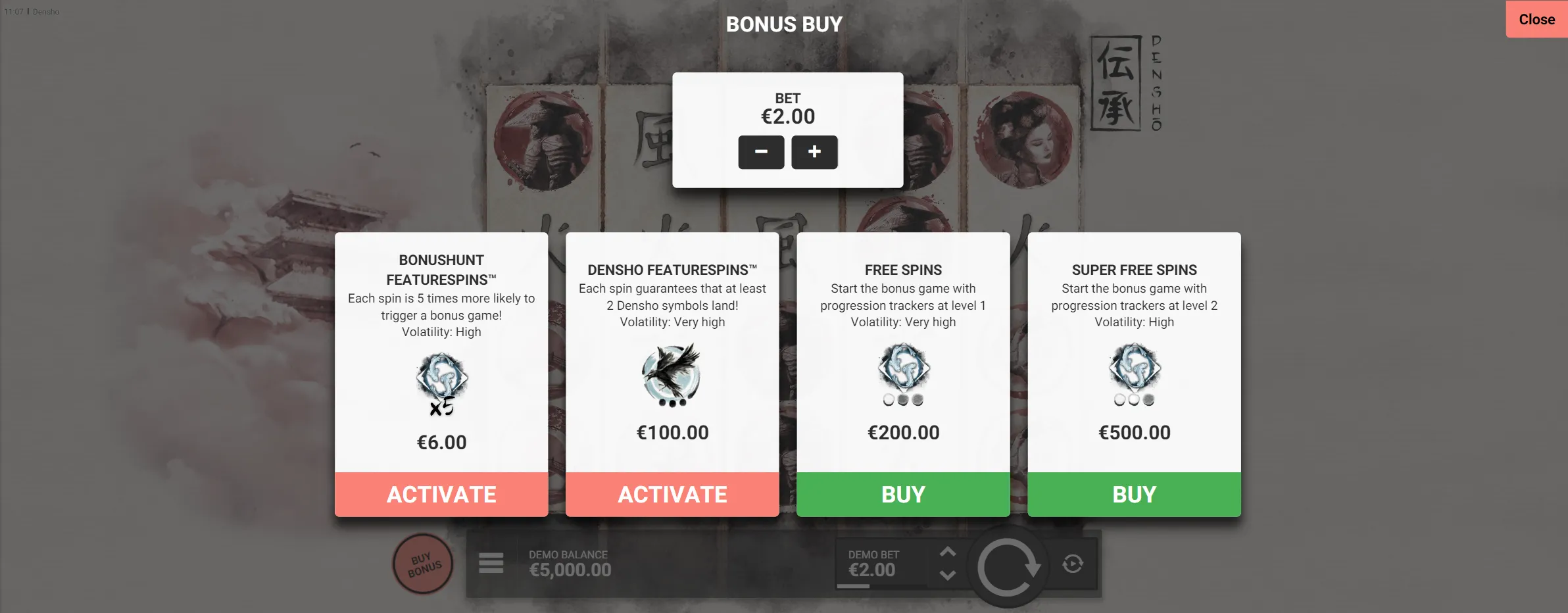
Every option on the buy menu returns between 96.33% and 96.37% against 96.40% for ordinary spins. On a 250× Super buy the widest gap of 0.07 points comes to 0.175× the bet, under a fifth of one stake. The menu is honest.
The two bonus buys differ in shape, not value. Buy Free Spins costs 100× and averages about 96× back; a five-reel screen at the Common floor pays 2,000×, 20 times the price, and the cap sits at 100 times the price. Buy Super Free Spins costs 250× and has to average about 241×; a five-reel screen at the Rare floor pays 5,000×, again 20 times the price, but the cap is now 40 times the price. The Super buy raises price and floor by the same factor of 2.5 and leaves the ceiling where it was. With the returns level, I read it as the narrower purchase, and the 100× buy is the one whose cap is the larger multiple of what it costs.
The FeatureSpins modes are fair by return and uneven in what they guarantee. BonusHunt charges 3× a spin for five times the trigger chance, so a bonus arrives for 60% of the average spend ordinary spins need to reach one. Densho FeatureSpins charges 50× for at least two Densho symbols and promises nothing about their expansion. A spin whose Densho symbols stay folded pays only the paytable, whose best possible screen of 200× is four times the price, and a line of five Samurai is worth 40% of it. I rank it last on the menu: correctly priced, but the guarantee covers a landing rather than the Multiplier Reel that makes a landing worth anything.
Fair prices do not rescue a thin frame
Densho suits a player who wants the reel-multiplier format with a buy menu that charges almost nothing over ordinary play. Anyone who wants a base game with lines worth following should look elsewhere, since between Densho symbols the best single line is 20×. So should anyone who wants a bonus that builds: ten spins and retriggers of 2 or 4 leave the tracker too little room to change a round.
I rate the return setting as a bigger decision than any choice on the menu. Casinos can run Densho at 88.34%, which keeps 11.66% of every stake against 3.60% at the top setting, more than three times the house edge, and that 8.06-point spread is over a hundred times the 0.07 separating the buys from ordinary spins. The rules screen shows which setting is loaded.
A well-built, fairly priced game earns more than a routine score from me. A paytable that reaches a fiftieth of its cap and a bonus with one gear keep Densho at 6.6.