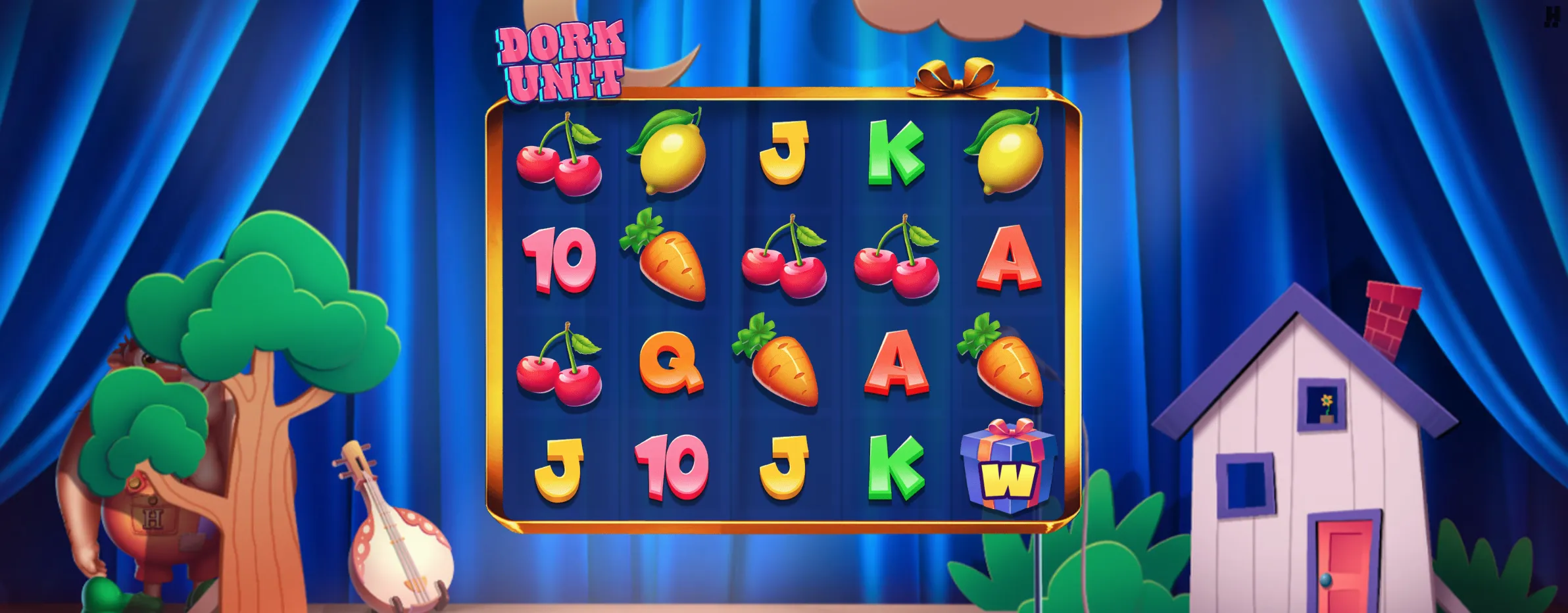
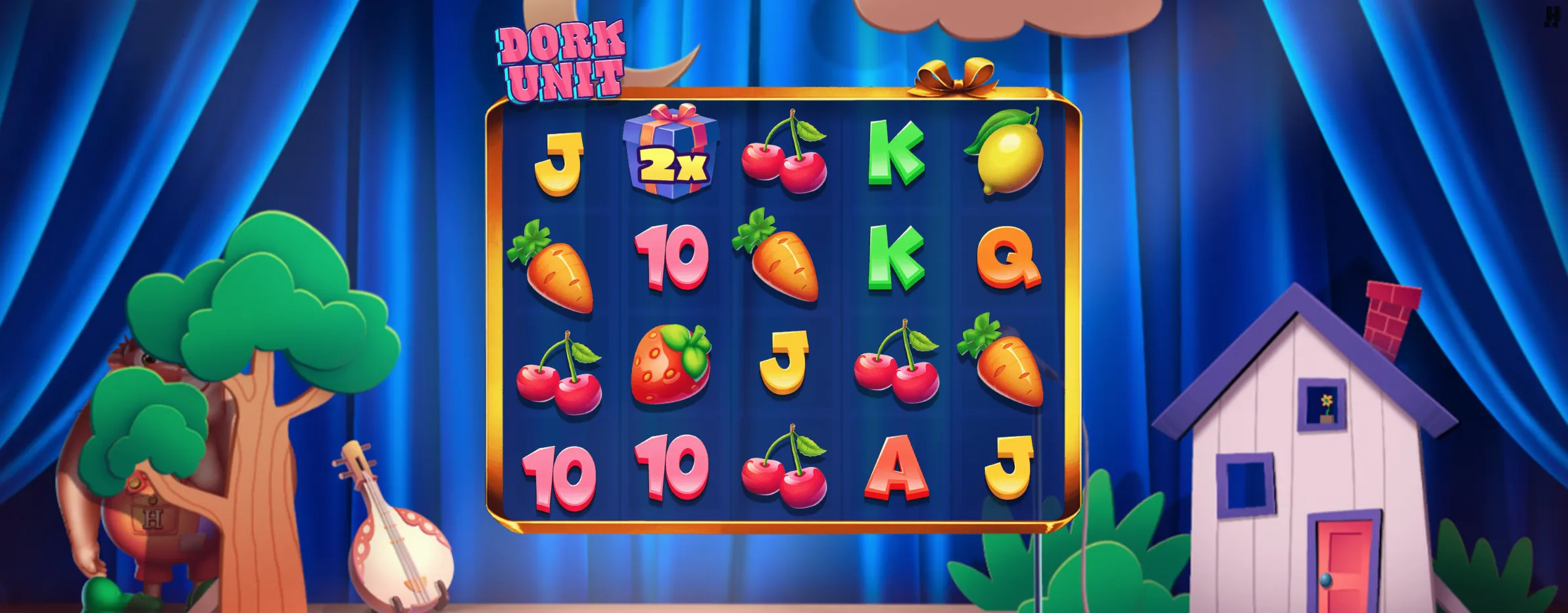
One reveal decides this game, and the maths keeps it that way
I read Dork Unit as a slot with a single question in it: does a Rare or Epic Gift Box reveal into a winning line? Its multipliers add rather than multiply, and its tiers are spaced so that five boxes from one tier only ever match one box from the tier above. The additive rule that makes the 10,000× cap honest is the same rule that stops either bonus round from turning a crowd of modest multipliers into a big one. That makes the game unusually easy to read, and it is also why I see it as a single trick.
Its parts are ones Hacksaw uses across several games. Cursed Seas shares the frame of one symbol as wild and multiplier at once, additive stacking and two bonus rounds over a shallow paytable. Xmas Drop runs the same 2× to 200× ladder. Gladiator Legends has the expanding wild reel that stays for the round with a multiplier on it, under the same 10,000× cap, and LIT City pairs additive wilds with the same FeatureSpins-and-buy menu. What Dork Unit does with those parts is split the multiplier idea across two reel sets that cannot reach each other. Gift Boxes never appear in Dork Spins, Lenny never appears in Gift Bonanza, and each round gets half the idea with no way into the other.
Five boxes of one tier are worth one box of the next
The ladder runs Common at 2× to 4×, Rare at 5× to 20× and Epic at 25× to 200×. When I sum five of the best Commons on a line I get 20×, which is the top Rare. Five top Rares make 100×, a mid-ladder Epic, and a single 150× or 200× box beats them outright. Quantity never climbs a tier. Compounded, two 200× boxes on one line would be worth 40,000×; added, they are worth 400×. I can work the ceiling out from the flat version with no slack at all: five 200× Epics sum to 1,000×, and the 10× that five Gift Boxes pay turns that into exactly 10,000×.
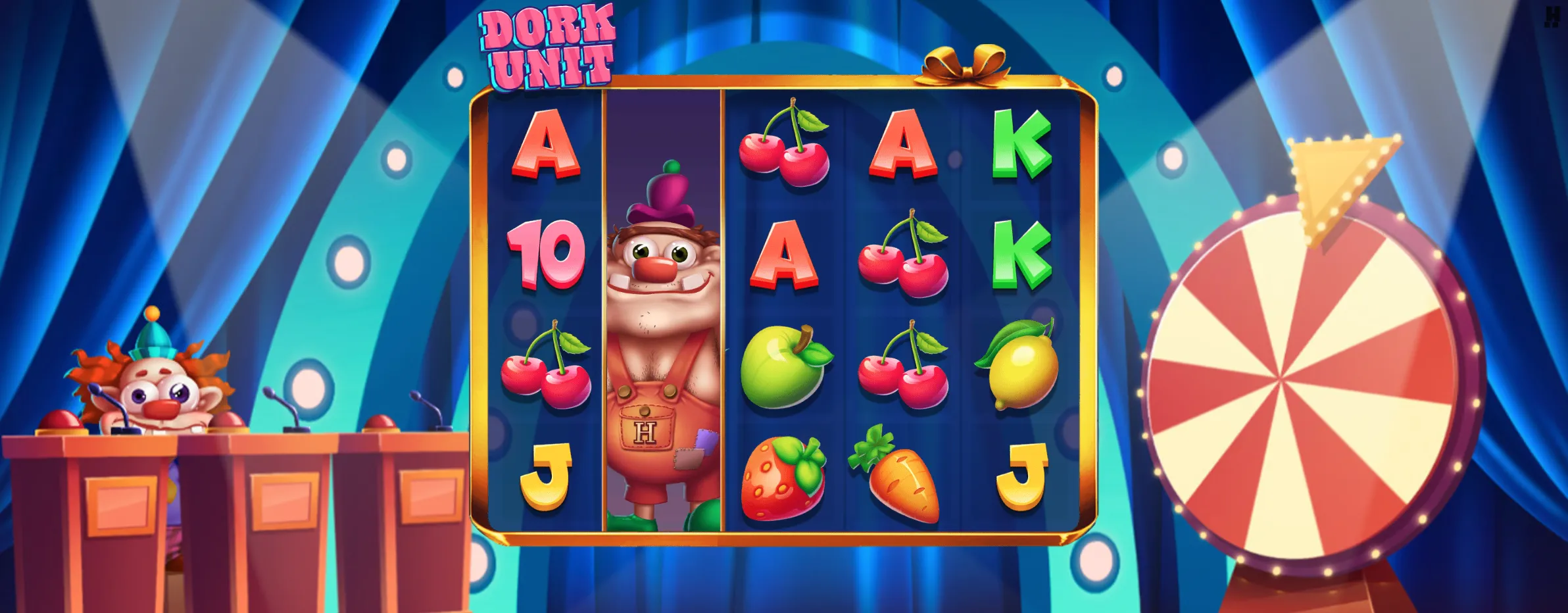
The paytable underneath cannot hold any of this up. A board of twenty strawberries, the most the reels can show without a multiplier, pays 10× on each of the 16 lines for 160× on the spin. The cap is 62.5 times that. I count half of the ten regular symbols as card ranks paying 2× or less for five, and the jack and ten only return the stake. At a 30.96% hit frequency roughly seven spins in ten return nothing, and a line with no box on it never pays more than 10×. On any single spin, everything past 160× is multiplier, and a multiplier is only worth what its tier is worth.
Gift Bonanza is the only round where a big box keeps paying
Three boxes landing on one spin open it, and they keep their positions and values. Each new box locks where it falls, and the locked board goes on working as wild multipliers on every respin. An Epic that locks early therefore multiplies each line it completes for as long as the round survives. Nowhere else does a good reveal outlast the spin it lands on, which is why I rank Gift Bonanza the better round by a distance.
Survival is the catch. The counter refills to three rather than adding, and a 5×4 board that opens with three boxes has room for only 17 more. A Common box resets the counter exactly as an Epic does, so a round can run long on Commons alone. By themselves those boxes are small change: a 4× Common completing five aces pays 8×, and a 2× on five jacks pays 2×. I read their real job as buying three more respins for whatever Epic is already locked. With no Epic on the board, a long Gift Bonanza is a long wait for a small number.
Dork Spins keeps the reel and throws away the number
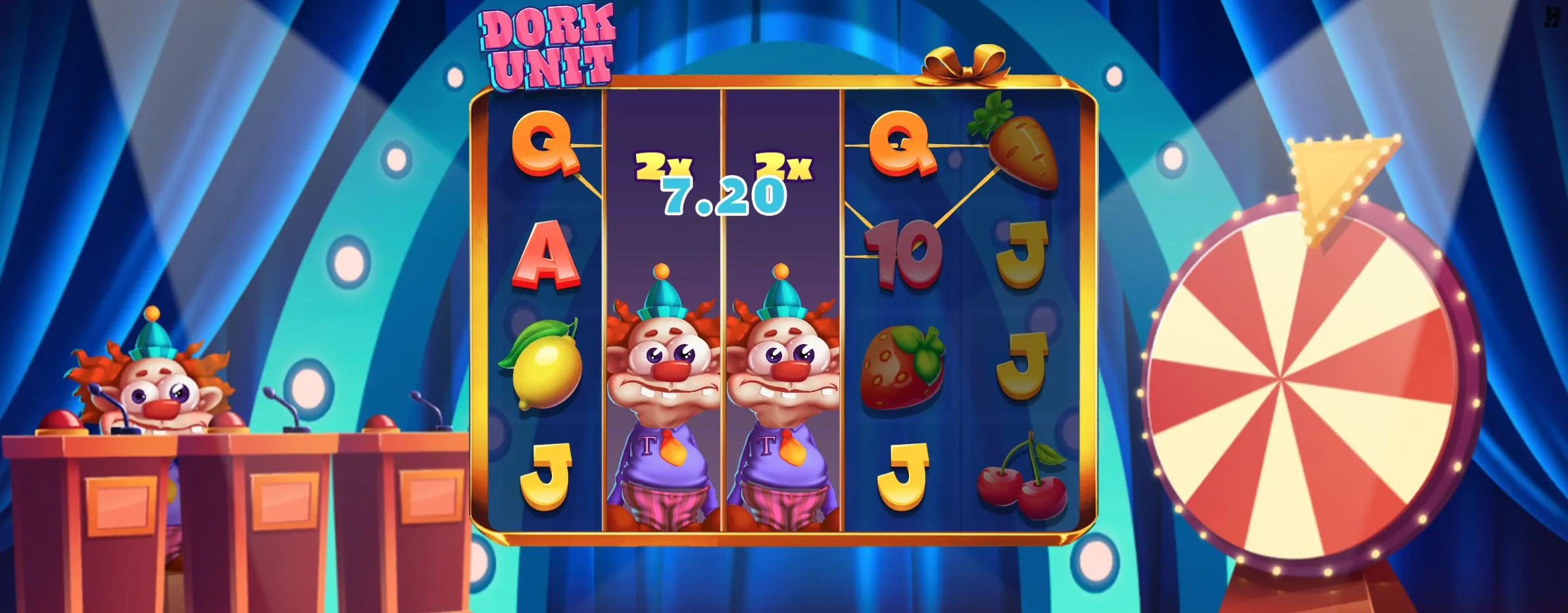
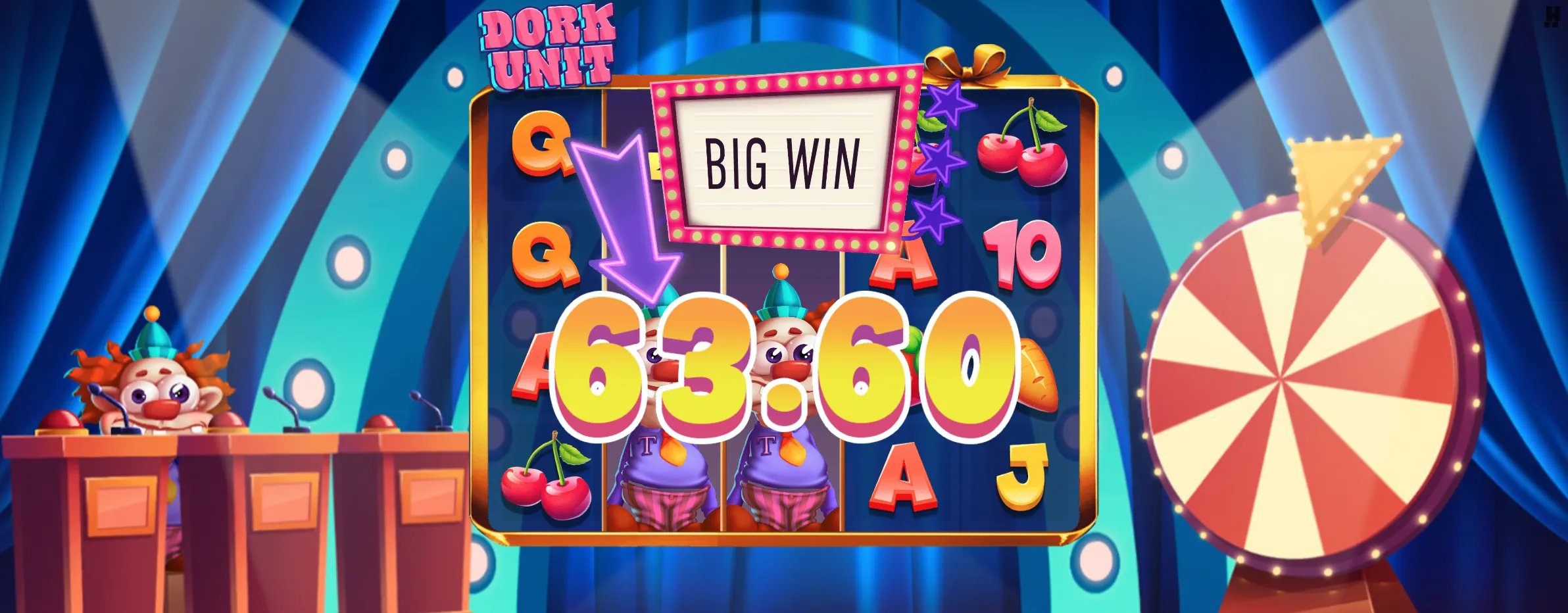
The ten free spins run on a reel set with the Gift Box removed. Any spin in the round with no expanded reel is a base-game spin without its wild, held to 10× a line. Once a Lenny lands on reel 2, 3 or 4 and expands, the geometry does real work. Wins start on reel 1 and need three symbols, so every winning line crosses reels 2 and 3. An expanded reel in either position multiplies every win on every spin that remains, while an expanded reel 4 only joins four- and five-symbol wins.
The value on that reel does not persist. Each spin a new Dork stands on it and rolls from the same ladder, 2× to 4× for Tiny Timmy, 5× to 20× for Hefty Hector, 25× to 200× for Long Lenny. With three reels able to expand, a line's multiplier tops out at 600× against 1,000× on a Gift Bonanza line, and three Hefty Hectors at their best add to 60×, less than one 75× Long Lenny. The best single line is 10× at 600×, or 6,000×, so reaching the cap here takes more than one line or more than one spin. I would call the round persistence without memory, and the multiplier wild that defines the game sits out the whole of it.
Half the price buys twice the ceiling
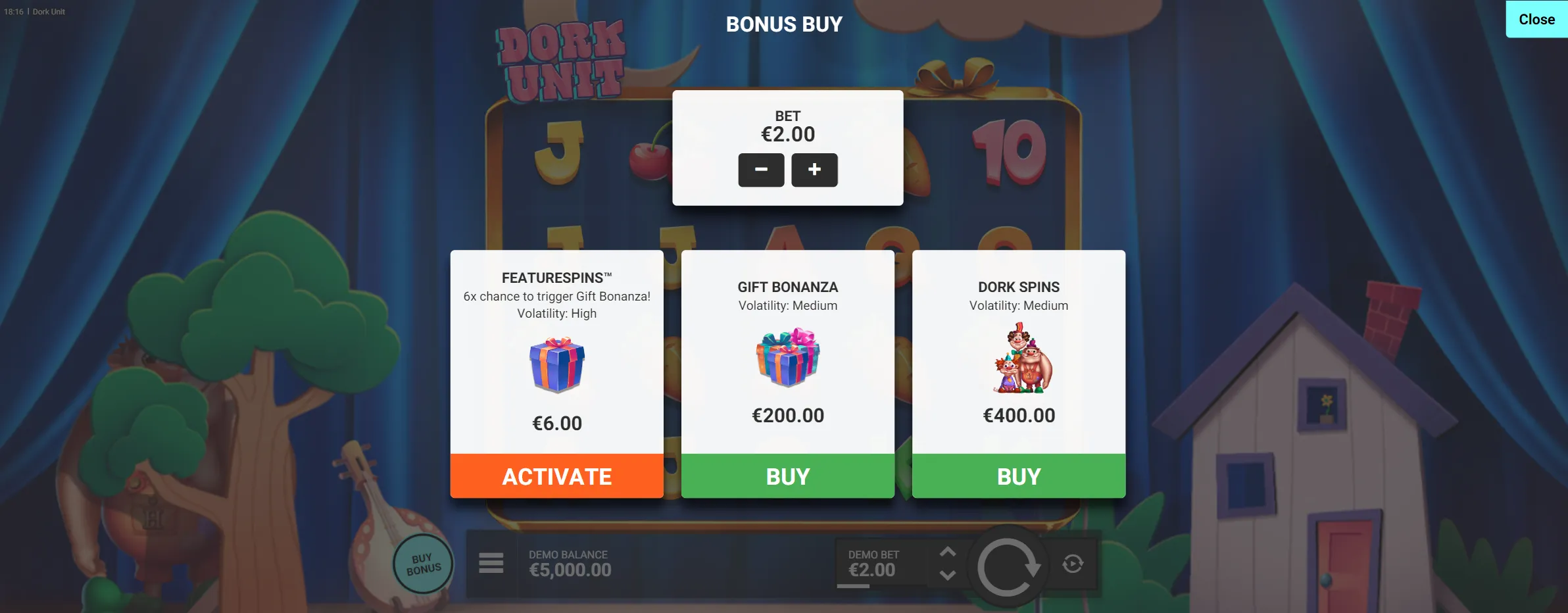
Every item on the menu returns more than the best base setting of 96.28%: FeatureSpins at 96.41%, the Gift Bonanza buy at 96.38%, the Dork Spins buy at 96.35%. By my arithmetic none of them is overpriced on average. The difference is what each costs and what it can reach.
The Gift Bonanza buy costs 100× and can return the 10,000× cap, 100 times its price, for an average cost of about 3.62× the stake per purchase. The Dork Spins buy costs 200× against the same cap, a best case of 50 times its price, and loses about 7.3× the stake on average. It is the round without the Gift Box, the round whose multipliers reset every spin, and the one that costs double. I rate it the weakest purchase in the game.
FeatureSpins is the item I find most defensible. At 3× a spin it gives six times the chance of opening Gift Bonanza, so twice the trigger rate for each unit staked, at the highest return on the menu. A FeatureSpin loses about 0.11× the stake on average against about 0.037× for a base spin at 96.28%, roughly three times the cost per press for a slightly better return per unit wagered. It points the game at the round that deserves the money.
It suits anyone who wants to see the whole machine
What I value most in Dork Unit is that nothing is hidden in the arithmetic. The maximum is one line, the paytable fits in a glance, and each round's ceiling follows from the ladder. A player who wants a slot they can reason about gets exactly that. A player who wants a bonus that escalates, where modest multipliers build into large ones, is in the wrong game, because here they add, stop at the cap and, in Dork Spins, reset.
The build matters more than usual because the paytable gives nothing to fall back on. At 96.28% the house edge is 3.72% of each stake. At 94.3% it is 5.7%, half as much again for identical reels, and the 88.22% build takes 11.78%, more than three times the top setting. The rules screen shows which one is loaded, and I would check it before anything else.
Read end to end, the game is legible, honestly capped and thin. Gift Bonanza is where its one idea pays, Dork Spins is where the same idea is diluted, and the base game is a wait for either. That is competent assembly of shared parts with no second gear, and I score it accordingly.