One wild, three bodies, and only the top of the ladder counts
Beast Below runs on a single multiplier ladder from 2× to 200× and changes only the shape of the wild that carries it: a Yellow Siren that grows up its reel, a Pink Siren that lingers and climbs away, a Diver that fills a whole reel. Since tags of one kind add and never multiply, a win here is worth what its highest tag is worth, spread over however much reel that tag covers. I read the maths as rationing both of those things, height on the ladder and width on the reel, and I think that is the whole story of why a clean, fairly priced game ends up competent rather than special.
Most of the parts come from Hacksaw's existing 5×4 line format. Cursed Seas and LIT City use the same wild that opens only when it would join a win. Dork Unit shares the 2× to 200× ladder with added values, Undead Fortune has full-reel multiplier wilds stepping sideways between spins, and Cursed Seas also sends three scatters to one round and four to another. Beast Below is a refinement of that format, not a new idea, so I judge it on whether the arrangement earns more than the parts do. What gives it a shape of its own is two limits: Oxygen Charges that stop every Diver after three moves, and a Pink Siren that loses a row per spin.
A second wild is nearly worthless beside a big one
Addition decides what extra wilds are worth. I count twelve of the fifteen rungs at 25× or lower, and any one of them added to a 200× tag lifts that win by 12.5% at most; a 2× partner adds 1%. Only another rung from the top three changes the result, and even two 200× tags make 400× where multiplication would make 40,000×. The additive ceiling is five Sirens on a line, one per reel, for 1,000×, and three Divers for 600×. How many wilds join a win matters far less than whether one draw lands near the top.
Width is the other half, and in the base game it is left to chance. A Yellow Siren expands upward to the top of its reel, so the row it lands on sets its reach: from the bottom row it becomes a full reel, from the top row it stays a single cell. Its expansion rule also interacts with left-to-right pays. A Siren on the fifth reel can open only for a five-of-a-kind win, and one on the fourth needs at least four. The rule wastes no Siren, but I see the cost on the other side: it confines the base game's only multiplier to the 25% of rounds that win anything, leaving three in four with nothing for it to attach to.
Down Below is the better-built round, and it charges for that
The Diver removes the landing-row gamble. It is always a full reel, a full reel sits on all 14 lines, and up to three Divers can share the reels. Each can step to an adjacent reel up to three times, with its multiplier updated on every move. Position still counts under left-to-right pays, since a Diver stepping from the third reel to the fourth drops out of every three-of-a-kind win, but it never shrinks.
The Pink Siren is built the other way round. At best it covers all four rows and stays in view for three more free spins, a row shorter each time, so across those four spins I make it 10 of the 16 cells a full reel would cover, 62.5%. Sirens land more often in The Sirens' Call, so the round trades width for frequency, and its buy has very high volatility against high for Down Below.
Both rounds start at 10 free spins, and two or three FS add only 2 or 4. Without a retrigger, a full Pink Siren landing on the eighth spin gets three of its four spins, and a Diver landing on the ninth makes one of its three moves before the round ends. I hold the short rounds responsible for cutting off any Pink Siren or Diver that lands in the last few spins, so neither of the game's two best mechanics is sure of room to finish.
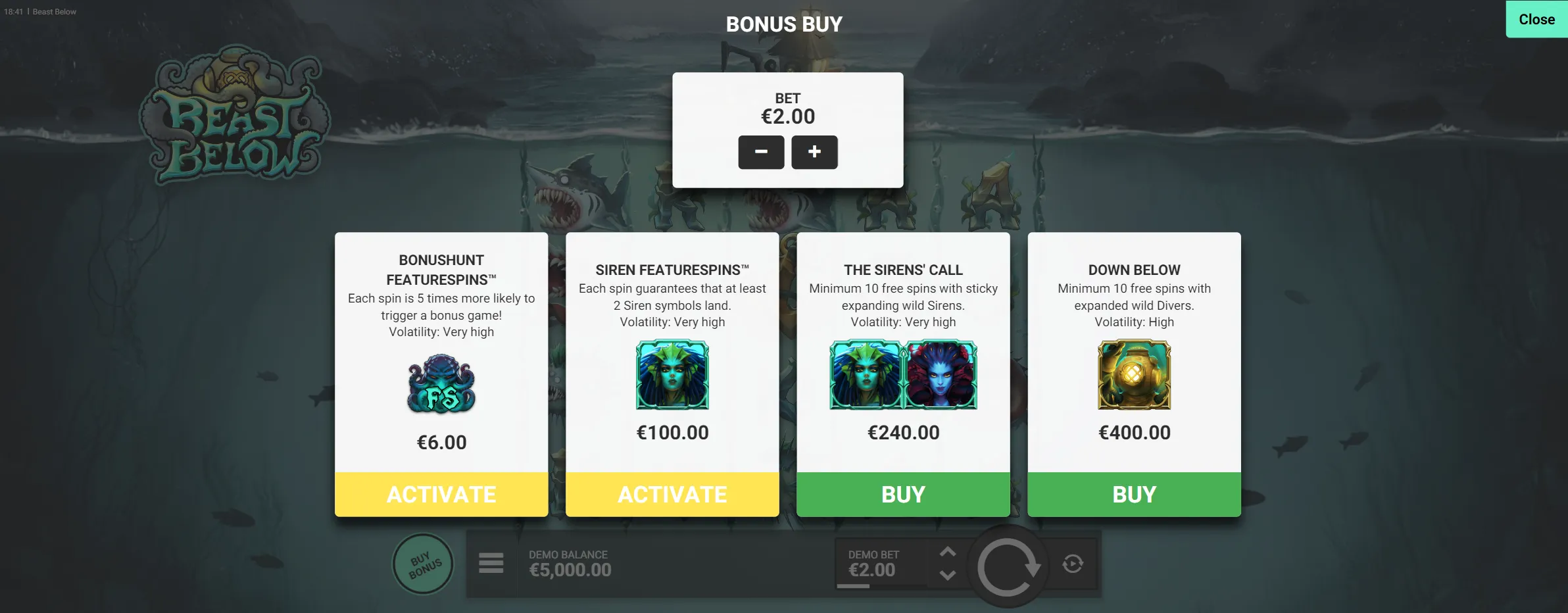
The prices follow the design. The Sirens' Call costs 120× the bet and returns 96.27%; Down Below costs 200× and returns 96.31%. I work the average cost of a buy out at about 4.48× the bet and 7.38× respectively, and the 10,000× cap at 83 times the first price against 50 times the second. Down Below costs two-thirds more for the same 10 starting spins, a lower cap-to-price ratio and lower volatility, so the extra 80× buys a steadier round, not a taller ceiling. I consider that an honest trade, and it is the best evidence that the two rounds differ in kind rather than in size.
The FeatureSpins modes are fairly priced and never switch themselves off
BonusHunt FeatureSpins cost 3× the bet per spin and make a bonus five times as likely. Per unit staked I get about 1.67 times the base trigger rate, while the return stays at 96.29%, exactly the base figure. The mode changes where the return comes from, not how much of it comes back.
Siren FeatureSpins cost 50× per spin for at least two Sirens. The guarantee covers landing, not expansion: each Siren still opens only when the expanded wild would join a win. Two 200× Sirens on one line make 400× that line win, and the cap is 200 times the price of the spin. At 96.32% the mode's average cost comes to about 1.84× the bet per spin, close to fifty base spins' worth, and it stays active until DISABLE is pressed. Across the whole menu every return sits within 0.05 points of the base game, so I find nothing overpriced. The danger is a 50× charge that repeats until someone turns it off.
The setting matters more than any button in the menu
At 96.29% the game keeps 3.71% of stakes; at 88.28% it keeps 11.72%, 3.16 times as much. The buy returns above belong to the 96.29% build, which is why I put the rules screen ahead of every other decision. The cap, by contrast, moves less money than its size suggests. At one round in 11,000,000, a 10,000× win returns about 0.09% of stakes, so roughly 96.2 of the 96.29 points come from wins below it, the middle rungs and ordinary line pays.
I would point this at a player who wants two genuinely different rounds with the variance priced plainly, and who accepts that one tag, not a chain of them, sets the size of a win. Anyone after multipliers that compound, or rounds long enough that a late sticky or walking wild still runs its course, should look at a different design. Beast Below is clear, fair on price and held down by its own arithmetic, and its score sits where those three things meet.