Cursed Seas adds, and only one skull multiplies
I read Cursed Seas as a game built on addition, and its score follows from how seldom it does anything else. Chest multipliers crossing one payline are summed. Sunken Treasure keeps a running sum above the reels. The reel meters in Dead Men Tell No Tales total every Cursed Skull and Kraken that lands on them. The one element that multiplies is the Tormented Skull, and it exists only inside the four-lantern round. The base game and the free spins grow in straight lines from a paytable too small to give them much to grow from, and one good round inside an additive frame is a competent game, not a distinctive one.
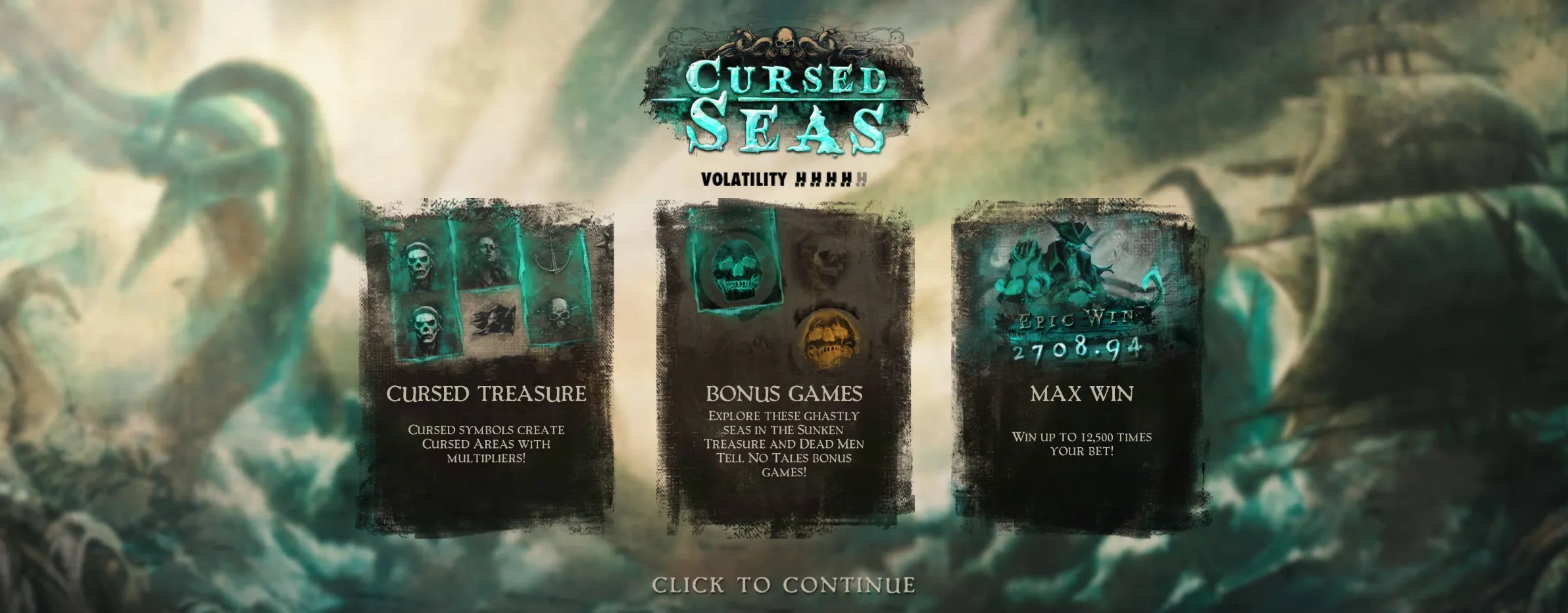
The frame is house stock. Stormforged uses the same Hacksaw 5×4 fixed-payline board with symbol-driven multipliers, a buy menu and the same 12,500× ceiling. Wanted Dead Or A Wild shares the arrangement of separate bonus rounds behind different trigger conditions carrying the payout weight under that cap, and RIP City is another Hacksaw payline game stopped at 12,500×. What Cursed Seas brings to the format is geometry: a multiplier tied to an area running from a landed symbol to the top of its reel, and a hold-and-win round that pays according to how much of the board that geometry covers.
Without a chest the reels stop at 1,300×
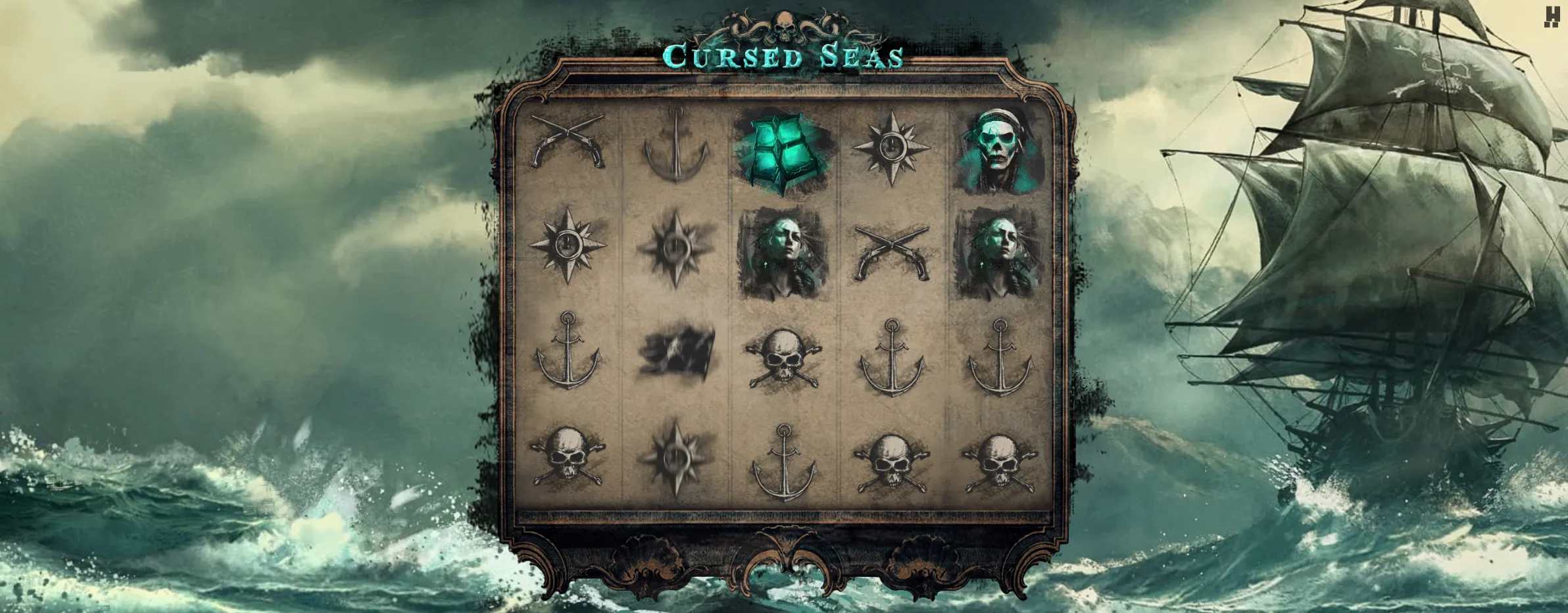
As a plain line slot, Cursed Seas is thin on purpose. The bearded captain pays 10× for five of a kind, the two matched pirates pay 3×, and I count five of the nine regular symbols paying 1.5× or less for their best combination. The anchor and the compass need all five reels just to return the stake, so every three- or four-symbol line on them pays less than the spin. That is where most of the 37% hit rate lands.
A board with five captains on every one of the 26 lines pays 260×, about 2% of the cap. Fill all 20 cells with wilds and the 50× row across 26 lines reaches 1,300×, just over a tenth. Everything above that tenth has to come from a multiplier, which makes the paytable raw material rather than a source of return.
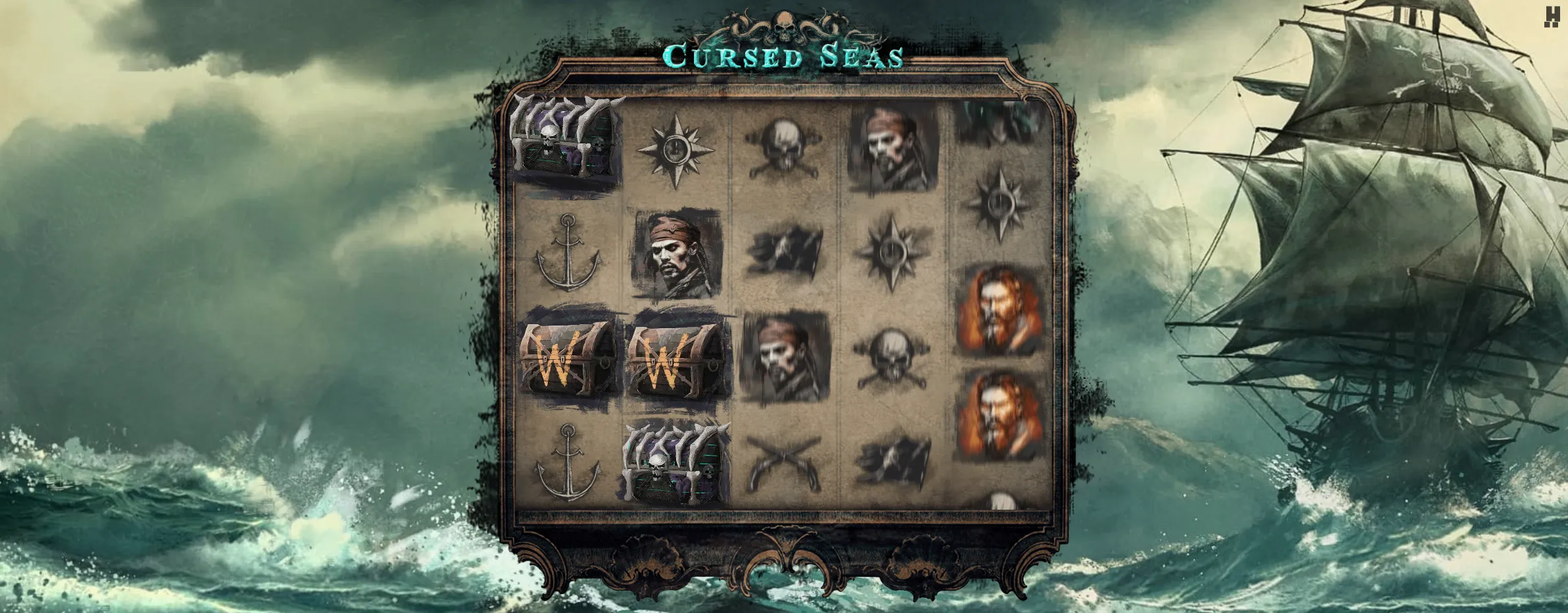
The Cursed Chest is the base game's multiplier, and its opening condition is the best-written rule on the reels. A chest opens only when the area from its cell to the top of its reel holds a winning combination, and because it is also a wild it can complete the win it then multiplies. A base-game multiplier never opens onto nothing. The weakness is what it has to work with. A 200× chest over a five-anchor line pays 200×, four times the best wild line, and the same chest over a three-anchor line pays less than 200× because that line pays less than 1×.
Stacking obeys the same arithmetic. Five 200× areas crossing one line add up to 1,000× that line, where multiplying them would run into the hundreds of billions. The cap stays reachable in the base game, but addition keeps a multi-chest spin far below what the chest values suggest.
Sunken Treasure is the chest with its condition removed
Three lanterns open 10 spins in which every chest opens whether or not its column holds a win, every area lasts to the end of the feature, and every revealed value joins one Total Multiplier. Each winning payline crossing a cursed area takes that whole total. Line wins start on the leftmost reel, so one chest on the bottom row of reel one curses all four cells of that reel, and from that spin on every winning line across the 26 crosses a cursed area.
The total is still a sum, so the round is linear. A 200× chest adds 200 wherever it lands, and timing only changes how many wins it touches: a chest on the first spin lifts every win that follows, while a chest on the tenth lifts one spin's worth. No landing makes the next chest worth more than its face value.
Two further lanterns add 2 spins, three add 4 and four add 6. Two lanterns is one fewer than the trigger, so extensions come cheaply, but the smallest is a fifth of the starting 10 and the largest is 60% of it. The top step also needs four lanterns at once, the same count that opens Dead Men Tell No Tales from the base game. An additive total needs length to build, and this ladder keeps runs close to the length they started with.
Dead Men Tell No Tales is where coverage becomes the multiplier
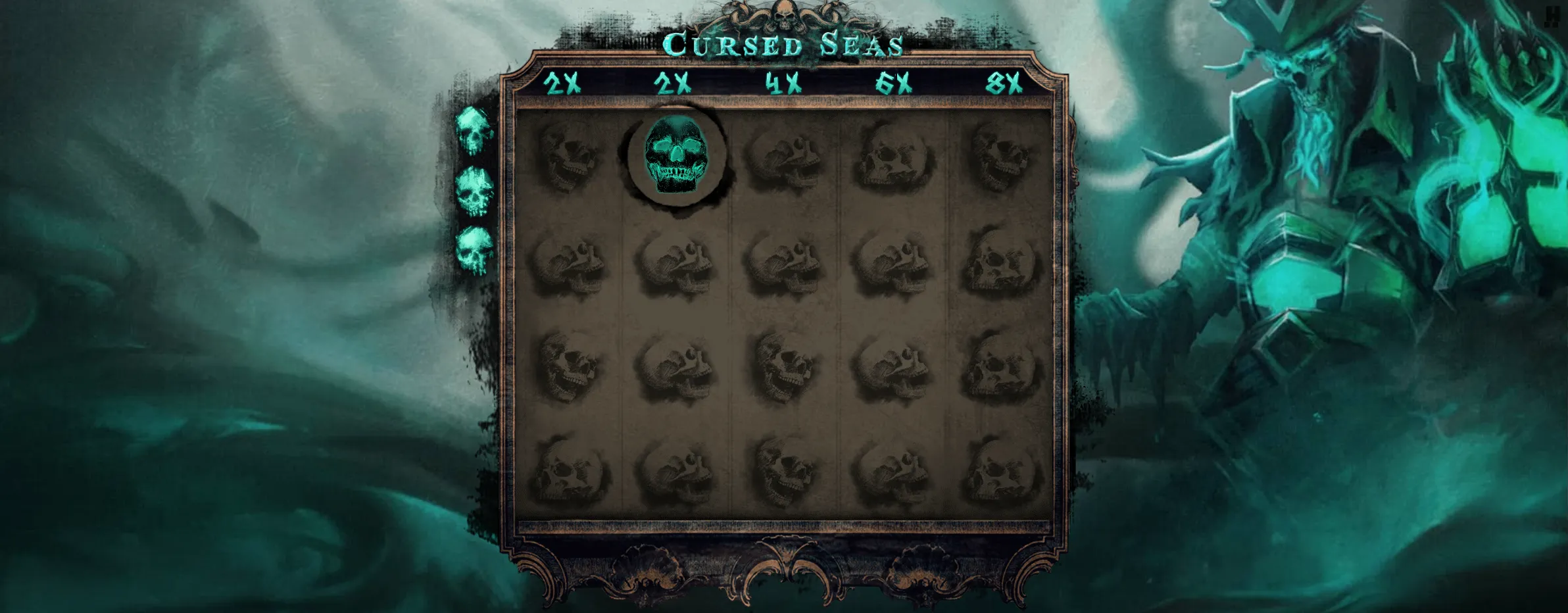
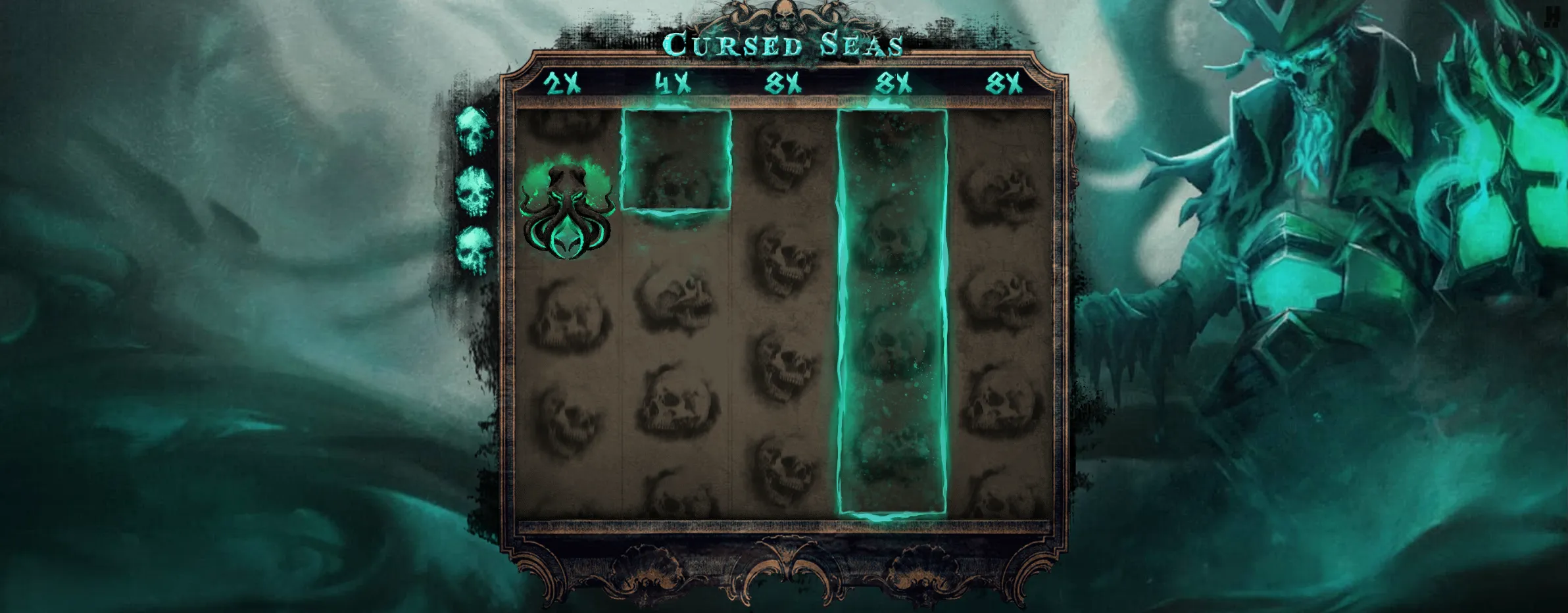
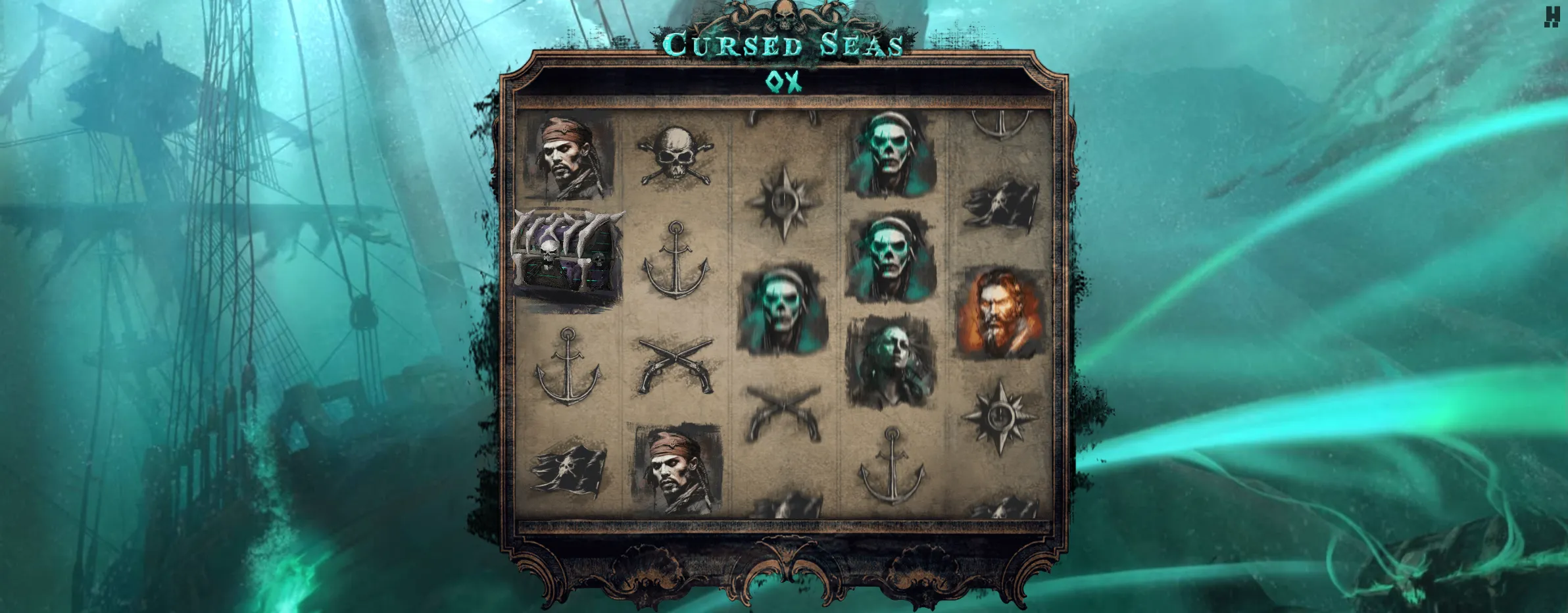
Four lanterns switch the paytable off. Each reel carries a meter that starts at 1× and holds its value to the end. Cursed Skulls add to their own reel's meter and open a cursed area up to the top of that reel, Krakens add to all five meters, and Tormented Skulls multiply their reel's meter by ×2 up to ×25. At the end each meter is counted once for every cursed cell on its reel, and the sum is the win.
That settlement makes coverage a second axis, from zero to four cells per reel, independent of meter size. A 100× meter over four cells settles at 400× and beats a 250× meter over one. The Kraken is where that axis pays most. On a board with all 20 cells cursed, a 500× Kraken is worth 10,000× by itself, four fifths of the cap, while a 500× Cursed Skull over its own fully cursed reel is worth 2,000×. Breadth cuts the other way on a thin board. A meter on a reel with no cursed cell settles at nothing, and only Cursed Skulls create cells, so Kraken value sits idle on any reel a Skull has not opened.
I find the Tormented Skull the most telling rule in the game, because the cap is drawn exactly around it. A 500× meter multiplied by ×25 is 12,500×, so the top Cursed Skull value and the top Tormented Skull value on one reel meet the cap over a single cursed cell. Over four cells that reel would come to 50,000×, and the cut-off removes three quarters of it.
Refilling lives give the round its shape. Any spin with a Skull or a Kraken restores all 3 lives, and the round ends after three blank spins in a row, so its length follows what lands rather than a counter. The price of switching the paytable off is the floor. Two low Cursed Skulls on one reel followed by three blank spins settle for a few times the bet, and that outcome comes through the four-lantern gate.
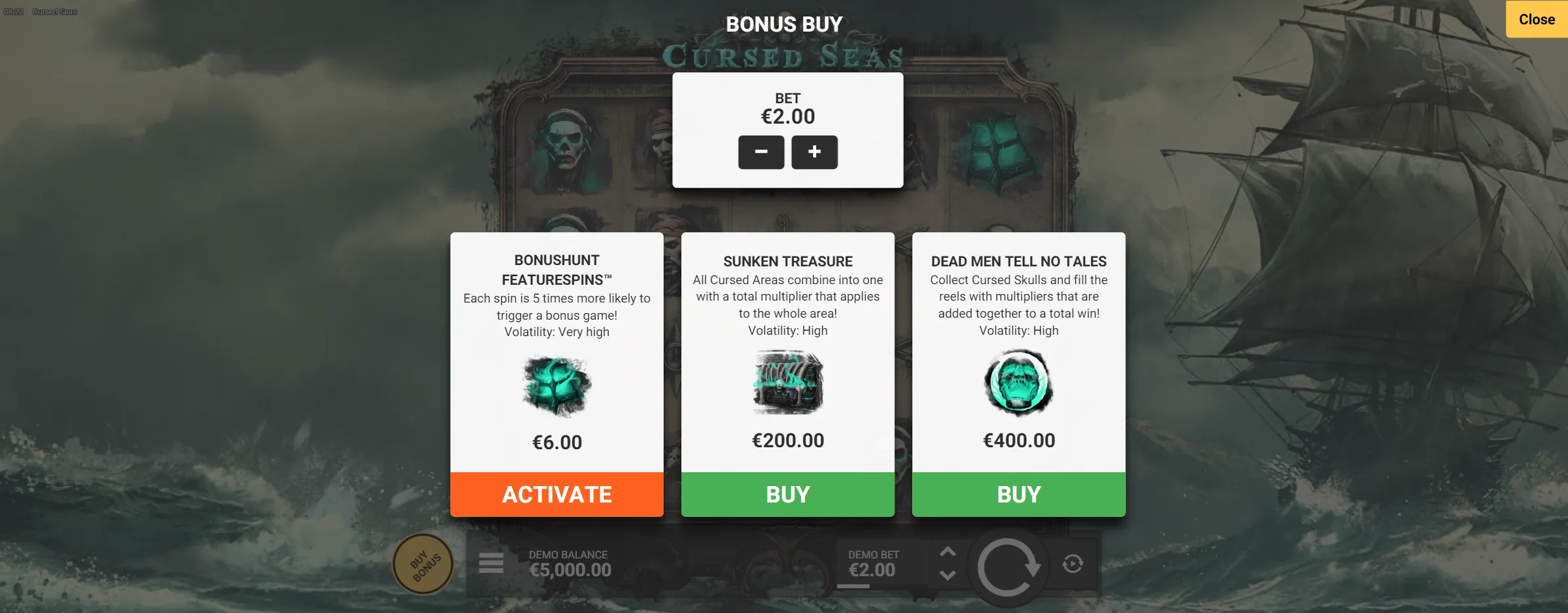
The buy menu sells three routes to one ceiling
BonusHunt FeatureSpins™, Sunken Treasure and Dead Men Tell No Tales all stop at the same 12,500×, because the cut-off applies in the base game and in both rounds. No item buys more headroom than another, so a purchase chooses a route and nothing else. Sunken Treasure is the base game's chest with its condition lifted, still running on addition. Dead Men Tell No Tales holds the only compounding element and the only settlement where coverage multiplies, and I rank it as the one purchase that pays for the idea the game is built around. The FeatureSpins™ mode runs at very high volatility and both round buys at high, which puts the per-spin mode at the harsh end of the menu.
The casino's return setting outweighs the lanterns
The same reels, features and cap run at 96.42%, 96.22% and 94.24%. The distance from top to bottom is 2.18 points, an expected loss of 3.58 per 100 staked against 5.76, so the low build costs about 1.6 times as much for an identical game. On a high-volatility slot whose paytable returns so little by itself, that gap is settled before the first spin, by the choice of casino.
Cursed Seas suits someone who wants a hold-and-win round with a settlement worth reasoning through, and who accepts a base game whose real work is finding four lanterns. Anyone who wants the reels to carry the gaps between features should look elsewhere, because there is no cascade, no ways engine and no weight in the paytable.