The cell that keeps count is the whole idea
I read Sugar Rush as a free spins round with a base game attached, and the round is strong enough to outgrow the game's own 5,000x ceiling. Multiplier cells that survive the whole round and double up to x128 turn a modest paytable into a board that can pass the cap many times over, so in the rounds that matter most the limit is the cap and not the idea. That tension is why this lands in the good band rather than the excellent one: a first-rate central mechanic, with a thin base game on one side of it and a low roof on the other.
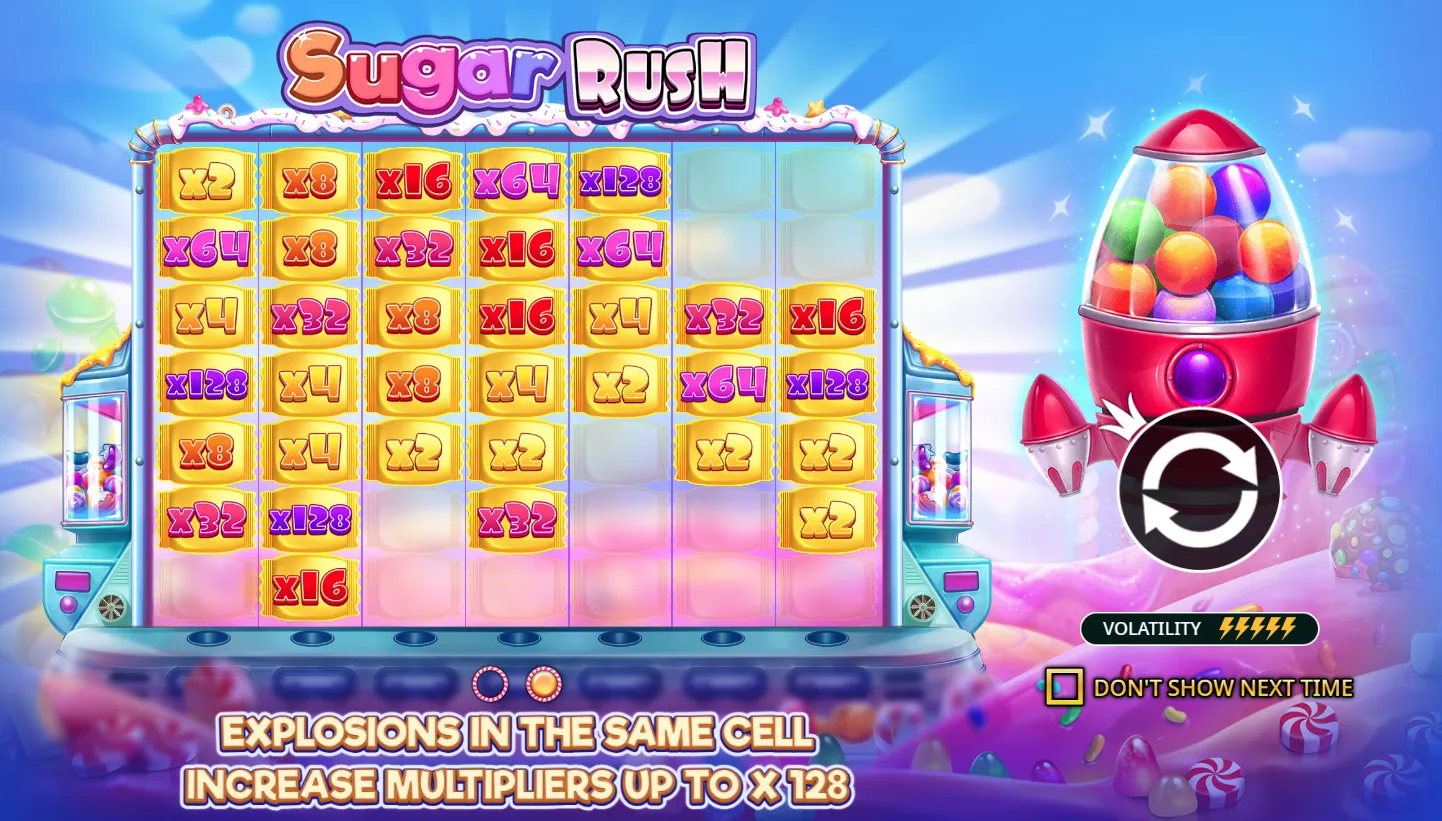
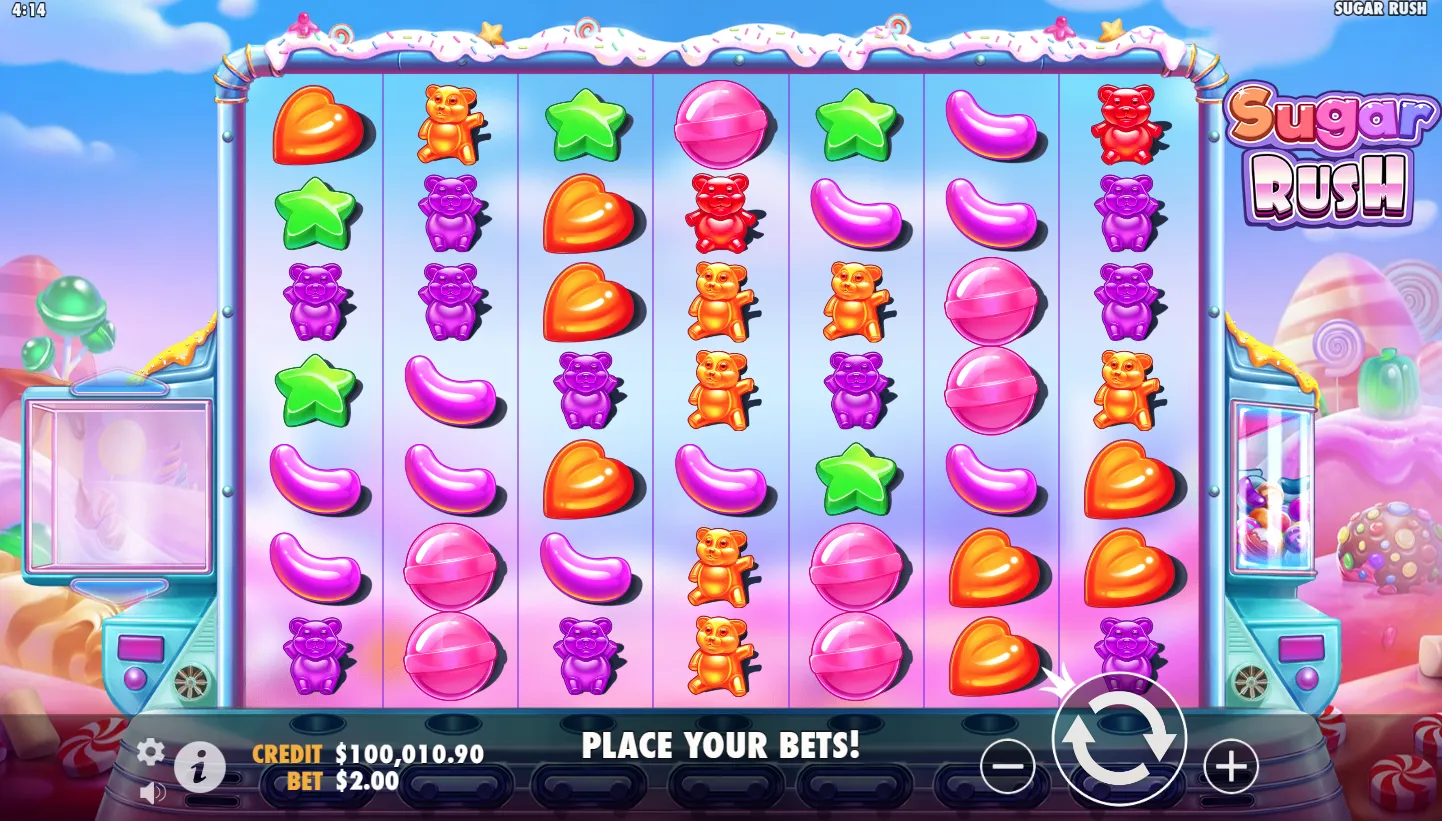
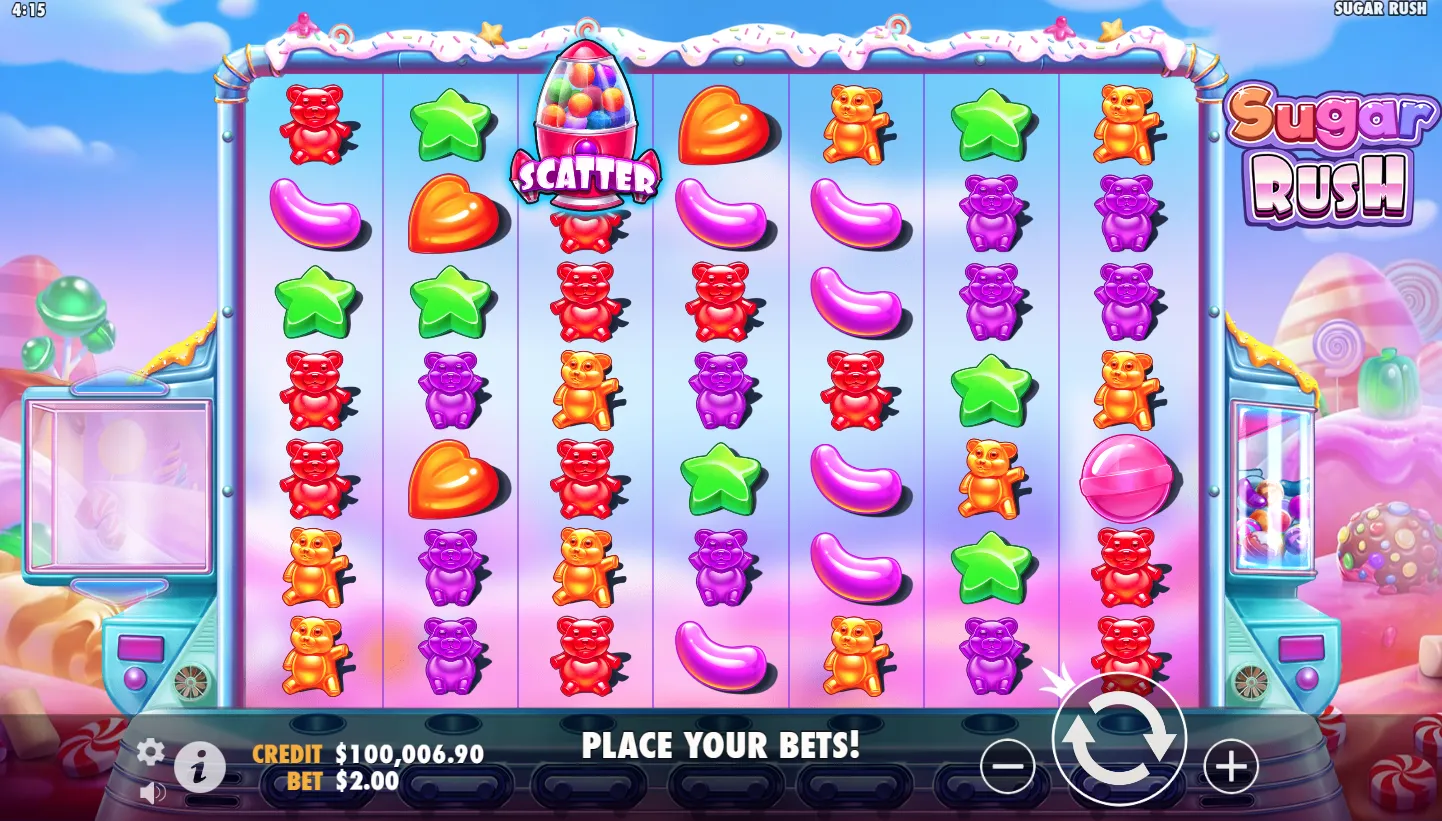
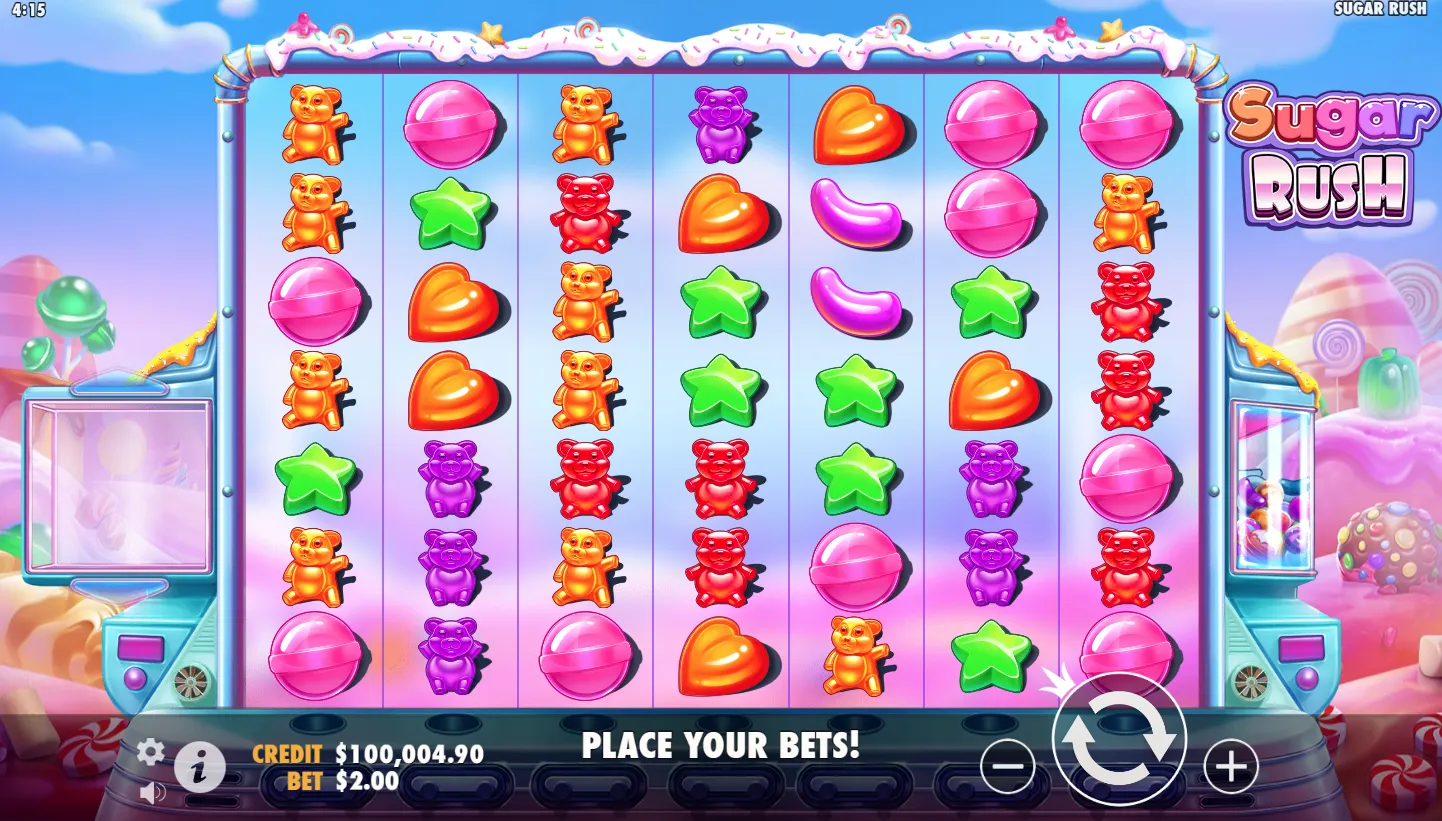
The frame is one Pragmatic Play also uses in Fruit Party: a 7x7 cluster-pays grid, tumbles, and a minimum cluster of five. What gives Sugar Rush its identity on that grid is a cell that remembers. A winning symbol that explodes marks its square, the second explosion there sets x2, and each later one doubles the value until it tops out at x128 on the eighth. The follow-up, Sugar Rush 1000, keeps those cells persisting through free spins, and Sugar Rush Super Scatter is built around them as well. Keeping them was the right call, because they are the part of this design that carries the weight.
The paytable is three percent of the ceiling
The best cluster on the paytable, 15 or more Pink Candy, pays 150x the bet. Against a 5,000x cap that is 3%, and a single cluster can cover the other 97% only with multiplier cells beneath it. The symbols set the rate; the cells supply the size.
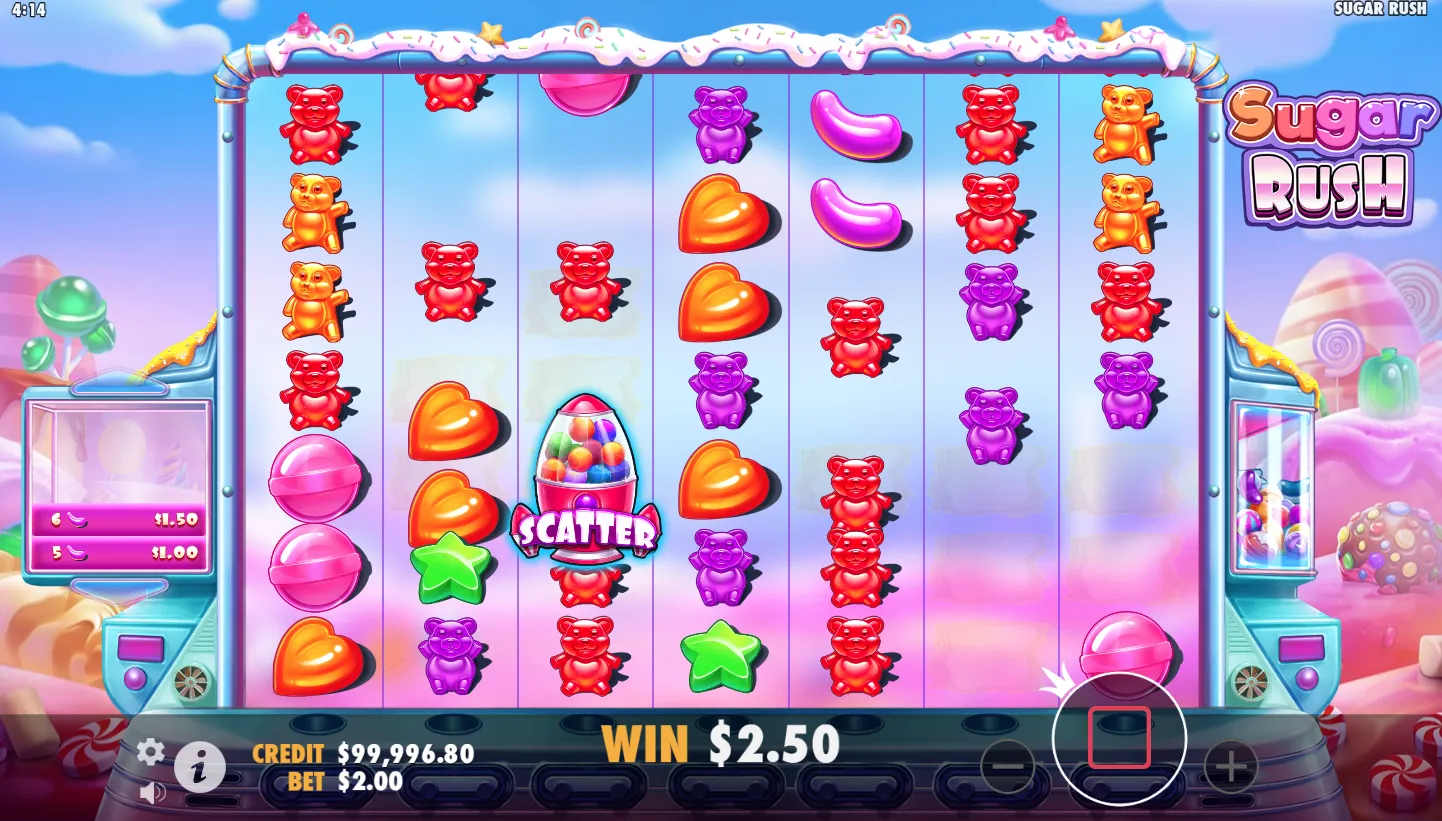
Below the top step the table is thin. All seven symbols pay 1x or less for a five-symbol cluster, from 1x for Pink Candy down to 0.2x for the Orange Gummy Bear, and at nine symbols three of the seven still return the stake or less. The steep part starts at ten. Pink Candy pays 5x there and 150x at fifteen, thirty times as much for five more symbols, and a fifteen-symbol cluster fills nearly a third of the 49 cells.
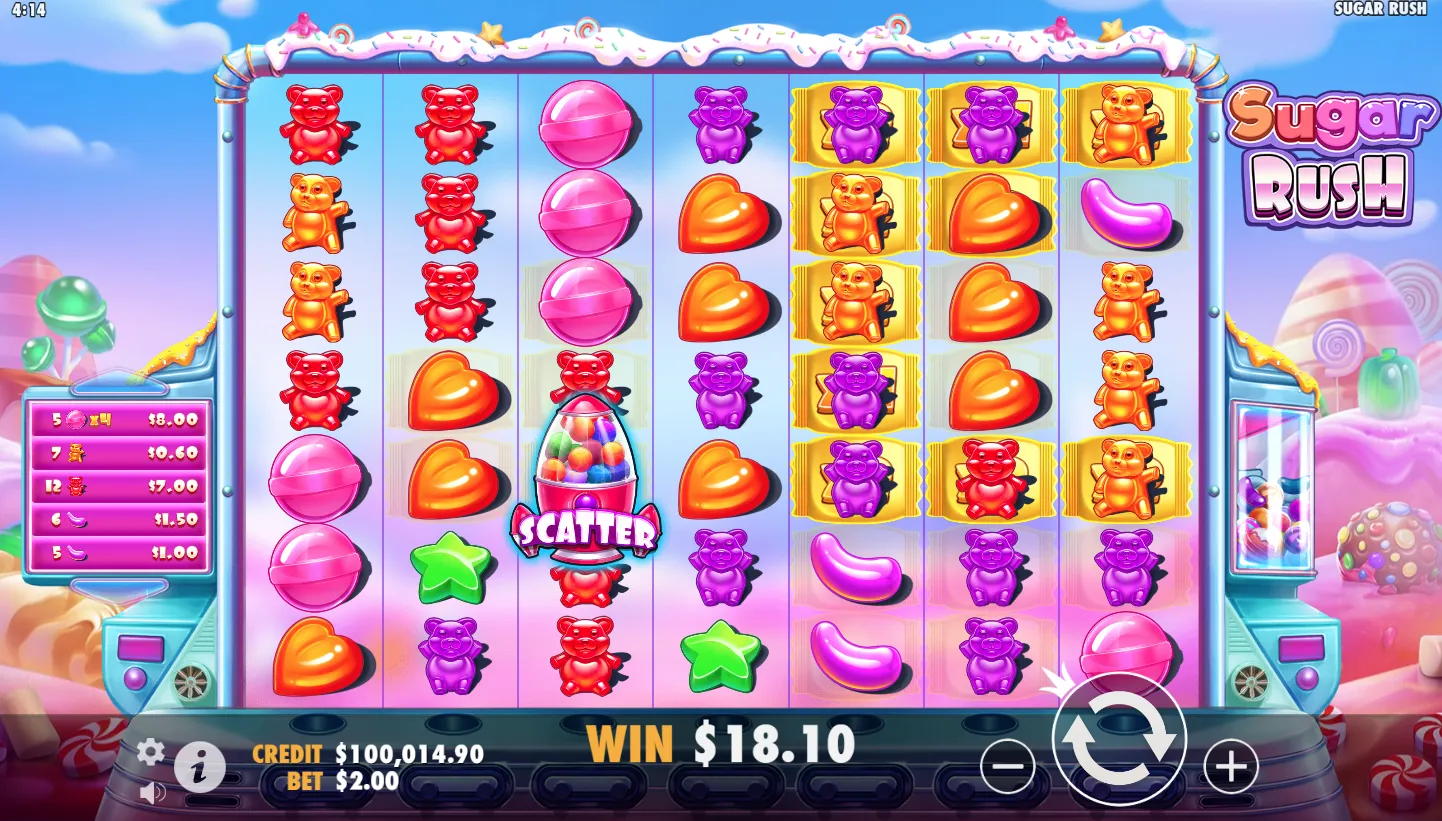
The base game gets little help from its multipliers, because its cells clear when the tumble chain ends. A base spin shows a multiplier when one chain explodes symbols on the same square twice, and x128 needs eight explosions on one square before that chain stops. No wild exists to help clusters connect. A hit frequency of 34.48% leaves 65.52% of spins with no win at all, and free spins arrive from the base game once in 323 spins on average. I find the stretch between those triggers repetitive, since the base game's one distinctive mechanic resets before it can build anything.
The ladder climbs higher than the cap will pay
Free spins move play onto a special reel set, but the change that carries the game is that marked cells and their values stay until the round ends. The eight explosions behind an x128 cell no longer have to fall inside one tumble chain. They can spread across the ten spins of the shortest starting round or the thirty of the longest, so each spin lands on a board at least as built as the one before it. A retrigger adds 10 to 30 more spins to that same board without clearing it.
The multiplier under a cluster is the sum of its cells, and against the cap that sum runs out of room fast. A top-step Pink Candy cluster passes 5,000x once its cells sum past x33, which one x32 cell and one x2 cell already do. At a sum of x64 the win would be 9,600x, and the round stops at 5,000x with 4,600x of it unpaid. At x128 it would be 19,200x, 3.84 times the cap. The weakest symbol meets the same wall: 15 Orange Gummy Bears pay 20x, and two x128 cells beneath them take that past the cap. Fifteen x128 cells under one top-step cluster sum to x1,920, a 288,000x win on paper, 57.6 times what the game will pay.
The arithmetic also runs the other way. Nine Pink Candy on nine x128 cells make 2,880x, so a single win at the cap needs a cluster of ten or more; ten on maxed cells would make 6,400x. The board writes its biggest wins through big clusters, and big clusters are exactly where the cap bites.
Forfeiting the spins left after the cap costs nothing in itself, because the cap covers the round as a whole and nothing after it could pay. What the cap takes is the part of the winning cluster above 5,000x. Rarity is not my complaint. With the round triggering once in 323 spins and the cap reached once in 2,340,000, a triggered round reaches the cap no more often than once in about 7,245. The complaint is the height: a board that passes its ceiling with two cells has a ceiling set too low for it.
The buy is fairly priced and badly shaped
Buy Free Spins costs 100x and returns 96.5% at the 96.5% setting, the same as normal play. That is 96.5x back for every 100x spent over the long run, with no extra edge charged for skipping the base game. The most a bought round can return is the cap, 50 times its own price. Reaching the round by spinning takes 323 spins on average, and a buy that replaces that wait at the same rate of return is fairly priced.
The shape is the problem. The buy lands three to seven scatters at random, so the same 100x starts a round of 10, 12, 15, 20 or 30 spins. That is 10x per starting spin at the short end and about 3.3x at the long end, and the real gap is wider than the price per spin, because the twenty extra spins of the long round all land on a board that has already had at least ten spins to build. The price is fixed and the thing it buys is not.
Operator settings move the base maths as well. A 94.5% setting keeps 5.5% of normal play instead of 3.5%, about 57% more edge per spin, and the rules screen shows which setting is running.
A game for the round, not for the spins between
Sugar Rush suits a player whose interest is the free spins board itself, whether it arrives once in 323 spins or at 100x, and who accepts 5,000x as the top of the range. A player who wants the base game to hold attention should look elsewhere: without wilds, and with every base multiplier clearing at the end of its chain, the time between features has little to offer. So should anyone who chooses high volatility for a ceiling above 5,000x, since this board reaches that ceiling long before it runs out of ladder.