The value arrives late, and the rules cut the end off
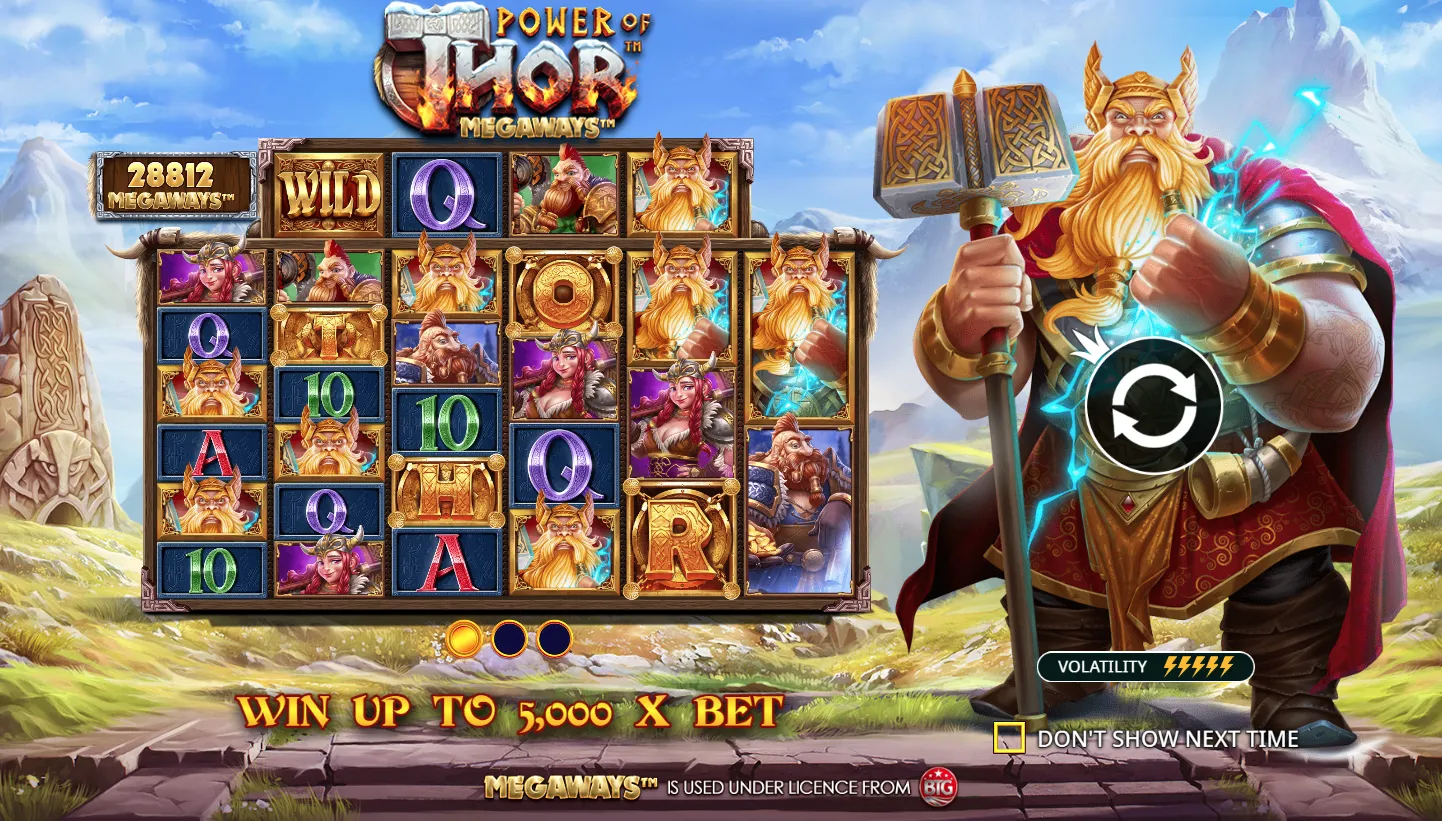
Power of Thor Megaways is built so that its best moments come last. In free spins a win multiplier gains 1x on every tumble and never resets between spins, so the closing spins of a round play at the highest multipliers it reaches. In the base game the top row runs right to left, so a Hammer that a tumble moves is travelling toward reels 2 and 3, the one position where it pays with nothing more than a regular symbol on reel 1. I read the whole game through that shape, and through the three rules that trim its far end: a gamble wheel that stops at 22 spins, a buy that never starts a round above 22, and a 5,000x cap that ends the round and forfeits whatever spins are left.
The engine is a familiar one. Great Rhino Megaways runs the same free spins multiplier on Megaways reels, rising 1x on each tumble win, and Gates of Olympus and Starlight Princess both hold a free spins multiplier for the whole round, Starlight Princess feeding it with multiplier symbols where this game adds 1x per tumble. What Power of Thor brings is the Hammer. It gives the base game an event that can fire more than once in a chain, but it sits on a paytable built around one symbol and under a ceiling the multiplier outgrows.
The Hammer pays on its own from one position out of three
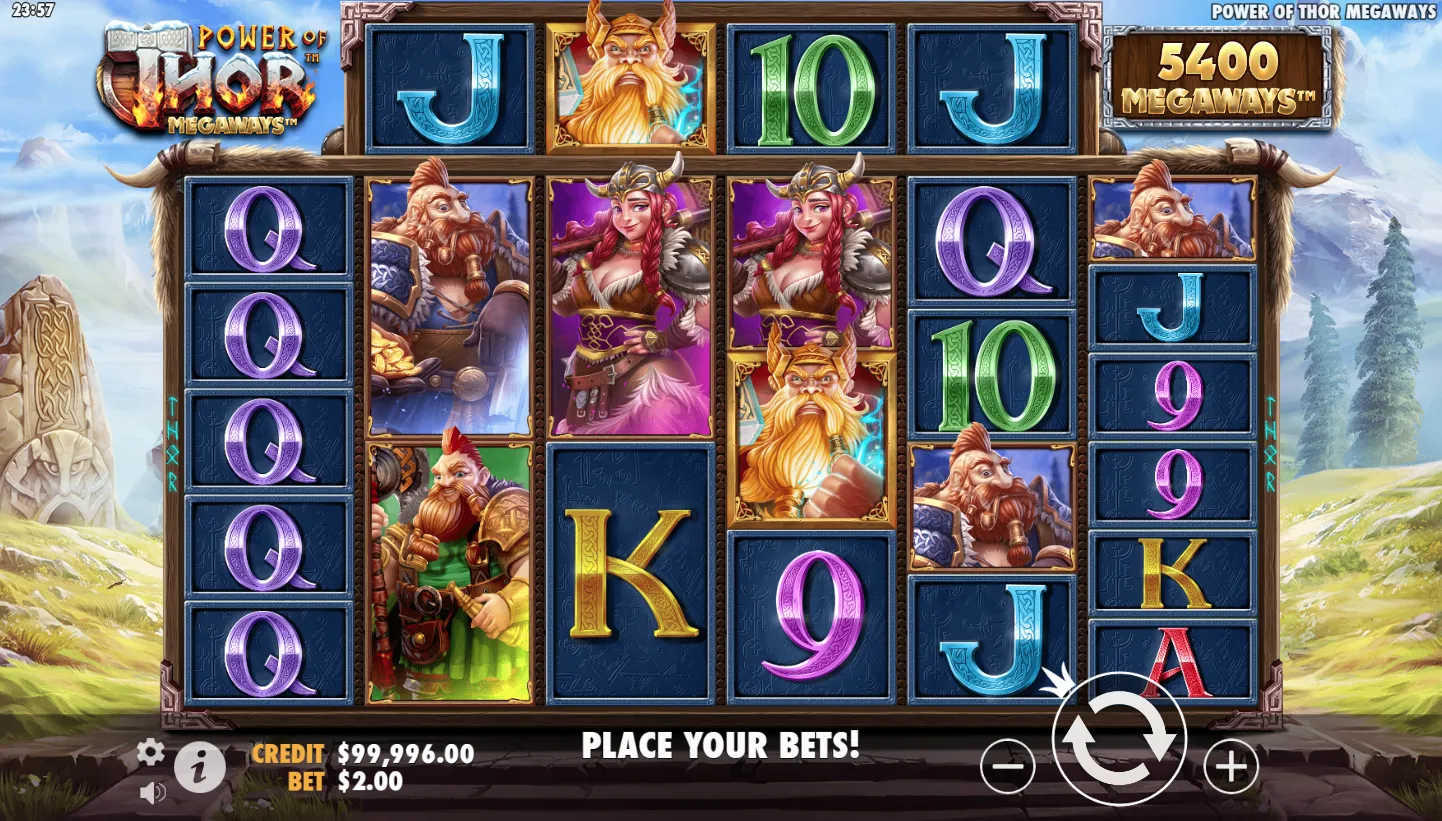
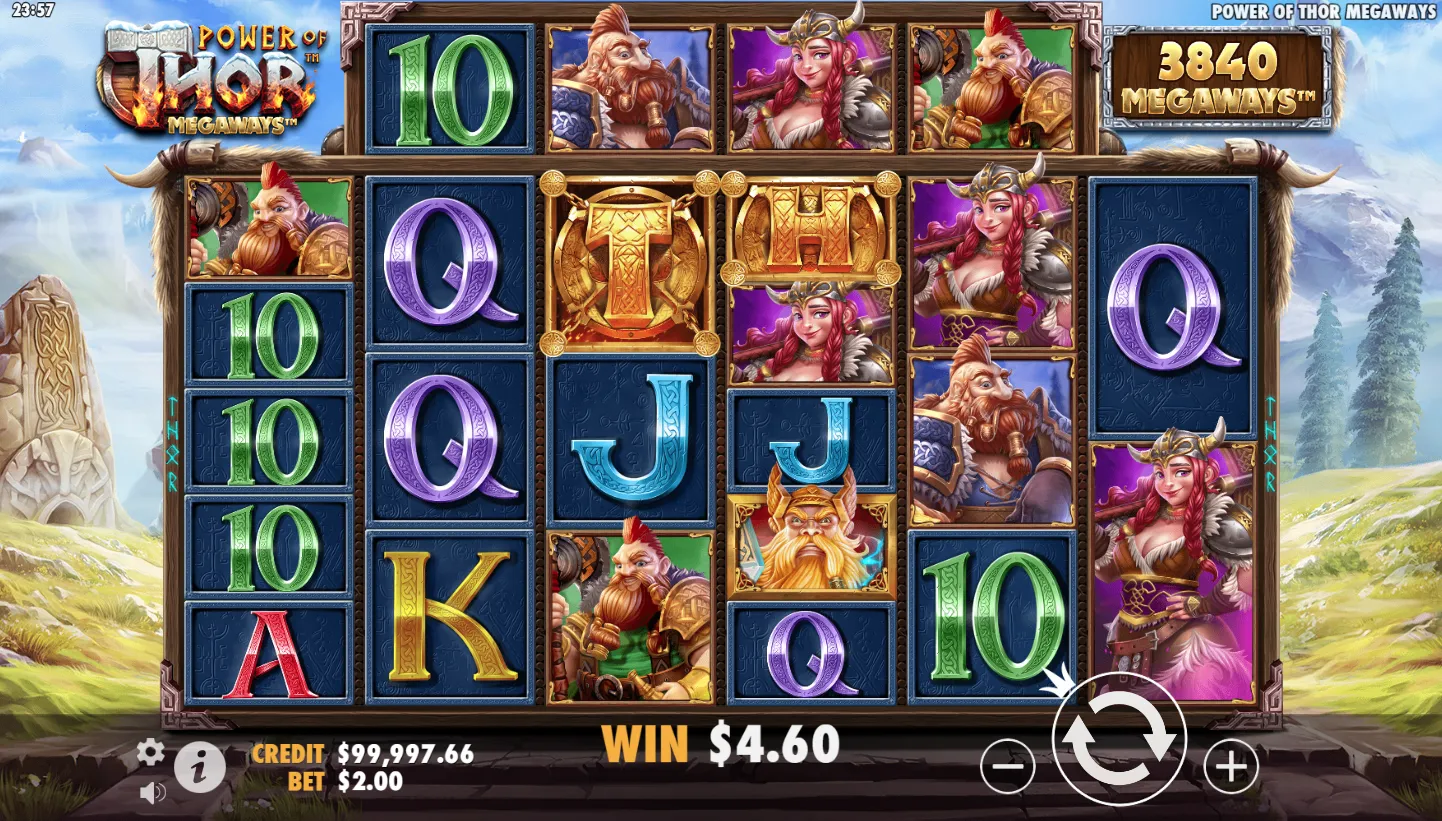
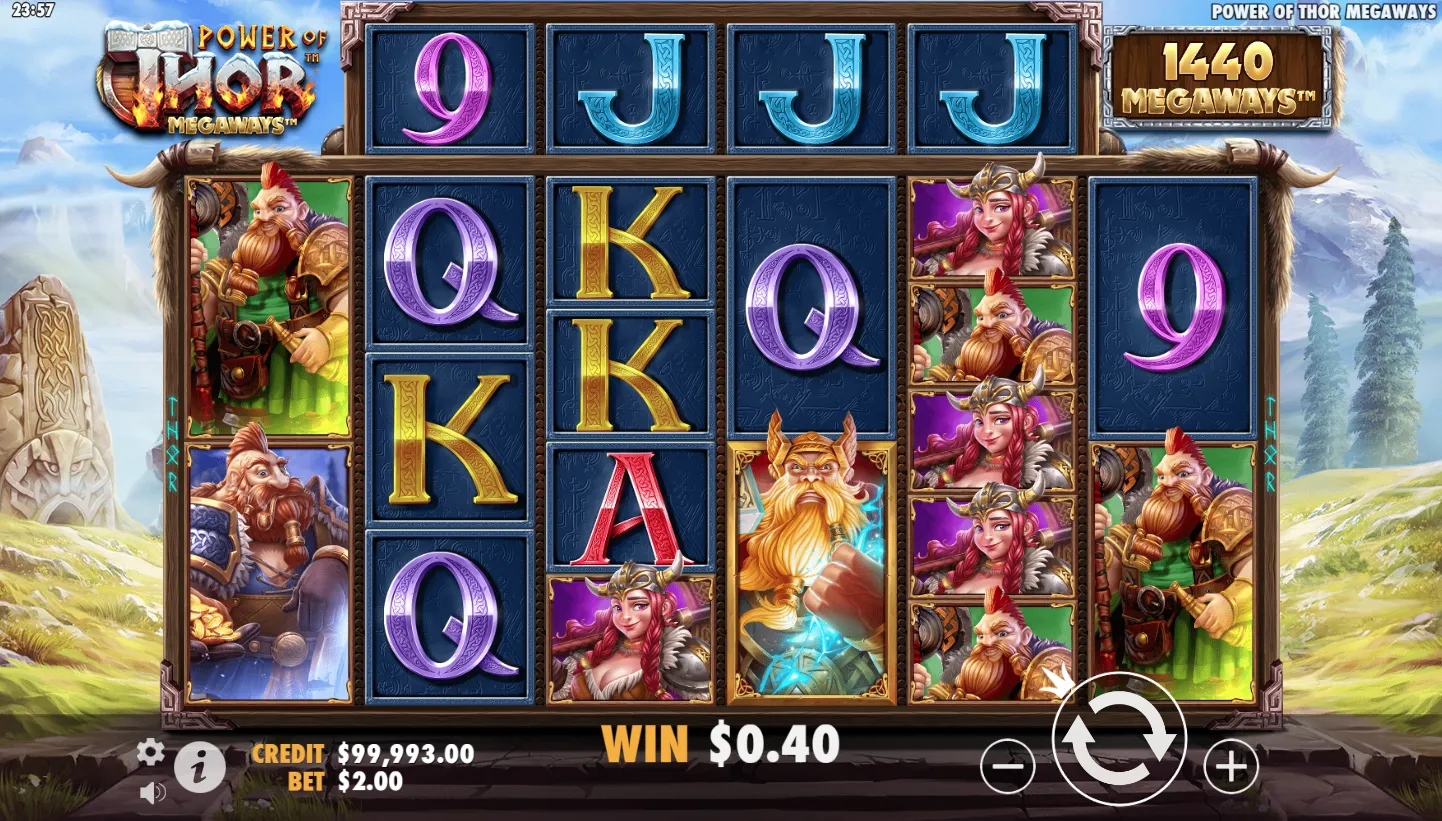
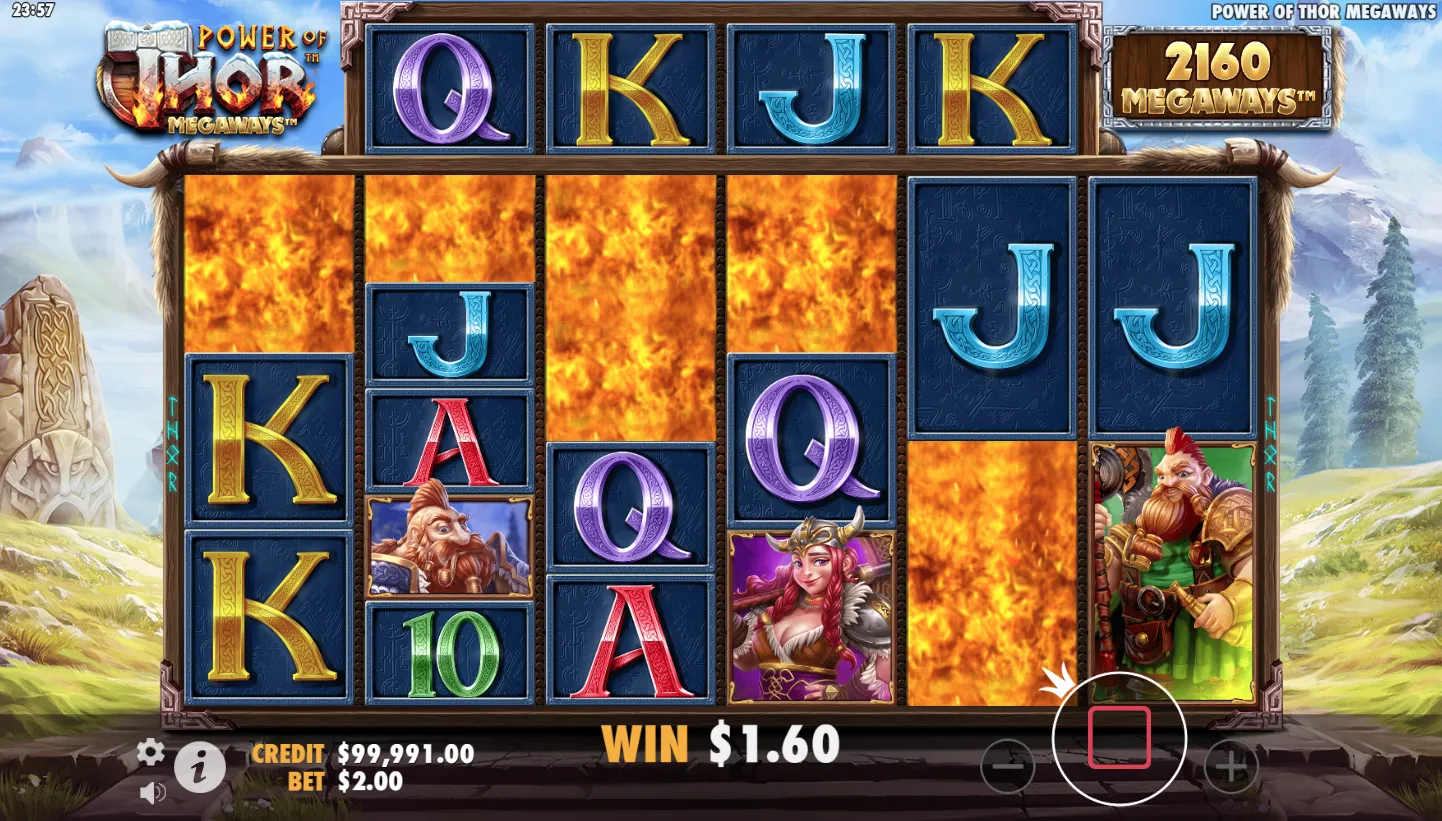
The top row has four positions over reels 2 to 5, and the two-wide Hammer fires when it is fully visible over reels 2 and 3, 3 and 4, or 4 and 5. Over reels 2 and 3 it needs nothing more than a regular symbol on reel 1. With both reels wild at their full six symbols, each regular symbol on reel 1 has 36 wild pairs behind it, so a lone ten pays 3.6x and a lone Thor 36x before reel 4 is counted. A full reel 1 of seven regular symbols makes 252 winning ways of three of a kind or better, worth at least 25.2x.
Over reels 3 and 4 the Hammer needs reels 1 and 2 to connect first, and over 4 and 5 it needs reels 1 to 3. There it builds on a connection that has to exist already. A single Thor way across reels 1 to 3 is worth 1x, and with reels 4 and 5 wild at full height it becomes 36 ways of at least five of a kind, 360x or more. That is the larger swing and the harder one to set up. If reels 1 to 3 never connect while those wild reels sit on the board, that Hammer pays nothing.
The row also sets the Hammer's route. It moves right to left, tumbles included, and a Hammer fires again each time a tumble moves it to a new fully visible position. One that lands over reels 4 and 5 still has 3 and 4, then 2 and 3, ahead of it, so a single Hammer fires at most three times in a chain, and the last position it can reach is its most dependable one. It is the free spins round in miniature, with the payoff at the end of the path.
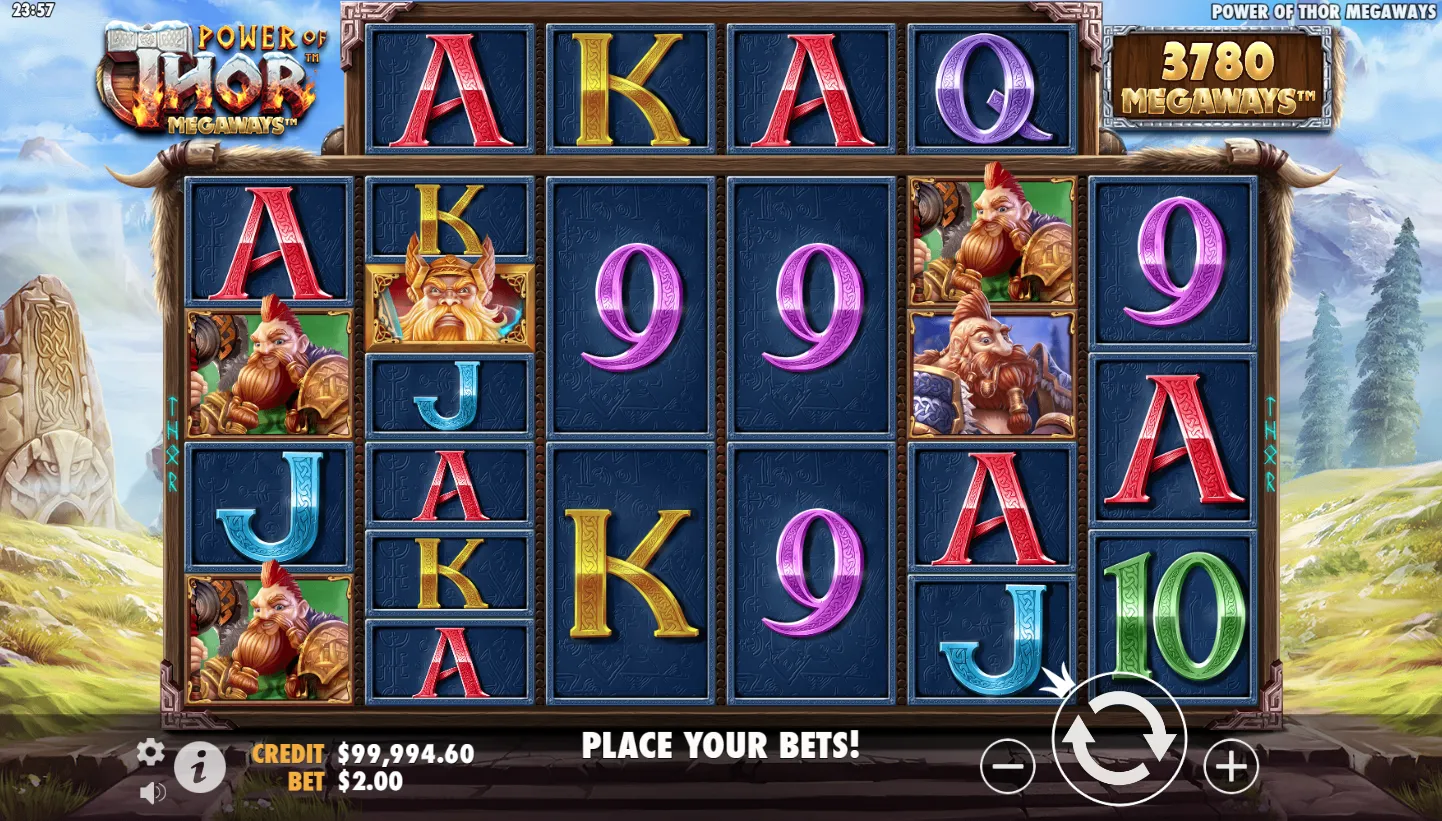
Between Hammers the paytable does little. I count six card symbols that pay 1.5x or less for six of a kind on a way, and a three of a kind of any card returns 0.2x or less. Thor is the paytable: 20x for six, four times the blue Viking's 5x, and the one symbol that pays for two of a kind. With 32.79% of spins winning anything, roughly two in three pay nothing. Reaching 5,000x from the paytable alone takes 250 ways of six Thors, and a full-height Hammer over reels 2 and 3 shows how close the base game can come. One Thor on each of reels 1, 4, 5 and 6 under it is 36 ways of six of a kind, 720x. Two Thors on three of those reels and one on the fourth is 288 ways, 5,760x on paper, which the cap ends at 5,000x.
The wheel is short of even in spins, and spins are the wrong unit
Four scatters award 10 free spins and each scatter beyond adds 4, up to 30 for nine. Any award below 22, bought or won, can go to the wheel for 4 more, and a loss forfeits the whole award with no round played. Counted in spins, each step loses. Going from 10 to 14 at 62.81% needs 71.4% to break even, 14 to 18 at 70.39% needs 77.8%, and 18 to 22 at 75.02% needs 81.8%. The shortfall shrinks as the ladder climbs, from 8.6 points to 7.4 to 6.8. The full climb from 10 to 22 succeeds 33.2% of the time and is worth 7.3 expected spins against the 10 already held.
Spins are the wrong unit, though. The four spins the wheel adds are played after the ones they join, and each starts on a multiplier at least as high as any spin before it. Short of the cap, that puts the value break-even below the spin break-even at every step. How far below depends on how often the free spins reels tumble, so the player at the wheel cannot price it exactly. I read the wheel as clear odds on a lopsided bet: short of even on spins, closer to even on value, and a total loss on the downside. On a 10-spin award, taking all three steps wipes out the round before it starts two times in three.
5,000x is a low roof for a multiplier that never resets
The multiplier starts at 1x and gains 1x per tumble, so nineteen tumbles into a round it stands at 20x. At that point a six-of-a-kind queen, worth 1x on a way, pays 20x, the same as six Thors pay in the base game. Six more tumbles take it to 25x, where one way of six Thors pays 500x, a tenth of the cap. At 50x, five such ways end the round. The deeper the round runs, the less it takes to reach 5,000x, and a round that gets there stops at once and forfeits every spin left, including those the wheel or a 3-scatter retrigger added.
The cap is not what most rounds meet. Set the 1 in 867,302 chance of the top win against the 1 in 510 free spins trigger, and even if every 5,000x win came from a natural round, no more than about one round in 1,700 would end there. It is what the best rounds meet: the long, high-multiplier ones the design exists to produce, and each of them stops at the same 5,000x however many spins it still holds. The one way to start a round above 22 spins, eight or nine scatters for 26 or 30, adds length the cap can still take away.
The buy is the better-priced way in, until it meets the wheel
Buy Free Spins costs 100x the bet and returns 96.97%, against 96.55% for spinning. Per 100x staked, that is an average shortfall of 3.03x against 3.45x, a 0.42-point edge that makes buying the better-returning way to play the feature. Its best case is the cap, 50 times its price. A bought round starts on 10 to 22 spins, never the 26 or 30 of a big natural trigger, and it can go to the wheel like any other award below 22. That is where I draw the firmest line in this game. The buy's appeal is a fixed price for a guaranteed round, and the wheel removes the guarantee: one step from a bought 10 loses the whole 100x 37.19% of the time, and the full climb loses it 66.8% of the time before the round begins.
Casinos can also run the game at settings as low as 94.59%, which on 100x of spins is 5.41x lost on average instead of 3.45x. The rules screen shows the setting in use.
Power of Thor suits a player who wants a held tumble multiplier on Megaways reels, accepts 5,000x as the top of it, and will sit through a base game where the event worth watching is a Hammer reaching reels 2 and 3. A player drawn to the multiplier for its long tail should look elsewhere, because this game ends that tail at 5,000x. What remains is a competent game at a fair default return that never rises above the multiplier games it resembles.