A multiplier that counts tumbles is the whole game
Great Rhino Megaways is worth what its free spins multiplier is worth, and that multiplier counts tumbles rather than spins. I read every other part of the game as either the wait for that count or the terms it runs on: a base game that pays for one animal, a menu that sells a head start at a fixed rate, and an ante and a buy that change how often the round arrives but not the cap it runs under.
Its free spins are assembled from ideas other games also use. Gonzo’s Quest Megaways pushes a multiplier higher with each consecutive cascade, Gates of Olympus keeps its free spins multiplier across the round instead of resetting it each spin, and The Dog House Megaways opens its free spins on a choice that shapes the round. This Megaways follow-up to Great Rhino joins all three: growth fed by tumbles, a value that survives from one free spin to the next, and a menu that fixes the terms first. I count that as a sound combination rather than an invention. Because the value only rises, each free spin runs at a multiplier at least as high as the spin before it.
The base game pays for one animal
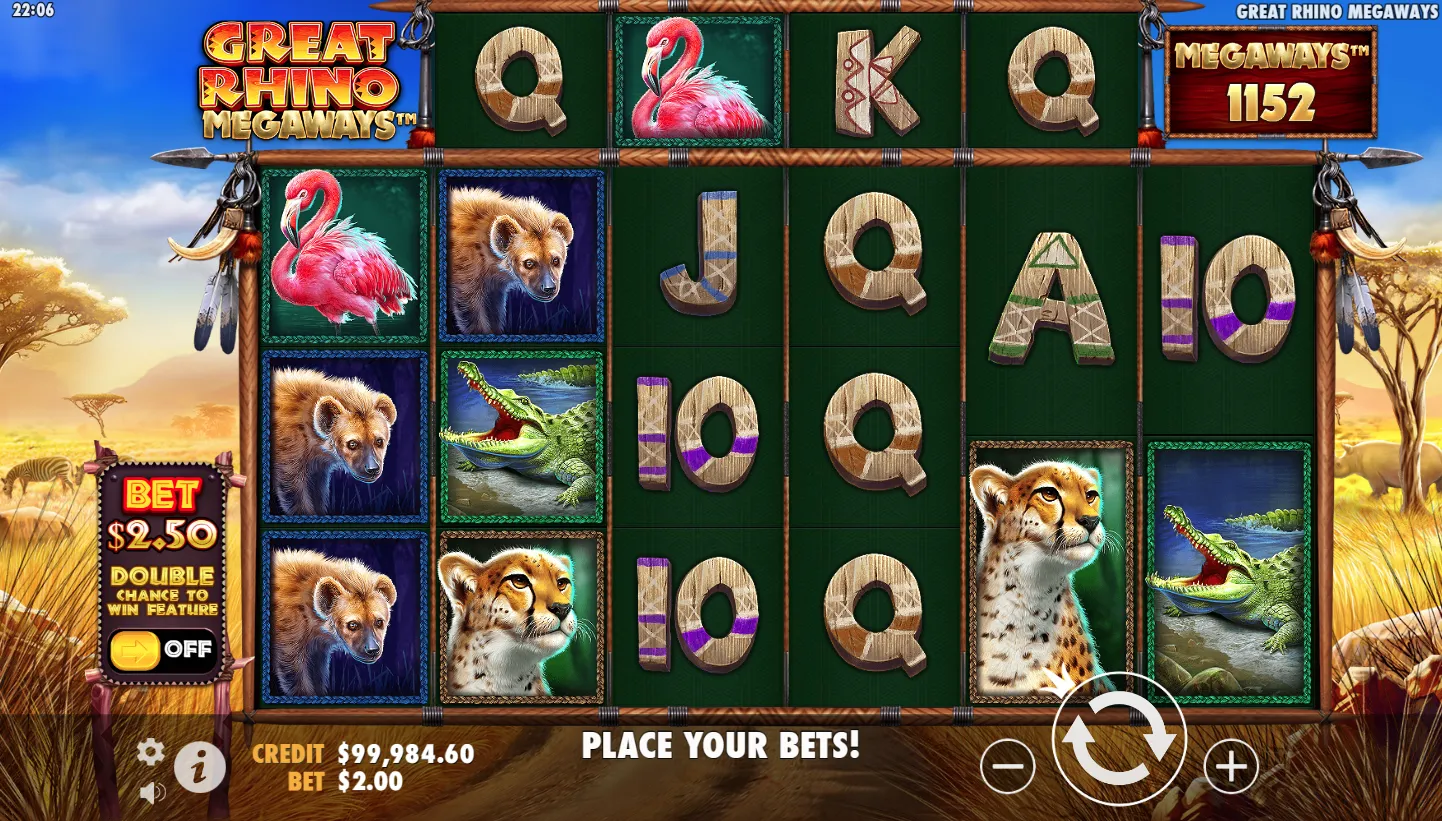
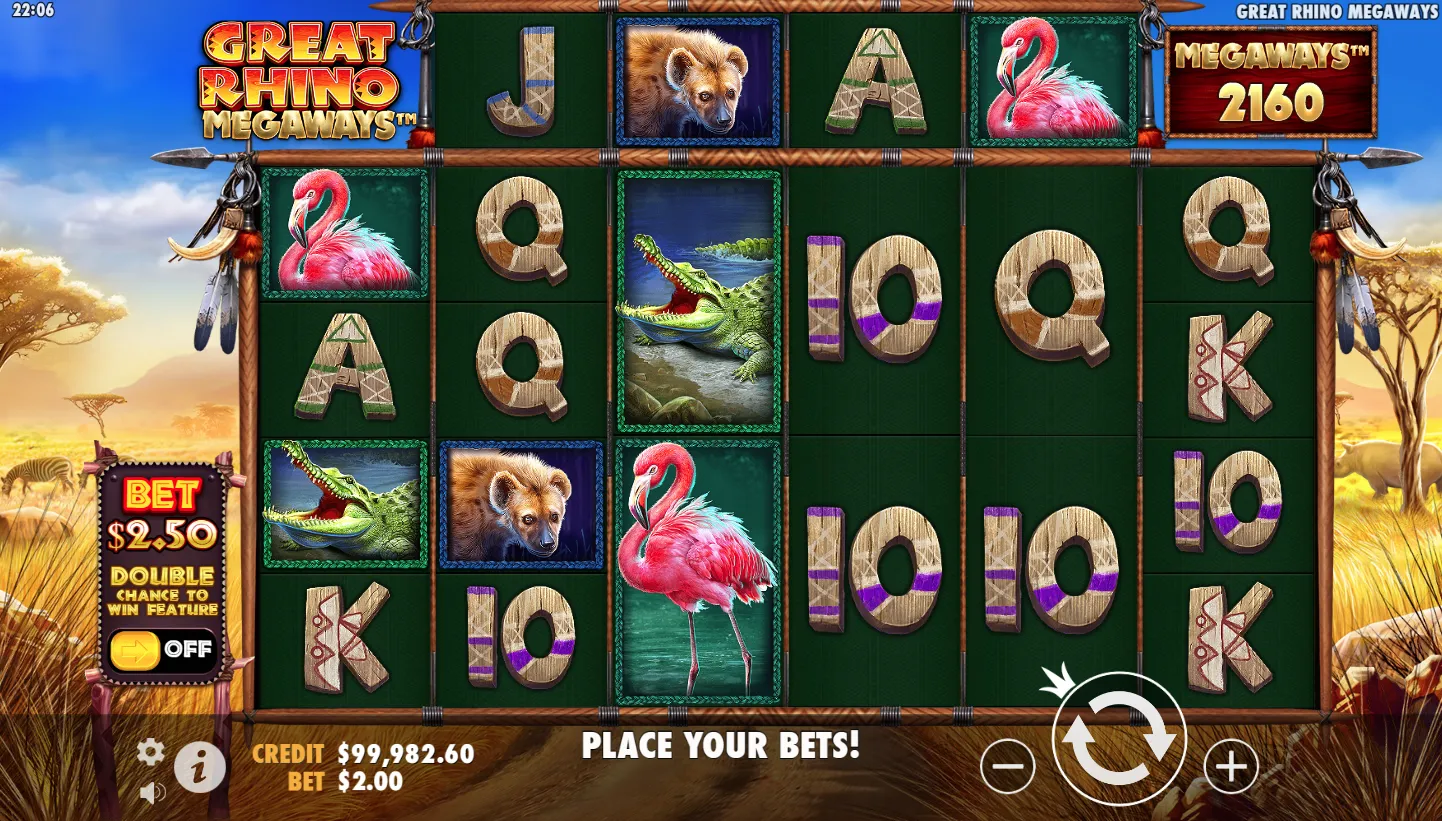
Adding up every symbol's six-of-a-kind prize gives 67x the bet, and 50x of that belongs to the cheetah, nearly three quarters of the table on one symbol. Its four of a kind, at 10x, is double the best six of a kind any other symbol pays. Its two of a kind pays 1x, which is what the queen, jack and ten pay for a full six-reel way. Six of the ten symbols return 1.5x or less for six of a kind, and eight pay less than the bet for three.
Nothing in the base game multiplies a win, so this table, spread across ways, is its entire return. On the paytable alone, the 20,000x cap takes 400 six-cheetah ways in one spin, or 4,000 six-gorilla ways. Two cheetahs on every reel make 64 such ways, worth 3,200x. Three on every reel make 729, which would come to 36,450x and stops at 20,000x instead. A base spin can reach the cap, but the arithmetic puts it a long way off, in a game where 64.3% of spins win nothing at all.
The wild changes little. It lands only on the four top-row positions above reels 2 to 5, so reels 1 and 6 get no help: every winning way starts on a real symbol on reel 1, and every six of a kind needs one on reel 6 too. A top-row wild adds one to its reel's count of every paying symbol, which completes a way where a symbol is missing and doubles it where the symbol sits once. Four wilds over a board with one cheetah on each reel turn a single 50x way into 16 ways and 800x. Nothing the base game builds reaches the round either, because the free spins multiplier starts from the package on the menu.
The menu sells a head start at a fixed rate
The option menu is the one choice the round hands the player, and its exchange rate never moves. On four scatters it offers 15 spins at 1x, 10 at 5x or 5 at 10x. Each scatter beyond four adds four spins to every fixed package, so the gaps hold at every scatter count: against the 1x package, the 10x package gives up ten spins for a nine-step head start, and the 5x package gives up five spins for four steps.
That rate settles the race to the final multiplier. For the 1x package to finish above the 10x package, it needs at least ten more tumbles than the 10x round produces, one for every extra spin it holds. Retriggers add five spins to any package, so equal retriggers leave that gap where it was. Along the way, the long package's first nine wins are paid at 1x through 9x, every one below the value the 10x package pays its first win at. Taking 15 spins at 1x is a bet that tumbles come at close to one per spin, and taking 5 at 10x is a bet that they do not.
Extra scatters change the proportions, not the rate. At four scatters the 10x package gives up two thirds of the spins the 1x package holds; at six it has 13 against 23 and gives up under half, yet the price is still ten spins for nine steps. What extra scatters rescue is the 10x package's weakest case. Five spins is few enough that the round can end before a single tumble has lifted the value, and 13 leave far more room. The mystery package draws both values at random, which throws away the one decision the menu exists for. I see no case for taking it.
The cap is the only thing that cuts a good round short
Nothing in the round resets the multiplier and retriggers have no limit, so a strong round compounds: each set of five extra spins starts from whatever the tumbles have already built. What stops it early is the 20,000x cap. A round that reaches it ends at once and forfeits its remaining spins.
A high multiplier brings the cap within reach of single wins. At 50x, one tumble worth 400x at face value reaches it on its own; at 100x, 200x is enough, which is four six-cheetah ways. From a 10x start, 50x takes 40 tumbles, which a five-spin package reaches only at eight per spin or through retriggers. Per spin, the cap is about 600,000 times rarer than the free spins trigger, 1 in 266,772,667 against 1 in 442, so I treat it as the boundary on the best rounds rather than a reason to choose the game.
Buy Free Spins costs 100x and opens the same round under the same cap, so its best case is 200 times its price. It lands four to six scatters at random, and the scatter count sets how many spins each package holds. Before any retrigger, the price per free spin on the fixed packages runs from 20x the bet on a four-scatter 10x package to under 5x on a six-scatter 1x package. I rate the price as fair rather than generous: the buyer pays to skip the wait, and 100x cannot buy the scatter count that matters most to the 10x package.
The ante makes the wait cheaper and the base game poorer
The ante raises the bet multiplier from 20x to 25x, a quarter more per spin, and doubles the chance of a natural trigger. The stake spent per trigger becomes 1.25 divided by 2, or 62.5% of what it was, which is 37.5% less. The cost falls on the base game. Wins are still paid on the base bet, so every paytable value is worth a fifth less against what the spin now costs, and the cheetah's six of a kind drops from 50x to 40x of the stake.
The trade pushes the game further toward what it already is, with more of the return coming from the round and less from the base game. It also locks out the buy, so the two are one decision about how to wait: a quarter more on every spin, or 100x at once. For a player here for the free spins, and I see no other reason to be here, the ante is the cheaper way to reach the round short of buying it.
One good round does not make an excellent game
This game suits a player who wants one long round with a climbing multiplier and accepts a thin base game as the price of reaching it. Anyone who wants the base game to pay its way should look elsewhere. Casinos can run it at several return settings, from 96.58% down to 94.69%, a gap of 1.89 points, and the rules screen shows the one in use.
The free spins are well built, with a tumble-fed multiplier that never resets between spins, a menu with a real and fixed price, and retriggers without limit. The frame around them is sparse: one premium symbol, four wild positions and no multiplier outside free spins. A round this good deserves a better frame, and the frame is what holds the game at good rather than excellent.