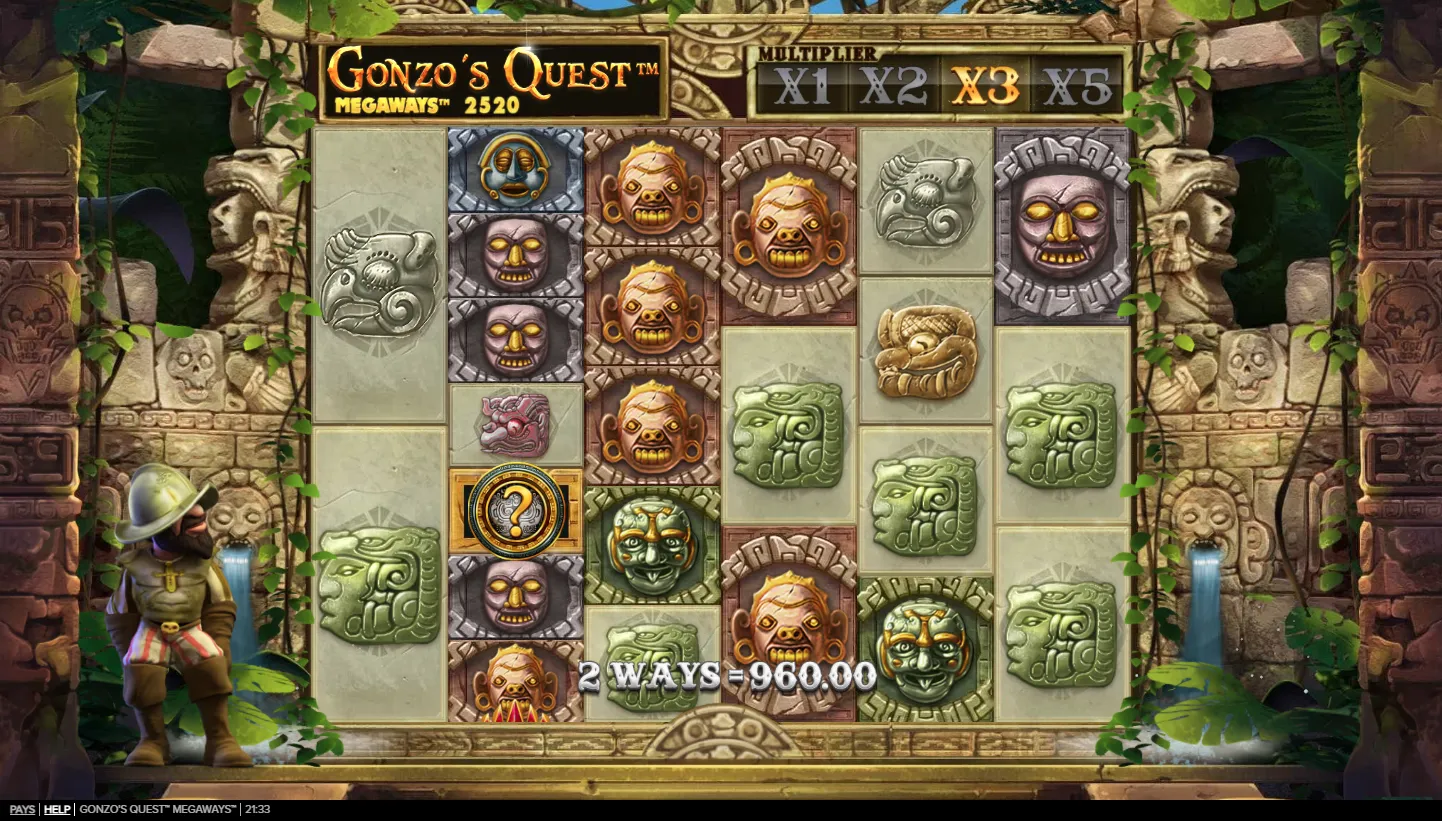
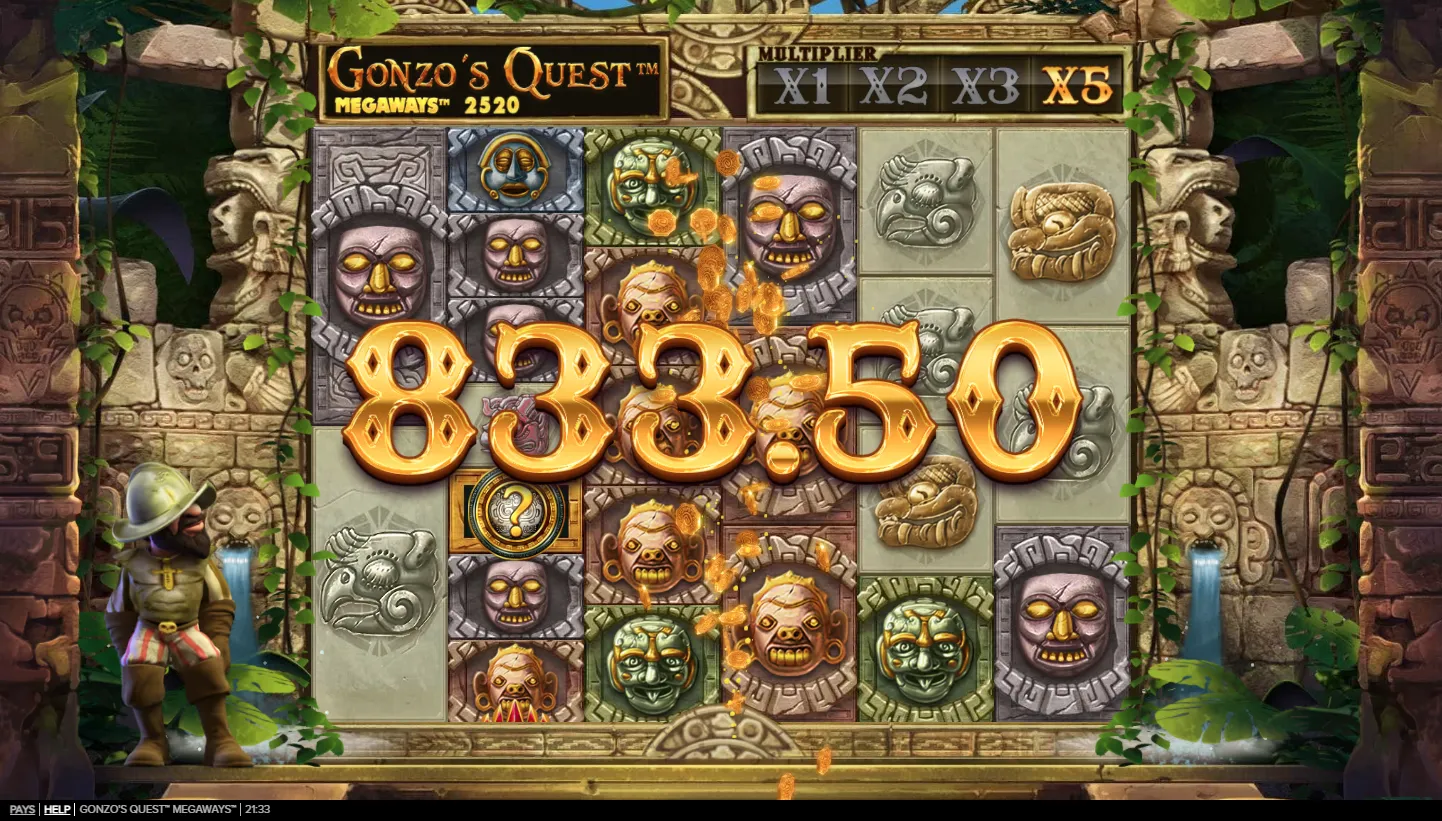
Every number in this game is small until it meets another one
Gonzo’s Quest Megaways pays by multiplication, and none of its factors is large on its own. The best symbol pays 15× the stake per way. The base-game Avalanche Multiplier stops at x5. The Wilds multiply nothing at all. What the game gets right is making those small factors meet: an Unbreakable Wild holds a chain open, an Earthquake narrows what can fall into it, and Free Fall triples every rung of the ladder. My argument is that Free Fall is the real game, that the base game is a thin toll paid to reach it, and that with no feature buy there is no way around the toll. The parts are good and the frame around them is weak.
The grid is shared, and the ladder is the identity
Most of this frame exists elsewhere. Piggy Riches Megaways, another Red Tiger game, and Lucky Phoenix Megaways run the same six reels of up to seven symbols and the same 117,649 ways. Pirates Plenty Megaways, also from Red Tiger, clears the low-paying symbols with its Wild Monkey the way Earthquake does, and awards 9 free spins for three scatters plus 3 for each extra, the same count Free Fall gives for a way of its own symbols.
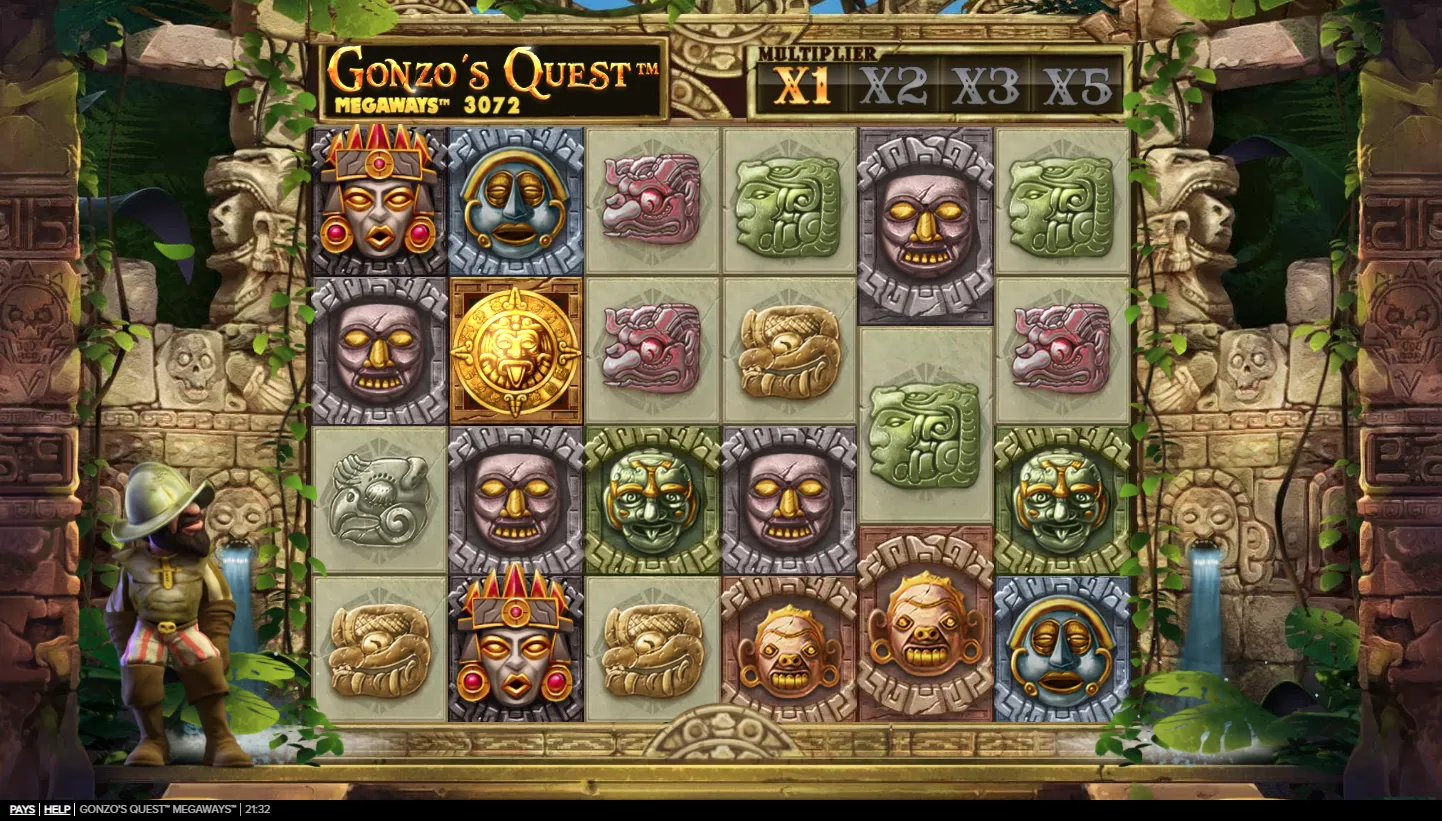
What separates this game is where the multiplier lives. Lucky Phoenix hangs its multipliers on Wilds. Piggy Riches raises a free-spins multiplier by 1 with every win. Here the multiplier measures the depth of one chain: x1, x2, x3 and then x5 from the fourth Avalanche onward, reset when the spin ends. A Free Fall round is a series of separate climbs from x3, not one long climb. The design rewards a single spin running deep rather than a round adding up, and the Wilds are built correctly for it. Where the chain is the multiplier, a Wild that multiplied would duplicate the ladder. A Wild that stays gives the ladder what it lacks.
The paytable exists to be multiplied
I count five of the nine symbols returning no more than the stake even for six of a kind, and three of a kind pays between 0.1× and 1× per way. The top of the table is one symbol. Six ruby masks pay 15×, nearly four times the 4× of the blue mask behind it, and the four tablets never pass 0.8×.
The maximum win of 20,972.4× is 1,398 times that best single way, so ways and the multiplier have to supply nearly all of it. I find it clearest to count how much board each rung saves. At x1, reaching the maximum from six-ruby ways alone takes 1,399 of them, and the smallest set of ruby masks and Wilds that makes that many ways is 21 symbols out of 42 positions. At the base game’s x5 each such way is worth 75×, 280 ways are enough, and 16 symbols can make them. At Free Fall’s x15 each is worth 225×, 94 are enough, and 13 symbols, two on five reels and three on the sixth, make 96. The top rung is worth eight masks of board, and only Free Fall has it.
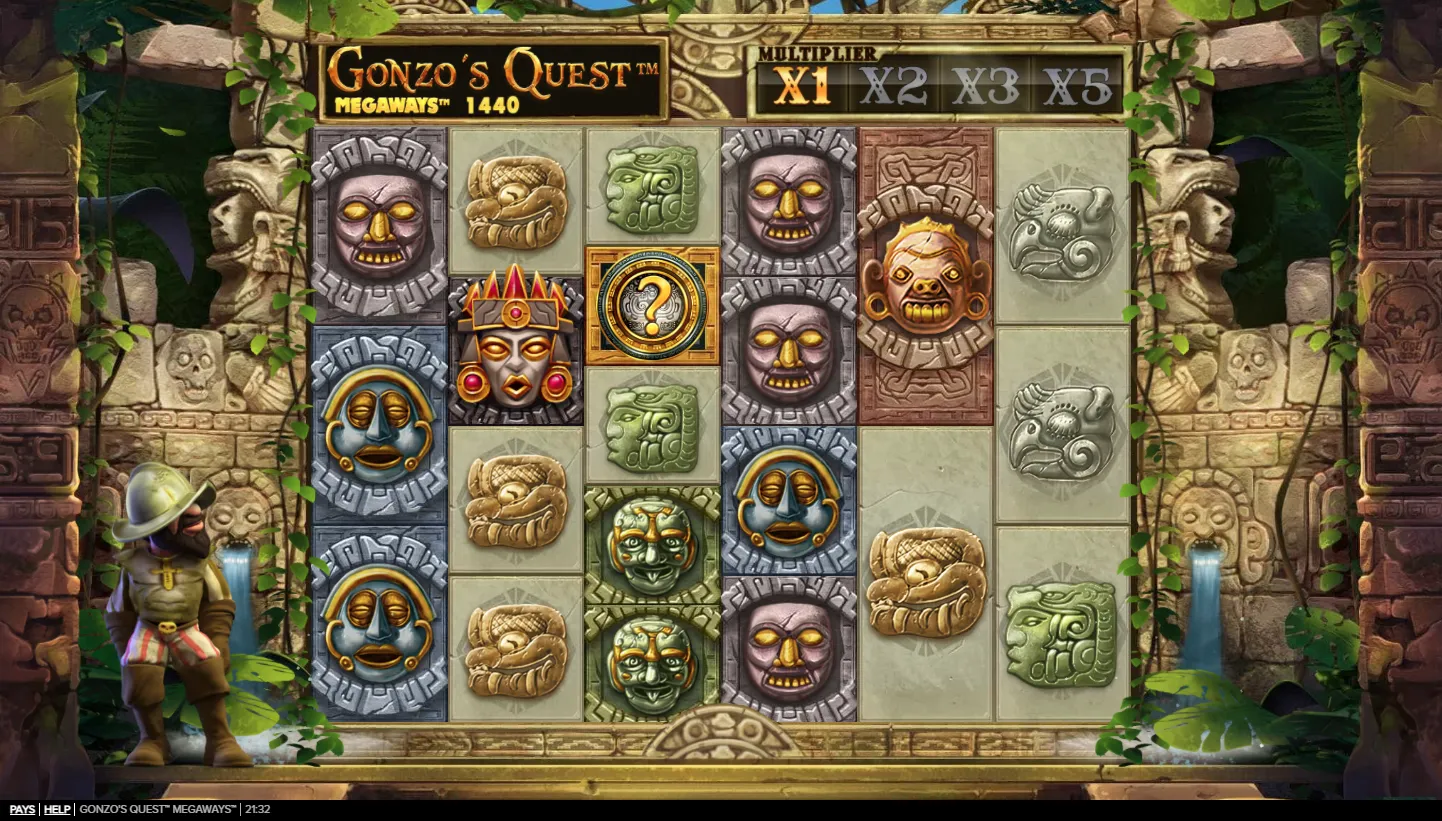
The Earthquake is the mechanic that pushes a board toward that density. It destroys the four tablets and lets only the five masks refill the gaps, which cuts the paying symbols competing for each position from nine to five, lifts the cheapest three of a kind from 0.1× to 0.3× and lifts the cheapest six of a kind from 0.5× to 1×. Without a multiplier behind it, that is still mask money, which is small money.
A Wild that stays is worth more than any symbol on the reels
Every winning symbol explodes and new symbols fall into the gaps. Of the symbols in a win, the Unbreakable Wild is the only one certain to still be on the board for the next Avalanche, and it holds the game up. The ladder climbs only while drops keep winning, and a Wild that survives its own win leaves every way through its position one match closer to paying. A chain with no Wild needs the new symbols to complete a fresh way, and the base game’s x5 needs four winning drops in a row. With a hit frequency of 26.25%, 73.75% of spins produce no win, no Avalanche and no step on the ladder at all.
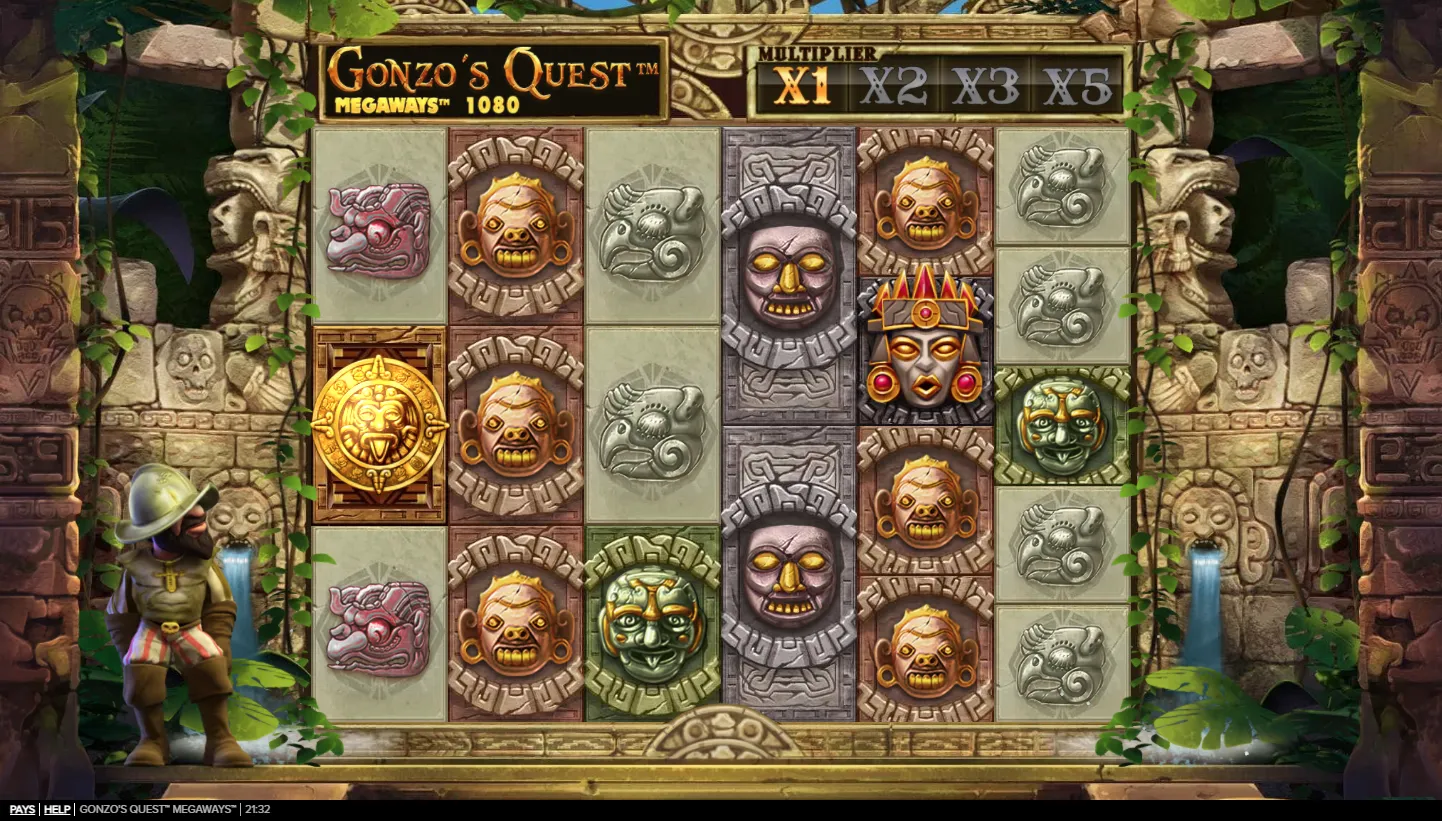
The limits on the Wilds matter as much as the Wilds. Only two can be on the reels, one on reels 1 to 3 and one on reels 4 to 6. A three-symbol way ends on reel 3, so the right-hand Wild never completes a three of a kind, including the three-symbol way that starts Free Fall with 9 free spins. Its job in the trigger is lengthening the award. The award is 3 spins per symbol in the way and no more than four Free Fall symbols can land, so the 18-spin maximum needs four of them connected with both Wilds.
Free Fall’s second rung already beats the base game’s top one
Tripling the ladder does more than scale it. Free Fall’s initial fall pays at x3, level with the base game’s third Avalanche, and its second Avalanche pays at x6, above the x5 the base game cannot pass however long a chain runs. A win on the second drop of a free spin is worth more than the same win at any depth of the base game. The round runs on a different set of reel strips and retriggers exactly as it starts, so it is a different game built from the same symbols, and the better one.
The best-designed detail sits at the exit. When Free Fall ends, play returns to the board that triggered it, the triggering symbols are destroyed to set off more Avalanches, and the multiplier from the last respin before the bonus stays in place until the chain stops. The spin that earned the round can keep paying after it.
The frame around the round is where the score is lost. The standard version has no feature buy, so there is no price to judge and no shortcut: Free Fall is reachable only from a base game whose paytable is thin and whose ladder stops at x5. The Royal Wheel version lets awarded spins be gambled, and on a disconnect it completes the wheel by always gambling unless the biggest win has already landed, a consistent default for a game whose value sits in Free Fall. In the jackpot version 1% of each stake funds a progressive jackpot that no win multiplier touches, the one prize in the game that ignores the ladder.
The lower settings turn a thin toll into a poor one
At the default 95.77% the game keeps 4.23% of stakes over the long run. Casinos can also run it at 94.66%, 92.71% or 90.71%, and the lowest keeps 9.29%, about 2.2 times the default’s share. A strong base game could absorb some of that cut. This base game has nothing spare, and at 90.71% I would leave it alone. The help screen shows the setting in use.
It suits someone who wants a cascade slot where the free spins are plainly the point and who accepts working through a base game, at stakes from €0.10, to get there. Players who want to buy the feature have no option here. Players who want a free-spins multiplier that rises with every win rather than with Avalanche depth are better served by Piggy Riches Megaways, and anyone who wants a paytable that pays without help should look past this one entirely.