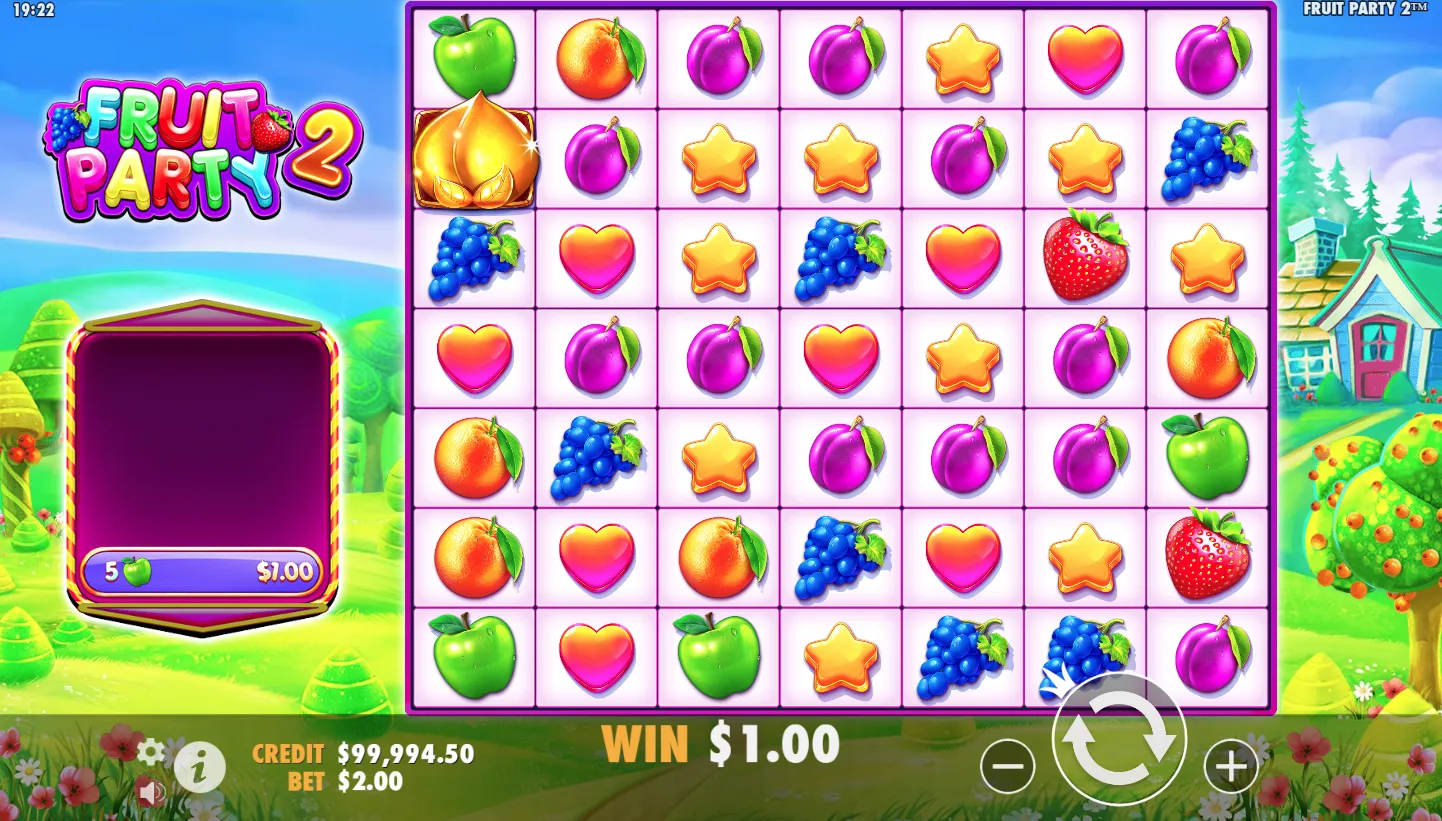
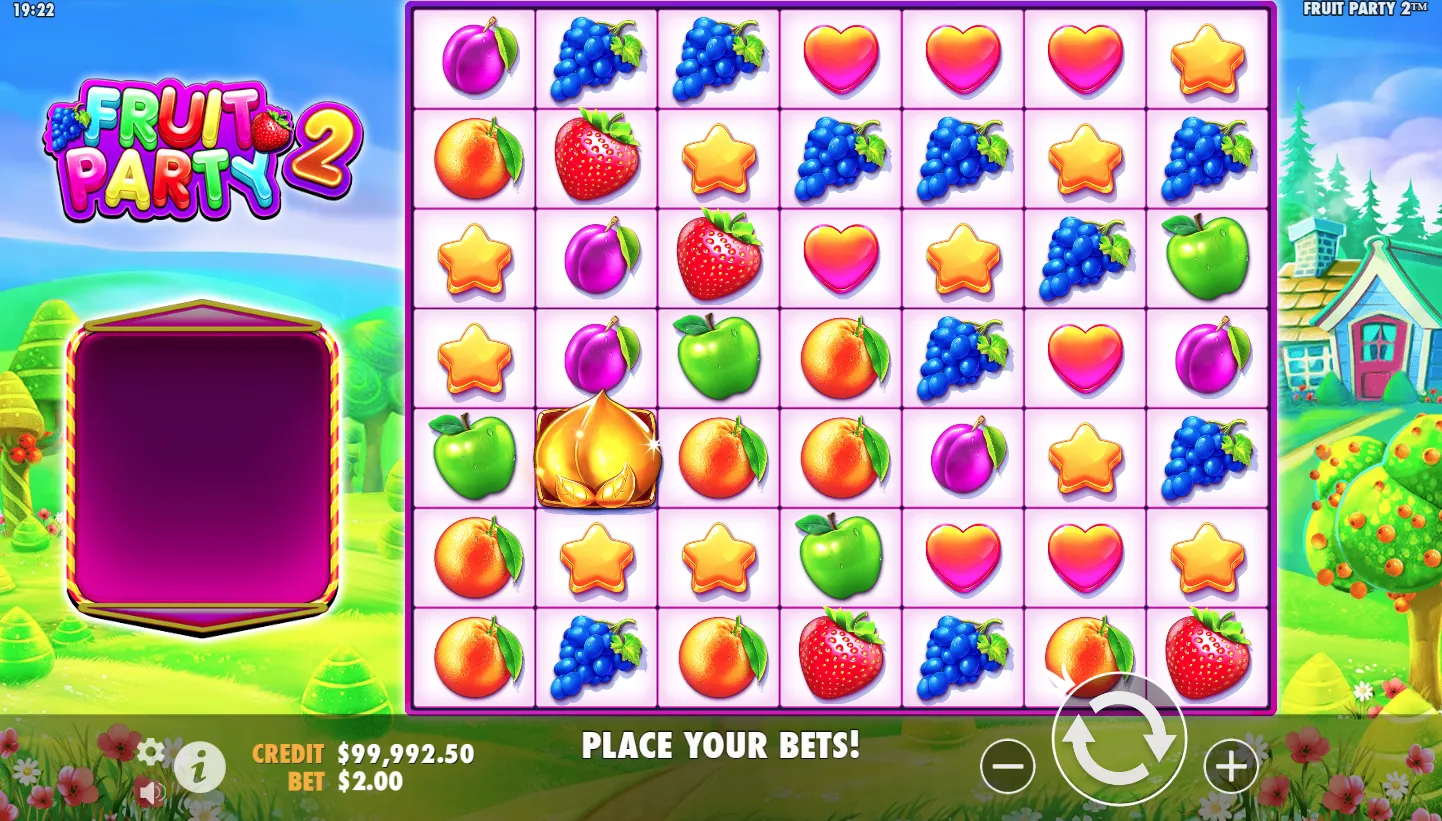
The sequel's one idea is a wild that has to survive
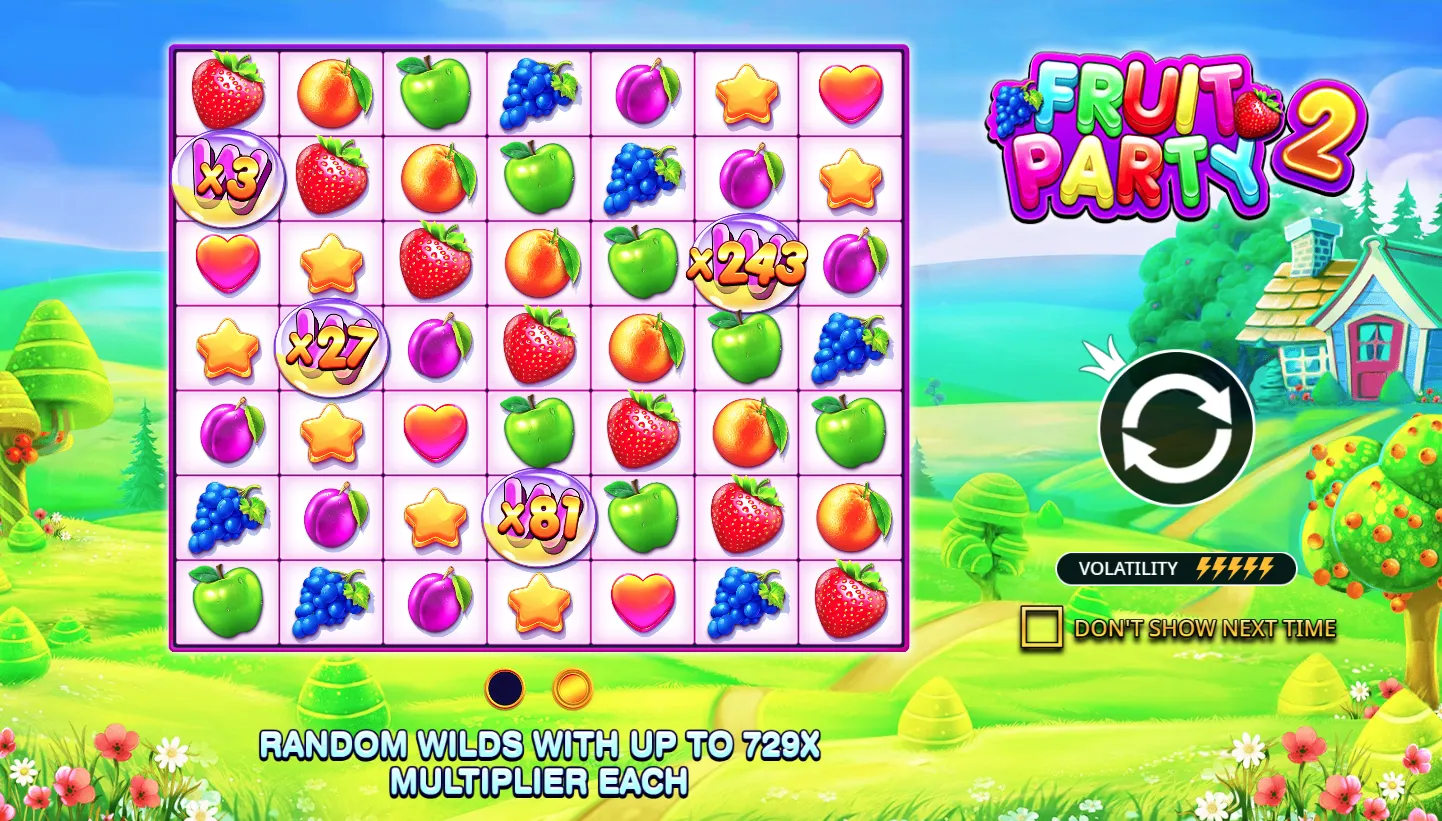
I rate Fruit Party 2 on a single rule and on what one number does to it. A new wild appears only where a winning cluster has just exploded, and it grows only by joining another win and then reappearing. In the base game that rule doubles, from 2x toward a 256x ceiling, and it moves too slowly to rescue a paytable whose 5-symbol clusters return the stake at best. In free spins the same rule triples, from 3x to 729x, and it compounds fast enough that on a big cluster the 5,000x cap arrives long before the top of the ladder. I build my whole reading of the game, and its score, on the distance between those two ladders.
The lineage explains the design. Fruit Party put random multipliers on wins across the same 7x7 grid of tumbling clusters. Its sequel keeps the grid and the tumbles and replaces the handed-out multiplier with a wild that is worth something only once it has survived. Doubling growth from repeated wins is the rule it shares with Sugar Rush and Sugar Rush 1000, which run it on the same 7x7 frame. The switch to tripling in free spins is what separates Fruit Party 2 from all three. I read that as a refinement of a family idea rather than an invention, and it is where the game earns its keep.
The smallest clusters hand back the stake at best
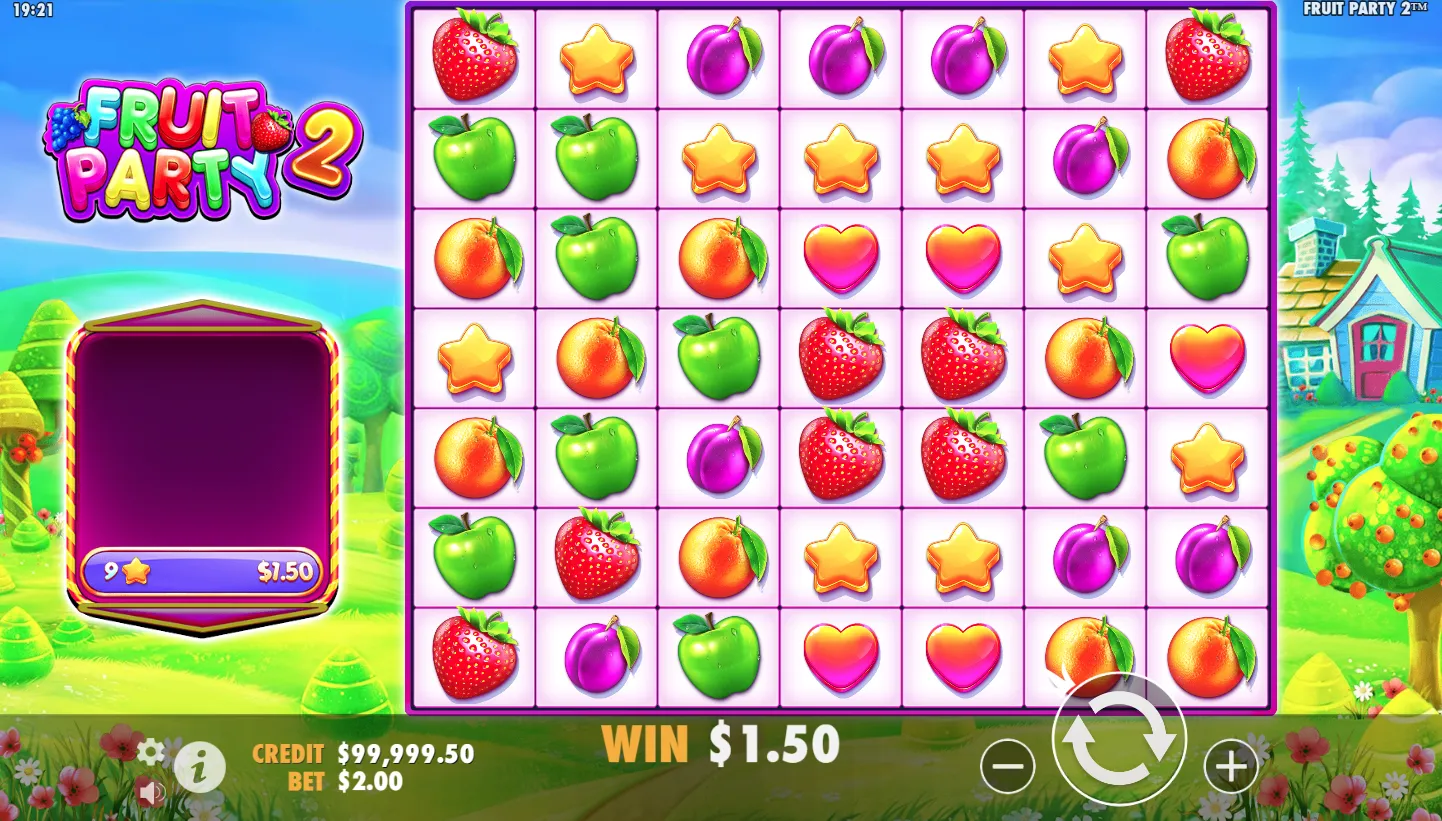
I count what a cluster has to be before it returns more than the spin that made it. A 5-symbol cluster pays between 0.2x and 1x. The strawberry beats the stake at 6 symbols, the orange at 7, the apple at 8, grapes at 9, plum and star at 10, and the heart at 11. On a 49-cell grid, the four low fruits need nine to eleven connected cells before one of their clusters is worth more than the bet. The most any single cluster pays without a multiplier is 150x, for 15 or more strawberries, and I make that 3% of the cap.
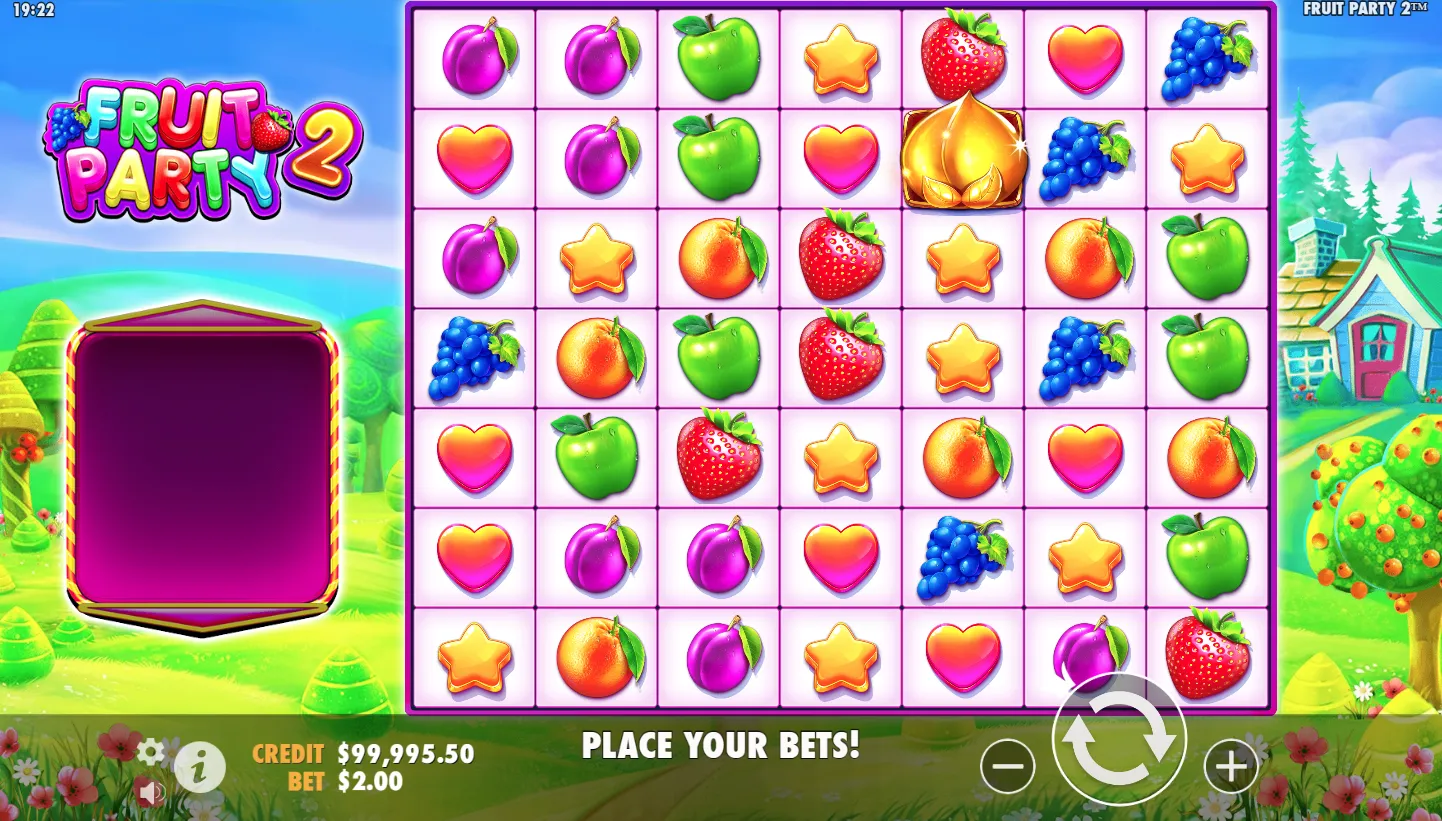
That leaves the base-game wild to do the work, and I count two pieces of luck in every step it takes. It appears only where a winning cluster has exploded, and not after every one. It starts at 2x, and every step up requires it to sit in a new winning cluster and then reappear after that cluster goes. Seven survivals take a single wild from 2x to 256x. Wilds in one cluster add their values instead of multiplying them, so two fresh 2x wilds give 4x, exactly what one wild earns by surviving once. Age is worth more than numbers, and age is the scarce thing.
The ceiling is real but distant. At a combined 256x, a 15+ cluster of any fruit reaches the cap, since even the heart's 20x becomes 5,120x. Below that the numbers shrink fast. A 15+ strawberry cluster needs a combined 34x to pass 5,000x, and a single wild clears that line only at 64x, five survivals after it appears. A wild three survivals old sits at 16x, and 16x on a 12-symbol strawberry cluster is 240x. That is what I mean by a thin base game: spins with an old wild are uncommon, and spins without one pay from a table built to lose small.
Tripling changes what survival is worth
I line the two ladders up by survivals, and the gap widens at every step.
| Survivals | Base-game wild | Free-spin wild |
|---|
| None | 2x | 3x |
| One | 4x | 9x |
| Two | 8x | 27x |
| Three | 16x | 81x |
| Four | 32x | 243x |
| Five | 64x | 729x |
At birth the free-spin wild is worth 1.5 times the base one. After four survivals it is worth more than seven times as much, and at 243x it sits 13x below the base game's 256x per-cluster ceiling, which a single base wild needs seven survivals to reach. The free-spin ladder tops out at 729x after five survivals, almost three times the base ceiling and two survivals sooner. I call this the feature that carries the game. The base game runs the family's doubling and waits; the round runs a ladder on which two survivals already reach 27x, a value a single base wild passes only after four.
Big clusters hit the cap long before the ladder tops out
In free spins, three survivals are enough for the biggest cluster on the table to pass the cap. At 81x, a 15+ strawberry cluster comes to 12,150x, more than twice the 5,000x limit. At 243x, a 15+ heart cluster comes to 4,860x, just under it, and at 729x every cluster of 14 or more symbols passes it, down to 14 hearts at 7,290x. The top two rungs deliver their full value on the clusters the table undervalues instead: at 729x, a 5-symbol strawberry cluster pays 729x and a 5-symbol heart cluster 145.8x, which turns the weakest wins on the table into real ones.
The cap covers each round as a whole, and a round that reaches it ends with its remaining spins forfeited. I treat those spins as the visible loss rather than the real one, because they could not have added anything: the round total stops at 5,000x whatever they would have paid. The real cost is the ceiling. Once a round's wilds are this steep, 5,000x is where the game stops paying, not where the ladder stops growing.
At a 1 in 495,050 chance per spin, the cap is worth about one point of the 96.53% return. The other 95.5 points come from wins below it, which is why I weigh the base game's thinness as heavily as the round's ceiling.
The buy is priced fairly and shaped badly
Buy Free Spins costs 100x and returns 96.45%, against 96.53% by default. I work one purchase out as an expected loss of 3.55x, against 3.47x on the same 100x staked in the base game, a difference of 0.08x. Skipping the base game costs almost nothing. The best a purchase can return is the 5,000x cap, 50 times its price.
The flaw is length. The trigger lands 3 to 7 scatters at random, which opens anything from 10 to 25 spins, and the price does not move. A round that opens with 10 spins costs 10x bet per spin before retriggers; one that opens with 25 costs 4x. With the tripling wild as the whole case for the round, a buy that can hand it 25 spins or 10 is a bet on length before it is a bet on the ladder. Retriggers add 5 spins for three or more scatters, which can stretch a short round without touching the price. The 96.45% averages short and long rounds together, so I call the return fair; what the buyer cannot choose is which of them the 100x pays for.
A round worth reaching, behind a base game that is not
I would point this game at a player who wants the tripling round and treats the base game as the queue in front of it, or who will pay 100x to skip the queue. At the 0.2 minimum stake one purchase costs 20. Anyone who wants a base game where clusters pay their way, or a bought round of known length, should look elsewhere. The sequel refines the family's growth rule where it matters most and builds a thin base game around it. I score that as a competent sequel with one strong feature, in the middle of the scale rather than near the top.