Borrowed rounds at an honest price
Floating Dragon Megaways is assembled from other games' parts, so I judge it on how it sells them, and it sells them fairly. Both bonus rounds can be bought, and both buys return the same 96.70% as a base spin. On top of the borrowed collector it adds one thing that matters: a 5,000x fish, which makes the 20,000x cap a real target for Free Spins. Everything outside the two rounds is a delivery system, and a thin one. Fair prices and a real ceiling, on a base game with little to offer, add up to a 6.8.
The parts are easy to name. The free spins use the Big Bass Bonanza collector format, where every 4th collector adds 10 spins and a higher fish multiplier. The Hold & Spin coin round extends the one in the earlier Floating Dragon. Fishin’ Frenzy Megaways had already put a fish collector on a Megaways grid, so this game arrived late to a format that was already on this engine. One adaptation is well judged: in Free Spins a fish sinks to the bottom of its reel instead of exploding, so a tumble chain does not wash the money off the screen.
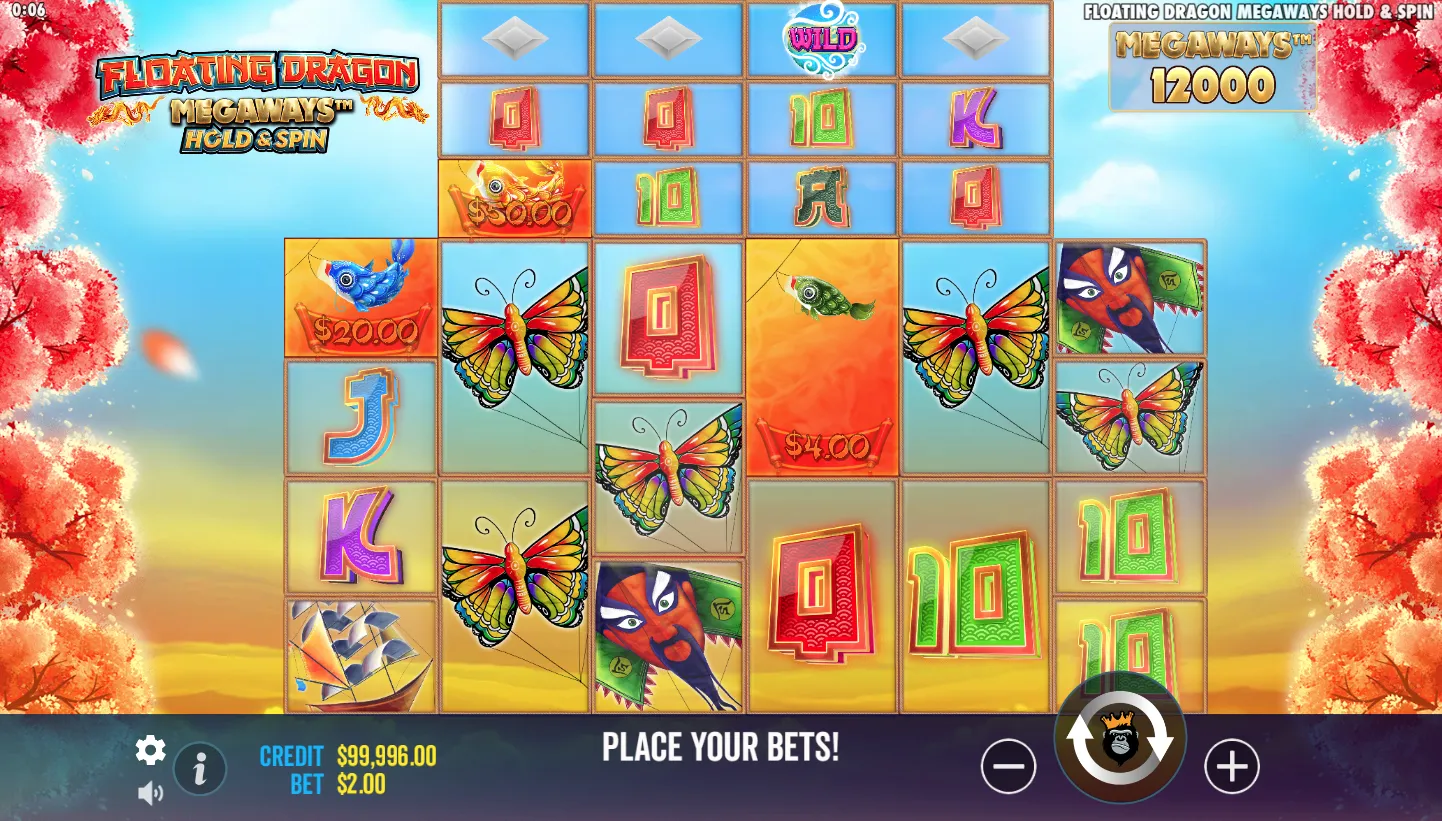
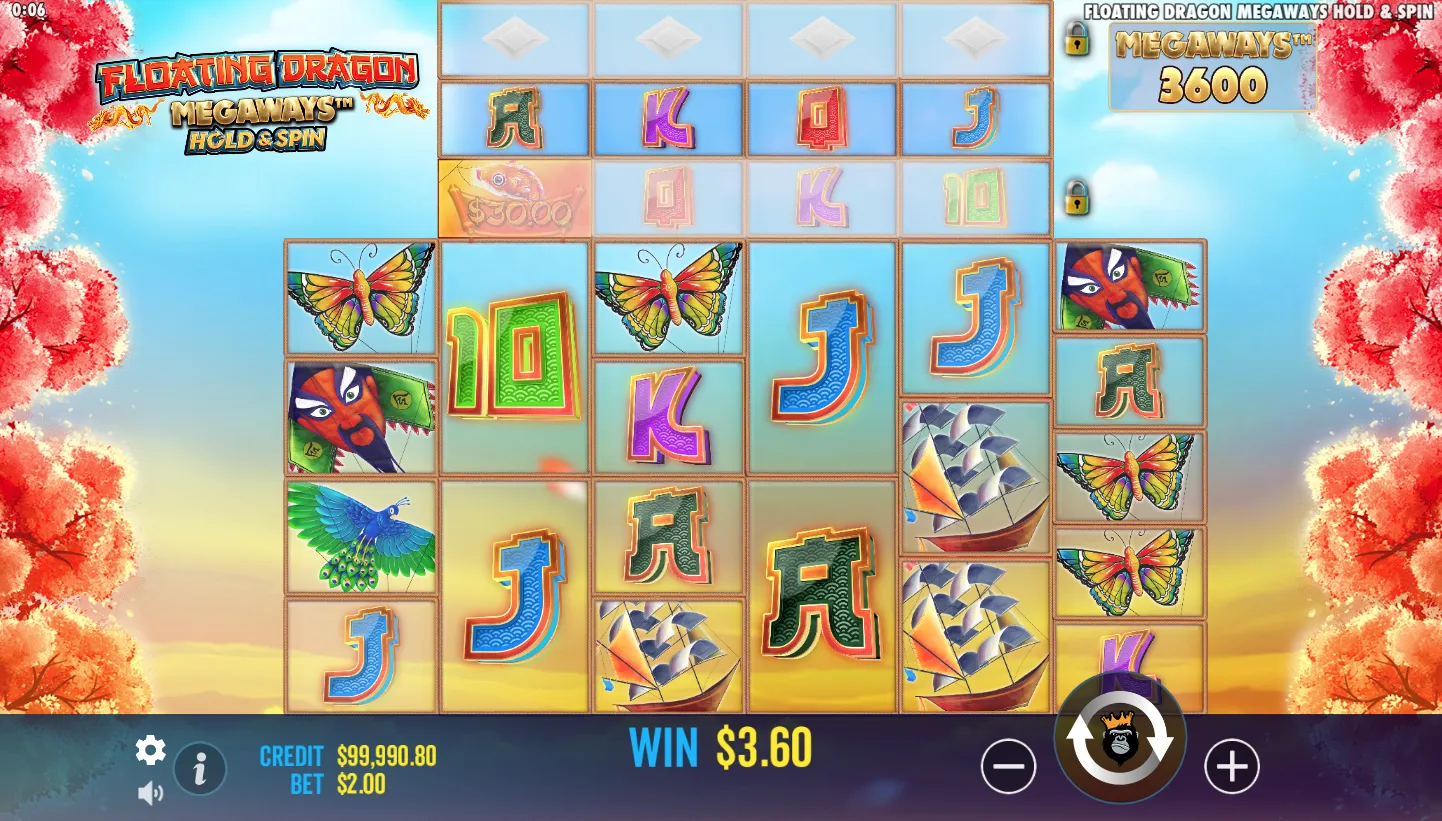
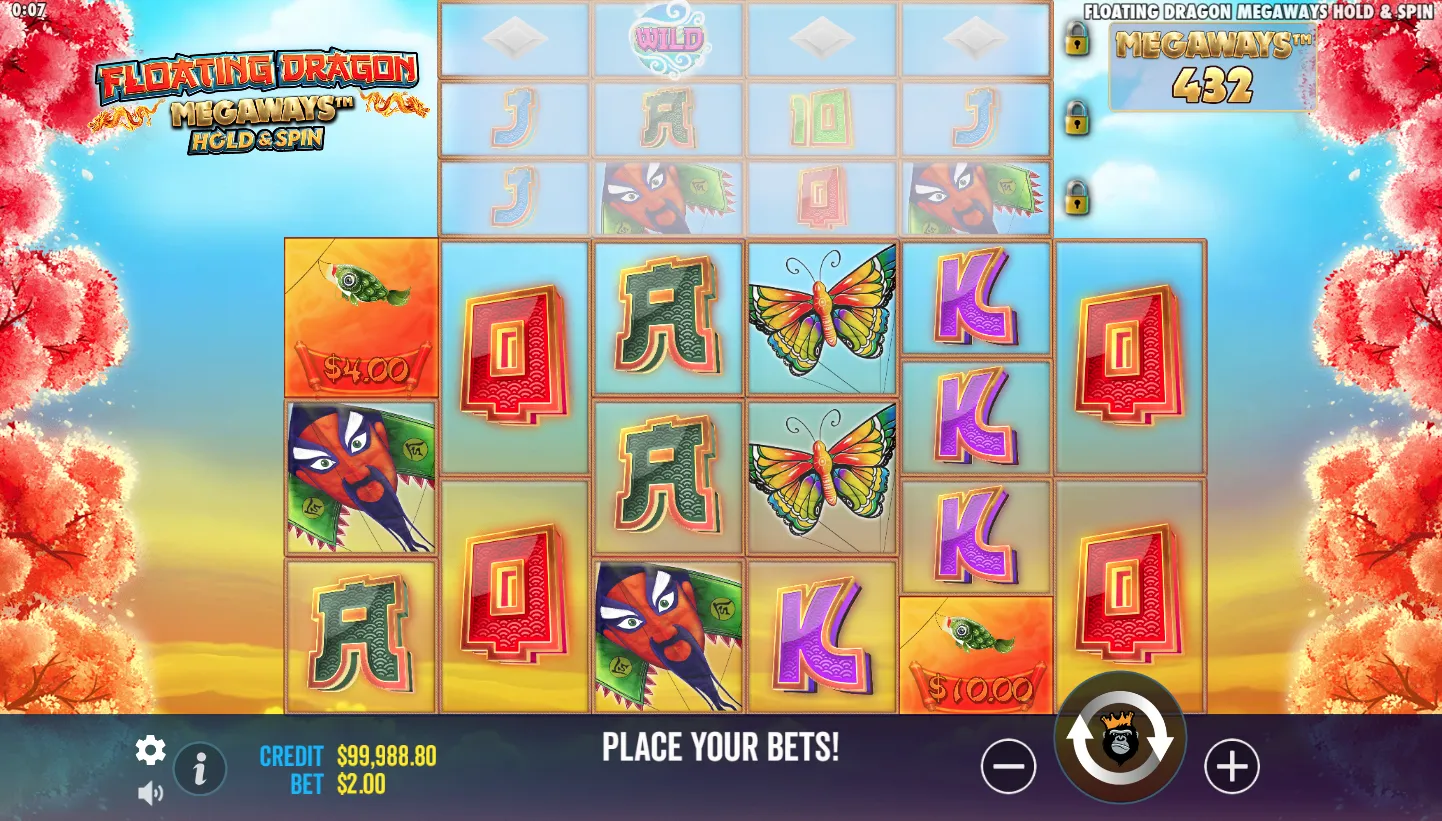
The base-game fish shows 5,000x and pays 1.5x
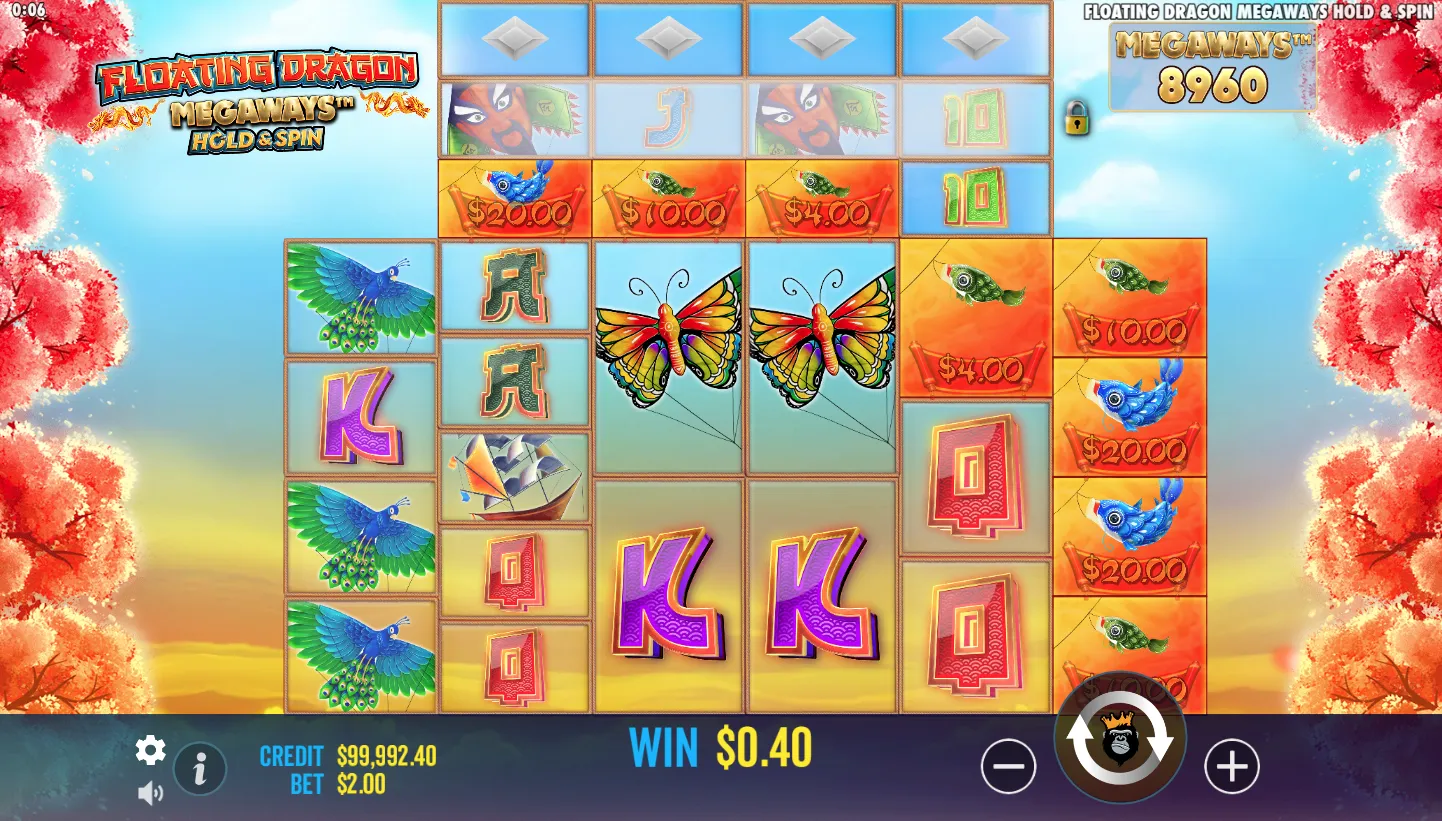
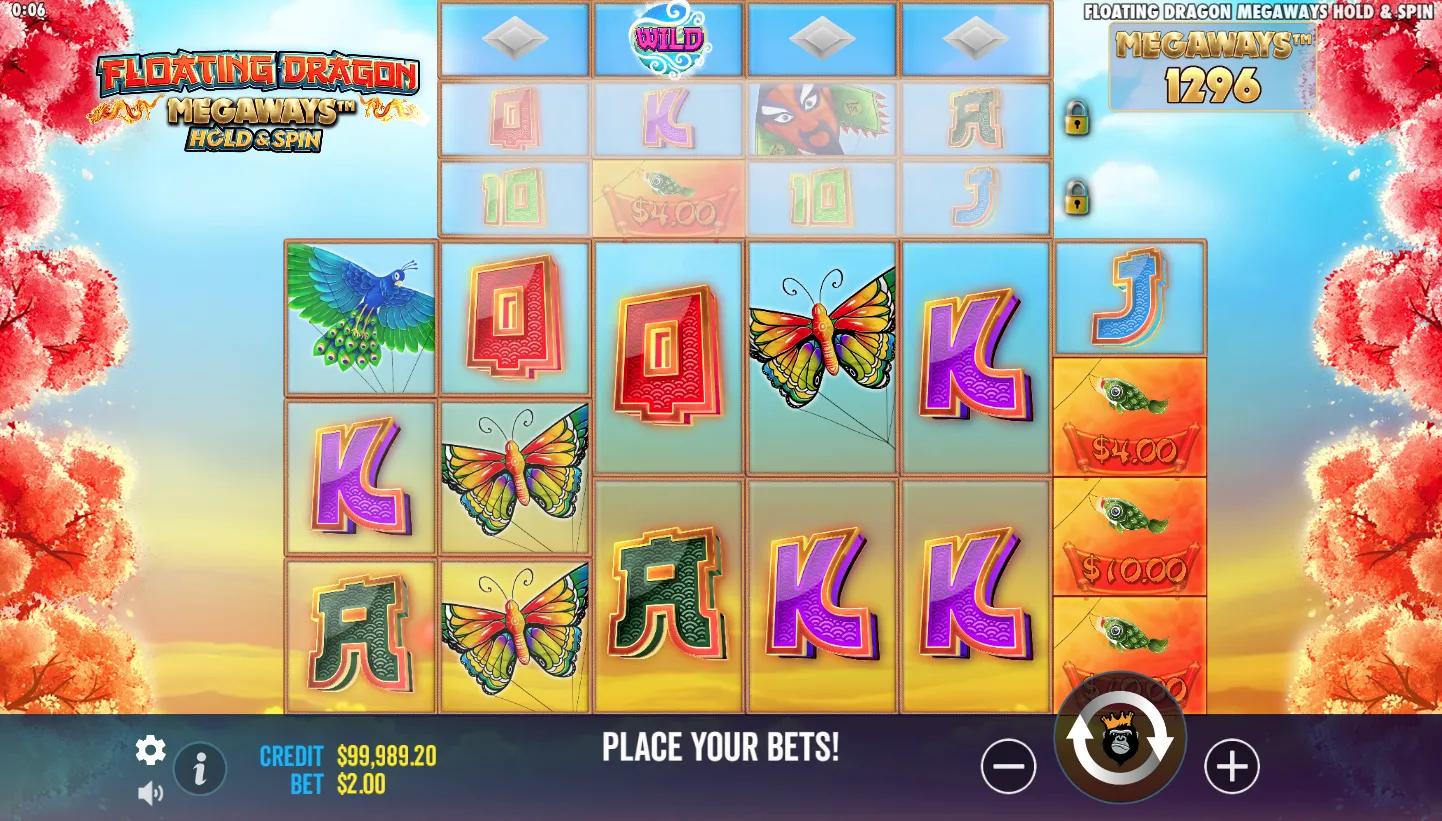
The paytable is flat by design. Six ships pay 50x per way. Below the ship no symbol pays more than 5x for six, and eight of the ten paying symbols return 2.5x or less. For three of a kind the same eight pay 0.3x or less, and the six low symbols pay 0.1x or 0.2x. With a 20% hit frequency, four spins in five pay nothing on average, and the spins that do pay are built from these fractions multiplied across ways and tumbles.
The fish makes the point sharper. A Fish Money symbol in the base game can show any value up to 5,000x, but that value is paid only when a Lady collects it, and Ladies appear only in Free Spins. Until then the fish is the koi, and six koi on a way pay 1.5x. The number on a base-game fish is an advertisement for the bonus, not a prize.
Can the paytable reach the cap by itself? At 50x a way, six ships need 400 winning ways to make 20,000x, a small fraction of the 147,456 ways the grid allows at its widest. The peacock needs 4,000 ways, and a symbol paying 1x for six needs 20,000. So the arithmetic does not bar the base game from the cap. What it says is that a large base-game win needs one symbol stacked across hundreds or thousands of ways. The lantern reveal, which turns every mystery symbol on screen into the same paying symbol, is the base-game mechanism that stacks a symbol like that. Meanwhile an average of 319 base spins separates one Free Spins trigger from the next, and this paytable gives those spins little to do.
Twelve Ladies before the ladder pays
Free Spins carries the game, and two sets of numbers decide it: the fish values and the multiplier ladder.
The fish values are 2x, 5x, 10x, 15x, 20x, 25x, 50x and 5,000x. Seven of the eight are 50x or less, and the eighth is 100 times the seventh. That gap decides what a round is worth. At face value the fish have to add up to 100x, two 50x collections or ten 10x ones, just to cover the 100x buy price on their own. A free spin with no Lady collects nothing from the fish on screen, however large they are, and a spin with Ladies but no fish depends on the firecracker, which fires at random.
The ladder is back-loaded. The 1st retrigger, at 4 Ladies, sets fish to x2; the 2nd, at 8, to x3; the 3rd, at 12, to x10; each later one adds another x10. The first two retriggers only double and then triple the fish. Each multiplier also applies to the batch of spins it unlocks, which plays after the current batch ends. Reaching x10 therefore means finding 12 Ladies inside the opening 10 to 25 spins plus the two 10-spin batches the first retriggers add, 30 to 45 spins in all, and the x10 then covers 10 spins. At x3 a 50x fish pays 150x to each Lady that collects it; at x10 it pays 500x.
The 5,000x fish changes the arithmetic at every rung. At face value one Lady collecting it pays 5,000x, a quarter of the cap, and four Ladies on the same spin reach 20,000x. At x2 two Ladies are enough. At x3 one Lady pays 15,000x. From x10 up, a single Lady on a single 5,000x fish passes the cap, so the round ends at 20,000x and forfeits the spins left in it. The small fish get there too once the ladder is high: at x10 it takes 2,000x of face value, forty 50x collections, and at x20 it takes 1,000x.
This is the part of the game I give credit for. The cap is a real destination for Free Spins, with more than one road to it. It is also a small part of the return. A round reaches the cap once in 1,496,522 spins, about 4,700 times the average wait for a Free Spins trigger, and at 20,000x a time that is worth 1.34 points of the 96.70%. The other 95.36 points come from everything below the ceiling, which is where this game's return lives.
The dearer buy is the safer one
Both buys return 96.70%, the same as a base spin, and that fixes the average value of each round. A bought Free Spins round is worth 96.7x the bet on average against its 100x price; a bought Hold & Spin round is worth 116.04x against 120x. Neither is a discount and neither is a surcharge: each costs 3.30% of its price in expectation, the same edge as spinning. What the price buys is time. The natural trigger averages 319 spins, and the buy replaces that wait with one 100x stake at the same edge.
Hold & Spin is the round whose worst case is known in advance. Every round pays at least 20x, one sixth of the 120x price, so a floor round loses five sixths of the buy. The average round, at 116.04x, is 5.8 times that floor. Coins top out at 30x, so it takes at least four coins to match the price on coins alone, while a single diamond, at 50x to 2,000x, moves the total further than any coin can. The ceiling is the same 20,000x as in Free Spins, and reaching it takes the equivalent of ten 2,000x diamonds. As multiples of their own cost, the best cases are 200 times for the Free Spins buy and nearly 167 times for Hold & Spin.
So the dearer buy is the safer one, and the cheaper buy is the one I would point to. The Free Spins buy costs less, reaches higher as a multiple of its price, and buys the round where the 5,000x fish lives. Hold & Spin suits a player who wants a floor under a 120x purchase and accepts that the floor is a sixth of it.
The 6.8 depends on the 96.70% setting
Casinos can run this game at 95.5%, 94.62%, 94.5% or 92.01% instead of 96.70%. At 92.01% the expected cost of a spin is 7.99% of the stake, about 2.4 times the 3.30% at full return. The case for this game is that it sells borrowed rounds at a fair price, so a lower setting removes the case rather than trimming it. The rules screen shows the setting in use.
Who fits it: a player who likes the Big Bass collector and wants it with a 5,000x fish in the mix, plus a second bonus route with a floor. Who should look elsewhere: anyone who wants the base game to do the work, because past the ship the paytable deals in fractions of the stake and four spins in five pay nothing. My 6.8 is the sum of those facts: honest pricing and a real road to 20,000x, held back by a copied collector and a base game that waits.