The conversion adds variance, not a second idea
Everything worth money in Fishin’ Frenzy Megaways happens on a free spin where a Fisherman lands alongside fish. The base paytable prices fish as filler, the round cannot extend itself, and the 100× Bonus Bet returns more than normal play in both paired builds. I read this as a free-spins game with a base game attached. The Megaways reels add variance to its one idea rather than supplying a second one, and the sensible way in is the buy on the 96.10% build. I put it in the competent-but-unremarkable band: fairly priced at the door, and familiar.
The loop is Blueprint’s own. Fishin’ Frenzy The Big Catch runs it on fixed paylines, with a Fisherman collecting the cash prizes of the fish in view. Big Bass Bonanza and Big Bass Bonanza Megaways run the same round with a Fisherman Wild, one symbol that substitutes and collects. Here I count two symbols doing that job. The Fisherman is a scatter that completes no ways, and the Wild that does complete them is barred from reel 1. Against Big Bass Bonanza Megaways that makes for a less versatile collector in the same format.
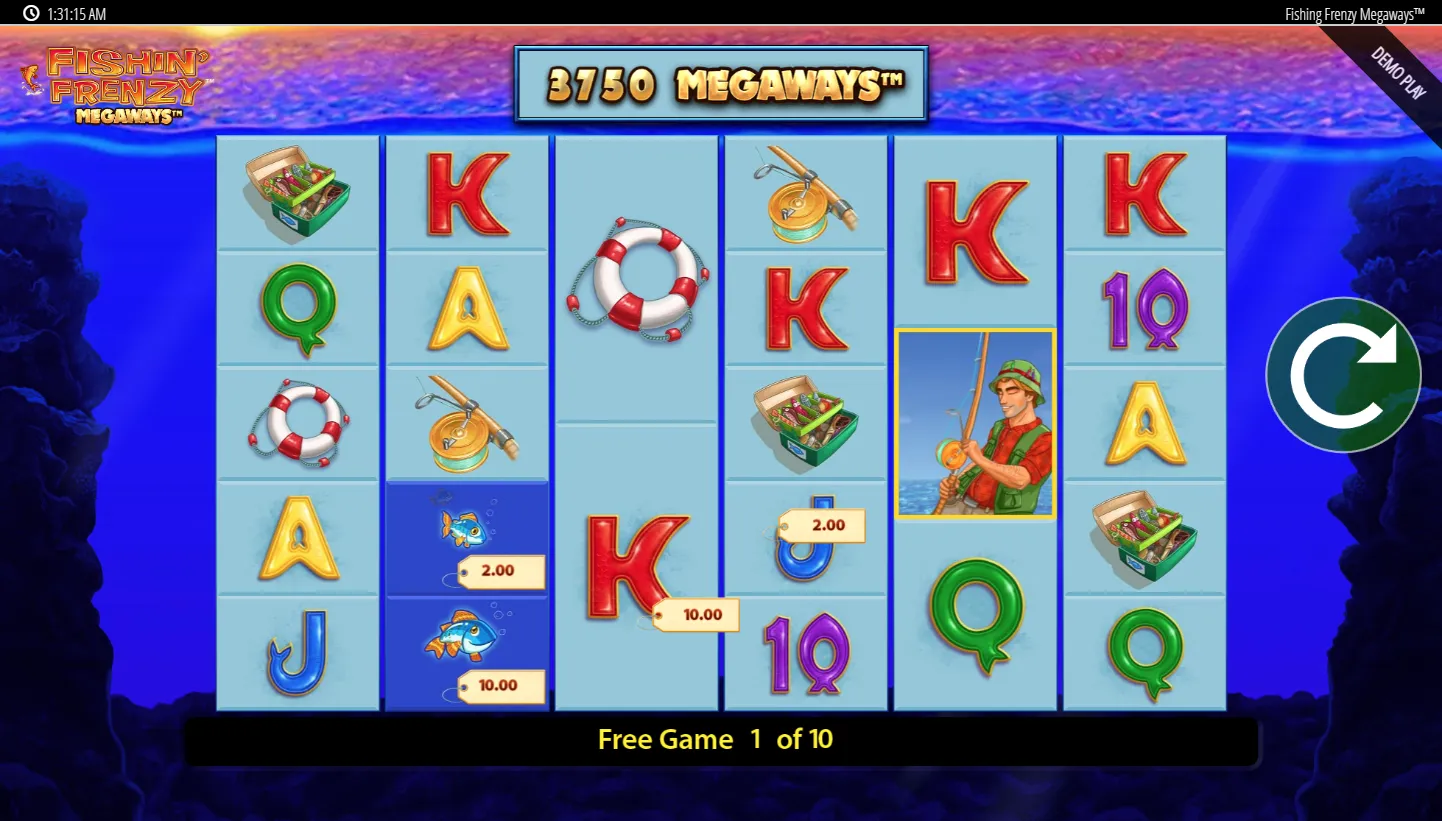
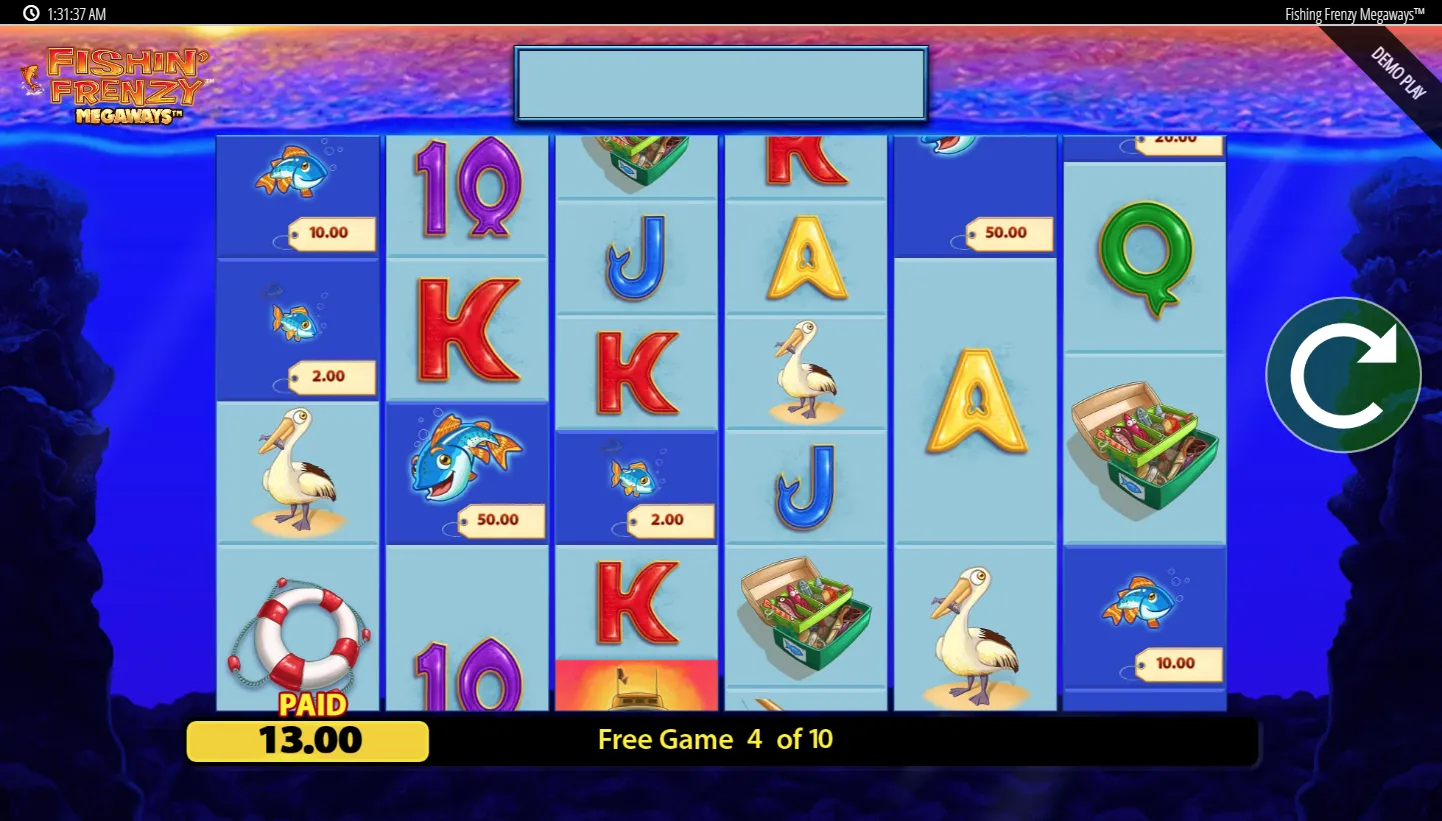
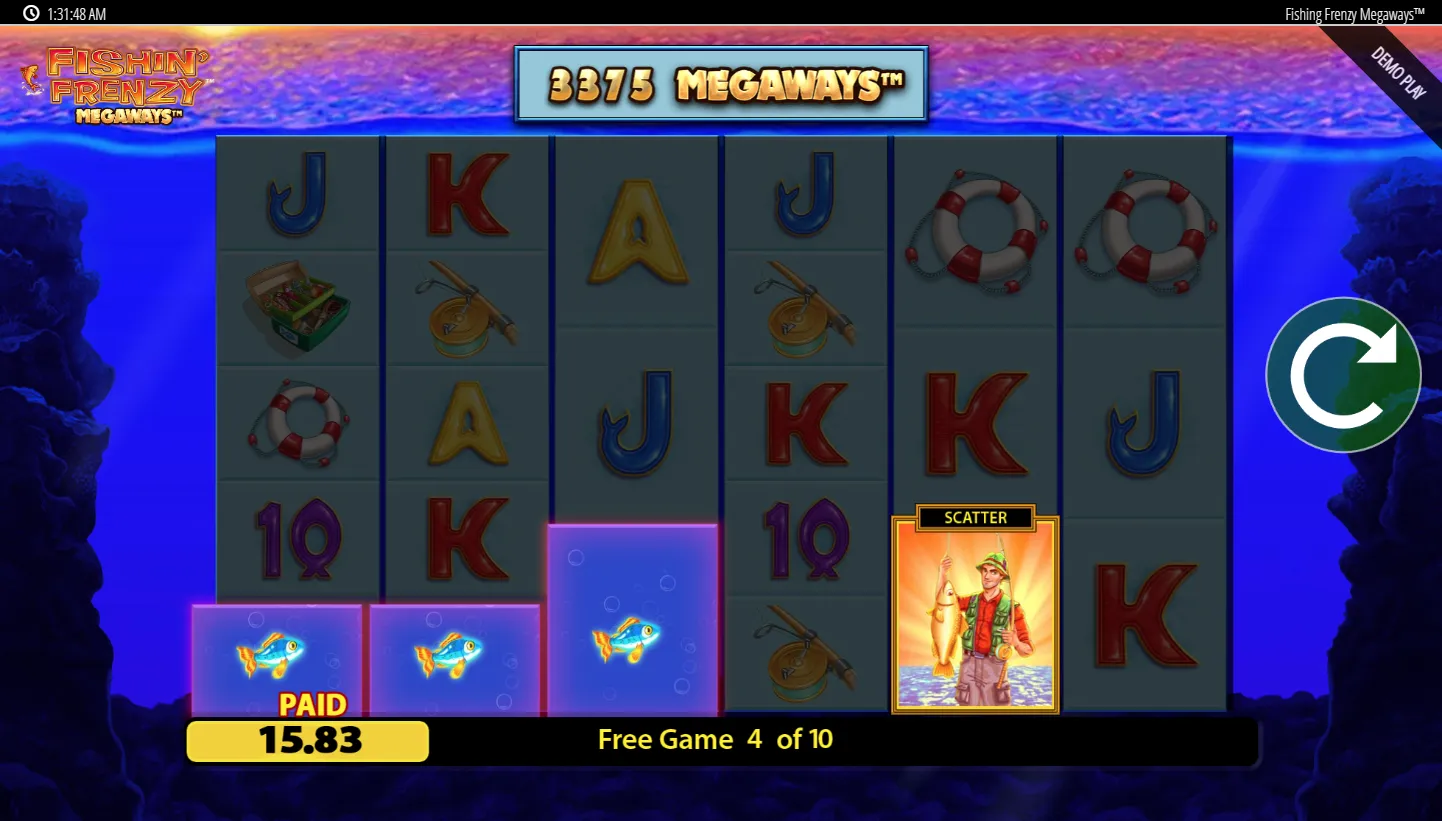
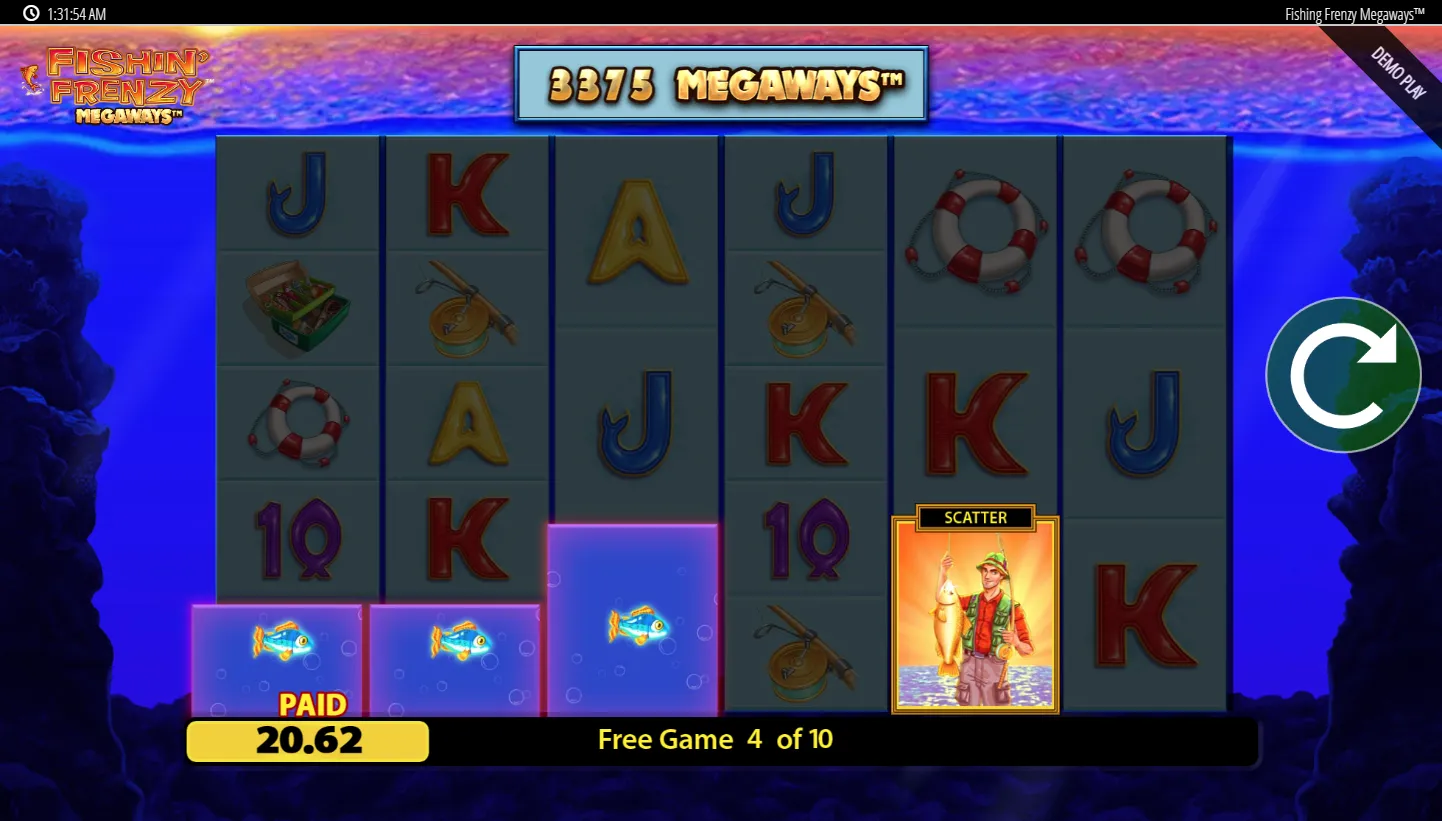
Inside the round, the conversion changes the screen. Reel heights move every spin, so the number of fish that can be in view moves with them, up to 30 positions on a six-by-five grid. A free spin now turns on three draws instead of two: whether a Fisherman lands, how many fish share the screen, and what those fish are worth.
The base paytable treats fish as filler
Fish are the only symbols with a second job, and the paytable prices them as if the first job barely matters. Six fish of any mix pay 10 units per way, the same as five lifebuoys or five tackle boxes and one-twentieth of six pelicans at 200. I get the same answer from the step between five and six of a kind. Pelicans and fishing rods multiply by 6.7 on the sixth reel, 30 to 200 and 15 to 100. Lifebuoy and tackle box multiply by 5, every royal by 2.5, and fish by 2. The row that the mixing rule makes easier to complete has the flattest sixth-reel step on the table, flatter than any royal.
Where the base game has reach, it comes from ways stacking the top two symbols. Two pelicans on each of the six reels make 64 ways, and every one of them pays the six-pelican value. That reach belongs to pelicans and rods, and only when reel 1 cooperates. The Wild cannot land there, so reel 1’s natural symbols decide which rows can pay at all. Reel 1 holds at most five symbols, which caps any spin at five paying rows however many Wilds fill reels 2 to 6.
Fishermen collect nothing outside Free Spins, so every fish that lands between bonuses is worth its line pay and no more. For a high-volatility game I call that a weak base, because its themed symbol is the lowest-paying row above the royals.
Every free spin is a coincidence test
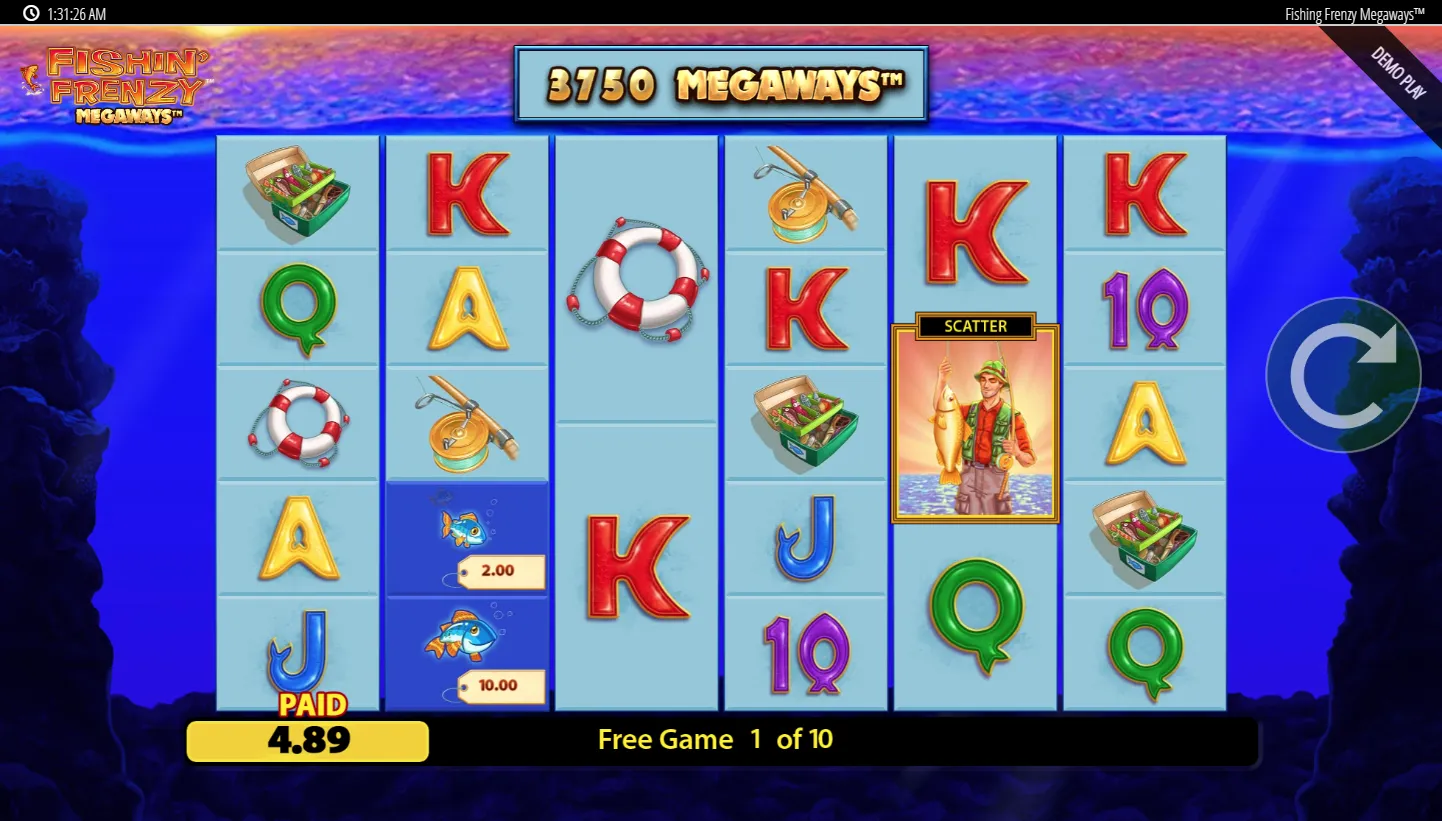
The round changes one rule. On a free spin each Fisherman in view pays the cash prize of every fish in view, so the haul is the Fisherman count times the sum of the fish prizes. Prizes run from 2× to 50× the total bet, a 25-fold spread per fish. One Fisherman over four fish pays between 8× and 200×. A second Fisherman over the same four lifts that to between 16× and 400×.
The grid sets the ceiling on any one spin. A Fisherman occupies a position a fish could have used, so k Fishermen sit over at most 30 minus k fish. Two Fishermen over 28 fish is 56 prizes, worth 112× at the bottom value and 2,800× at the top. I treat those as ceilings on a full-height screen, not expectations. What they show is that the upside lives in the multiplication by Fisherman count, and a spin with one Fisherman works at half the rate of a spin with two over the same fish.
The allotment is settled on the trigger. Three, four or five scatters award 10, 15 or 25 free spins, and nothing adds more. Every free spin runs the same collect rule at the same stake, so a 15-spin round is 1.5 times the draws of a 10-spin round and a 25-spin round is 2.5 times. I count the fixed allotment as the other half of the thin frame: the one strong idea runs on a clock that the scatter count sets and nothing resets.
The buy beats normal play, and the build beats the buy
The 100× Fishin’ Frenzy Bonus Bet returns 95.50% against normal play’s 95.02% in the Low build, and 96.60% against 96.10% in the High build. Turned into cost, normal play in the Low build gives up 4.98% of turnover and the buy gives up 4.50%, almost a tenth less. In the High build it is 3.90% against 3.40%, about an eighth less. At the £10 top stake a buy is £1,000, and I make its expected loss £45 in the Low build and £34 in the High, against £49.80 and £39 for the same £1,000 put through a hundred base spins.
The buy is fairly priced, then, and better priced than the game it skips. It does not rescue the Low build. The two normal-play builds sit 1.08 points apart, while the buy is worth about half a point within either one, so finding the 96.10% build is worth more than twice what pressing the buy is worth. The Low-build buy at 95.50% still returns less than High-build normal play. The 92% build is worse again, with an 8% edge that is more than double the High build’s 3.90%.
The guarantee is a floor. Three scatters mean 10 free spins, and 15 or 25 need a fourth or fifth scatter on the bought spin. Against a 100× price the collect arithmetic of a ten-spin round is tight at the bottom of the prize range: one Fisherman over four minimum-value fish on every one of the ten spins collects 80×, short of the price before line wins. Two top-value fish collected anywhere in the round cover it on their own. The prize spread is 25-fold and the allotment spread only 2.5-fold, so a buy turns on which prizes land far more than on how long the round runs.
The cap is a rule for the top stake
The £250,000 ceiling is cash, so its size as a multiple moves with the stake. At the £10 top stake it is 25,000× the bet and 250× the £1,000 buy. At the £0.10 minimum it is 2,500,000× the bet, and reaching it from fish prizes alone would take 50,000 top-value collections. I judge the cap a constraint only near the top of the stake range.
At £10, 25,000× from fish alone takes 500 top-value collections, for instance two Fishermen over 25 top-value fish on every spin of a ten-spin round. The grid can hold that screen, so the ceiling sits inside the arithmetic of a £1,000 buy, but only at the far end of the collect rule’s range. For a high-stakes player the binding limit is elsewhere. A normal spin takes at most £10 while the buy runs to £1,000, so the Bonus Bet is how stakes above £10 a round enter this game at all.
Only a buyer on the 96.10% build gets the good version
The player this game suits wants the Fishin’ Frenzy collect round at Megaways width, plays at a casino running the 96.10% build with the Bonus Bet enabled, and accepts that each round rests on Fishermen and high-value fish landing on the same spins.
Anyone who values the base game should look elsewhere, because fish pay closer to the royals than to the premiums until the round switches the collector on. So should anyone offered only the 92% build, and anyone who wants a round that can grow once it starts. A player who wants the collector to substitute as well will find that version in Big Bass Bonanza Megaways. My verdict is a competent conversion of a familiar loop: one strong rule, a thin frame around it, and a price list that holds up only in the better build.