The fish are the idea and the ceiling undoes it
Big Bass Bonanza is a counting game with one very good rule and one badly sized number. The rule is that a money fish is worth nothing until a fisherman wild collects it, and every fourth fisherman adds ten spins whose collections pay at a higher multiplier. Sitting over that rule is a 2,100× ceiling. I read the collection ladder as the best thing in the game and the ceiling as sized for that ladder's bottom rung, so the round the ladder is built to produce is exactly the round the game will not pay in full. What remains is a good slot with one real strength and a frame too small for it.
It is also the template for its series, and the later entries show where that frame was thin. Bigger Bass Bonanza is a direct follow-up on the same money fish and the same collecting fisherman. The Megaways build runs the same fisherman collection during free spins. Big Bass Splash keeps the loop and adds an extra multiplier level and a bonus buy. None of those successors replaced the fish, which I take as the clearest sign the central idea was right from the start. The buy in Splash answers this game's plainest limit: the scatter is the only way into the only feature.
The line pays are a waiting room
I count ten line symbols and only five distinct pay rows. All five card royals pay 0.5× the total bet for three, 2.5× for four and 10× for five. Tackle box and dragonfly are one pay row printed twice, at 2×, 10× and 50×. Eight of the ten symbols return 2× or less for three of a kind, and six of them top out at 20× or less for five. Only the multi-coloured float, at 200× for five and with the lone two-of-a-kind pay of 0.5×, gives a line any reach, and the fishing rod behind it stops at 100×.
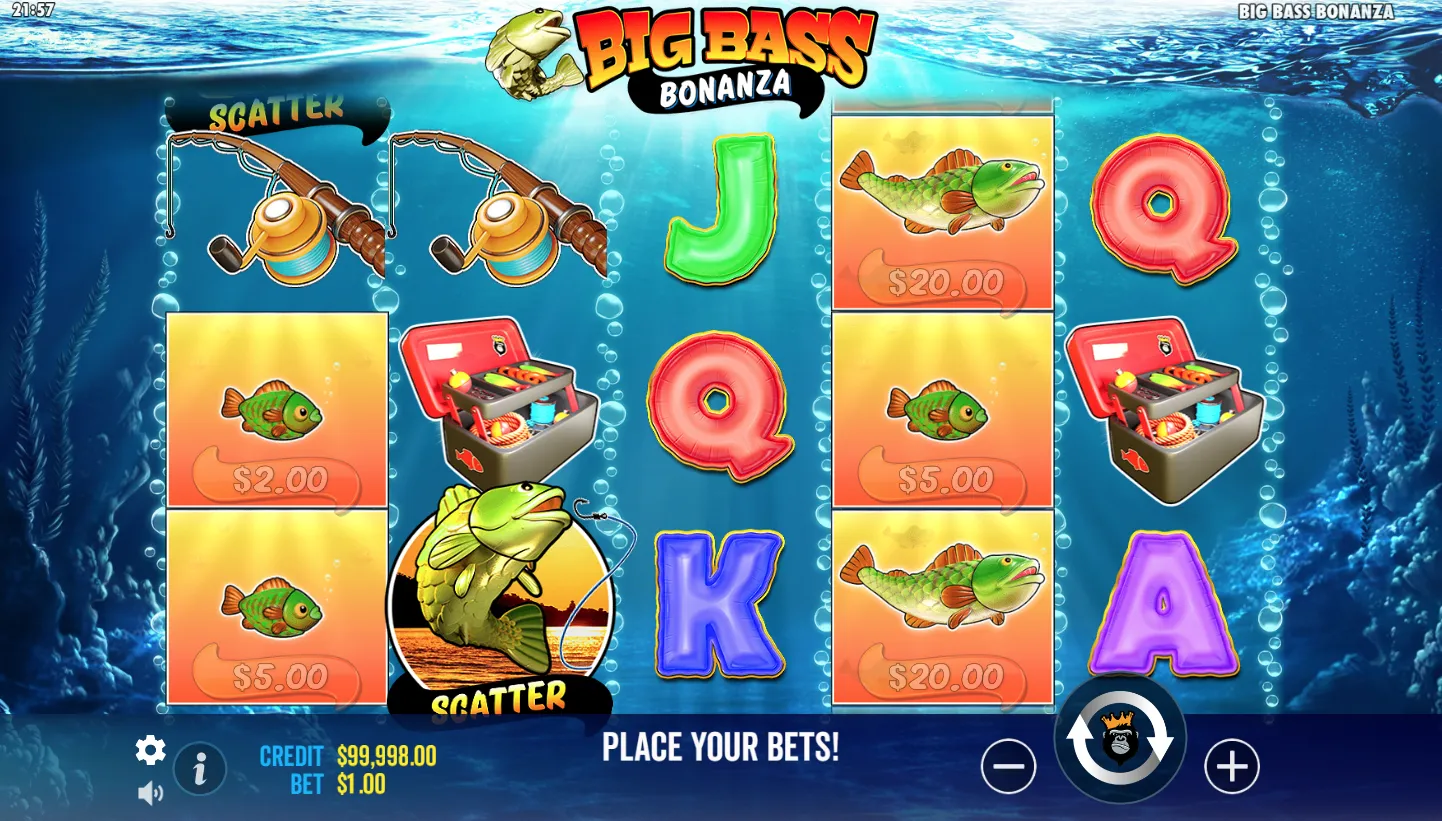
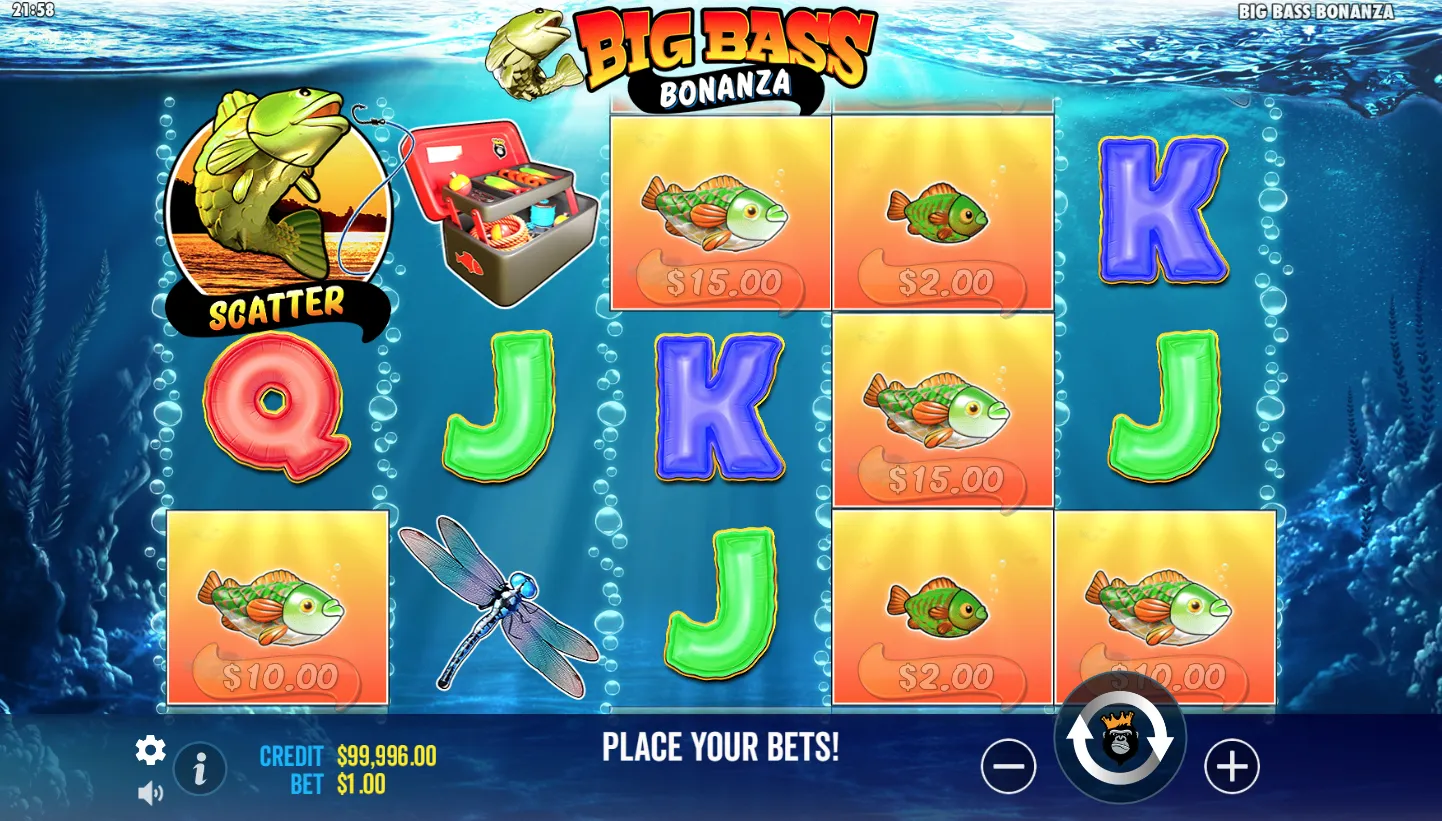
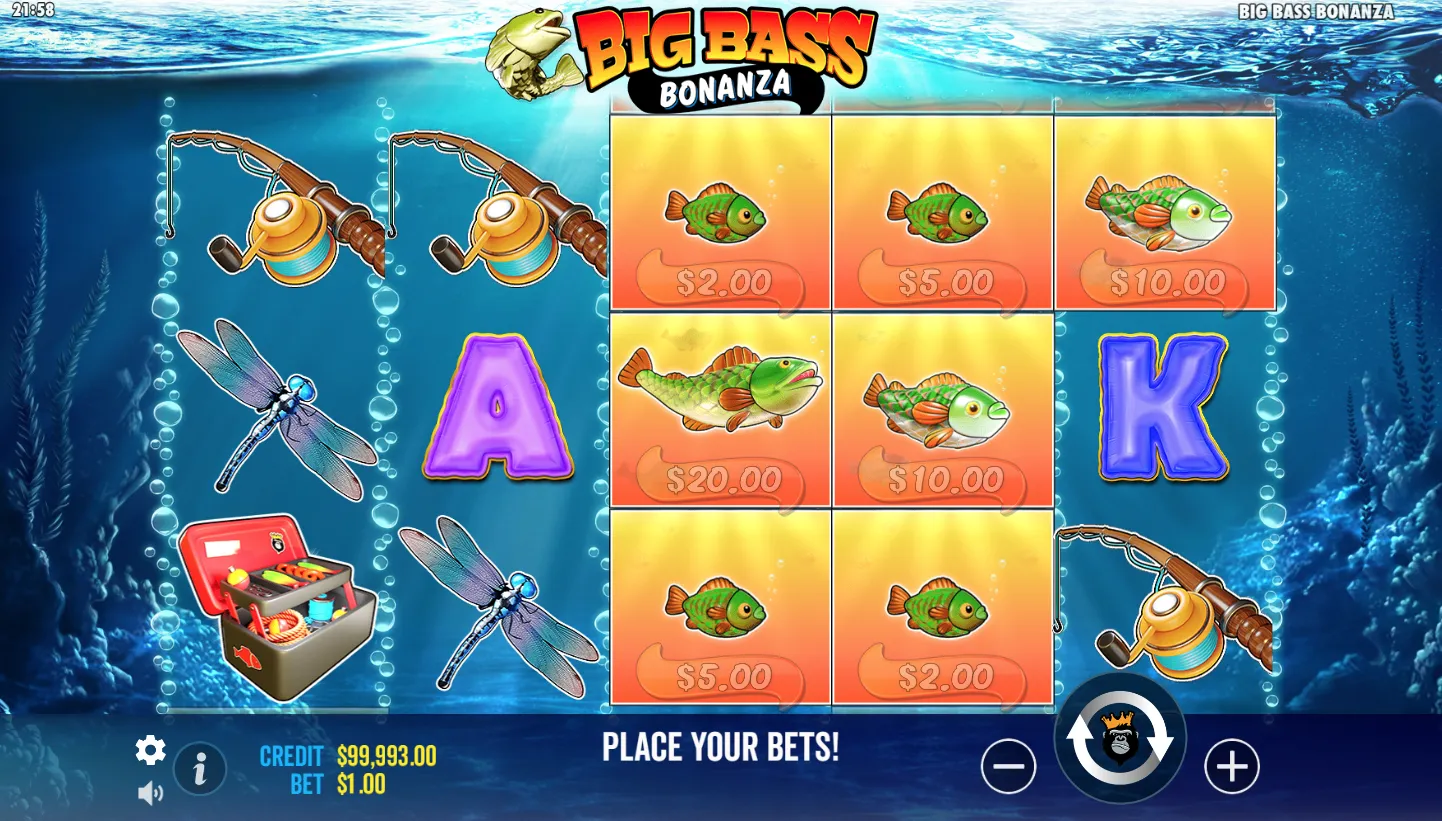
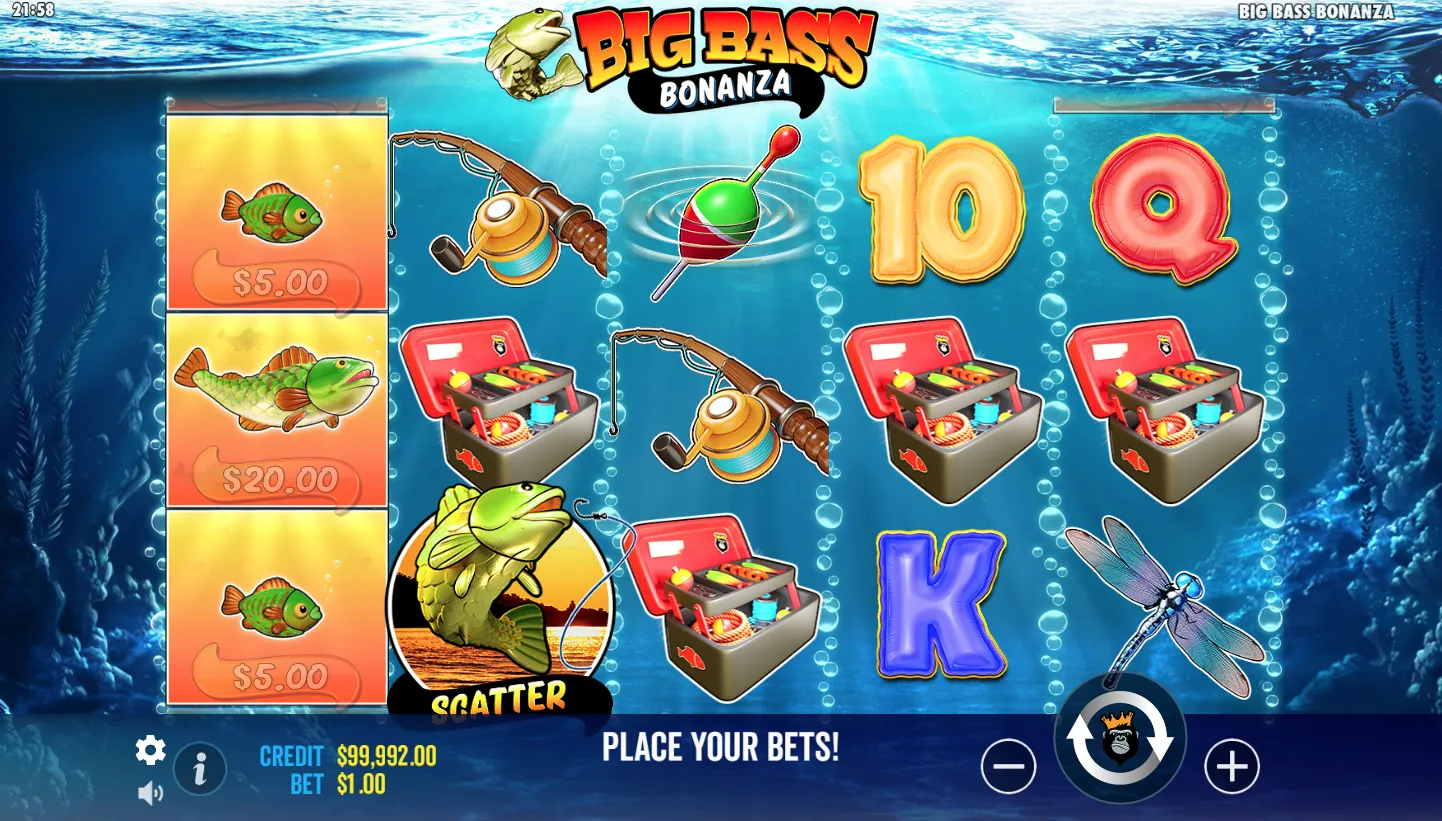
Fish are where the base game looks busiest and pays least. Every reel strip ends in a stack of five fish, so a screen full of them is the base game's signature outcome. It pays 20× on each of the ten lines, 200× the bet, while showing up to fifteen money values between 2× and 2000× that nothing can collect. On paper the paytable's arithmetic ceiling is ten lines of five floats, 2,000×, and that is the only place the lines approach the cap, because it needs every position on the screen to pay as a float.
None of this is an accident. The base game exists to deliver scatters, and the printed fish values give the wait a point by showing what the round could collect. Between triggers, though, the table has nothing to offer beyond card pays, and no side feature interrupts it.
Twelve wilds decide the round
Once the round opens, the scatter is gone from the reel strips and the fisherman is the only symbol that collects money or extends play. Each one takes every money value on screen at the current multiplier, and two on the same spin collect the screen twice. Every fourth wild adds ten spins and a rung: 2× at four wilds, 3× at eight, 10× at twelve. Line wins inside the round are untouched by any of it, because the multiplier applies to collection only.
That ladder's shape is the best decision in the game. Its first two steps add one to the multiplier each. From 3× to 10× the third step more than triples it, so the top rung alone pays more per fish than the three below it combined, since 10 exceeds 1 + 2 + 3. A 50× fish is worth 50×, 100×, 150× and then 500× as the count climbs. I find that legible: the wild count tells at every moment what the rest of the round can become, and a round that reaches twelve pays ten times as much per fish as one that never retriggers.
Spin counts follow the same arithmetic. Three retriggers add thirty spins to whatever the scatters awarded, so the 50-spin maximum belongs to a five-scatter start. A three-scatter round tops out at 40 and a four-scatter round at 45. Extra starting spins do not move the ladder; they only give the wilds more spins in which to arrive. The dynamite top-up can rescue the weakest spin in the round, a lone wild on a screen with no fish, by dropping fish in at random for that wild to collect. Because it needs exactly one wild, it never adds to a spin that is already collecting twice.
The ceiling was sized for the bottom rung
The largest fish value is 2000× and the ceiling is 2,100×. At 1×, a 2000× fish fits under the cap with 100× to spare. On every rung above it, the same fish is cut down:
| Rung | 2000× fish collected | Share the cap can pay |
|---|
| 1× | 2,000× | all of it |
| 2× | 4,000× | 52.5% at most |
| 3× | 6,000× | 35% at most |
| 10× | 20,000× | 10.5% at most |
Rare top fish are not the whole problem. At 10×, a single fisherman collecting 210× of face value ends the round, and 210× is four 50× fish and one 10× fish. Two wilds on one spin need only 105× between them. Whatever spins remain are forfeited at that point. The rung that takes twelve wilds to earn, and that the entire ladder is shaped to deliver, has room for one strong screen before the game shuts it, less whatever the round had already banked.
The cap is almost invisible in the return. The 2,100× outcome arrives about once in 3,880,481 spins, and 2,100 divided by 3,880,481 is about 0.054% of stake. Of the 96.71% default return, the ceiling round supplies roughly a twentieth of a percentage point. Everything else comes from rounds that never touch it, so the cap does almost nothing to the maths of an ordinary round and a great deal to the best one.
For counters, not ceiling-chasers
This game suits a player who wants a bonus round readable at a glance and accepts that its best version pays 2,100× the bet. The wild count gives every free spin a stake in the next one, and the money fish give the base game's waiting a point.
Anyone who needs the base game to hold interest on its own should look elsewhere, since eight of ten symbols pay 2× or less for three and nothing interrupts the lines. Ceiling-chasers should pass too: a single 2000× fish at the 2× rung already produces more than the cap can pay. Big Bass Splash is a later entry in the series with a bonus buy and another multiplier level; this one offers the scatter and nothing else.
Of every setting in this game, the return matters most. The default 96.71% leaves a house edge of 3.29%. At 95.67% it is 4.33%, and at 94.02% it is 5.98%, about 1.8 times the default. That 2.69-point gap is roughly fifty times the entire contribution of the 2,100× round. On a game that pays almost entirely through one feature, the rules screen is the first thing I would check.