Outside Rise to Salvation, nothing here is worth multiplying
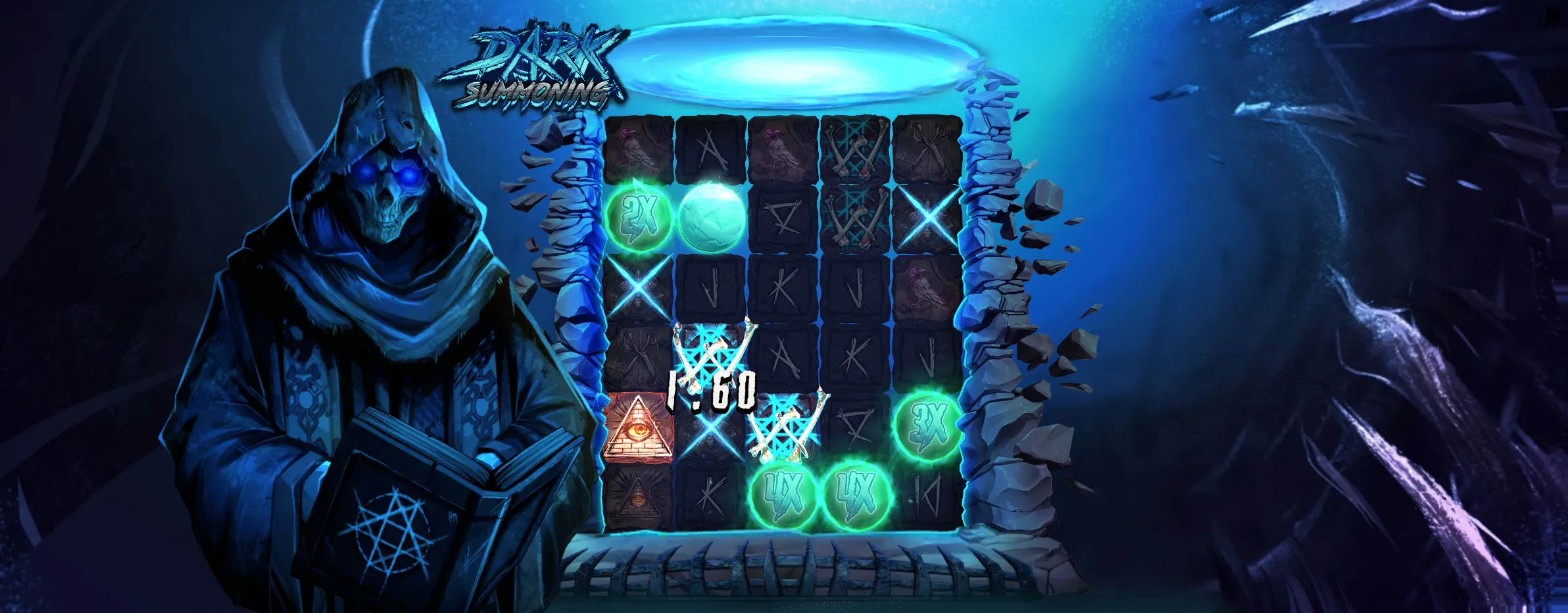
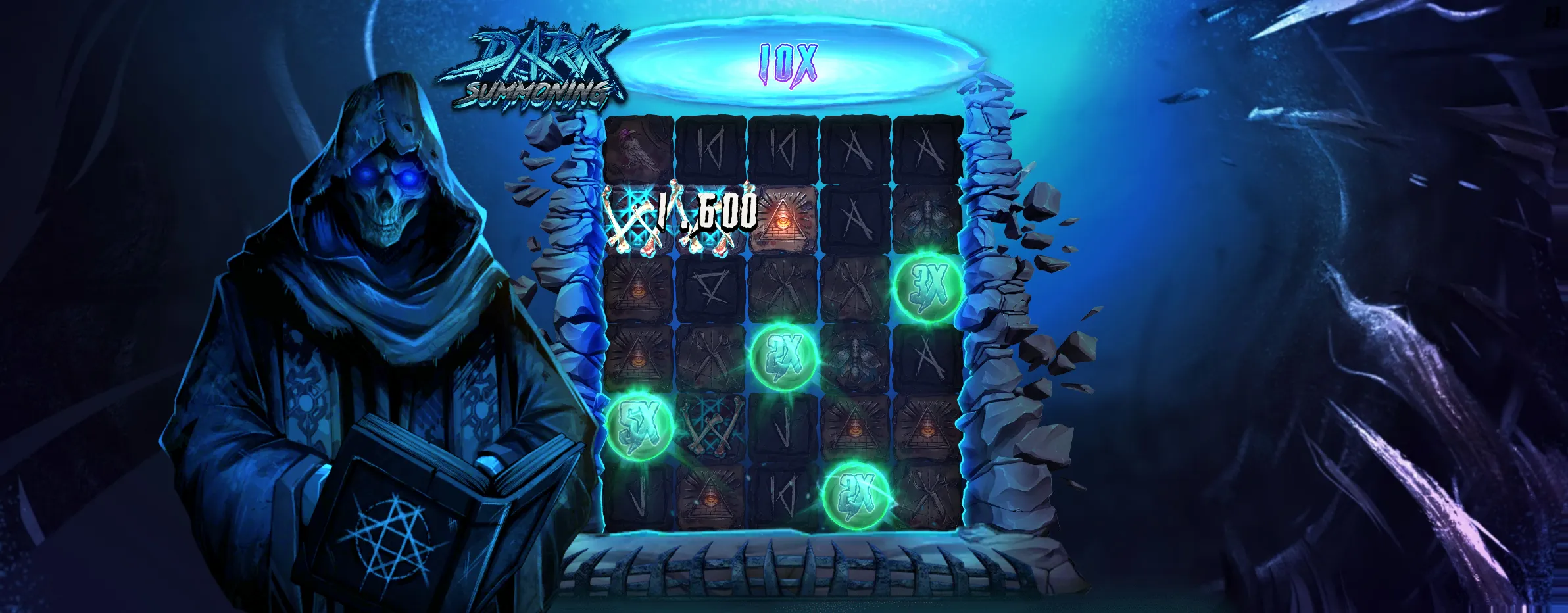
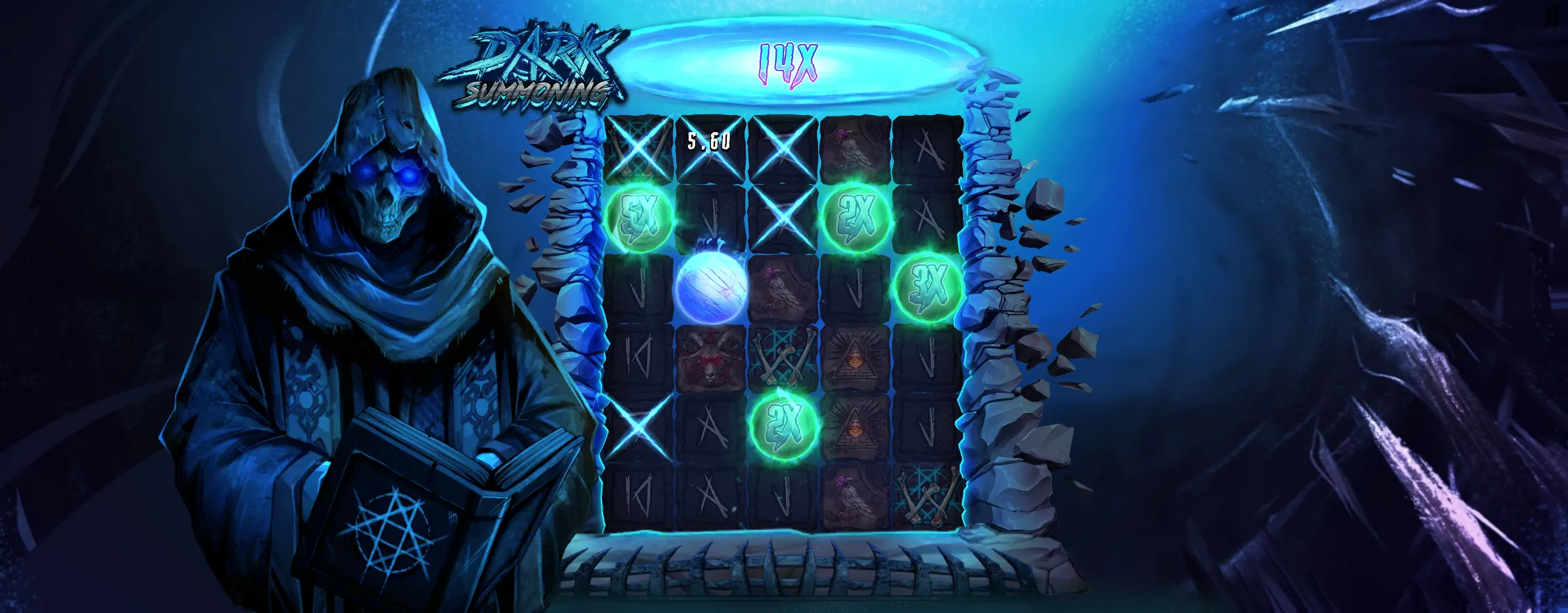
Dark Summoning puts wild multipliers of 2× to 100× on top of a paytable whose best regular line pays 10× and whose five-wild line pays 30×, and it adds those multipliers together instead of compounding them. I read that combination as the whole game. In the base game and in Trial by Hellfire the only road toward the 10,666× cap is more wilds on more lines, because nothing a multiplier sits on is large. Rise to Salvation is the one round built the other way: it strips the multipliers off the wilds and applies a global meter to cash prizes of up to 666×. That round is why the game is good, and the fact that the grid rather than the player decides whether it opens is a large part of why it stops at 7.2.
The arithmetic I run on the paytable is short. A grid with the goat sigil on all 30 positions pays 240× across the 24 lines. The same grid made entirely of wilds without multipliers pays 720×, under 7% of the cap on a single cascade step, so an unmultiplied chain would need fifteen of those full grids in one round to get there. No line of regular symbols reaches the cap alone either: a goat sigil with four 100× wilds adds up to 400× on a 10× pay, which is 4,000×, or 37.5% of the cap. Only a line of five wilds can cap the round by itself, and I make the requirement at least 356× between them. Two 100× wilds and three 50× wilds add to 350× and pay 10,500×, still 166 short.
Hacksaw assembled this from its own parts
Dork Unit shares the fixed lines, the wild multipliers that add, the rule that pays only the highest win on each line, and the practice of keeping each bonus round's trigger symbol out of the other round. Cursed Seas shares the wild that pays only for five of a kind and a trigger whose make-up decides which of two bonus rounds opens. Supreme Zeus runs the same Super Cascade on 1,024 ways. I read Dark Summoning as those three ideas fitted to one 5×6 board, a refinement rather than an invention, and the Unholy collection and Rise to Salvation are what lift it above a remix.
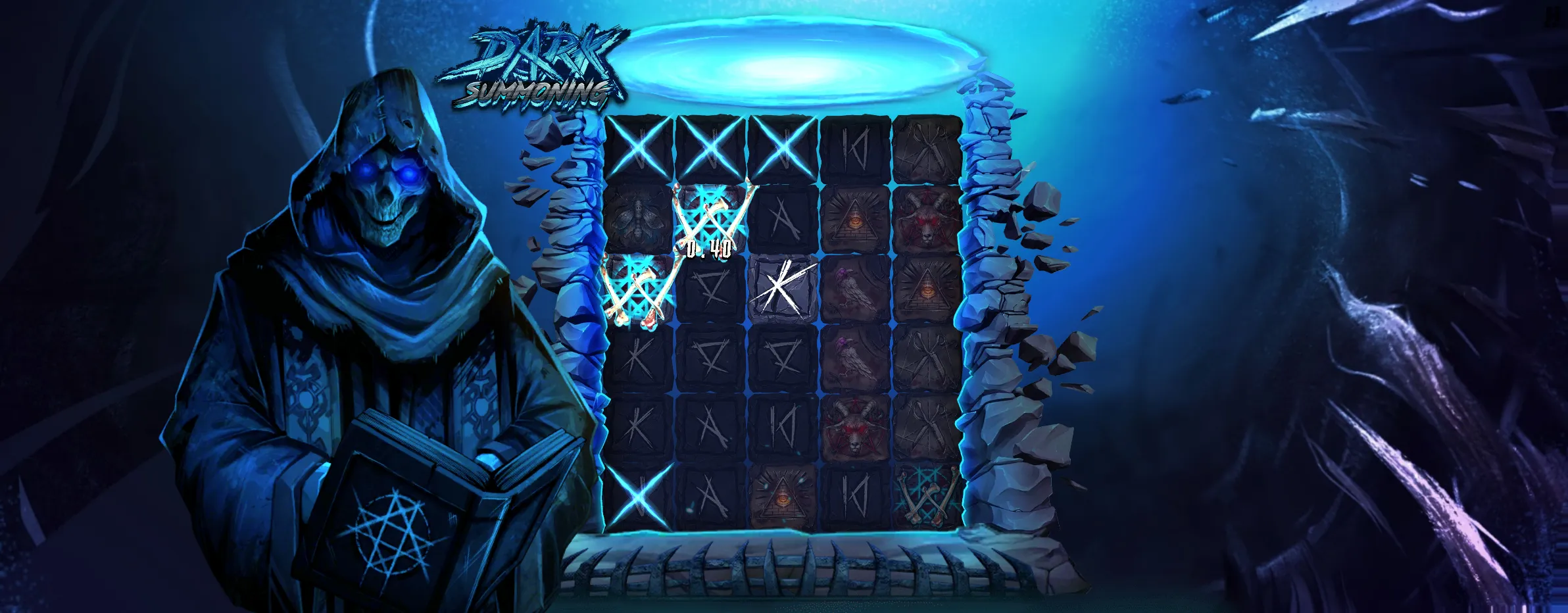
Moving the Super Cascade onto 24 lines changes what it does. A winning line pays for at most five positions, but the winning symbol can sit anywhere on the thirty, so one win can clear far more of the board than the line that paid. A three-rune line worth 0.2× clears every copy of that rune under the same rule that clears every goat sigil after a 10× line. I treat the low pays as the price of refills rather than a source of return, and read as a fuse rather than a prize table, the shallow paytable is doing its job.
Chains, not scatters, open the bonus
An Unholy scatter counts only when it lands alongside a win, unless three arrive together, and the collection empties when the round ends. On the 92.22% build a spin wins something about once every 3.4 spins, which leaves roughly seven base spins in ten with no win for a lone Unholy to land beside. Every cascade step is another drop in which an Unholy can arrive next to a new win, so the trigger rate climbs with chain length.
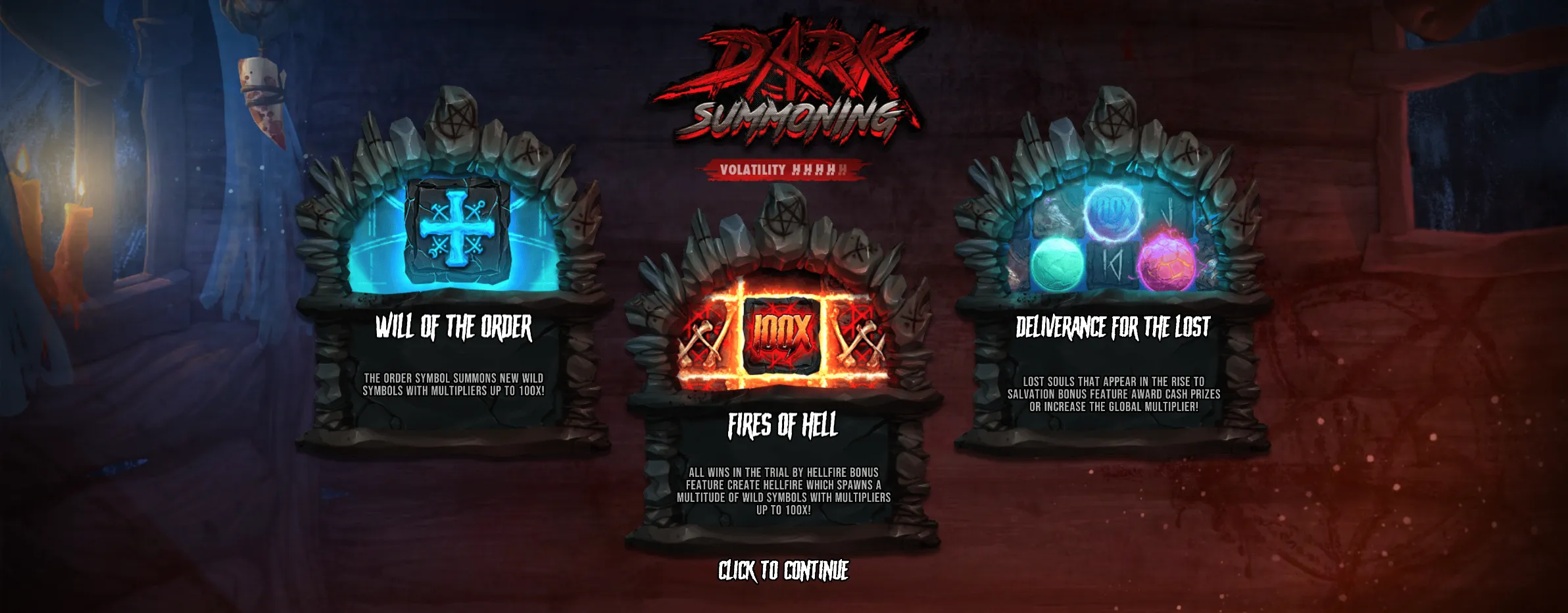
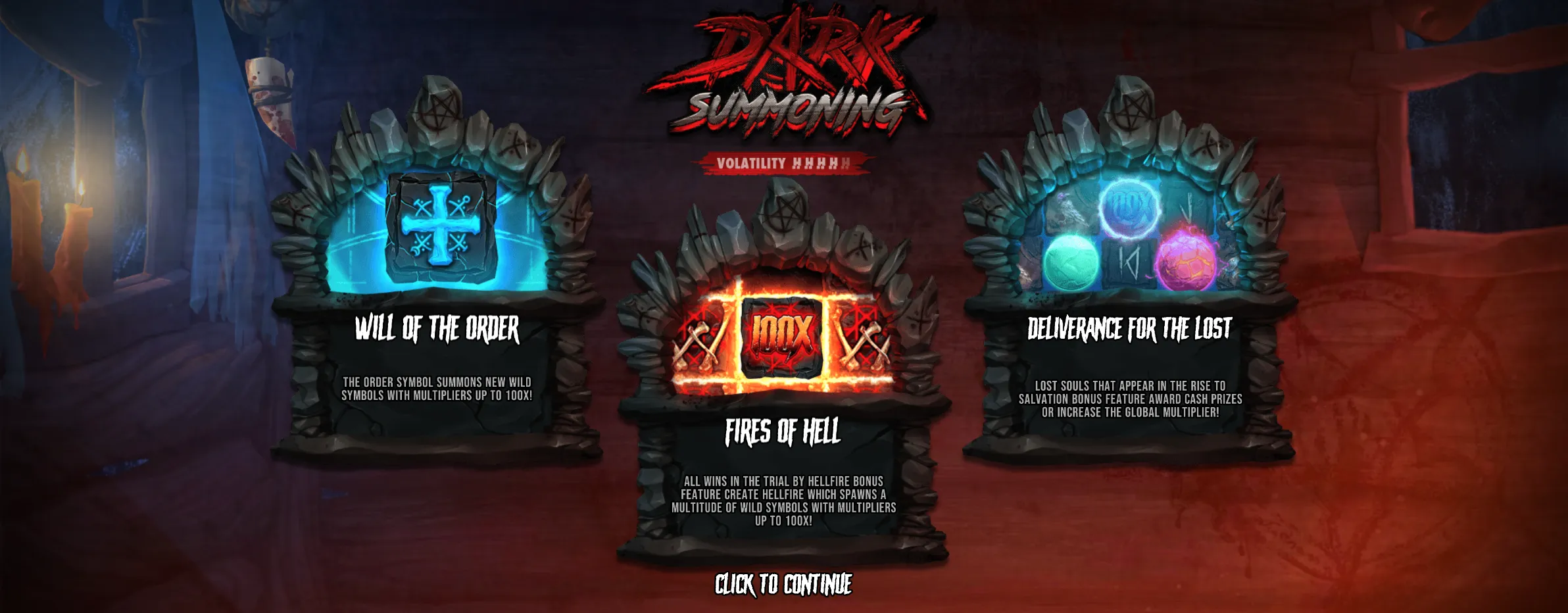
The same chains then hand the choice of bonus to the grid. An Order symbol present when the third Unholy is collected sends the round to Rise to Salvation, and its absence sends it to Trial by Hellfire. The player has no say short of buying Rise outright at 250×.
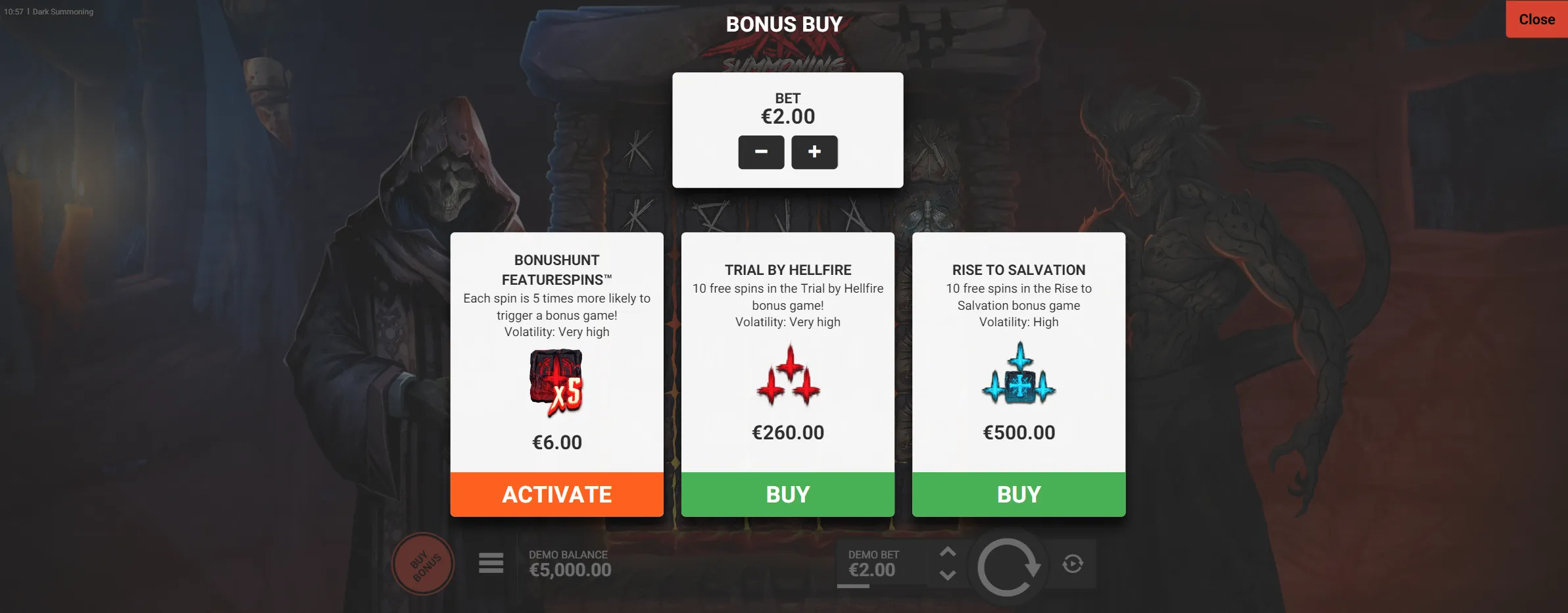
BonusHunt FeatureSpins is the efficient lever on the trigger. Each spin in the mode costs 3× the bet and is 5 times more likely to trigger a bonus, so a unit staked there buys 5/3, about 1.67 times, the bonus chances of a unit staked on normal spins, for 0.03 points of return on the top setting. I rate that a good trade. It does nothing about the routing, though, so it buys more bonuses without buying the better one.
Trial by Hellfire scales the problem and Rise to Salvation solves it
Trial by Hellfire is the base game's arithmetic with a bigger supply of wilds. Every winning position takes a Hellfire mark, and a landing Unholy turns itself and every marked position into a wild that can hold up to 100×. It reaches the cap through breadth, with many multiplied wilds across many lines at once. It is still adding multipliers onto pays of 30× or less, the Order symbol never appears to add wilds of its own, and an Unholy that lands before the cascades have marked much converts little.
Rise to Salvation changes the shape of the problem. Wilds hold no multipliers, cascades run upward, and Lost Souls climb until they reach the top row and Ascend, either adding a 2× to 100× step to the global multiplier or paying 10× to 666× the bet, multiplied by that global. The global touches every line win and every cash prize, so for the first time a multiplier sits on something large. By my arithmetic a 666× prize needs a global above 16× to cap the round on its own: 666 × 16 is 10,656, ten short, and under a 25× global the same prize is 16,650×. A 100× prize under a 100× global is 10,000×. Outside this round, a five-wild line needs 356× of stacked wild multipliers to do what one 666× Soul does here under a 17× global.
The cost of that design falls early in the round. Until a Global Multiplier Soul Ascends, every win pays face value off a paytable whose best regular line is 10×, and the stall breaker that removes 3 to 5 symbols after three non-winning spins in a row keeps the grid moving without paying anything itself. I still rank it the better of the two rounds by a distance, because it is the only place where the number under the multiplier is big enough to matter.
Each purchase is the best on one build and the worst on another
On the 96.36% setting the order is Rise to Salvation at 96.42%, Trial by Hellfire at 96.36% and FeatureSpins at 96.33%. On the 94.34% setting it becomes Trial by Hellfire at 94.34%, FeatureSpins at 94.32% and Rise to Salvation at 94.29%. On the 92.22% setting FeatureSpins leads at 92.45%, ahead of Rise to Salvation at 92.29% and Trial by Hellfire at 92.28%. Across those three settings I count each purchase first once and last once. The button still matters less than the build the casino loads: the widest gap between purchases on one setting is 0.17 points, and the gap between the top and bottom settings is 8.08.
On the top setting the two bonus buys are priced sensibly against each other. Trial by Hellfire costs 130×, so the cap is about 82 times its price. Rise to Salvation costs 250×, 1.92 times as much, with a cap of about 42.7 times its price, lower volatility and a return 0.06 points higher. I call that the right shape for a dearer buy: more money for a better rate and a tighter spread. The better rate still costs more per purchase, about 8.95× the bet on average against about 4.73× for Trial by Hellfire, because 3.58% of 250× is larger than 3.64% of 130×. At a €75 top stake, a Rise buy is €18,750, far above the table maximum.
The engine earns 7.2 and the paytable stops it there
The game suits someone who values long cascade chains and will pay 250× for Rise to Salvation on the 96.36% build, the one setting where the best round also has the best-priced buy. Anyone who wants line pays to carry weight, or wants to pick a bonus round without buying it, should look elsewhere, and below the top build the Rise buy loses its lead while the 88.28% build can run with no buy at all.
The Super Cascade is a real engine, the Unholy collection rewards it, and Rise to Salvation is a strong round with an honestly priced buy. I count that as one real strength, and the score goes no higher because everything outside that round adds multipliers onto pays of 30× or less, the grid chooses which bonus opens, and a casino can run the game 8.08 points below its best.