The new parts sit outside the round
Big Bass Splash is the series' collection loop with a draw bolted to its front. Inside the free spins round, the fisherman wild, the money fish he collects and the four-level ladder that multiplies them all behave as the loop always has. What this entry adds sits before the round, in a draw of zero to five modifiers, or in the base game, in two helpers whose only purpose is to finish a scatter trigger. My reading is that the game has one pay event that matters, a wild collecting a fish, and that its most consequential new machinery decides how well that event is set up before the first free spin turns. None of that is in the player's hands, and it is the ceiling on my score.
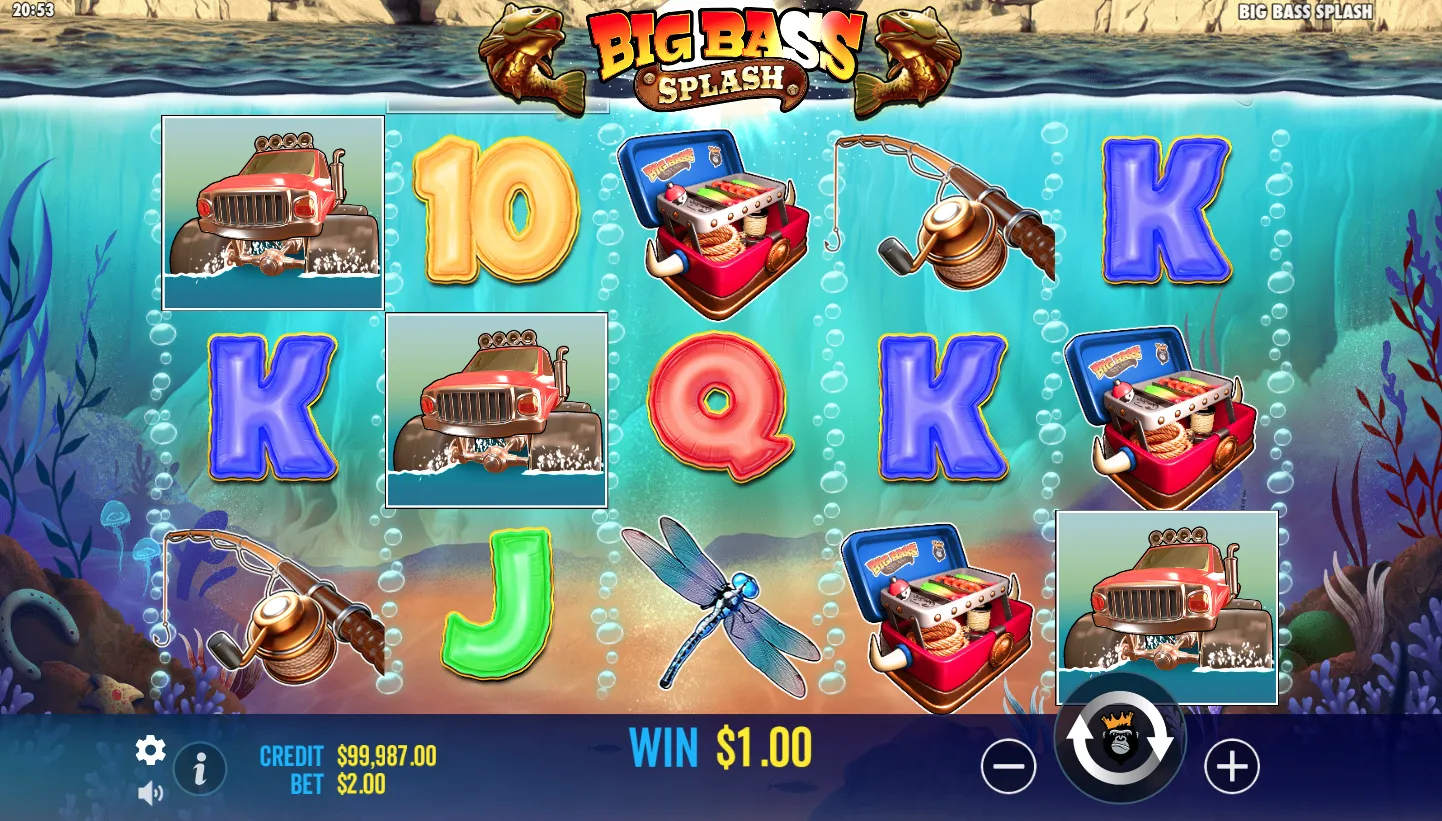
Big Bass Bonanza is the original ten-line version of this loop, and Bigger Bass Bonanza had already reused its money fish and collecting fisherman. The entry that actually reworked the collector is the later Big Bass Rock and Roll, which splits the fisherman into two meters advancing independently. Splash leaves the engine alone and refines its edges: a monster truck at the top of the paytable, the familiar equipment symbols under new art, a nudge and a hook for two-scatter spins, and a modifier draw ahead of the feature. Anyone who knows the original already knows how a round here works. The only question worth asking is whether the edges change what a round is worth.
The paytable cannot pay for this game
I count five of the ten line symbols returning 0.2× the total bet for three of a kind, and three of those five top out at 5× for a full line. The fish pays 20× for five while also holding a money value that nothing in the base game can collect. The monster truck is the only symbol that pays from two, at 0.5×, and its 200× for five is the per-line ceiling. Ten fixed lines of it, which takes a screen of fifteen trucks, come to 2,000×. That is two fifths of the 5,000× cap from the most extreme board the paytable allows, so no base-game spin can reach the ceiling, and the only single event in the game large enough to cover it is a collection.
The base game has no wild and no multiplier. The money values sitting on its fish are prizes that expire when the reels stop. Its two-scatter helpers, the respin that nudges scatter reels down and the hook that pulls a reel up to expose a third scatter, are random and never guaranteed, yet they are the only base-game mechanics pointed at anything worth having. I treat the base game as the price of admission to the feature rather than as part of the game's appeal, because on these line values that is what it is.
That makes the return setting matter more than usual. At the default 96.71%, the game keeps 3.29 of every 100 staked. The reduced 95.67% setting keeps 4.33, and the 94.60% setting keeps 5.40, close to two thirds more than the default. On a game that pays through one feature, that gap separates a slow bleed from a fast one, and the rules screen shows which setting is running.
The fish values are the cap divided by the ladder
The thirteen money values run from 2× to 5,000×, and the top four are not arbitrary. Each is the cap divided by one collection level:
- 5,000× collected at level one's 1× is the cap.
- 2,500× collected at level two's 2× is the cap.
- 1,666× collected at level three's 3× is 4,998×, the cap divided by three and rounded down.
- 500× collected at level four's 10× is the cap.
The value table was built backwards from the ceiling, so at every rung of the ladder there is a fish that ends the round in one collection. The same arithmetic shows what the cap takes away. Because it stops the round at a 5,000× total and forfeits the remaining spins, the ladder's upside is flattened exactly where it grows. At 2× the top value already overshoots. At 3× the top two do. At 10× every value from 500× upward pays the identical capped amount, so 1,666×, 2,500× and 5,000× stop meaning anything at the one level where the multiplier is largest.
That largest step is the ladder's real prize. Level four's 10× is more than levels one to three combined, and more than triple the 3× below it. What it transforms is the middle and bottom of the value table: a 50× fish becomes 500×, a 100× fish becomes 1,000×, and the humblest 2× fish becomes 20×, the same as five fish on a line. A round lives or dies on reaching that band with spins left, which takes twelve collected wilds.
The cap is a smaller part of the maths than its prominence suggests. A 5,000× result once in 3,086,876 spins is worth about 0.16% of everything staked, roughly a sixth of one point of the 96.71% return. Nearly all of the return comes from rounds that finish below the ceiling, which is why the conditions a round starts under matter more than the headline number.
The draw decides more than the trigger does
Those conditions are drawn, not chosen. Two of the five modifiers change the ladder in ways I can count.
START FROM LEVEL 2 cuts the wilds needed for 10× from twelve to eight, a third fewer. A retrigger and a level-up are the same event, so the modifier also removes one of the three retriggers: a round that opens with 20 spins tops out at 40 instead of 50. It trades ten spins for a shorter road to the only multiplier that transforms mid-range fish, and I count that trade as favourable, since each wild collected before the top level pays one rung higher than it otherwise would. EXTRA FREE SPINS adds two at the start and two per retrigger, eight at most, so a 20-spin opening with three retriggers runs to 58 instead of 50.
The other three, MORE FISH, MORE FISHERMEN and MORE HOOKS AND EXPLOSIONS, raise the density of fish, of wilds and of the dynamite, hook and bazooka events that patch a spin showing fishermen without fish or fish without a fisherman. The trigger sets 10, 15 or 20 spins and the draw adds anything from no modifiers to all five, so a round opens with anywhere from 10 to 22 spins before a single wild lands, and only twelve collected wilds under EXTRA FREE SPINS carry a 20-spin opening as far as 58. The draw is the most interesting thing in the game, and I object to where it sits: it is variety handed down before the round, not a choice made inside it.
The buy is fair because the price ignores the draw
Buy Free Spins costs 100× the total bet and returns 96.71% in the default setting, the same as ordinary play. On average a buy hands back 96.71× and keeps 3.29×, the identical edge a spin charges, so there is no premium for skipping the base game. Its best case is the 5,000× cap, fifty times its own price. At the 250 top stake that is 25,000 per buy against a 1,250,000 ceiling.
The flat price is the honest part and the limiting part. A bought round that opens on 10 spins with nothing drawn costs exactly what a 20-spin round with START FROM LEVEL 2 and EXTRA FREE SPINS costs, so the 100× is fair only as a blend of good and bad draws. Nothing lets a player pay more for a better-set round or less for a worse one. Even so, for high stakes I rate the buy the best-designed element here: it turns the base game's thin line pays into a fixed entry fee with no markup, paid straight into the only part of the game that pays.
A good round, not a new one
This game suits players who already like the Big Bass collection loop, accept the pre-round draw as its source of variety, and buy features, since the buy costs nothing extra in return. Players who want the base game to hold up its end should look elsewhere, because on these line values it cannot. So should anyone at a casino running the 94.60% setting, and anyone who wants the collector itself to change, which is what the two meters of Big Bass Rock and Roll offer. Splash is a competent, well-priced repetition of a proven round, and its best-set rounds are decided by a draw rather than earned inside one.