A fourth row on a borrowed loop
Most of what Bigger Bass Bonanza can pay is decided in ten spins at the 10x level, and the game makes those ten spins hard to reach and then caps them early. Twelve fisherman wilds have to be collected before that level opens, it lasts one batch of 10 spins, and the 4,000x cap sits where eight 50x fish collected at 10x already meet it. In front of all this is a base game with no wild at all. I read it as one good idea, borrowed, wrapped in limits that stop the idea from paying in full.
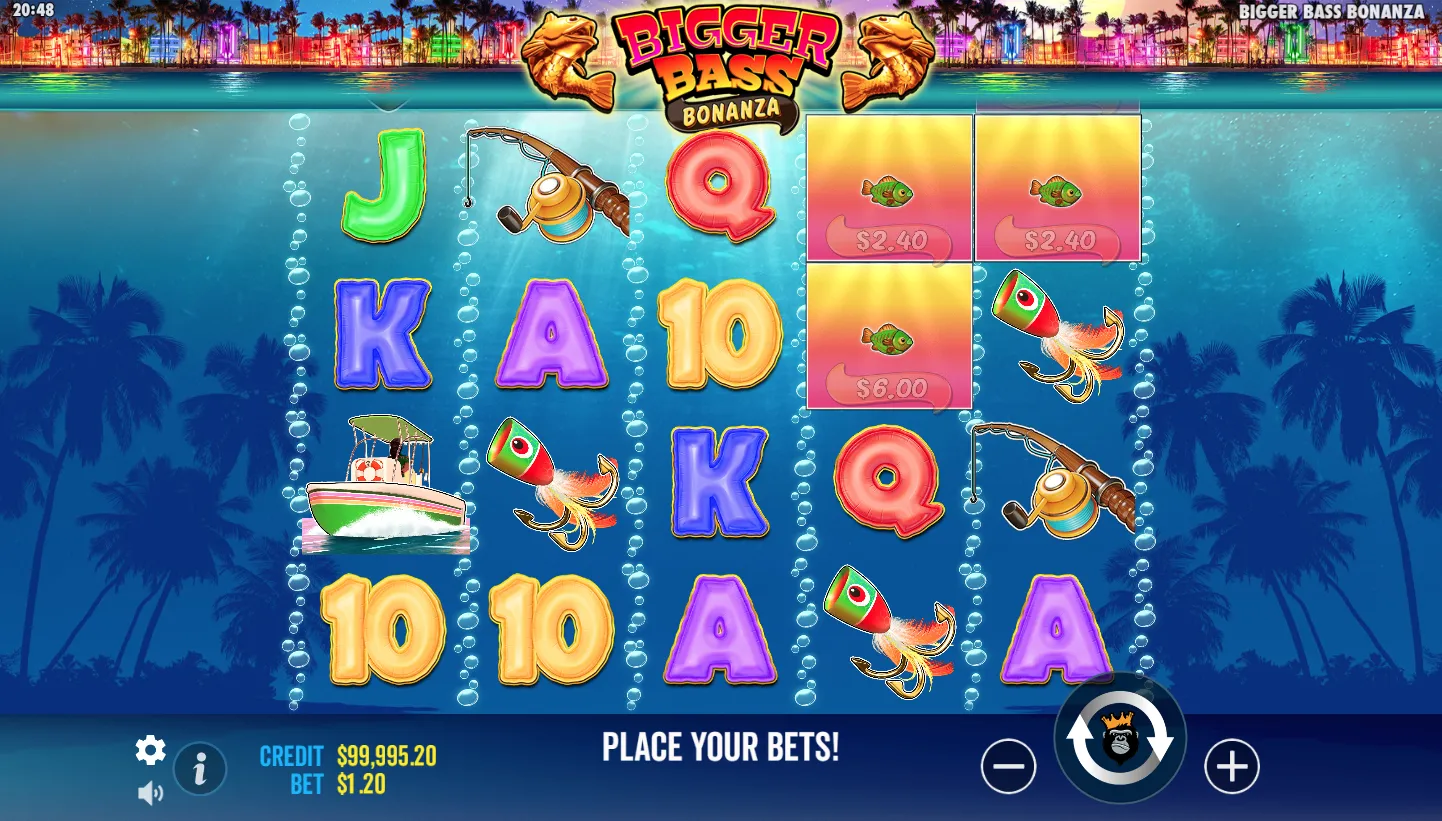
The idea is the one Big Bass Bonanza runs: a fisherman wild collects the money values of fish during free spins, and a meter of collected wilds adds spins and raises the multiplier. Bigger Bass Blizzard - Christmas Catch and Big Bass - Keeping it Reel use the same collect, the second with collected wilds unlocking its retriggers. This game is one entry in a crowded family, and the change I can point to is the board: five reels and four rows with 12 fixed lines. The extra row gives each free spin more positions for fish and for the wild that collects them. Value, though, is decided by three rules the board does not touch here: the ladder, the delayed multiplier and the cap.
The base game is a waiting room
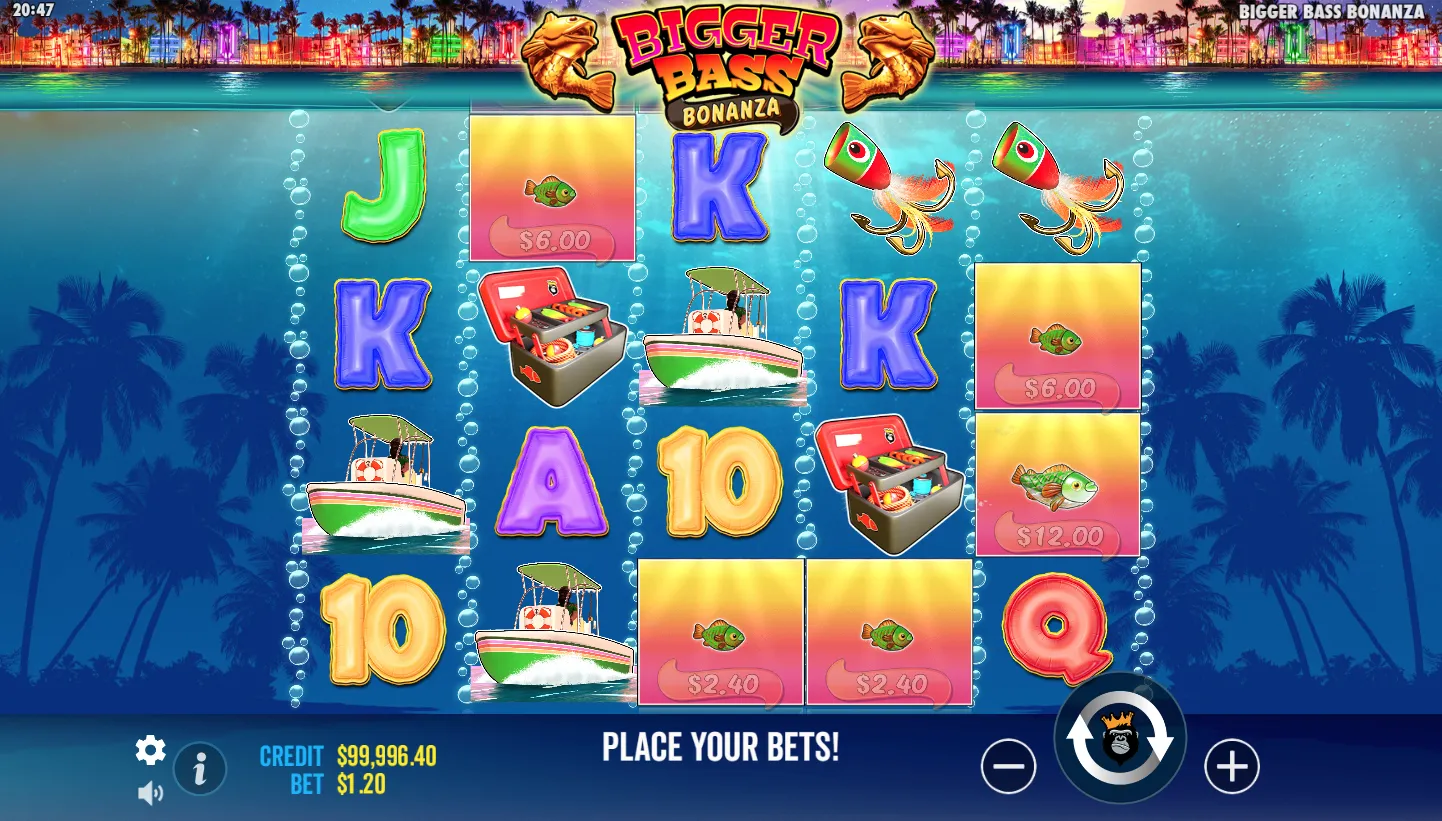
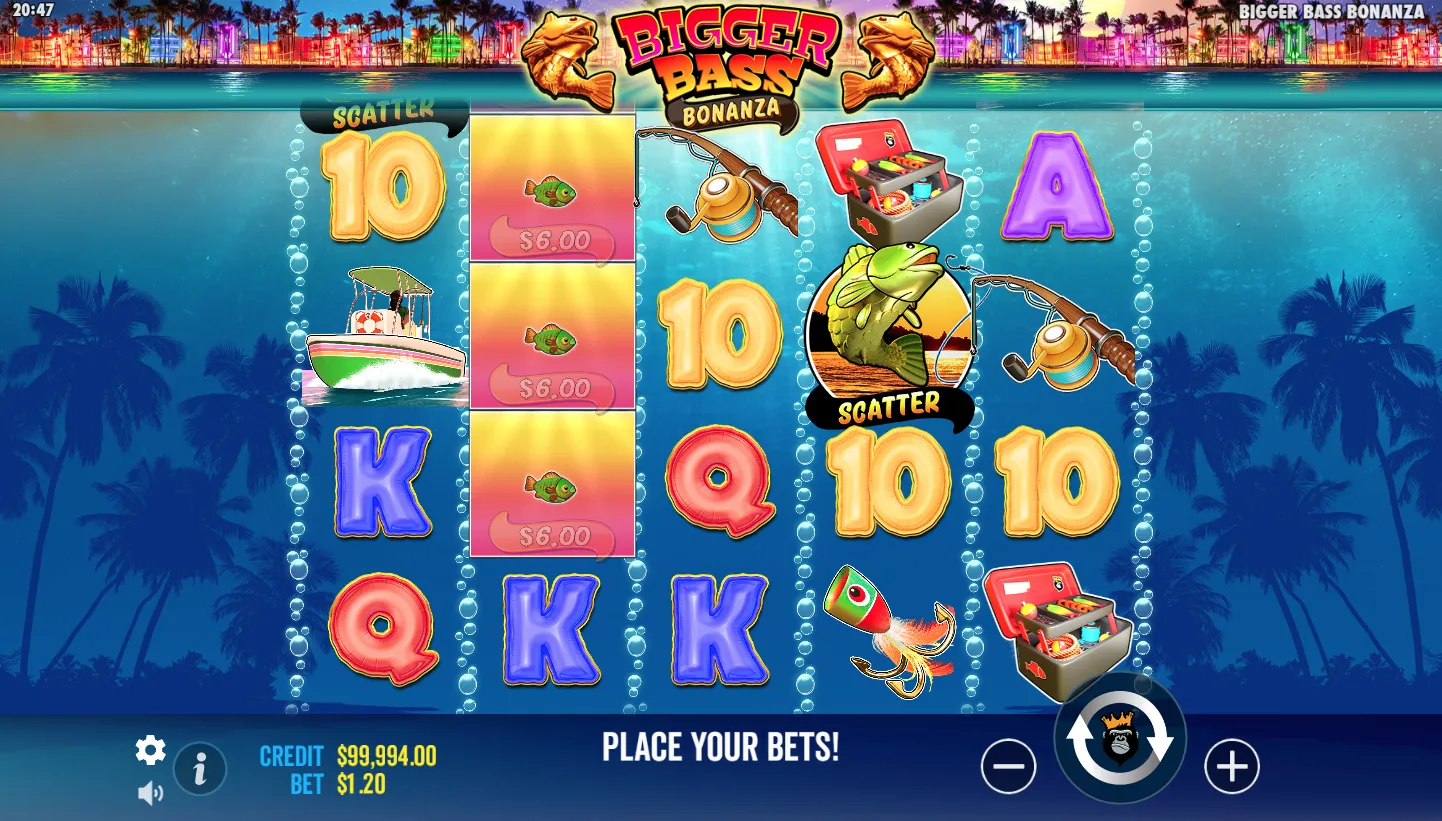
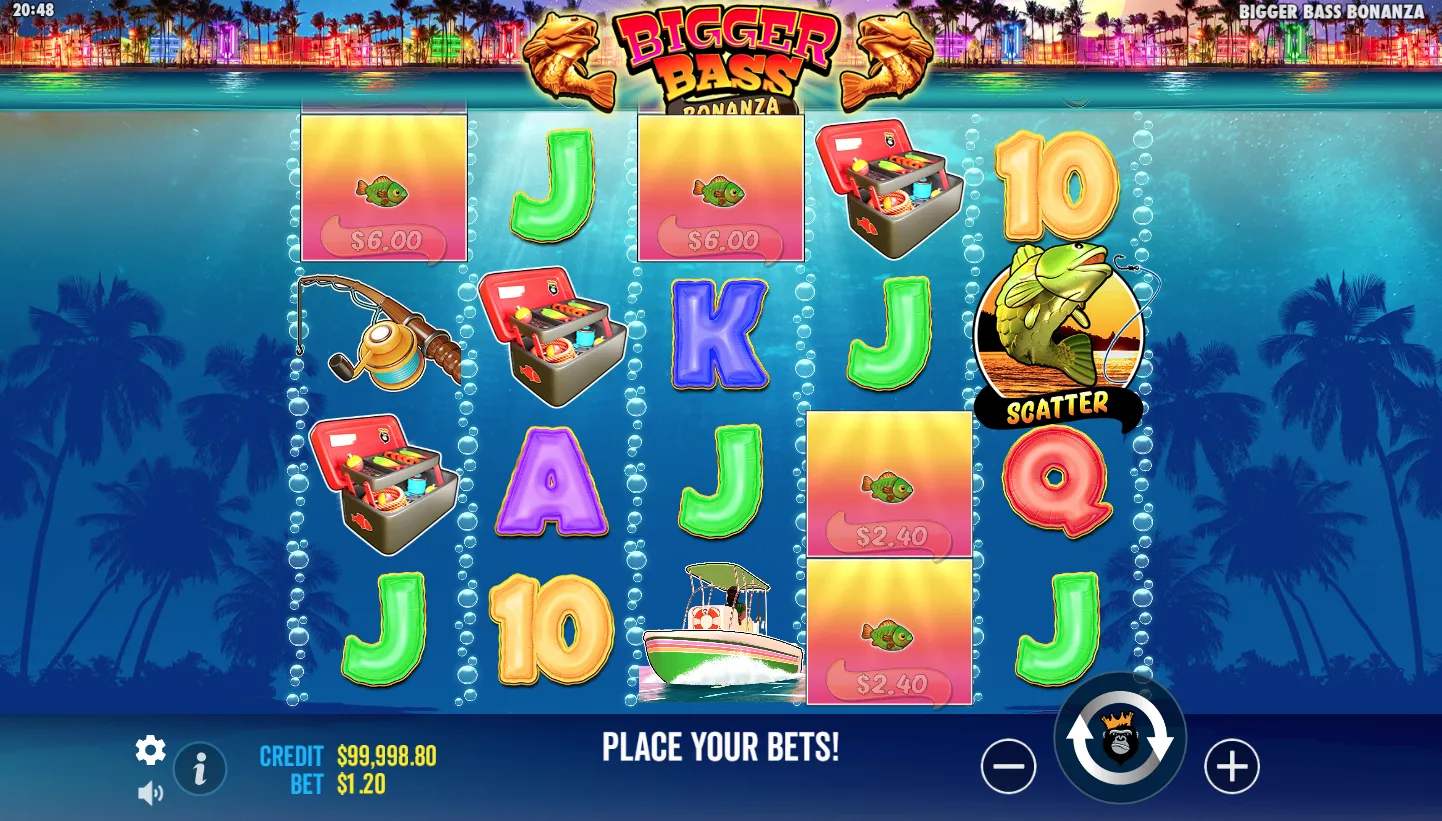
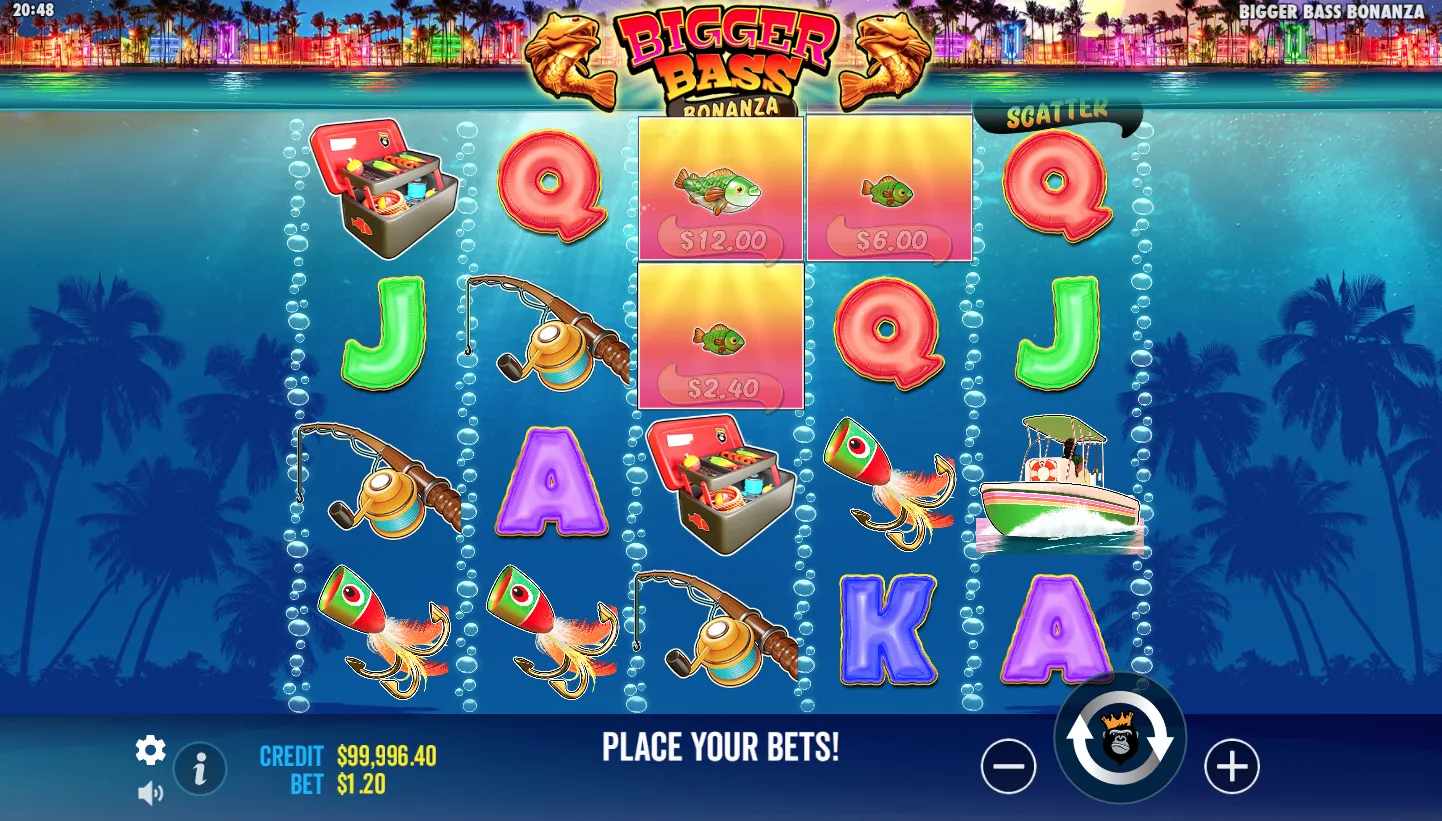
The fisherman wild never lands outside Free Spins, so a base spin pays plain line wins and nothing else. I count five of the nine regular symbols paying half the total bet for three of a kind, and the boat pays the same half for two. The best regular line is 200x for five boats, 5% of the cap. A board paying five boats on all 12 lines would total 2,400x, which is 60% of the cap, so the regular symbols cannot reach it on their own.
Fish are the exception. Three and four of them pay a flat 1x and 5x, but five on a line pay the sum of their money values: at least 10x, 250x if all five are 50x fish, and the full cap if one of them is the 4,000x fish. That last case matters, because it means the cap is not reserved for the bonus round. Away from that five-fish line, the values drawn on every base spin are decoration, since nothing in the base game collects them.
There is no feature buy, so three scatters are the only way in, at 1 in 121.84 spins. That averages about 122 stakes of turnover between rounds, spent on a board whose regular symbols top out at 200x per line. The base game is thin, and the wait is the price of the round.
Only the last step of the meter is worth climbing
Collected fish pay at face value until the meter's first level, then at 2x from four wilds, 3x from eight and 10x from twelve, each starting with the spins that level adds. The first two steps each add one to the multiplier; the third adds seven. A 50x fish collects for 50x, 100x, 150x and then 500x. Set against the 121.84-spin average wait, that fish at 3x pays about 1.2 times the turnover spent reaching the round, and at 10x about four times. Below the top level the ladder is worth little.
Reaching the top level is the hard part. From three scatters the round starts with 10 spins, and 12 wilds have to arrive within the first 30: four by the end of the opening batch, eight by the end of the next, twelve by the end of the one after. That is four wilds per ten spins, sustained across three batches. A round that falls short in its first 10 spins ends there, with every fish paid at face value.
The delayed multiplier then trims the reward. A level starts only with its extra spins, so the twelfth wild, and any wild after it in the same batch, still collects at 3x. The 10x level covers exactly the 10 spins it adds, and no retrigger follows it. That is a quarter of the 40-spin maximum from three scatters and a fifth of the 50-spin maximum from five.
Extra scatters help more quietly than they look. Five of them double the start to 20 spins but leave the 10x batch at 10; what they buy is room, since the 12 wilds now have 40 spins to arrive in, three per ten. I rate that as the most useful thing a scatter does in this game. The fourth row matters most in the same place: every fish the larger board fits into a 10x spin collects at ten times its face value. The lone-wild fish drop fixes a smaller weakness, a wild with nothing to collect, but it adds fish for one spin and leaves the meter arithmetic alone.
The cap arrives just as the top level starts to pay
The cap is 4,000x, and so is the largest fish value. Collected at any level, that fish ends the round at the cap: at 10x it would be worth 40,000x, and it pays the same 4,000x it pays at face value. The ladder adds nothing to the single biggest value in the game.
Among the other fish, the cap is close to unreachable below the top level. It takes 80 fish of 50x at face value, 40 at 2x and 27 at 3x. At 10x it takes eight. The cap therefore binds almost only inside the one batch the whole round builds towards, and when it binds, the round ends on the spot and forfeits the spins left. The strongest rounds are exactly the ones it shortens.
Its chance is 1 in 981,884 spins against a trigger of 1 in 121.84, so the cap turns up roughly 8,000 times less often than the round itself. A ceiling that is both remote and low is the weakest part of the design.
Below 96.71% the same loop costs noticeably more
Casinos can run the game at 96.71%, 95.67% or 94.62%, and the rules screen shows which setting applies. The house edge moves from 3.29% to 4.33% to 5.38%, so the UK setting takes about 1.6 times as much per unit staked as the standard one. My rating assumes the standard setting; on a game this dependent on one 10-spin batch, the lower ones make a thin base game thinner.
The game suits a player who wants a single feature with rules short enough to hold in the head: every fourth wild, one level, ten more spins. It does not suit anyone who wants a wild or real pay in the base game, a buy that skips the wait, or a ceiling that lets a strong top level run. That is where 6.4 comes from. The loop is clear and borrowed, the fourth row suits it, and a wildless base game, small line pays and a cap that one fish can reach hold it in the competent band.