Round length is the whole game
The Hand of Midas keeps nearly all of its value in the back half of a long free spins round. What a spin pays there depends on how many wilds have already stuck, so the number of spins left once the board fills decides the outcome. I read the rest of the design as following from that. The base game is too thin to matter, the buy ladder charges for round length at a fair rate, and the 5,000x cap lands on exactly the long, loaded rounds the structure exists to produce. That last point is why I stop at 6.8.
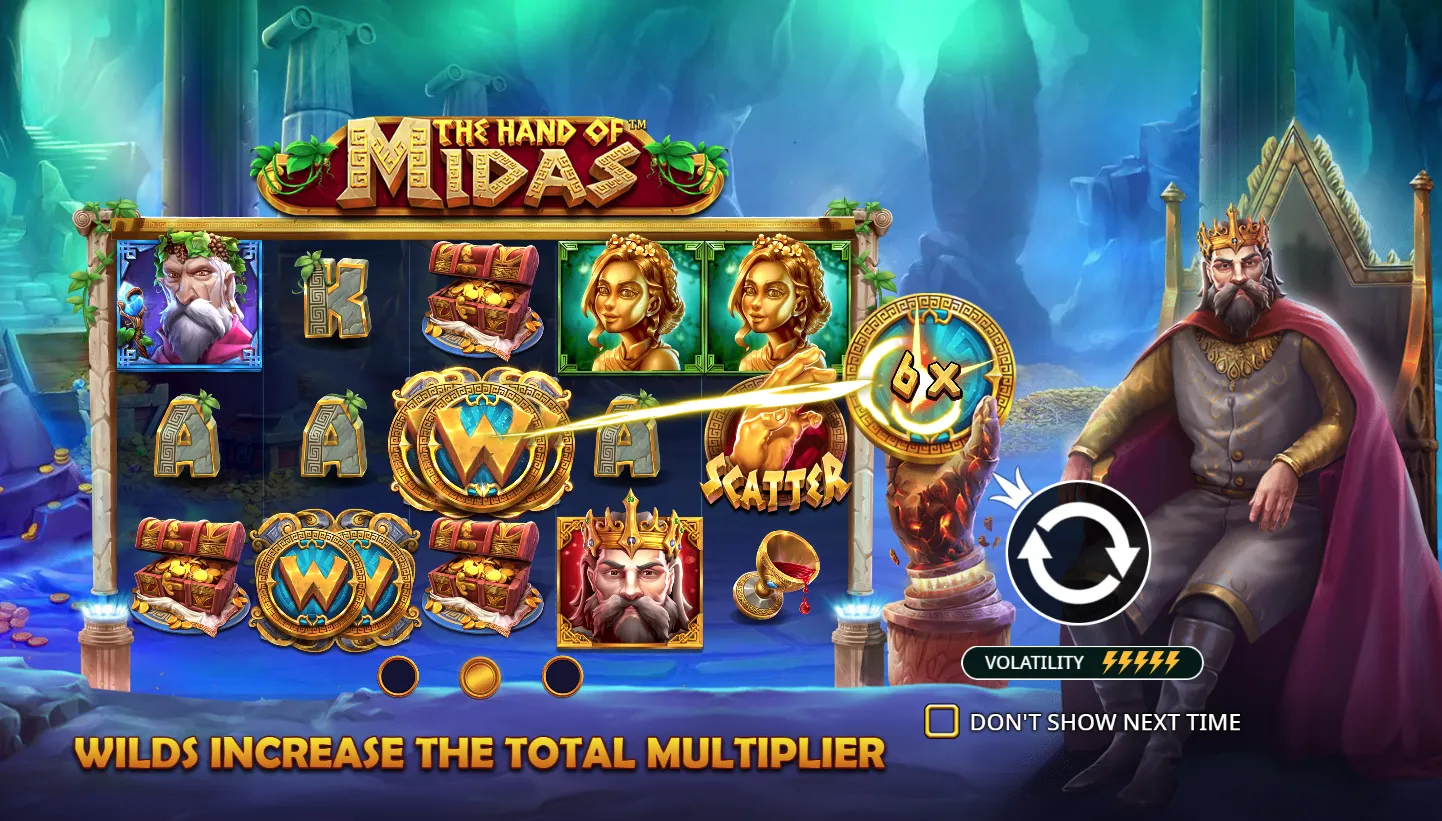
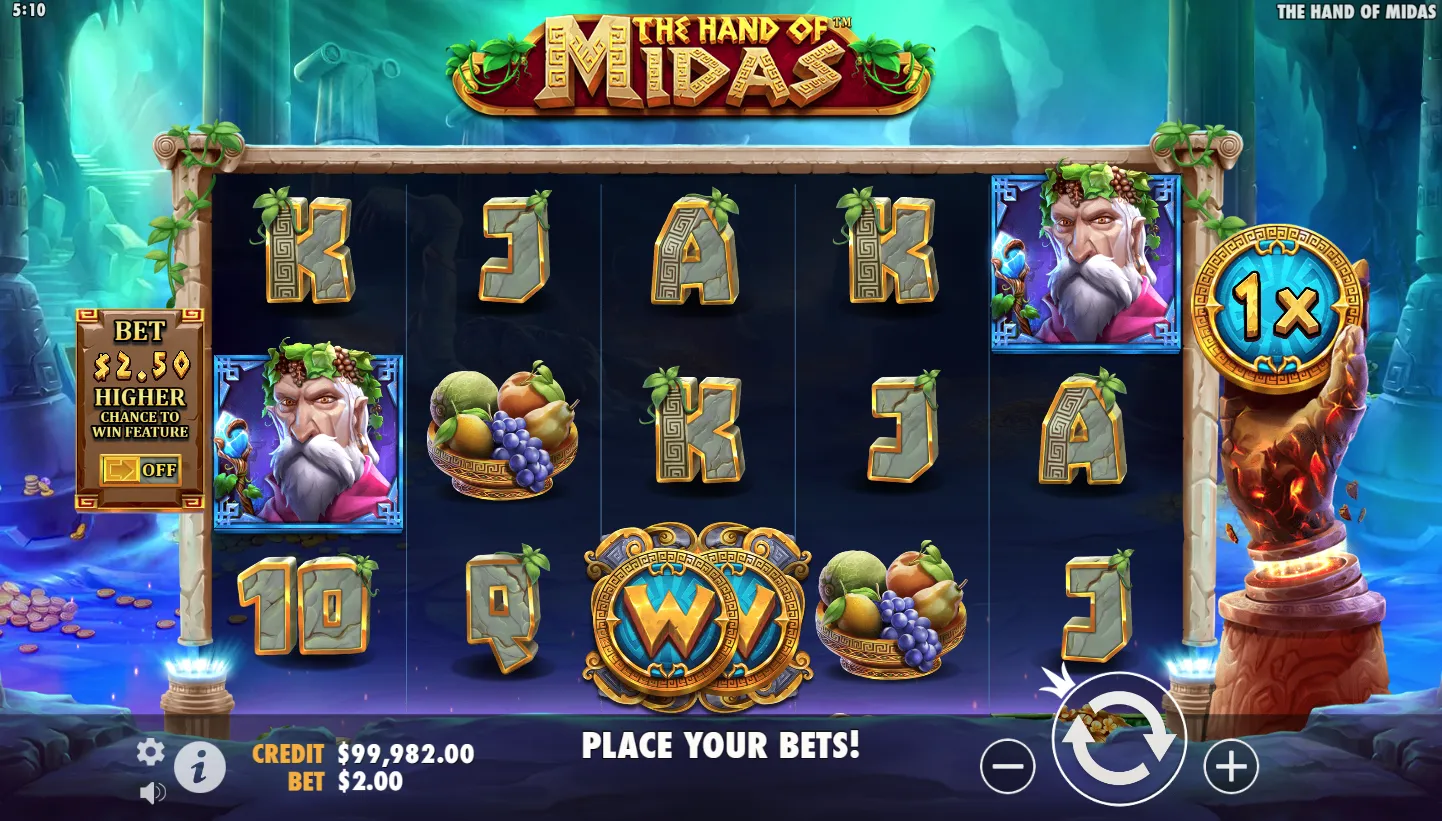
The frame is the one The Dog House and Wild West Gold use: wilds confined to the middle reels that stick for the whole free spins round. What sets this game apart is where the multiplier lives. A wild here does not multiply its own lines. It adds 1x, 2x or 3x to one round multiplier that applies to the total win of every spin from then on, lines without a wild included. A stuck wild therefore pays on every later spin twice over, as permanent cover on reels 2 to 4 and through the multiplier it raised. The mini reels serve length as well. Three per triggering scatter set the round at 9 to 45 spins before it starts, and more spins are added only while the round sits below its guaranteed minimum.
I work out the end state because it shows what that length is worth. Once reels 2 to 4 are fully covered, nine wilds have each added at least 1x, so the round multiplier is somewhere from 10x to 28x, and all 20 lines pay at least four of a kind of whatever reel 1 shows. The weakest four of a kind in the paytable is 0.25x, so a covered board pays at least 5x before the multiplier and between 50x and 140x after it on every remaining spin, depending on how the nine wilds rolled. A round that fills the board with ten spins left collects at least 500x from them. One that fills it on its last spin collects a single such spin.
The base game is not built to pay, and it does not
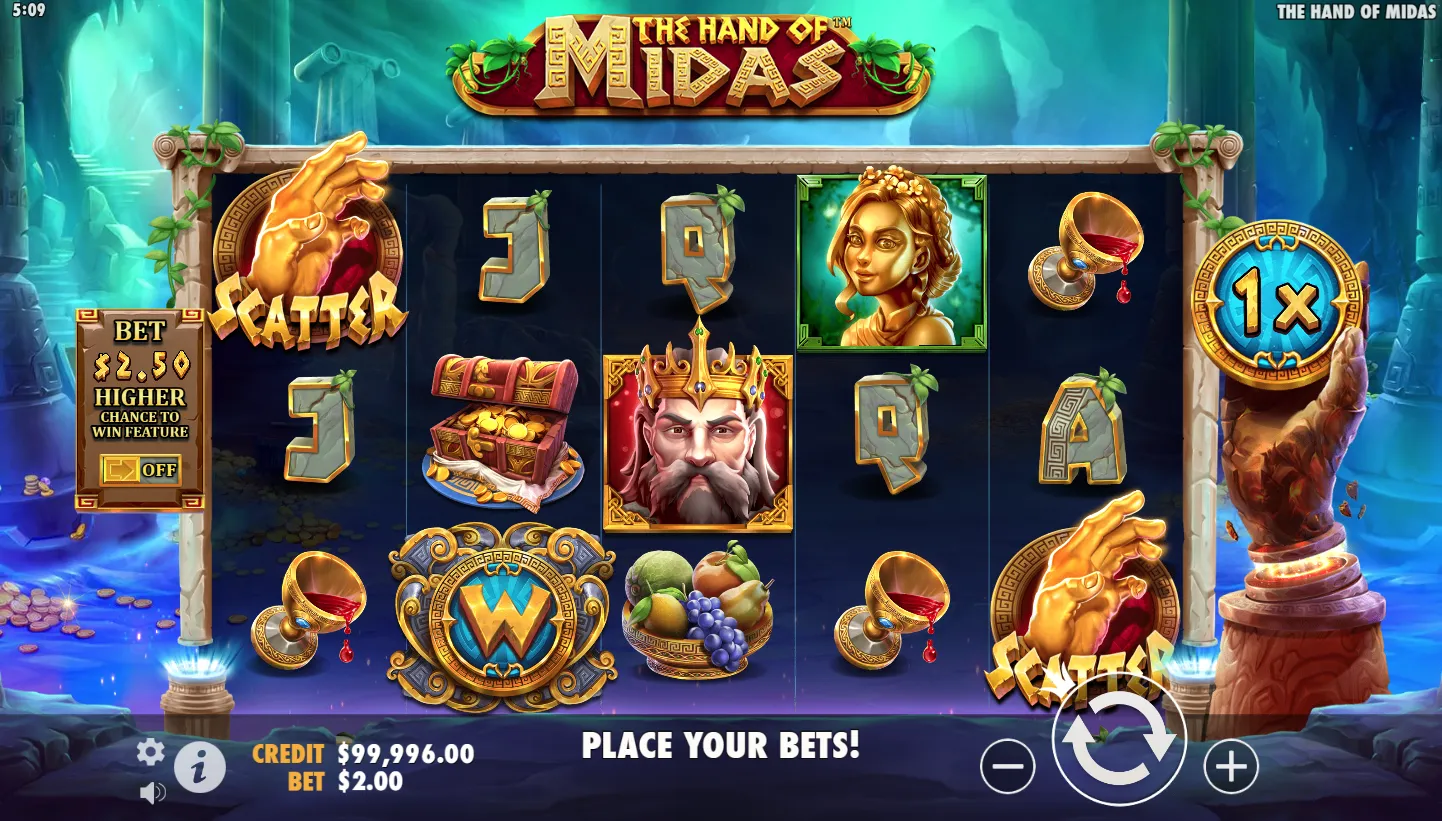
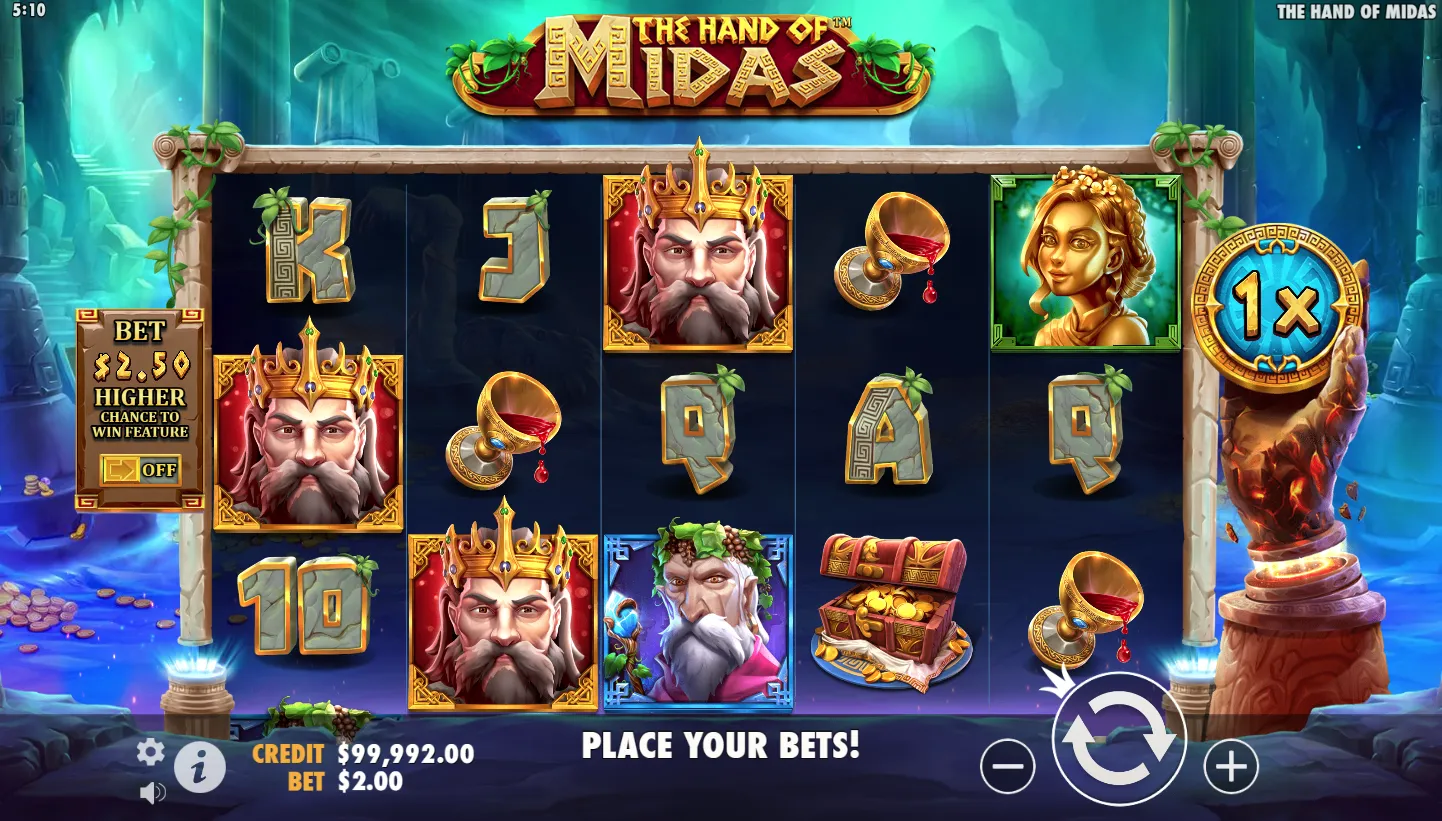
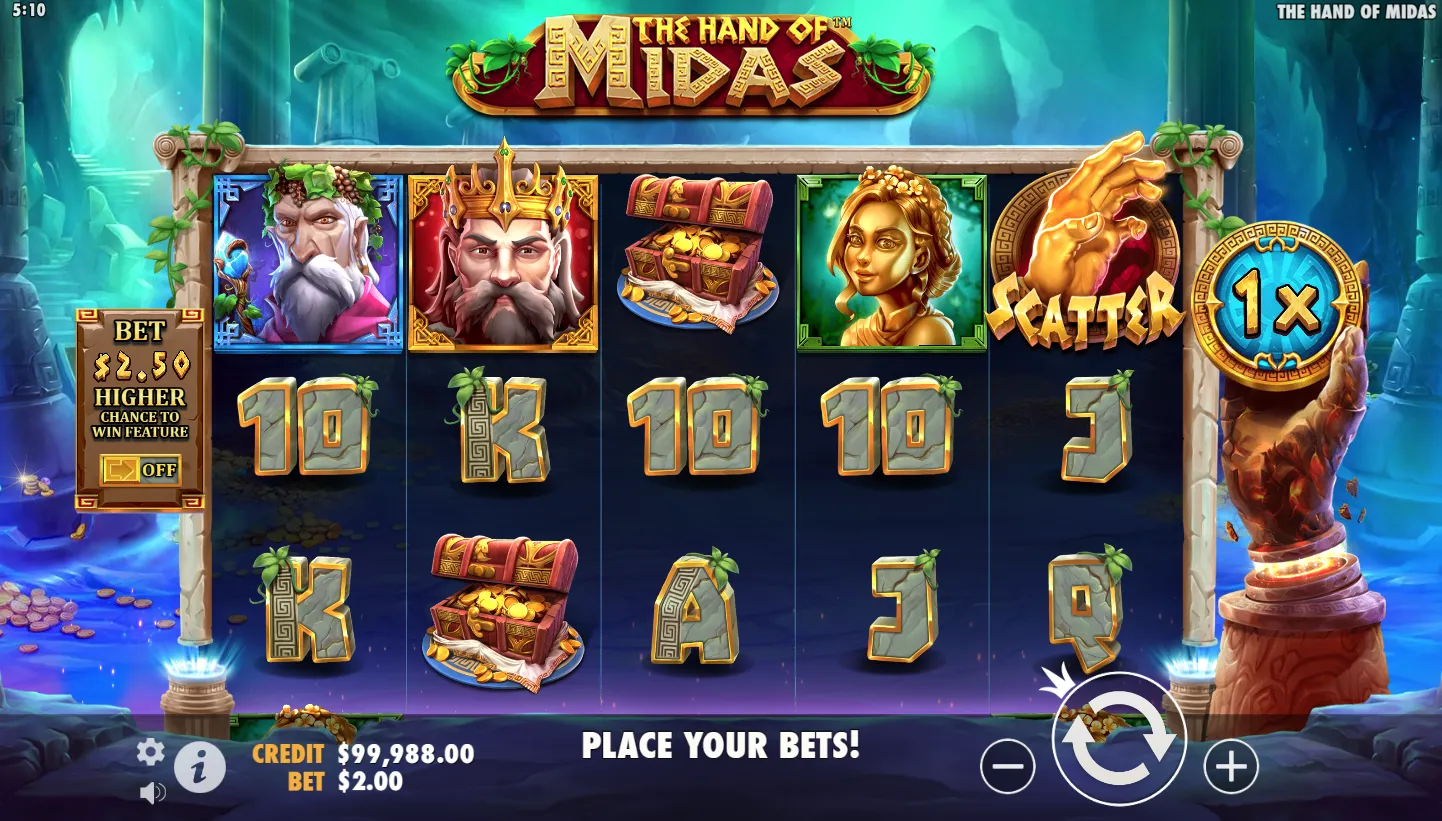
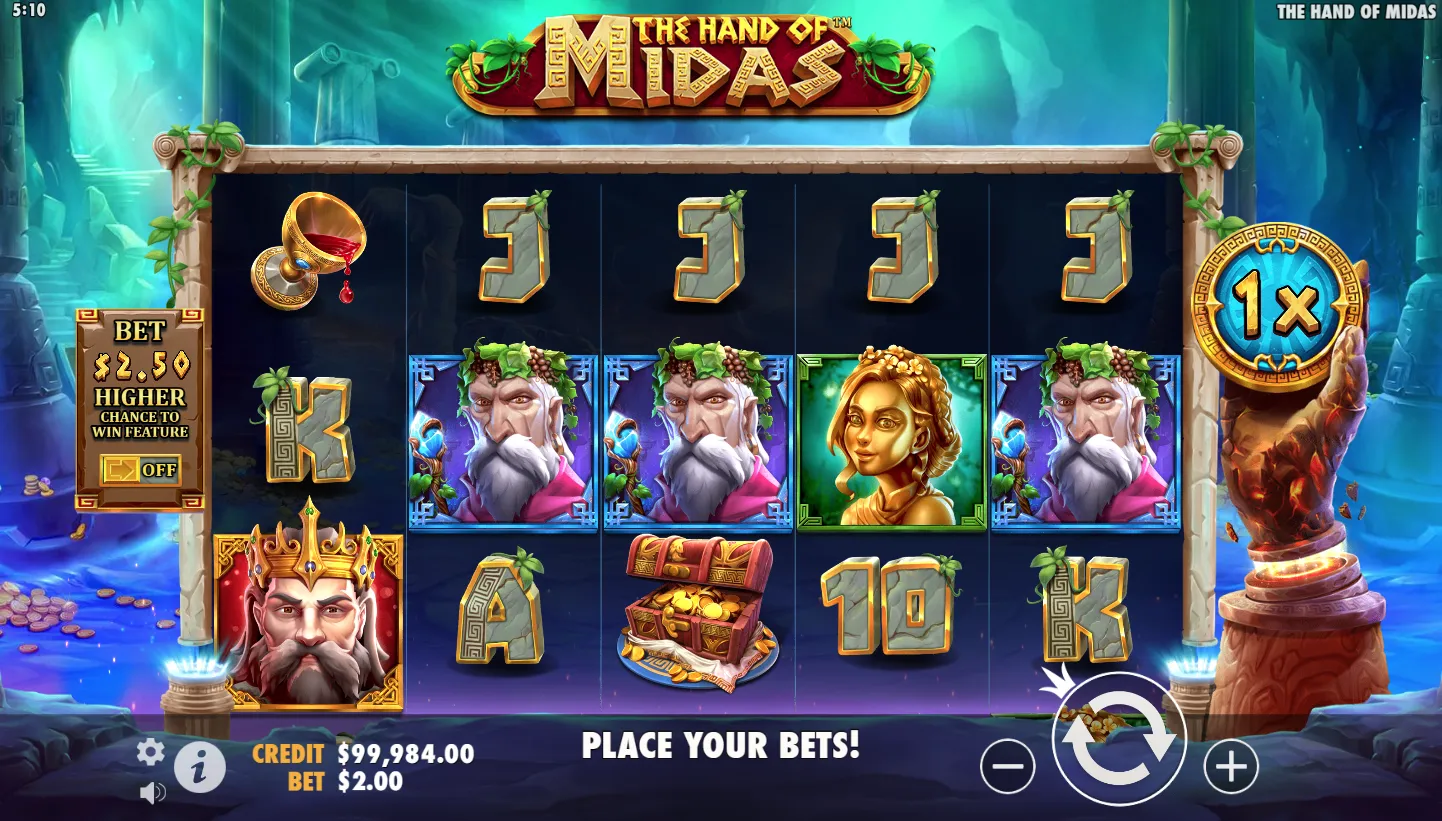
Five King Midas on a line, the best combination in the game, returns 20x the total bet. Three tens, jacks or queens return a tenth of the stake. I count three of the eleven symbols paying more than the stake for three of a kind: King Midas at 2x, Dionysus at 1.5x and the princess at 1.25x. A screen where every line held five King Midas would pay 400x before any multiplier, and that screen is the ceiling of the paytable on its own.
The base wild multiplier is what gives these spins any shape. Each wild adds 1x to 3x to a spin multiplier that starts at 1x, so a single wild turns the whole payout into two to four times itself, lines it does not touch included. It is still multiplying small numbers. For a base spin to reach the 5,000x cap, even that 400x screen needs a multiplier of at least 13x, which means wild values adding up to 12 or more, which takes at least four wilds on one spin. I treat that as a corner of the base game, not a route through it. The free spins are where the cap is in play, and the base game is the wait for them: free spins trigger once in 214 spins on average in standard play, and the paytable is too small to carry the spins in between.
Buy 5 charges 80% more per mini reel, and that is the right price
The three buys cost 100x, 200x and 300x for nine, twelve and fifteen mini reels. I make that 11.1x, 16.7x and 20x per mini reel, so the top option charges 80% more for each unit of round length than the bottom one. All three return 96.54%, which puts the expected return at 10.7x per mini reel in Buy 3, 16.1x in Buy 4 and 19.3x in Buy 5. A mini reel in the fifteen-reel round has to be worth 1.8 times one in the nine-reel round, and the covered-board arithmetic says why: the extra spins arrive after more wilds have stuck, on a higher multiplier. Each buy also plays its own reel set, so the strips share in that gap, but the direction follows the mechanism. I call the menu fairly priced, and because the return is equal, choosing between the three changes the shape of the risk rather than the return.
The floor and the ceiling do not scale together. Each guaranteed minimum is a tenth of its buy price, 10x, 20x and 30x, so a bought round can never return less than 10% of its cost, and the most it can lose is 90x, 180x or 270x the stake. The 5,000x cap stays where it is. It is 50 times the price of Buy 3, 25 times the price of Buy 4 and under 17 times the price of Buy 5. Tripling the outlay for the longest round buys 15 to 45 spins of runway before any top-up, and cuts the best case, as a multiple of the price, to a third. That is the clearest place I see the cap costing this game.
The cap arrives where the compounding starts working
On a covered board, five King Midas on every line reaches the cap at any round multiplier of 13x or more, and a covered board sits anywhere from 10x to 28x. Four King Midas on every line at 28x comes to 3,360x in one spin. The cap counts the round's running total, so a loaded board with spins left does not need a perfect screen to get there. When it does, the round ends and the unplayed spins are forfeited. The only rounds that end early are the ones that hit 5,000x, and those are the rounds in which the compounding has worked. At volatility 5 of 5 I find that ceiling low, and it sits right where the round does its best work. The chance of hitting it is 1 in 998,191 spins in standard play, and set against a trigger once in 214 spins, that is no better than one natural round in about 4,660.
The ante makes the same trade from the other side. It raises the stake from 20 to 25 coins, a quarter more, and doubles the natural trigger chance, which puts free spins at once in 107 spins on average. Line pays stay the same in cash, so they fall by a fifth as a share of the stake, and the return still holds at 96.54%, which means the doubled trigger rate carries the difference. Value moves out of the base game and into the rounds, which is where this game keeps it anyway. The price is the ceiling, because 5,000x the standard stake is 4,000x the ante stake. For anyone who already treats the base game as a wait, I rate the ante the logical setting, and that lower cap is what it costs.
One real idea in a thin frame is worth 6.8
The free spins hold a real idea, and the design around them is honest. Standard play, the ante and all three buys return the same 96.54%, the buy ladder charges for length at a rate the mechanism justifies, and the guarantee means no round finishes below 10x, 20x or 30x the bet for three, four or five scatters. What keeps my score in the 6s is everything outside that round: a base game whose best line pays 20x, a 5,000x ceiling that ends the strongest rounds with spins unplayed, and no way for a round to gain spins once it passes its minimum, because scatters do not land in free spins.
The game suits a player who wants one feature, accepts a long wait or a buy price for it, and values a floor under every round. Anyone who needs the base game to carry the stake between rounds, or who wants a ceiling that matches volatility this high, should look elsewhere. The return is worth a glance first as well: casinos can run the game at 95.5% or 94.51%, up to 2.03 points under 96.54%, and the rules screen shows the setting in use.