Two symbols have to meet before anything large can happen
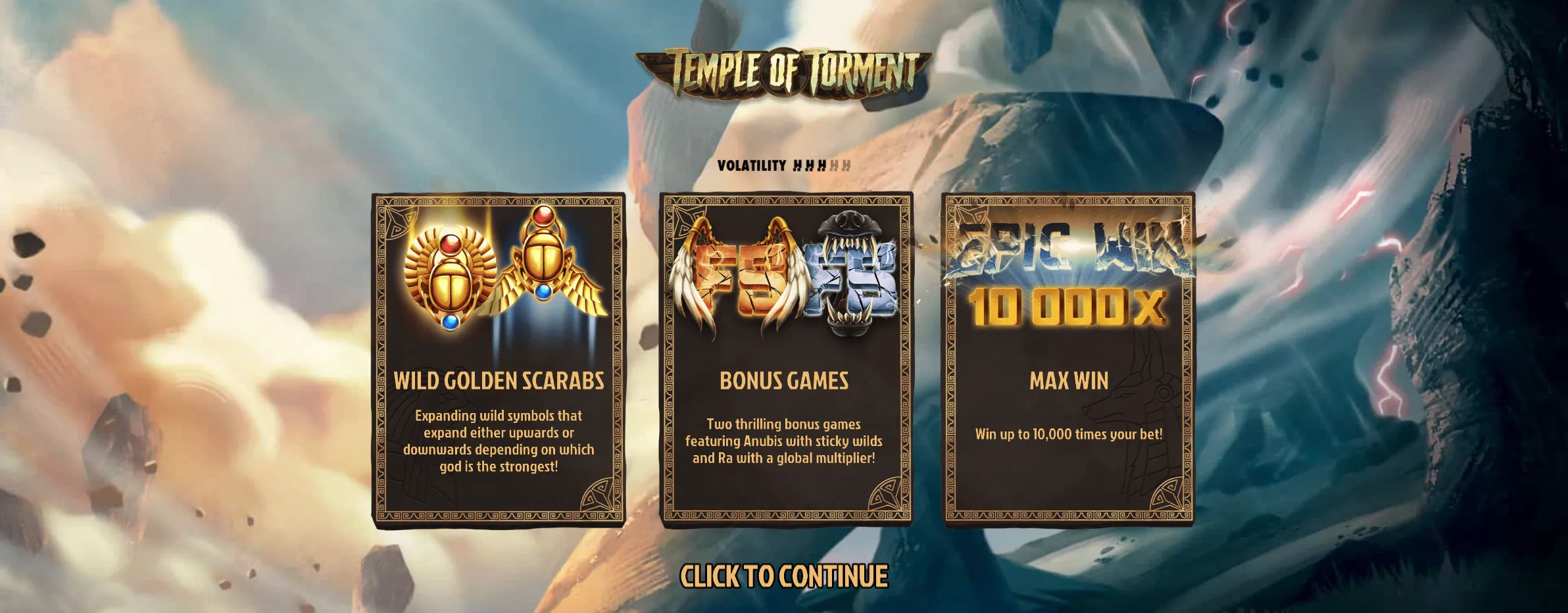
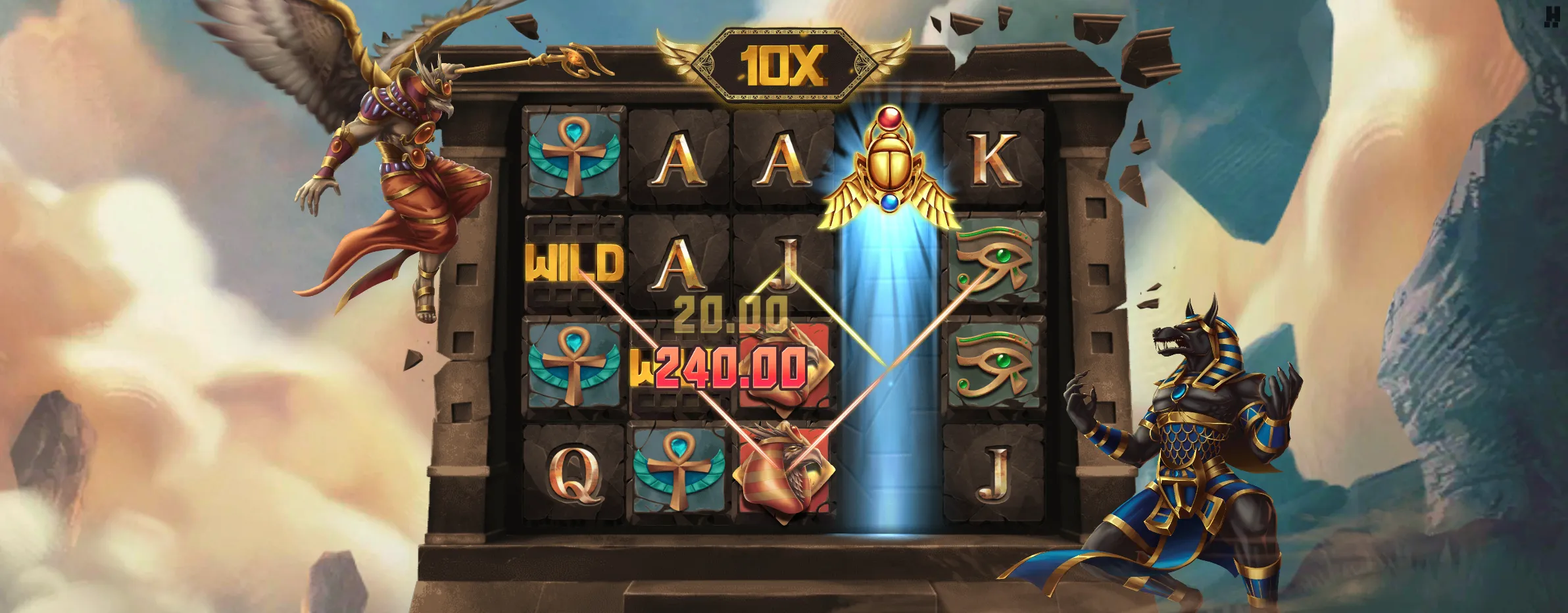
Temple of Torment keeps everything above 700x the bet behind one coincidence: a Golden Scarab and a WILD on the same reel, with the WILD on the side the scarab expands towards. Whatever that meeting produces is then added to, not multiplied by, any other scarab multiplier on the same line. I read the whole game through those two rules. The base game waits on the coincidence, both bonuses are ways of manufacturing it, and the buy menu sells access to them at honest prices. The idea is good, the frame around it is modest, and that combination is what a 6.8 looks like.
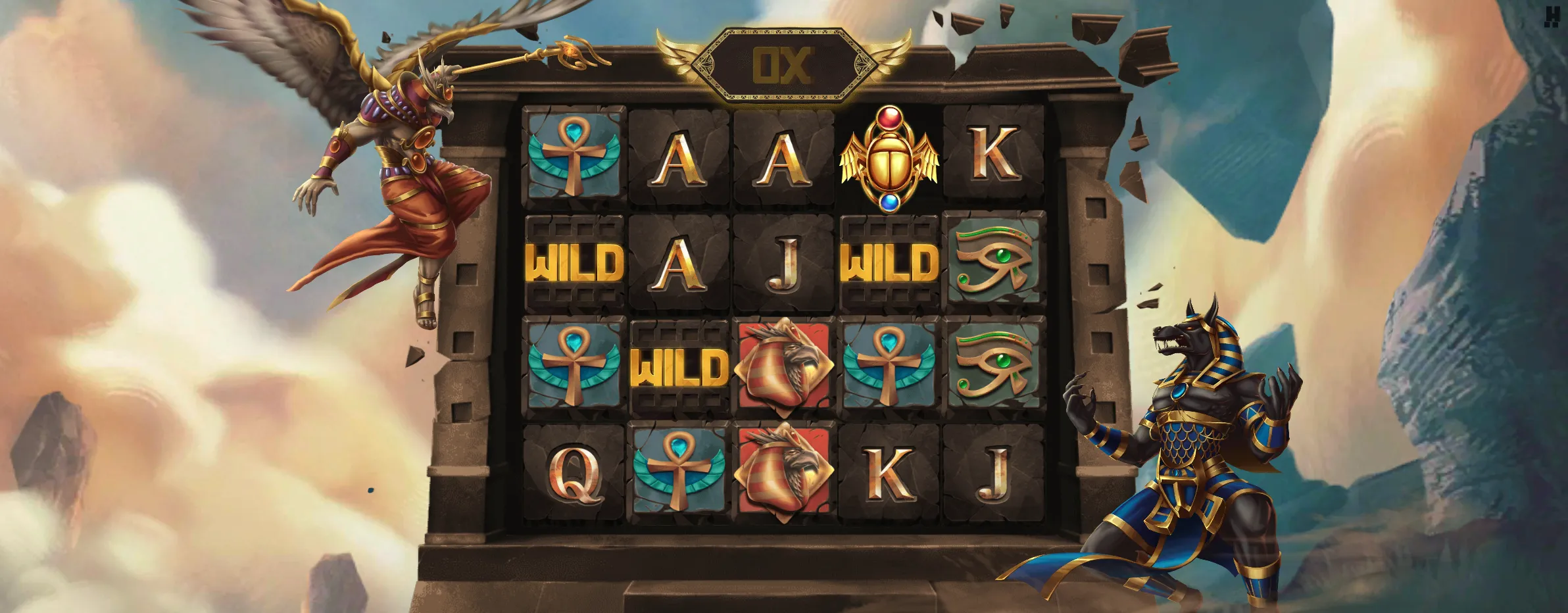
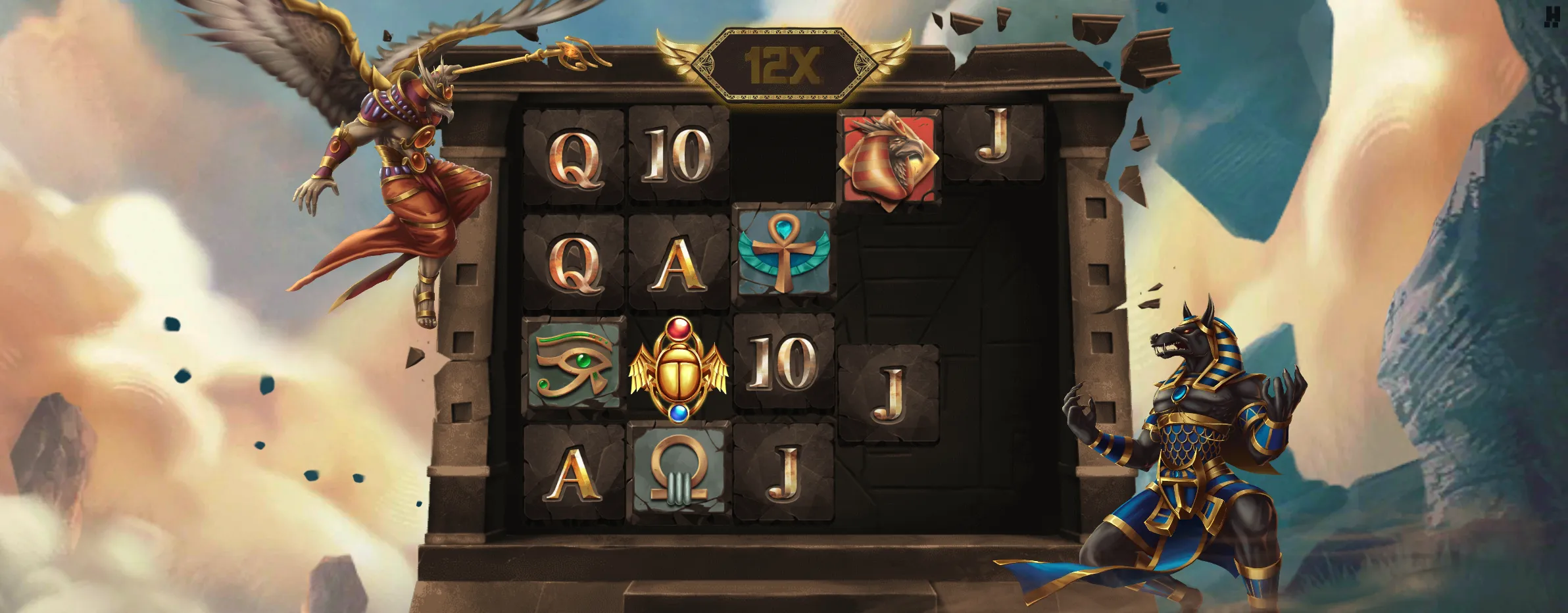
The family is easy to place. Wanted Dead or a Wild expands special symbols into full wild reels that carry multipliers. The Dog House and Wild West Gold keep multiplier WILDs sticky through their free spins. Temple of Torment combines both ideas and then splits them in two: the scarab does the expanding but holds no multiplier, and the WILD holds a value from 2x to 200x that stays dormant until a scarab crosses it. I count that split as a real refinement rather than a reskin. It is also a tax, because one lucky symbol becomes two that have to line up. The scarab stretches to one edge of the grid, so it covers a full reel only from the top or bottom row, and every scarab in view goes the same way. A WILD on the far side of its scarab stays a plain wild on that spin.
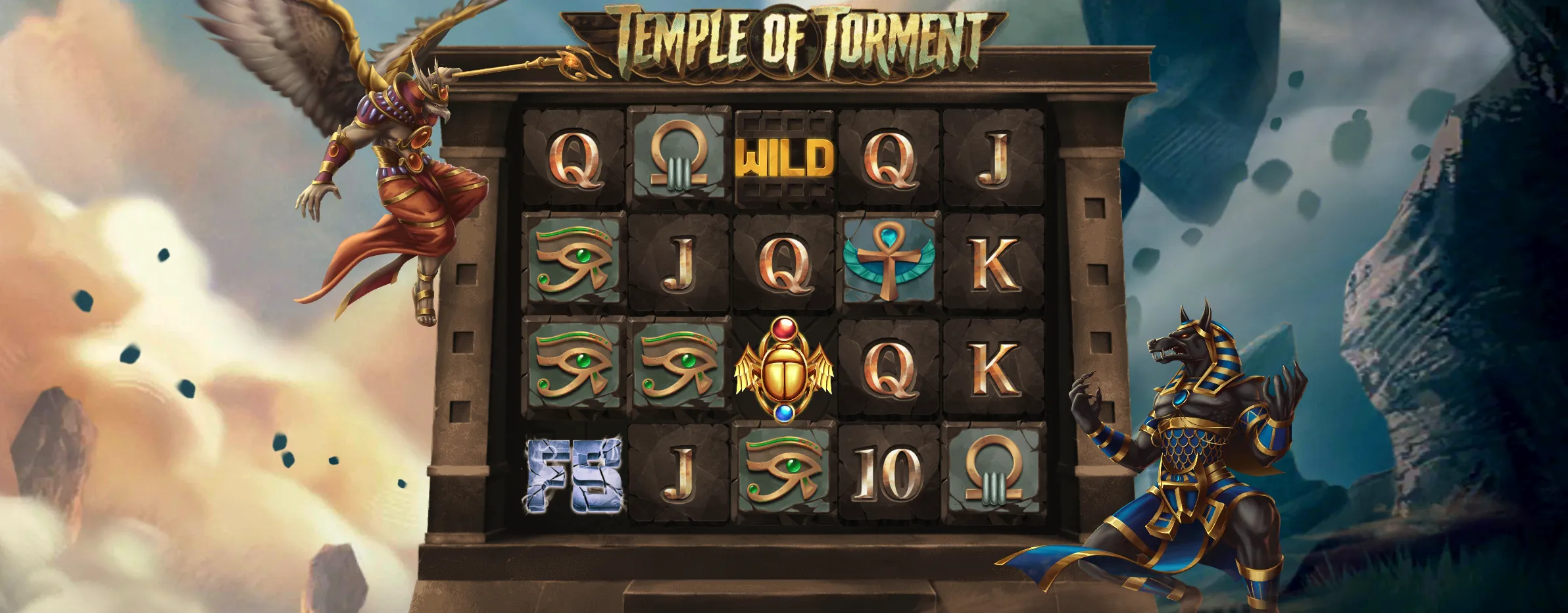
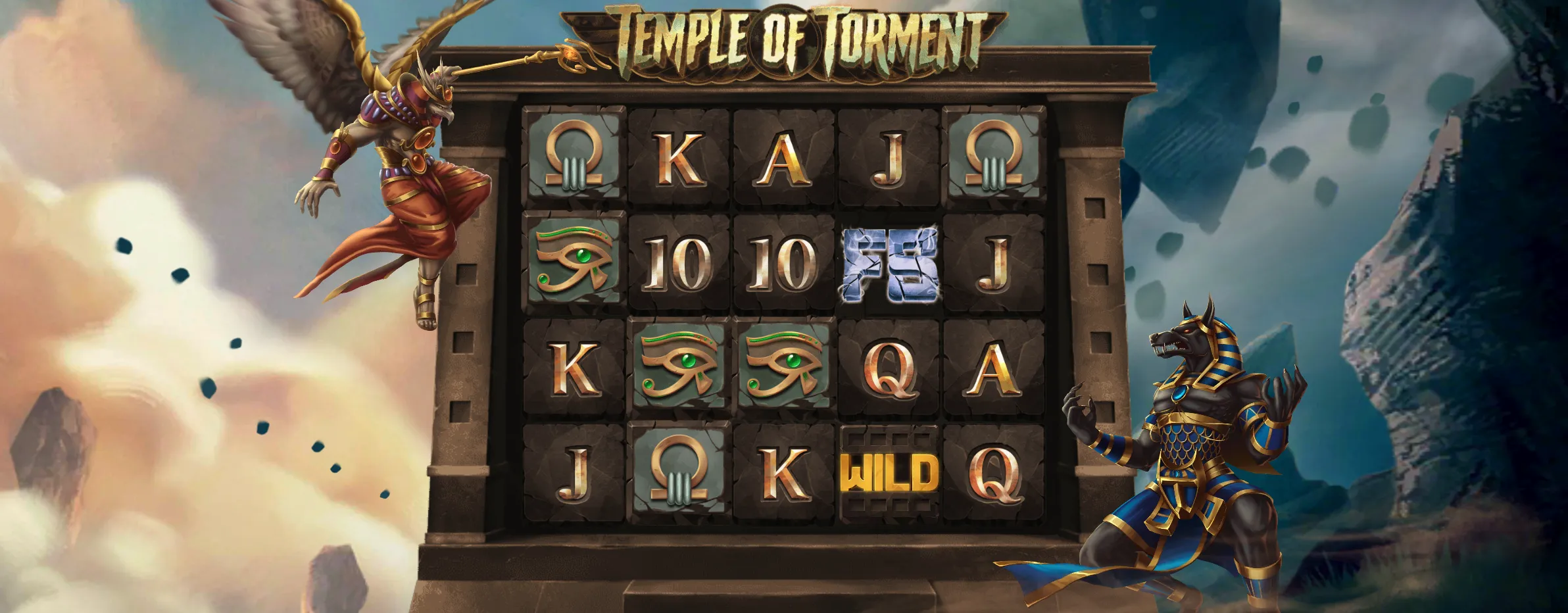
Without the meeting, the paytable has to carry the game, and it is not built to. I count five of the ten regular symbols returning less than the stake for three on a line, and three of a kind beats the stake only for the four highest. Five Ra, the best regular line, pays 30x; five WILDs pay 40x; five Golden Scarabs pay 50x. Fourteen lines at that 50x top come to 700x, 7% of the 10,000x cap, and 700x is the most any single spin can pay without a scarab crossing a WILD, in the base game or in either bonus. With a 28.2% hit rate, roughly seven base spins in ten return no win at all.
Addition makes the top three rungs the whole ladder
I count fifteen values on the multiplier ladder, and nine of them are 10x or less. If multipliers on a line multiplied, those small values would compound: three 10x scarabs on one line would make 1,000x. Here they make 30x. Five scarabs each carrying 10x, one on each reel, sum to 50x, which a single scarab on the 50x rung matches alone. Two 200x scarabs on one line give 400x instead of 40,000x.
The cap shows what that does to the upside. A base spin with a single activated multiplier from the bottom nine rungs cannot reach 10,000x, because the 700x ceiling at 10x is 7,000x. The lowest rung that can, 15x, needs about 667x of line wins inside its expanded area, close to the table's absolute top. On one line, five Ra at the 200x rung make 6,000x, and reaching the cap from that line takes a summed multiplier above 333x: two 200x scarabs, or a combination such as 200x, 100x and 50x. Five Golden Scarabs get there with one multiplier, because 50x at 200x is exactly 10,000x.
I work the cap's share of the return out at 0.0625% of the stake, which is 10,000x paid once in 16,000,000 spins, or about 0.06 of the 96.20 points. Nearly all of the money is paid well below the cap, which fits the medium volatility and makes 10,000x a boundary rather than a reason to play.
Anguish of Anubis stores WILDs, Reign of Ra stores multipliers
Both rounds open on 10, 12 or 14 spins for three, four or five of their god's scatters, and both add 2 or 4 spins for two or three matching scatters during the round. The difference is what each keeps from spin to spin.
Anguish of Anubis keeps WILDs. Every WILD that lands stays for the round, up to three per reel, so the board can hold fifteen, and scarabs and WILDs both land more often than in the base game. Here the comparison with The Dog House and Wild West Gold bites. In those rounds a sticky WILD carries its multiplier. In this one it is a target that multiplies nothing until a later scarab expands across it on its own reel, so three reels loaded with sticky WILDs still pay as plain wilds while the scarabs land on the other two. The round is back-loaded by construction: WILDs stay put, each spin has at least as many targets as the one before it, and retrigger spins arrive at the end, when the board is at its fullest.
Reign of Ra keeps nothing on the grid and everything above it. WILDs do not stick; each activated multiplier joins a running total, and on a spin that activates a new one, the total multiplies every win on the grid. That makes the total the only multiplier in the game that reaches beyond an expanded area, and here the additive rule finally works for the player, because a sum that persists keeps growing. If a round activates 10x, 25x and 50x on three separate spins, the total on the third of them is 85x, applied to every win on the grid. The limitation is the other half of the same rule. A spin that activates nothing pays without the total, so a large total sits idle through every spin where no scarab crosses a WILD.
I rate Reign of Ra the better design, because its multiplier escapes the expanded area. Anguish of Anubis is the better-priced ceiling, and the menu shows why.
The buy menu charges nothing for the shortcut
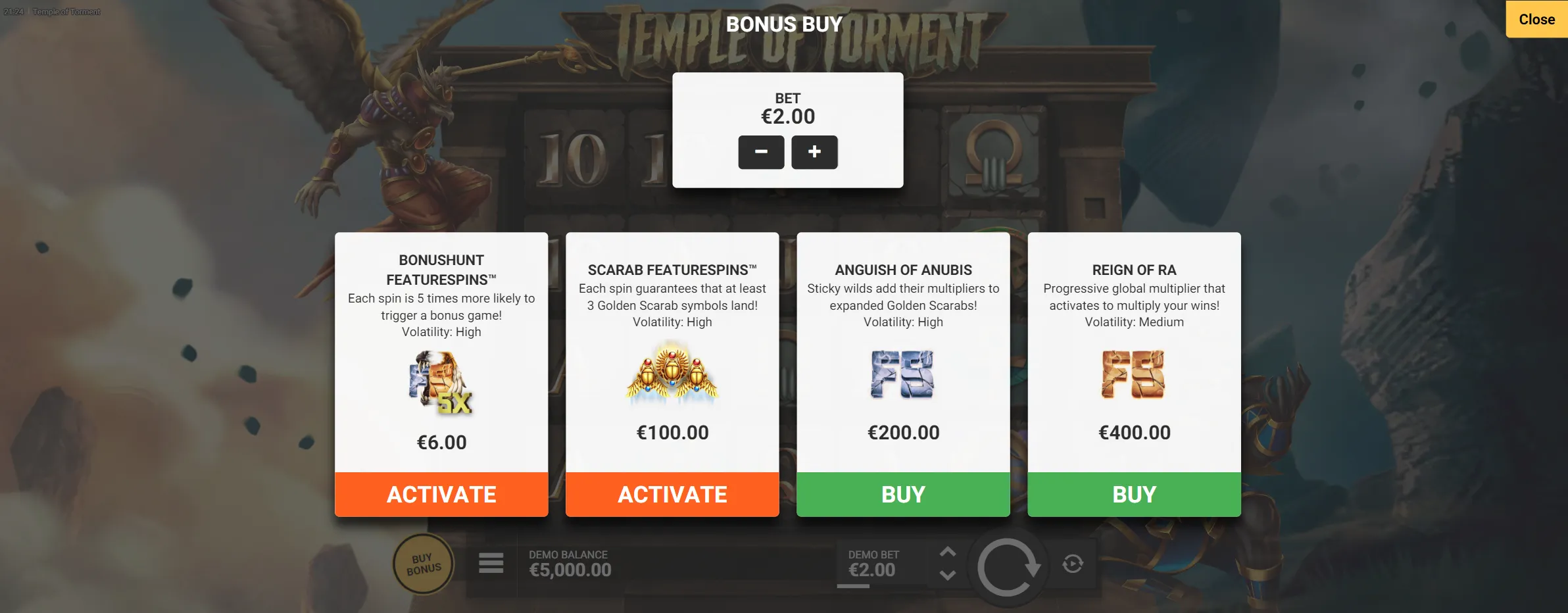
At the standard 96.20% setting every option returns more than plain spins: BonusHunt FeatureSpins 96.43%, Scarab FeatureSpins 96.25%, the Anguish of Anubis buy 96.28% and the Reign of Ra buy 96.29%. A menu with no surcharge is the main reason this game sits in the high sixes rather than lower.
I rank BonusHunt FeatureSpins first. Each spin costs 3x and makes a bonus 5 times as likely, so per unit staked a bonus arrives about 1.67 times as often as on plain spins, at 0.23 points more return. Its best case is still the 10,000x cap, more than 3,333 times the price of the spin.
Scarab FeatureSpins I rank last. At 50x a spin they guarantee at least three Golden Scarabs but not a single WILD, so they buy the half of the meeting that cannot multiply on its own. A spin whose scarabs cross no WILD is held to 700x, 14 times its price, and the expected return per spin is about 48x of the 50x. The margin over plain spins is 0.05 points, the thinnest on the menu.
Anguish of Anubis costs 100x and its average round pays about 96x; Reign of Ra costs 200x and averages about 193x. The two returns sit 0.01 points apart and both rounds are capped at the same 10,000x, which is 100 times the Anubis price and only 50 times the Ra price. The extra 100x buys a larger average round, not a higher ceiling. One Ra purchase costs the same as two Anubis purchases, and those two carry the same expected return plus two separate rounds that can each reach the cap. On ceiling per unit of price, I take Anubis.
Clever enough to study, too flat to rate higher
The scarab-over-WILD meeting is a genuine idea, and the two bonuses use it in ways that differ in structure, not only in theme. Against that sit the 700x gate, addition on every line, and a cap that contributes almost nothing to the return. I call a design gated twice, once by the meeting and once by addition, competent rather than good.
The return setting outweighs every comparison above. The gap between the standard 96.20% and the lowest 88.24% is 7.96 points, more than thirty times the 0.23-point edge of BonusHunt FeatureSpins. At the standard setting the expected cost of play is 3.80x per 100x staked; at the lowest it is 11.76x, a little over three times as much, and the buy returns above apply at the standard setting. The rules screen shows the setting in use.
I would point players at this game when they want medium volatility, a buy menu that costs nothing extra, and two bonus rounds whose difference repays understanding. Players who want multipliers that multiply each other, or a base game that pays through its table, should look elsewhere: the additive rule prevents the first, and a paytable topping out at 30x for five Ra prevents the second.