The grid is borrowed and the price is the point
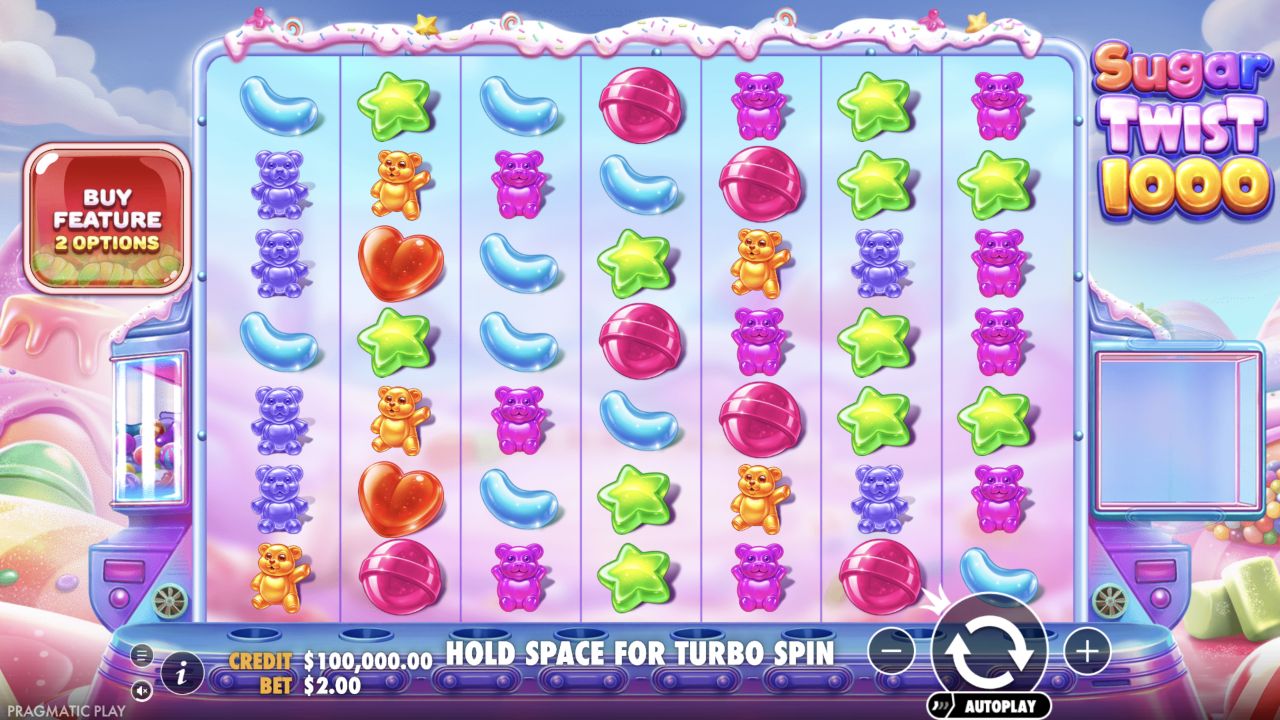
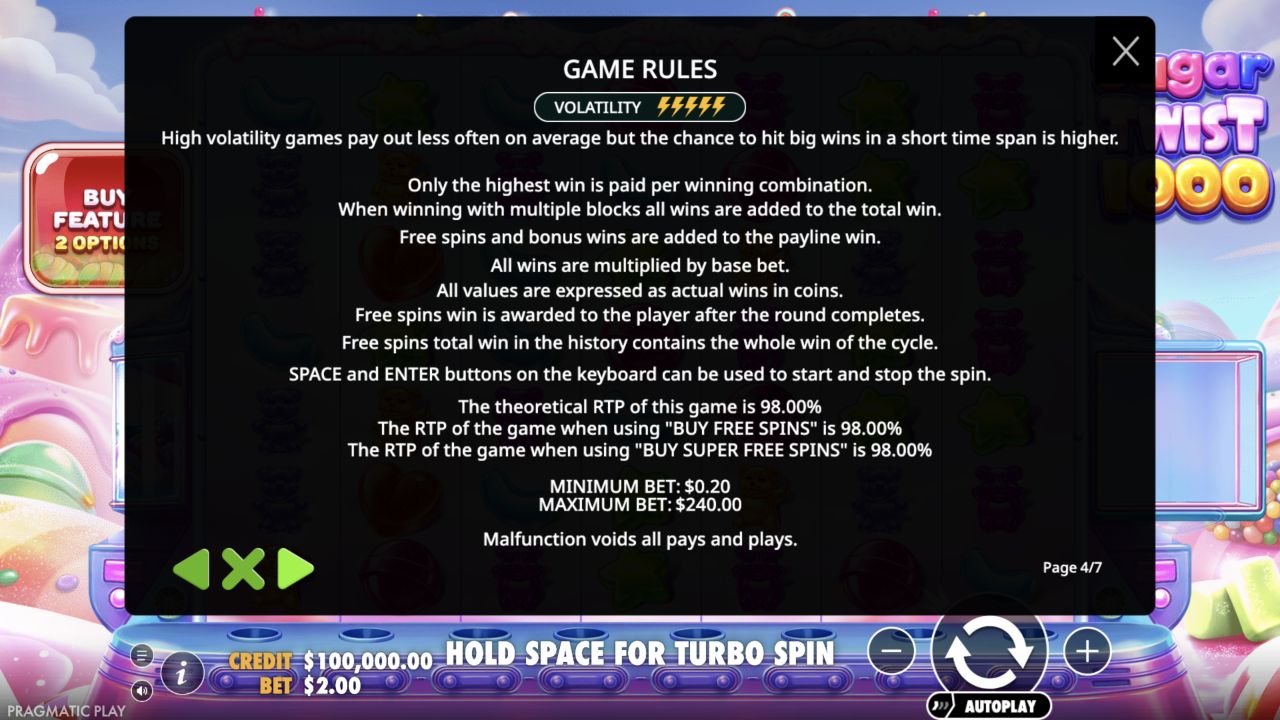
Sugar Twist 1000 arrives late to a format that already exists in Sugar Rush and Sugar Rush 1000. Sugar Rush is the earlier candy-cluster game built on tumbles and position multipliers, and Sugar Rush 1000 is another 7×7 cluster game whose multiplier cells persist through Free Spins. The frame here is that frame, and I find little in it that is new. What earns this version a look is the terms it is sold on. The return is 98.00% in the base game and 98.00% on both feature buys, and because the multiplier map carries from one spin to the next only inside Free Spins, a fairly priced door into Free Spins is worth more in this game than anything its base game does. I read it as a buy-first slot with a thin base game attached, and of its two doors I rate the cheaper one as the better purchase for a player aiming at the cap.
A cell is worth nothing until it has won twice
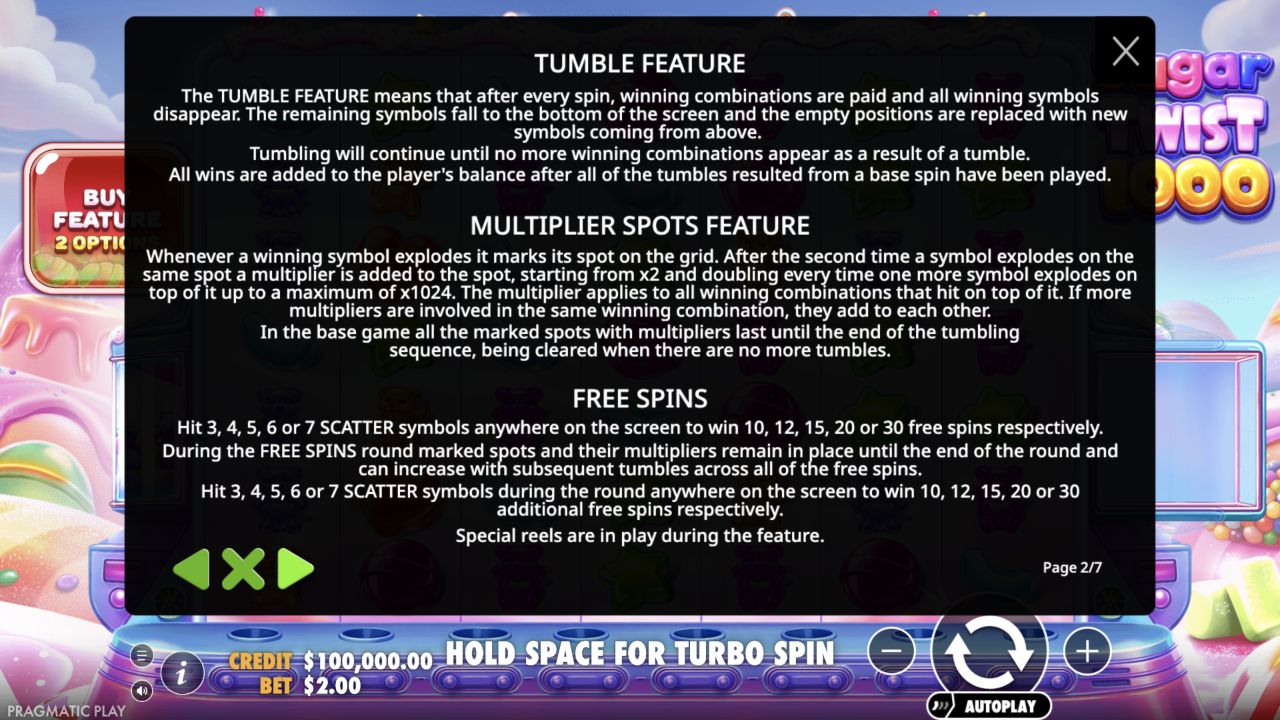
The multiplier ladder is the whole engine, so I start by counting its rungs. Outside the Super round, a regular symbol's first winning explosion on a cell only marks it. The second puts 2× there, and each explosion after that doubles the value: 4×, 8×, 16×, 32×, 64×, 128×, 256×, 512× and the 1,024× ceiling. I count eleven winning explosions on one position to reach the top, and before the second of them the cell carries no value at all.
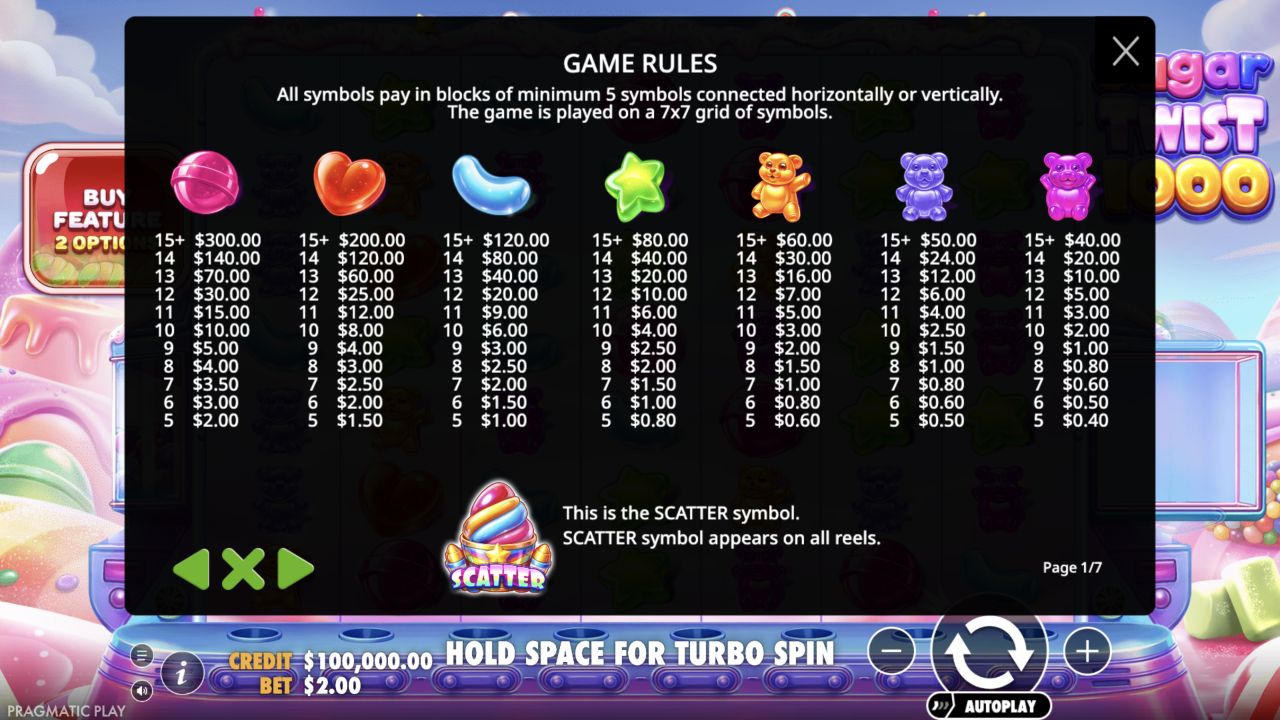
In the base game all of that has to happen inside one tumble chain, because marks and values clear when the chain ends. A base-game cell needs four winning explosions before the board stops tumbling just to show 8×, and whatever it builds is gone on the next spin. When a spin does not chain, the paytable pays on its own, and I find the paytable small money. At five symbols, the minimum cluster, all seven regular symbols pay the stake or less, from 0.2× for the pink bear to 1× for the lollipop. At eight of a kind I count four of the seven still paying 1× or less. The table turns serious at 13 symbols, where the lollipop climbs from 35× to 70× to 150× for 15 or more.
That 150× is the most a single cluster pays before multipliers, and I make it 0.6% of the 25,000× cap. Closing a gap of roughly 167 times is the multiplier map's job, and the base game erases that map at the end of every chain. I call the base game thin by construction, because the map that closes the gap cannot outlive a chain there.
The cap arrives long before the ladder runs out
When one winning cluster covers several developed cells, their values are added rather than multiplied together. Against a 25,000× stop, that sum does not need to be large. A lollipop cluster of 15 or more pays 150×, so by my arithmetic it reaches the cap once the cells beneath it add up to 167× or more. One cell at 256× does that alone, and 256× is the ninth explosion of eleven. Put the 1,024× ceiling under the same cluster and the arithmetic says 153,600×, more than six times what the round can pay, so for that cluster the last two steps of the ladder add nothing.
The small end of the table reads differently. A pink bear cluster of 15 or more pays 20×, and one 1,024× cell under it makes 20,480×, still short of the cap. The same cell under a red bear cluster of that size makes 25,600× and ends the round at 25,000×. No five-symbol cluster pays more than 5,120× in one win, because the best of them is the lollipop at 1× and five cells at the ceiling add to 5,120×, about a fifth of the cap.
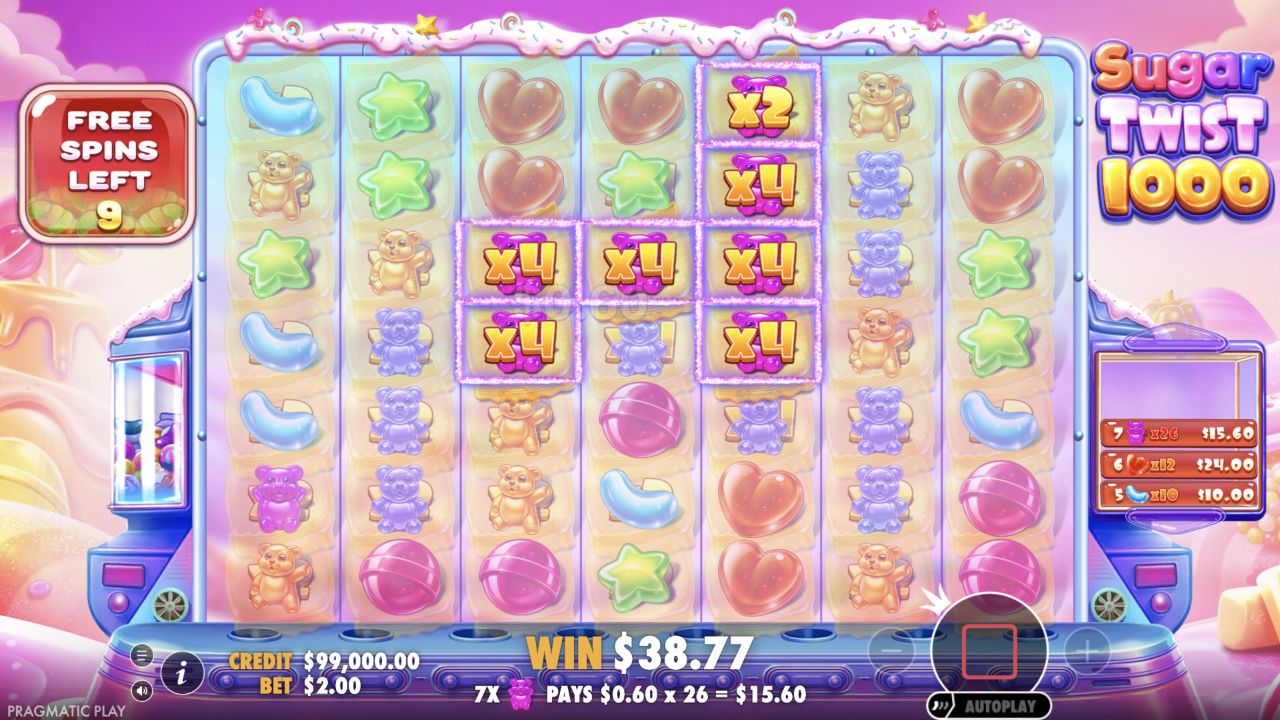
I take from this that the size of the cluster landing on the map matters more than the height of any one cell. A five-symbol lollipop cluster over one 1,024× cell and four empty ones pays 1,024×, while a 15-symbol lollipop cluster over a single 256× cell ends the round at the cap. A 15-symbol cluster covers almost a third of the 49 cells, so the useful map is one with developed cells wherever a large cluster might land. That is what persistence builds: a Free Spins map keeps every developed cell for the whole feature, while a base-game map starts from nothing on every spin.
The 500× buy pays 400× to skip two explosions
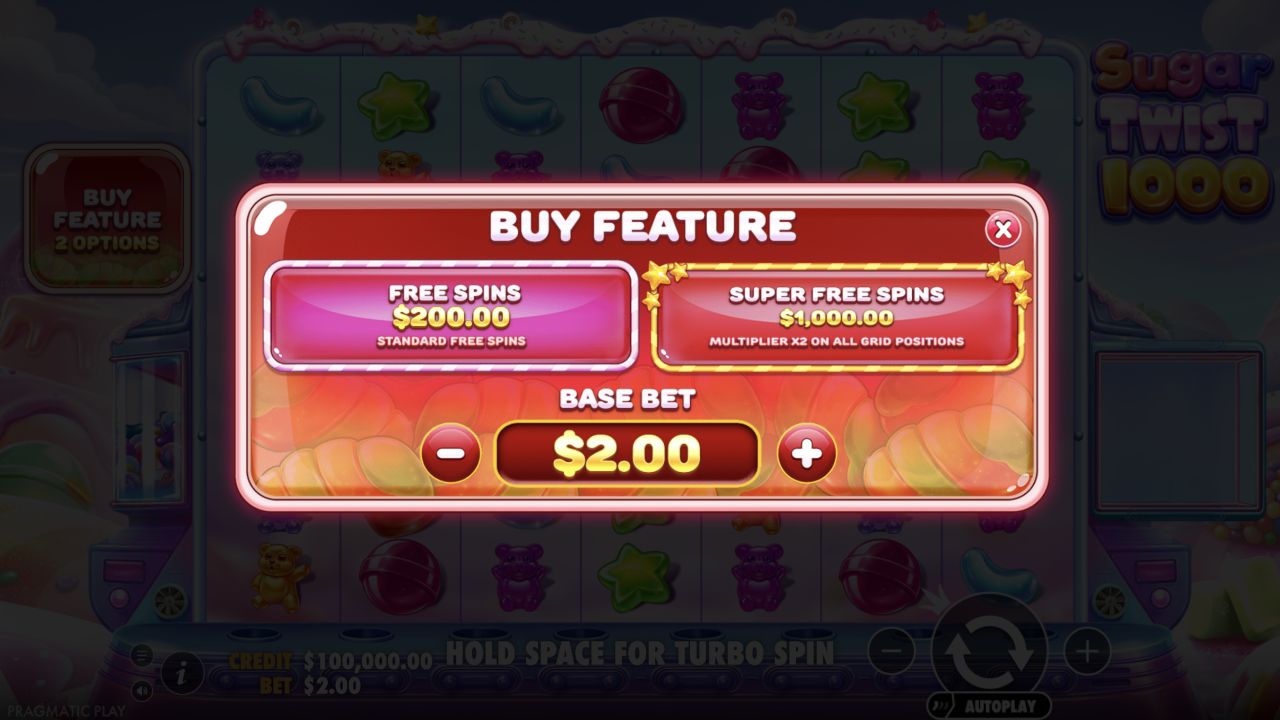
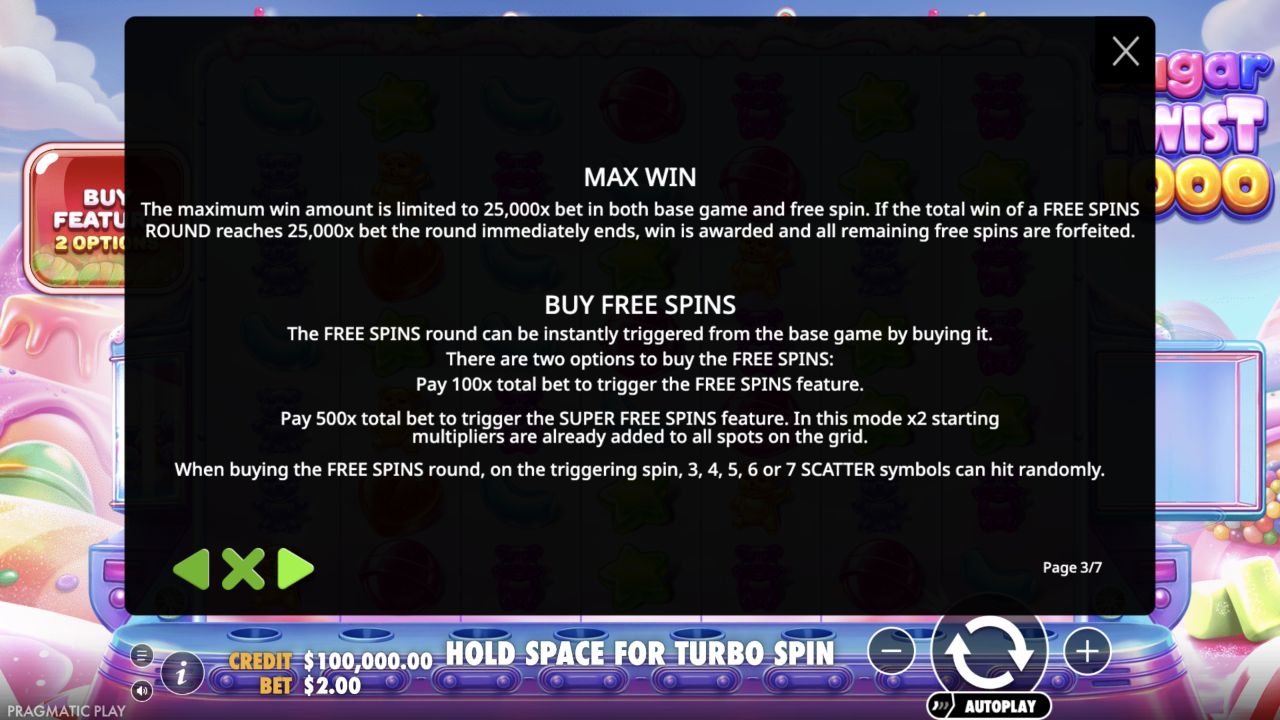
Both purchases return 98.00%, so their average cost per round is exact: 2× the bet for the 100× Free Spins buy and 10× for the 500× Super buy. I find neither overpriced. The question is what each price buys.
The 100× buy opens standard Free Spins on a random draw of three to seven Scatters, which sets 10, 12, 15, 20 or 30 starting spins. Its best case is the 25,000× cap, 250 times its price.
The 500× buy enters through the same draw, so it can open with 10 spins, which works out at 50× the bet per starting spin. Its best case is the same 25,000×, which is 50 times its price. The extra 400× buys the seeded board: all 49 cells start at 2×, the value a standard cell reaches only after two winning explosions, which is the equivalent of every cell on the grid winning twice before the first spin. On the untouched Super board a five-symbol lollipop cluster covers 10× in added values and pays 10×, where the same cluster on a fresh standard board pays its flat 1×. A lollipop cluster of 15 or more lands on at least 30× and pays at least 4,500×. The ceilings do not move. A seeded cell still needs nine more winning explosions to reach 1,024×, and the round still stops at 25,000×.
So the Super buy skips the two explosions a standard cell needs before it carries any value and leaves the nine doublings above them untouched. I count that a real upgrade, and at 98.00% it is fairly priced. It is still the weaker purchase for the cap. Five standard buys cost the same 500× as one Super buy and carry the same 10× average cost, but they are five rounds with five separate 25,000× ceilings. To hold 98.00%, a Super round has to average 490× where a standard round averages 98×, which puts the Super average at 1.96% of the cap against 0.39% for the standard one. The Super buy suits a player who wants a larger average result from a single round and accepts one ceiling in place of five. For reach, I rate the 100× buy the better door.
This is a game for buyers, not for spinners
Neither buy controls length. The Scatter scale is the same in both rounds and for retriggers, so a seven-Scatter entry gives three times the spins of a three-Scatter entry at the same price. Length also has a hard stop: a round that reaches 25,000× ends there, and any Free Spins not yet played are forfeited.
The player this game suits buys the feature and wants the return to hold while doing so, and here it does, at the same 98.00% as the base game. I see the seeded Super board as a fair option for a player who would rather pay for the early doublings than build them. The players who should look elsewhere are those who spin the base game expecting the grid to build, because the map clears with every chain, and those who already know the persistent cells of Sugar Rush 1000 and want a new idea, because this engine offers little that is new. I read Sugar Twist 1000 as a good game with one clear strength, its pricing, on a familiar and thin frame.