0xPlaySlots

Gems Bonanza — Free Demo & Game Details

Slot game

Slot by Pragmatic Play

#R

96.55%

RTP

Base game

#MWM

10000x

Maximum win multiplier

#V

high

Volatility

#BR

0.2–240 operator-dependent units

Bet range

#CP

Cluster Pays

Cluster Pays

#GG

8 × 8

Game grid

RTP profiles

Base game

96.55%

Base game

96.51%

Casino setting

95.54%

Casino setting

94.53%

Casinos can run this lower setting, and the rules screen inside the game shows which one is active.

Our verdict

0xPlaySlots opinion
6.6/ 10our score for this game

Marks that feed spin features and spin features that feed a level ladder form a real idea with a clear arithmetic route to 10,000×. The maths around it is stingy because the base paytable is thin and the meter forgets everything when the spin sequence ends. Because each level asks for more symbols than the trigger did, a round can close at a flat 2× after all the effort of reaching it. Good ideas held back by stingy maths make it competent rather than good.

About Gems Bonanza

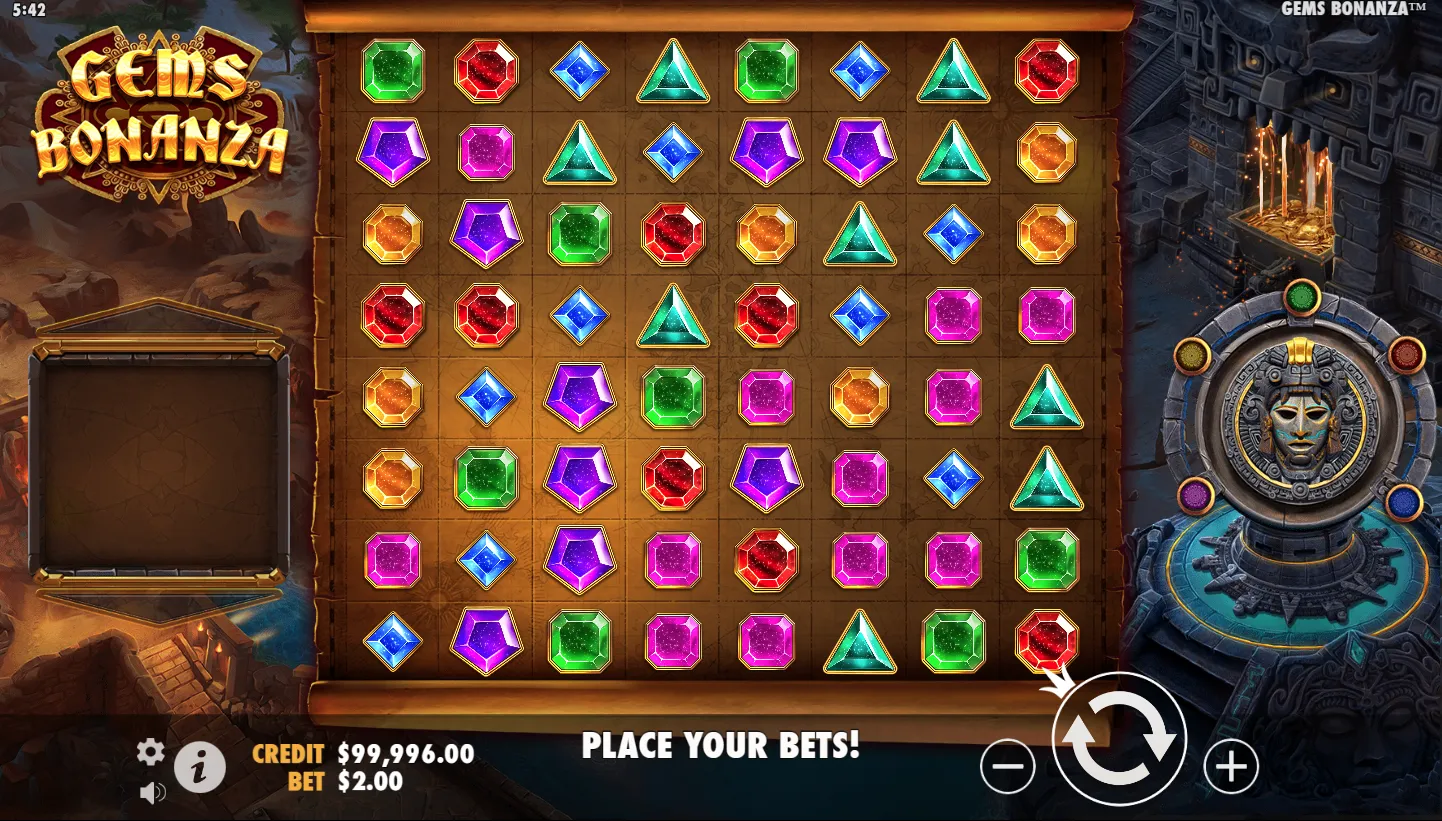
Wins are blocks of at least 5 matching gems connected horizontally or vertically on an 8×8 grid. The base paytable is thin because a 5-block of the lowest gem returns 0.1× and the top gem needs 8 cells to reach 5×. A win formed over a coloured mark queues a spin feature that plays after the tumbles end. Squares and Colossal Symbol drop in same-symbol blocks while Wild Gem and Lucky Wilds supply the only wilds the game has. The Gold Fever meter counts every winning symbol that explodes and empties when the spin sequence ends. Its 114-point trigger is almost two full boards of exploded symbols and depends on spin features chaining inside a single spin. Inside Gold Fever each level plays all five spin features once under a flat multiplier that climbs from 2× to 10×. Level targets rise from 116 symbols for level 2 to 132 for level 5 and every one of them exceeds the trigger. A 5×5 Colossal Symbol of the top gem is a 25-block worth 1,000× on its own and the level 5 multiplier lifts that to the 10,000× ceiling.

Gems Bonanza free demo

Launch the provider-hosted demo in a new tab.

Editorial takeaways

  • Casinos can run Gems Bonanza at 96.55% or at a lower 94.53%, so the rules screen is worth checking before playing.
  • Gold Fever starts when one base game spin and its tumbles explode 114 winning symbols.
  • Gold Fever multipliers climb from 2× at level 1 to 10× at level 5.
  • The Gold Fever buy costs 100× the total bet.
  • The top gem pays 1,000× the bet for a block of 25 or more symbols.
  • The maximum win is 10,000× the total bet.

Limitations and version notes

  • The four lowest gems pay less than the stake until a block reaches 9 symbols, so base play runs on small wins.
  • The Gold Fever meter wipes at the end of every spin sequence, so a spin that explodes 100 symbols banks no progress toward the next trigger.
  • Gold Fever can end after level 1 at a flat 2× when its five spin features fail to explode 116 symbols.

Features & Themes

Game features

Cluster PaystumbleSpin ModifierswildsProgressive FeaturemultipliersBonus Buy

Themes

gems

Game mechanics

Tumble feature

Base + bonus#01

Any winning block forms on the grid.

Winning symbols are removed, the remaining symbols fall, and new symbols drop in from above.

The chain runs until no new win forms and every queued spin feature has played.

Winnings reach the balance only after every tumble and spin feature of the spin has played.

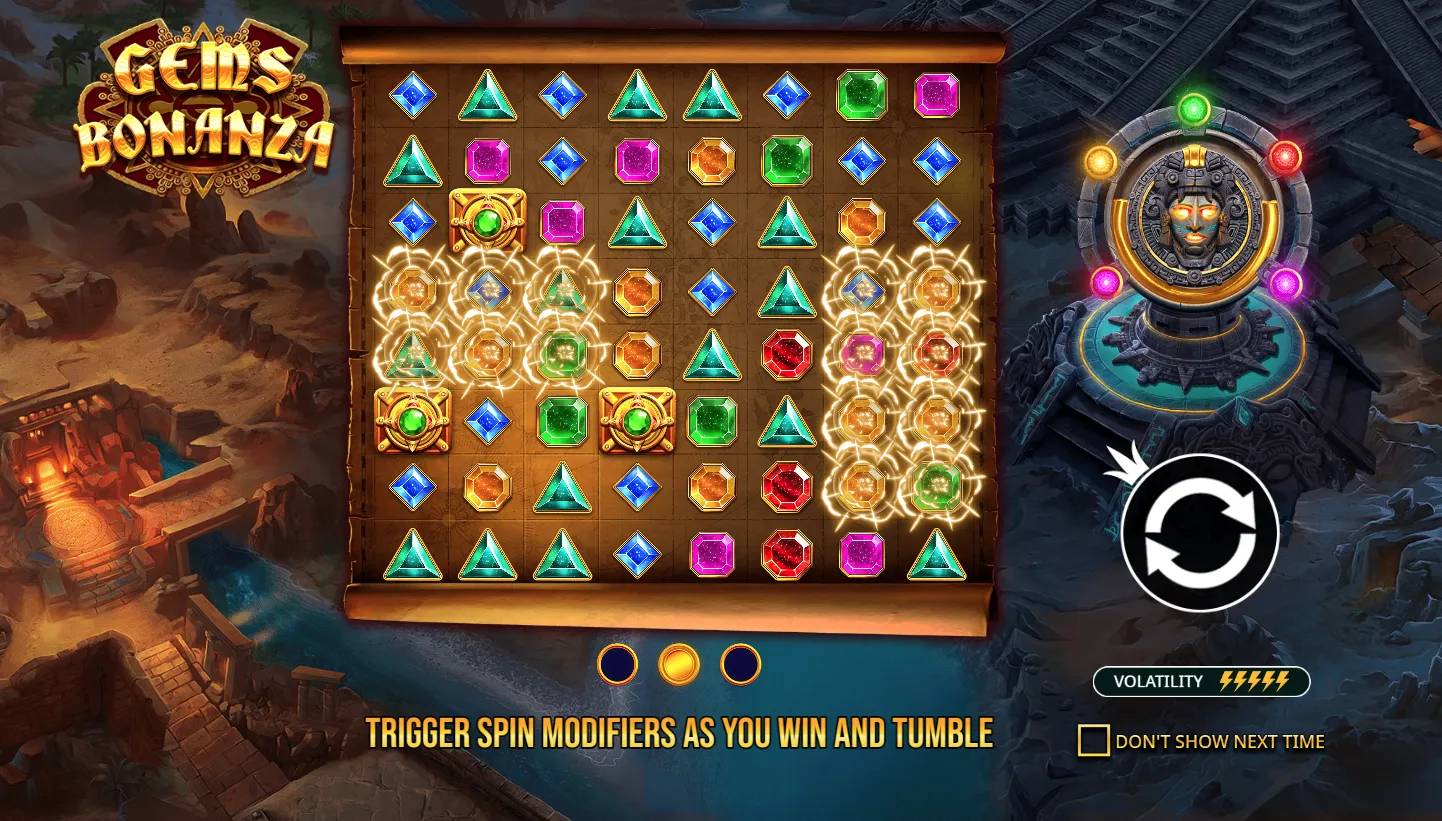
Coloured markings

Base game#02

Coloured marks can appear behind symbols on any base game spin.

A win formed over a marked position awards the spin feature tied to that colour.

Awarded features wait until the tumble chain ends and then play in a fixed order.

  • Nuclear plays first, from a blue mark
  • Wild Gem plays second, from a pink mark
  • Squares plays third, from a brown mark
  • Colossal Symbol plays fourth, from a red mark
  • Lucky Wilds plays last, from a green mark

Nuclear

Base + bonus#03

A win on a blue mark in the base game, or its guaranteed turn in each Gold Fever level.

After the tumbles end, the whole screen clears and a new set of symbols drops in.

Wild Gem

Base + bonus#04

A win on a pink mark in the base game, or its guaranteed turn in each Gold Fever level.

After the tumbles end, every instance of one random symbol on screen turns wild.

Squares

Base + bonus#05

A win on a brown mark in the base game, or its guaranteed turn in each Gold Fever level.

After the tumbles end, blocks of matching symbols are added in random positions.

  • Each block is 2×2

Colossal Symbol

Base + bonus#06

A win on a red mark in the base game, or its guaranteed turn in each Gold Fever level.

After the tumbles end, one block of a single random symbol is added in a random position.

  • 3×3 block
  • 4×4 block
  • 5×5 block

Lucky Wilds

Base + bonus#07

A win on a green mark in the base game, or its guaranteed turn in each Gold Fever level.

After the tumbles end, wild symbols are added in random positions.

  • At least 5 wilds
  • At most 15 wilds

Gold Fever meter

Base game#08

Every winning symbol that explodes during a base game spin adds 1 point.

Reaching 114 points from one spin with its tumbles and spin features starts Gold Fever once that spin finishes.

The meter resets to zero when no more winning symbols explode, so no progress survives into the next spin.

  • 114 points start Gold Fever

Gold Fever level multiplier

Bonus#09

Collecting enough winning symbols during a Gold Fever level moves play up to the next level.

Every win in a level is multiplied by that level's multiplier.

Each multiplier holds for its level until the next level replaces it.

  • Level 1 pays 2× from the start of the round
  • Level 2 pays 4× and needs 116 symbols
  • Level 3 pays 6× and needs 120 symbols
  • Level 4 pays 8× and needs 125 symbols
  • Level 5 pays 10× and needs 132 symbols

Bonus rounds

Gold Fever Progressive Feature

Other bonus
No retrigger

The Gold Fever meter reaches 114 points within one base game spin and its tumbles.

Each level plays all five spin features once, in the fixed order from Nuclear to Lucky Wilds. Every win inside a level is multiplied by that level's multiplier. Collecting enough winning symbols during a level moves play up to the next one. The round ends when a level falls short of its target or when level 5 has played all its features.

  • Uses Tumble feature, Nuclear, Wild Gem, Squares, Colossal Symbol, Lucky Wilds, Gold Fever level multiplier.

Feature purchases

Purchase options and their bonus rounds

Feature-purchase costs can exceed the ordinary maximum stake shown for the base game.

Gold Fever buy

Bonus Buy

The price opens Gold Fever straight from the base game, with no need to explode 114 symbols in a single spin.

Cost
100x stake
Linked bonus round
Gold Fever Progressive Feature
Try in Demo

Screenshot Gallery

In-game screenshots

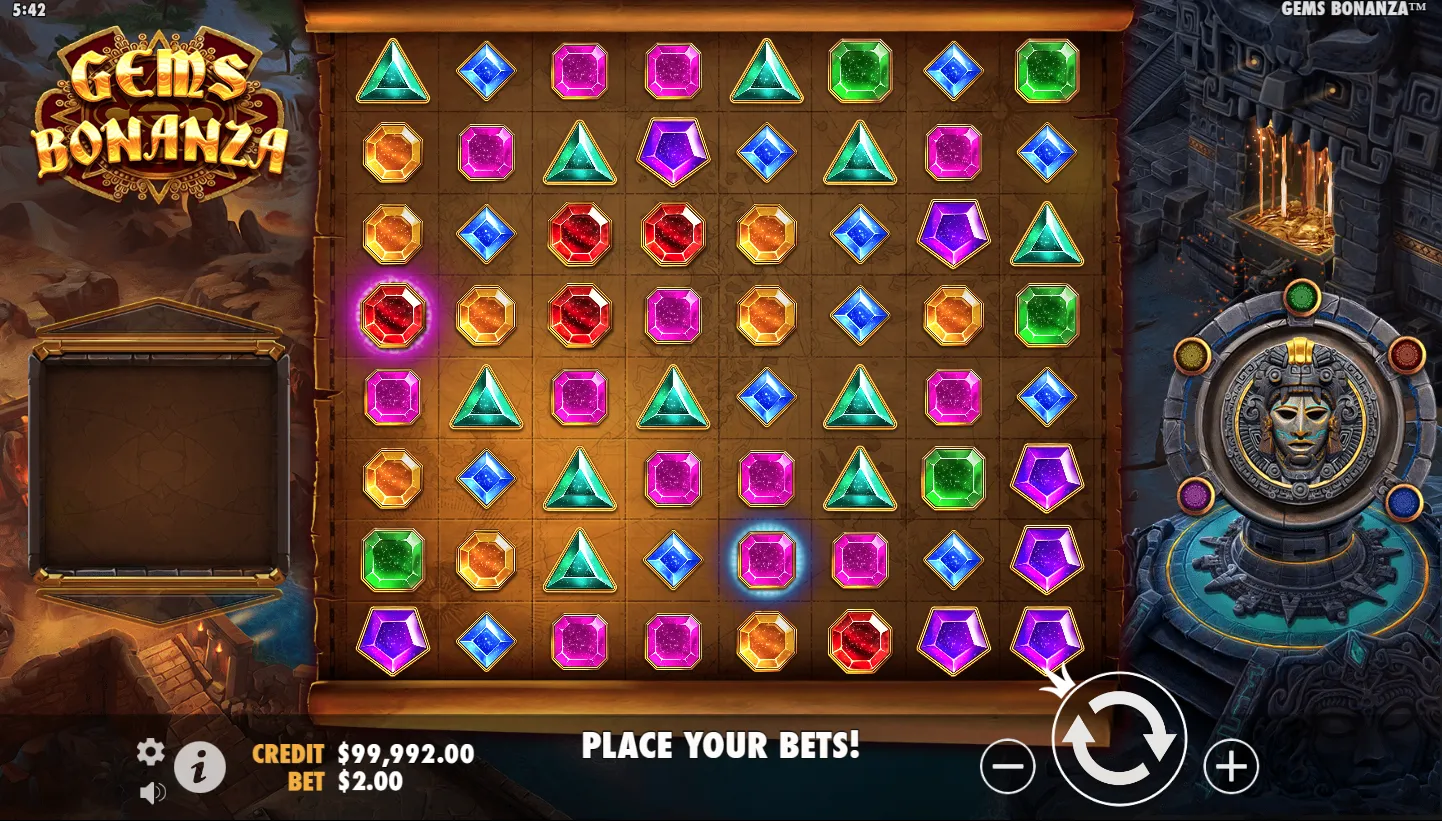
Gems Bonanza gameplay screenshot 1
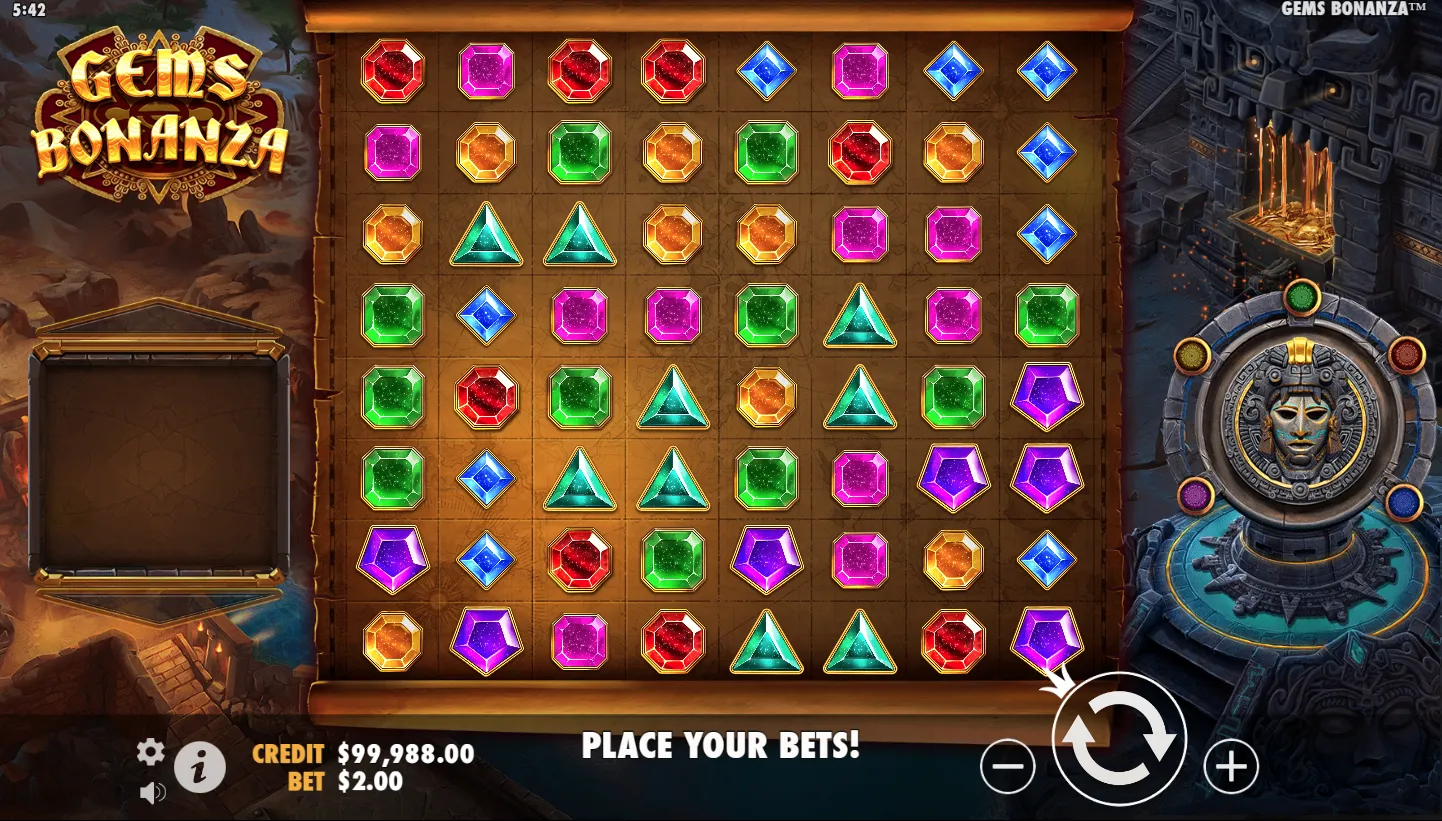
Gems Bonanza gameplay screenshot 2
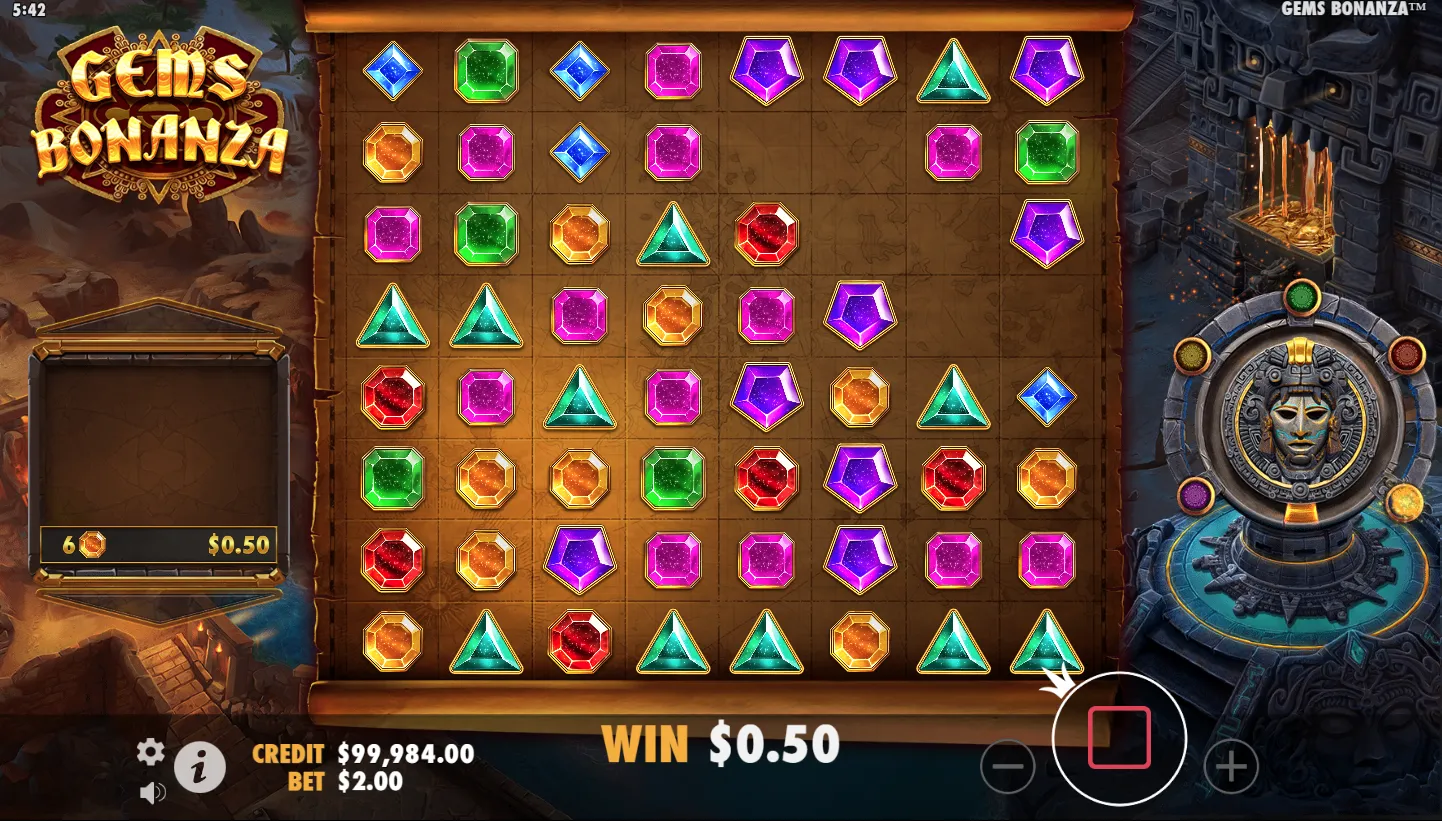
Gems Bonanza gameplay screenshot 3
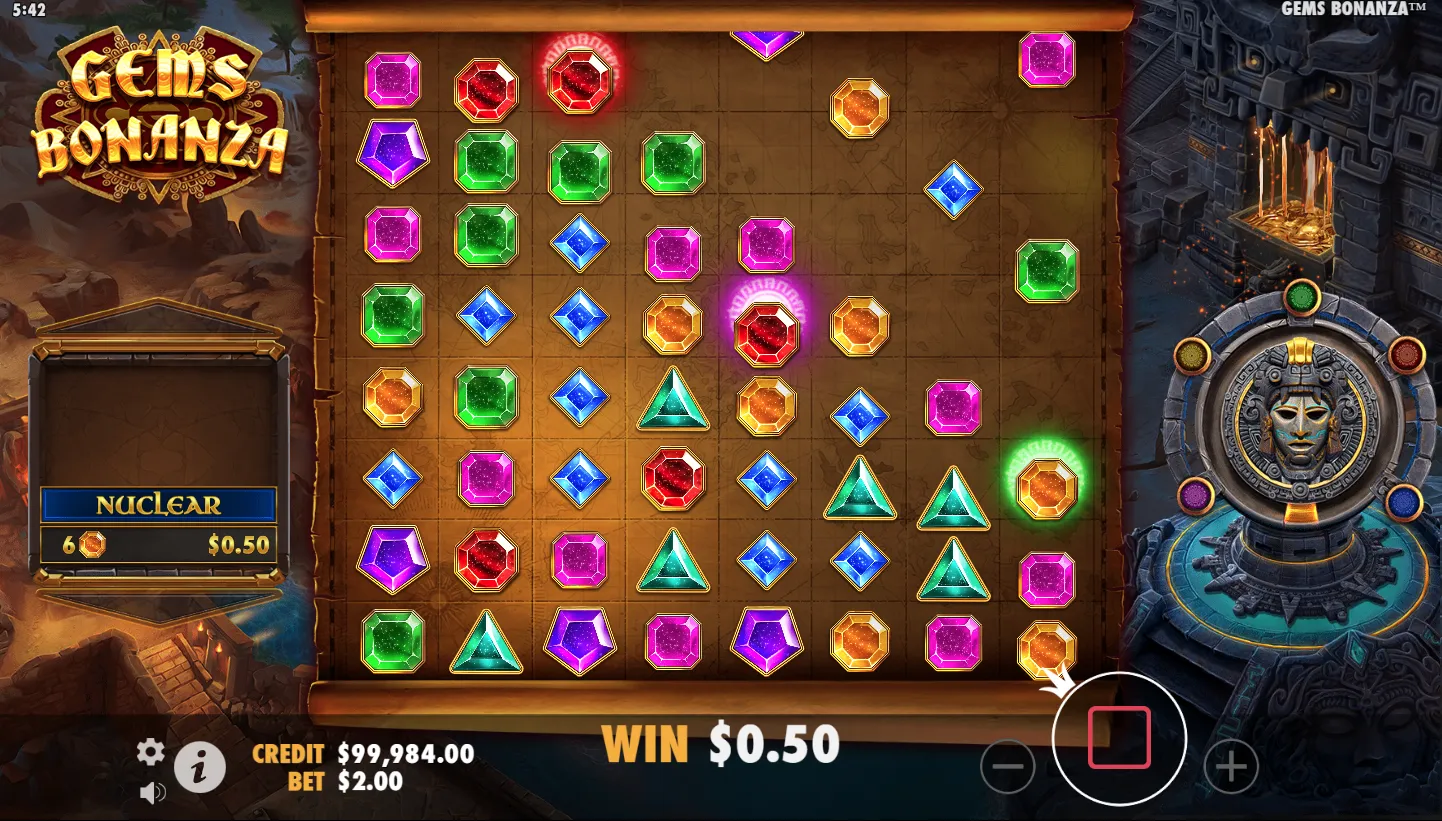
Gems Bonanza gameplay screenshot 4
Gems Bonanza gameplay screenshot 5

Paytable & Symbol Values

Winning combinations and symbol payouts

Symbol payouts

#PT
Symbol56789–1112–1415–1920–2425+
Gem 1other1×1.5×2.5×5×12.5×25×50×200×1000×
Gem 2other0.5×0.75×1.25×2.5×7.5×12.5×25×100×500×
Gem 3other0.3×0.5×0.75×1.25×3.75×7.5×15×50×300×
Gem 4other0.25×0.3×0.4×0.75×2.5×5×10×25×150×
Gem 5other0.2×0.25×0.4×0.6×2×3.75×7.5×20×100×
Gem 6other0.15×0.2×0.3×0.5×1.5×2.5×5×15×75×
Gem 7other0.1×0.15×0.2×0.35×1×2×3.75×10×50×

Each value is a multiple of the total bet for a block of that size. The seven gems run from the highest paying at the top to the lowest at the bottom.

Special symbols

#SS
Wild
The wild substitutes for all symbols and can join several winning blocks of different symbols at once. It reaches the grid only through the Wild Gem and Lucky Wilds features.

How 1,000 spins of Gems Bonanza can go

The shapes a session can take, with the chance of each

Gems Bonanza wins often and small, so a session turns on its 7.3 wins of 20x or more

SC

Sarah Chen

Streaming Specialist at 0xPlaySlots

1,000 spinsSeptember 14, 2026
  • A run of 10 or more spins without a win

    over 99%

    Ten dead spins in a row cost 10 units and belong to almost every session of this game. They are the normal rhythm of the grid and no reason to change anything.

  • A run of 14 or more spins without a win

    68%

    Fourteen spins is the typical longest dry spell. It costs 14 units, about two fifths of the 34.5 units the whole session is expected to cost, so the budget has to absorb it without strain.

  • A run of 20 or more spins without a win

    9%

    Twenty straight losses cost 20 units, more than half the expected cost of the session, in one stretch. This is the dry spell worth building into the bankroll.

  • A run of 30 or more spins without a win

    1 in 591

    Thirty dead spins cost 30 units, nearly the full expected cost of the session in one stretch. It is too rare to size a bankroll around.

  • No win of 20x or more in the session

    1 in 1,519

    With 7.3 such wins expected, a session without one leaves the balance to small blocks that mostly pay below the stake. It is the bleakest shape this game offers.

Over 1,000 spins at a stake of 1, Gems Bonanza is expected to return 965.5 units, so the session costs 34.5 units on average. That average hides almost everything about how the game treats a bankroll. This is a high volatility grid, and the gap between an average session and a real one comes from the size of its wins, not their number.

Many wins, most of them small

About 333 spins are expected to win something. That count flatters the game. A 5-block of the lowest gem pays 0.1x, and the four lowest gems stay below the stake until a block reaches 9 symbols, so a typical winning spin still loses part of the stake. A 0.1x win ends a dry run and still costs 0.9 units.

Runs with no win at all are pure loss, and they are routine. The longest one in a typical session is 14 spins, and the chance of meeting a run that long is 68%. A run of 10 or more comes up in over 99% of sessions. The run I would build the budget around is 20 spins or more: it arrives in 9% of sessions and takes 20 units straight, more than half of what the whole session is expected to cost. Thirty spins without a win is a 1 in 591 event and not worth sizing anything around.

Where the return comes from

The balance moves on bigger results. The session expects 16.67 wins of 10x or more and 7.3 of 20x or more, an average gap of 137 spins between the larger ones. Those 7.3 wins return at least 146 units on their own, and that floor counts nothing above 20x. The chance of going the whole session without a single 20x win is 1 in 1,519.

So the figure a bankroll has to answer is not the 34.5-unit average but the stretch between those wins, when small blocks hand back fractions of the stake and dry runs take whole units. I would bring enough to cover a gap longer than 137 spins, because an average gap is not a long one.

Gold Fever and the buy

Gold Fever is where the level multipliers climb to 10x, and reaching it is hard by construction: one base game spin has to explode 114 symbols, almost two full boards, and the meter empties when the spin ends. I would not plan a session around meeting it. The buy costs 100 units at this stake, close to three times the expected cost of the entire session, so it belongs to a separate budget from the spins weighed here. Casinos can also run this game at a lower return setting, which raises the expected cost of the session, and the rules screen shows the one in use.

Our Team Reviews

Signed reviews from our team

1 review
FEATURED

Every quota in Gems Bonanza is bigger than its grid, and each one after the trigger is bigger still

AP

Alex Petrov

Bonus Hunter at 0xPlaySlots

September 23, 2026
6.6/10

A quota game on a grid too small for its quotas

Gems Bonanza runs on counts its own grid cannot hold. The 8×8 board has 64 cells. Gold Fever opens when a single base game spin explodes 114 winning symbols, and the levels inside the round ask for 116, 120, 125 and 132 to climb. No dealt board can meet any of those counts by itself, so reaching the round the natural way, and climbing it by any route, depends on tumbles and spin features refilling the grid again and again. I think that is a real idea with a clean route to 10,000×. Against it, the quotas never ease and the paytable gives small blocks almost nothing, which holds the game at competent rather than good.

The family is easy to place. Wild Beach Party shares the cluster grid that tumbles and refills from above, Fruit Party attaches random multipliers to winning blocks, and Sugar Rush lets the grid positions that host wins build toward bigger payouts. Gems Bonanza shares that last premise, that where a win lands matters, but pays it out in a different currency. A win over a coloured mark queues one of five spin features, and none of them is a multiplier; the one multiplier in the game belongs to the Gold Fever levels. That choice sets the character of the base game. A base spin whose wins miss every mark gets no wild, because wilds reach the grid only through Wild Gem and Lucky Wilds, and no multiplier either. What remains is a bare tumble over a paytable where six of the seven gems pay less than the stake for a 5-block and the top gem pays exactly the stake.

The paytable is drawn around the Colossal Symbol

I count two cliffs in the paytable. From 8 symbols to 9, a block's pay multiplies by 2.5 on the top gem and roughly triples on the other six. Between 24 and 25 it multiplies by 5 on five gems and by 6 on the other two, which takes the top gem from 200× to 1,000×. The Colossal Symbol's three sizes sit on those steps: a 3×3 block is 9 symbols, the first cliff; a 4×4 is 16, inside the 15-to-19 band; a 5×5 is 25, the top tier. On its own, the base paytable is not built to carry play. It is a price list for blocks the features build.

Which gem the Colossal Symbol picks matters as much as its size. A 4×4 of the top gem is worth 50× on its own, exactly what a 5×5 of the lowest gem is worth. The other features feed the blocks rather than pricing them. Squares drops 2×2 blocks, four cells each and one short of the 5-symbol minimum, so a square pays only when a matching symbol or a wild joins it. Wild Gem turns every copy of one symbol wild and Lucky Wilds adds 5 to 15 wilds, and since a wild can join several blocks of different symbols at once, those two are how medium blocks merge into large ones. Nuclear pays nothing by itself. It clears the whole screen and drops in a fresh set, 64 new cells in a game measured in exploded symbols, which makes it the most useful feature for the quota.

The ladder climbs fivefold in pay and barely at all in effort

Gold Fever is a ladder of levels rather than a count of free spins. Each level plays all five features once, in the fixed order from Nuclear to Lucky Wilds, and a level that explodes enough winning symbols moves play up a rung. Multipliers run 2×, 4×, 6×, 8× and 10×; targets run 116, 120, 125 and 132. Pay rises fivefold from the first level to the last while the target rises by 16 symbols, about 14%, and the help each level gets stays the same: five features, once each.

So the round does not get steeper as it climbs. It sets the same test four times with the pass mark nudged up each time, and one miss ends it. Reaching level 5 takes at least 493 winning symbols across four consecutive levels, and the last target, 132, is more than two full boards of 64. Count for count, level 1 asks only 2 more symbols than the trigger did, with all five features guaranteed instead of only those whose marks a base spin's wins happened to cover. I rate that flat effort curve as the best decision in the design. Clearing level 4 asks for just 16 symbols more than clearing level 1, so the ladder does not tax a round for climbing. The cost sits in the repetition: four passes in a row have to succeed for level 5 to play, and a single short one ends the round.

One block is worth the cap only at level 5

Before multipliers, the most any single block can pay is 1,000×, and only the top gem's 25-block reaches it. At level 5's 10× that block is exactly the 10,000× cap, which makes level 5 the only place where one block is worth the cap on its own. The next-best 25-block, the second gem's 500×, comes to 5,000× there, half the cap. Below level 5 the cap is a sum. At 2× it takes 5,000× of paytable value, at 4× 2,500×, at 6× about 1,667× and at 8× 1,250×. The base game has no multiplier, so it needs 10,000× of paytable value, the equivalent of ten top-gem 25-blocks in one spin sequence.

The cleanest route to the ceiling therefore runs through three gates: four cleared levels, a Colossal Symbol that rolls its 5×5 size, and the top gem as its symbol. On the top gem, the size gate alone is worth a factor of 20, from 50× for a 4×4 to 1,000× for a 5×5. I do not count this as a flaw; a 10,000× ceiling should be hard to reach. It does mean the ceiling tells a reader little about a Gold Fever that stops early, and the ladder has four places to stop before level 5.

The buy is priced for the top rung and decided on the bottom one

The Gold Fever buy costs 100× and opens the round without the 114-symbol spin. Its best case is the cap, 100 times its own price, and against that ceiling the price is fair. Against the floor it is harsh. A bought round that falls short of 116 is one pass of the five features at 2×, and to pay back 100× that pass has to produce 50× of paytable value: a 4×4 Colossal of the top gem on its own, a 25-block of the lowest gem, or a 20-block of the third gem. Each is a large block to ask of one pass. Clearing level 1 changes the sums quickly, because at 4× level 2 needs only 25× of paytable value to cover the price by itself. The buy is therefore a bet on level 1 far more than a bet on the ceiling.

Worth it on the 96.55% setting, and for ladder players only

Casinos can run the game at 96.55%, 95.54% or 94.53%, and the rules screen shows the one in use. The gap between the top and bottom settings is 2.02 points, which takes the house edge from 3.45% to 5.47%, close to 1.6 times as much. A game whose base paytable is already this thin has nothing to spare, and the 94.53% version is a worse game rather than a variant of the same one.

The player this suits wants the whole game to turn on one question: whether the five features can keep clearing a quota of about two boards, level after level. That player accepts base spins built on small pays, no wilds without a mark, and a meter that forgets everything when the spin sequence ends. Anyone who wants progress that builds across spins, or wilds and multipliers in ordinary play, should look elsewhere. The design is better than its numbers, and the numbers are what hold it at competent.
Pros

  • Coloured marks make where a win lands matter, and each one queues a feature with a distinct job
  • Colossal Symbol sizes of 3×3, 4×4 and 5×5 land on the paytable's 9, 15-to-19 and 25-symbol tiers
  • Level targets rise only from 116 to 132 while the multiplier climbs from 2× to 10×
  • A top-gem 25-block at level 5 pays exactly the 10,000× cap, a clean single-block route

Cons

  • Six of seven gems pay under the stake for a 5-block, and base-game wilds need a mark win
  • Every quota is bigger than the 64-cell grid, and the meter forgets all progress when the spin sequence ends
  • A Gold Fever that misses 116 symbols ends after one pass of the five features at 2×
  • A bought round that stops at level 1 needs 50× of paytable value just to pay back its 100× price
  • Casinos can run it at 94.53%, taking the house edge from 3.45% to 5.47%

Verdict

Marks feeding features and features feeding a five-level ladder is a real idea with a clean route to 10,000×. A thin paytable, a forgetful meter and quotas that outgrow the grid at every step hold it at competent rather than good.

#GP

Game Provider

#GD

Game Details

Information

Pragmatic Play
October 28, 2020
Video Slot
Cluster Pays
Cluster Pays