Nothing in this game outlives its own spin
Extra Juicy Megaways is built from sealed spins. In free spins a multiplier lives only until its tumble chain ends, no symbol adds a spin, and the length of the round is fixed before the first free spin drops. I read that one decision as the key to the whole game. It is why the gamble wheel is honest, in expected value as well as in spin count. It is also why the round never gathers momentum, and why a 5,000x cap that sits low for volatility of 5 out of 5 is still so hard to approach. Honest and thin is what a 6.3 looks like to me.
I can trace every part of it. The free spins run the Sweet Bonanza rule, multiplier symbols whose values are added together and applied to the whole tumble chain's win, which is also the summed-at-the-end logic of Gates of Olympus. The frame is Pragmatic Play's own Megaways layout with tumbling wins and a scatter-triggered round, the one 5 Lions Megaways uses. What this game adds is mostly in the base game: ways that pay from any starting reel and tumbles that clear whole reels, plus a diamond that does double duty, a scatter before the round and a multiplier during it. I call that a refinement of the frame rather than of the bonus. The borrowed multiplier resets with every chain here, and nothing new was built around it to link one free spin to the next.
The base game moves a lot and pays in fractions
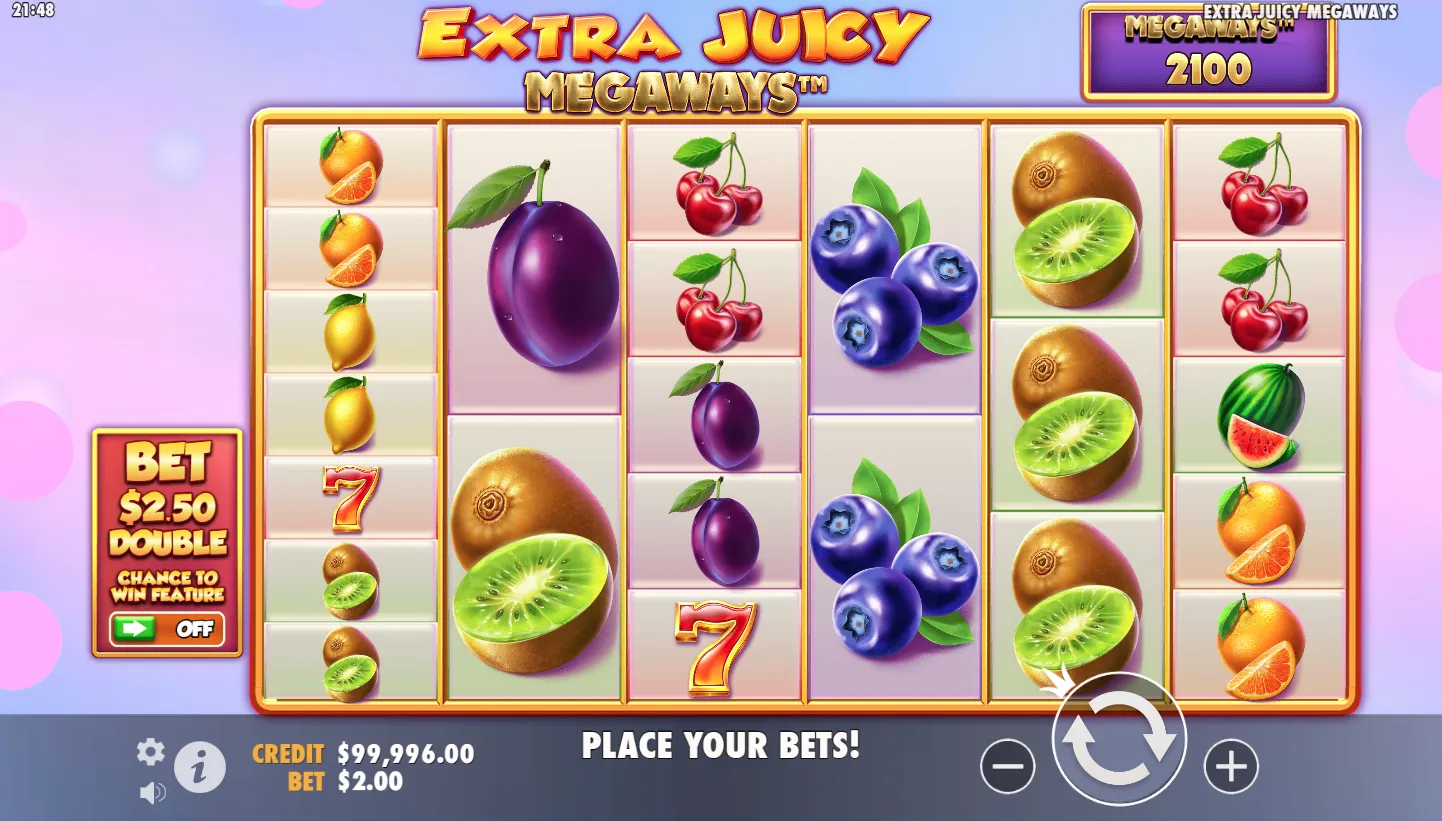
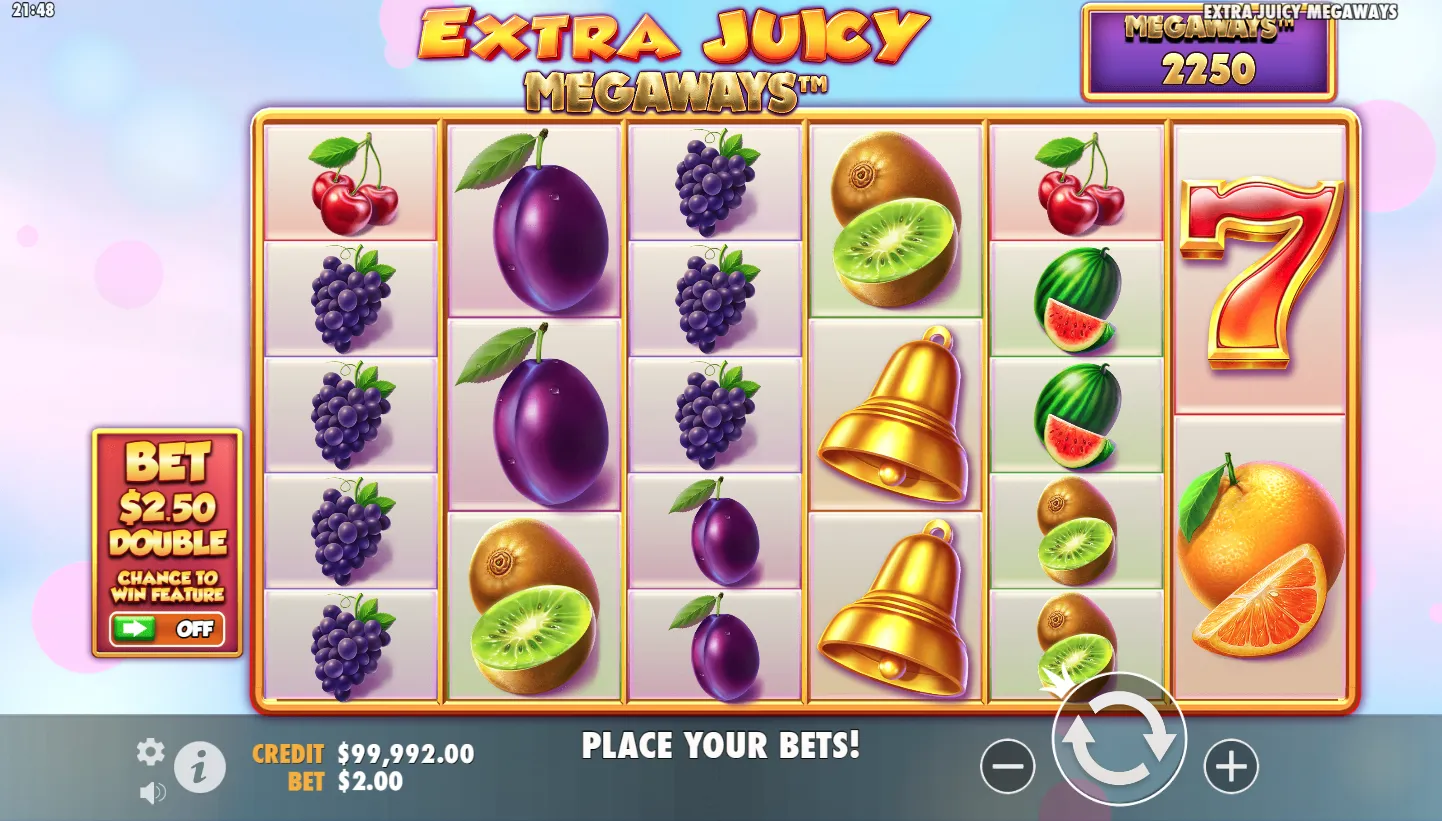
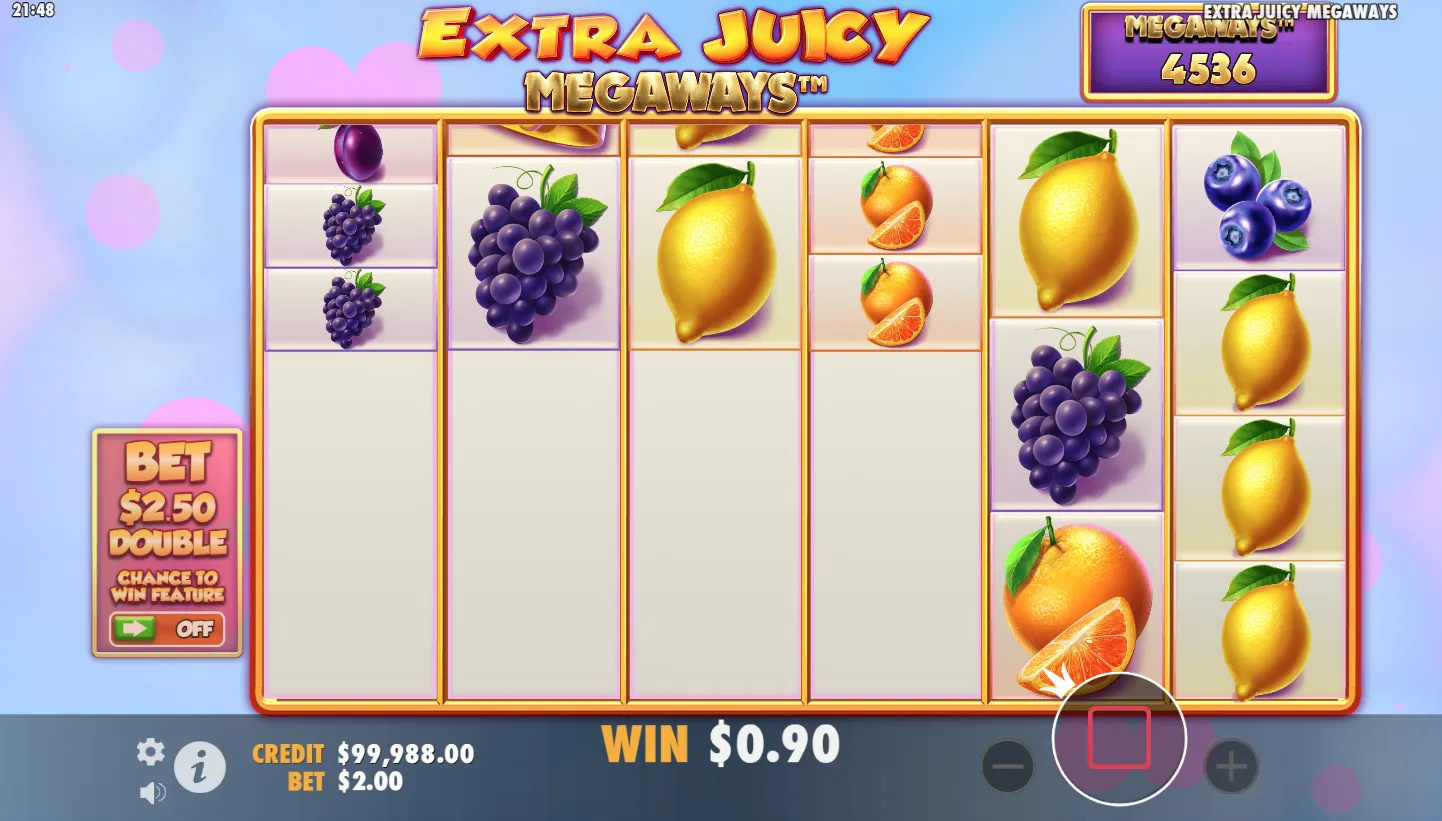
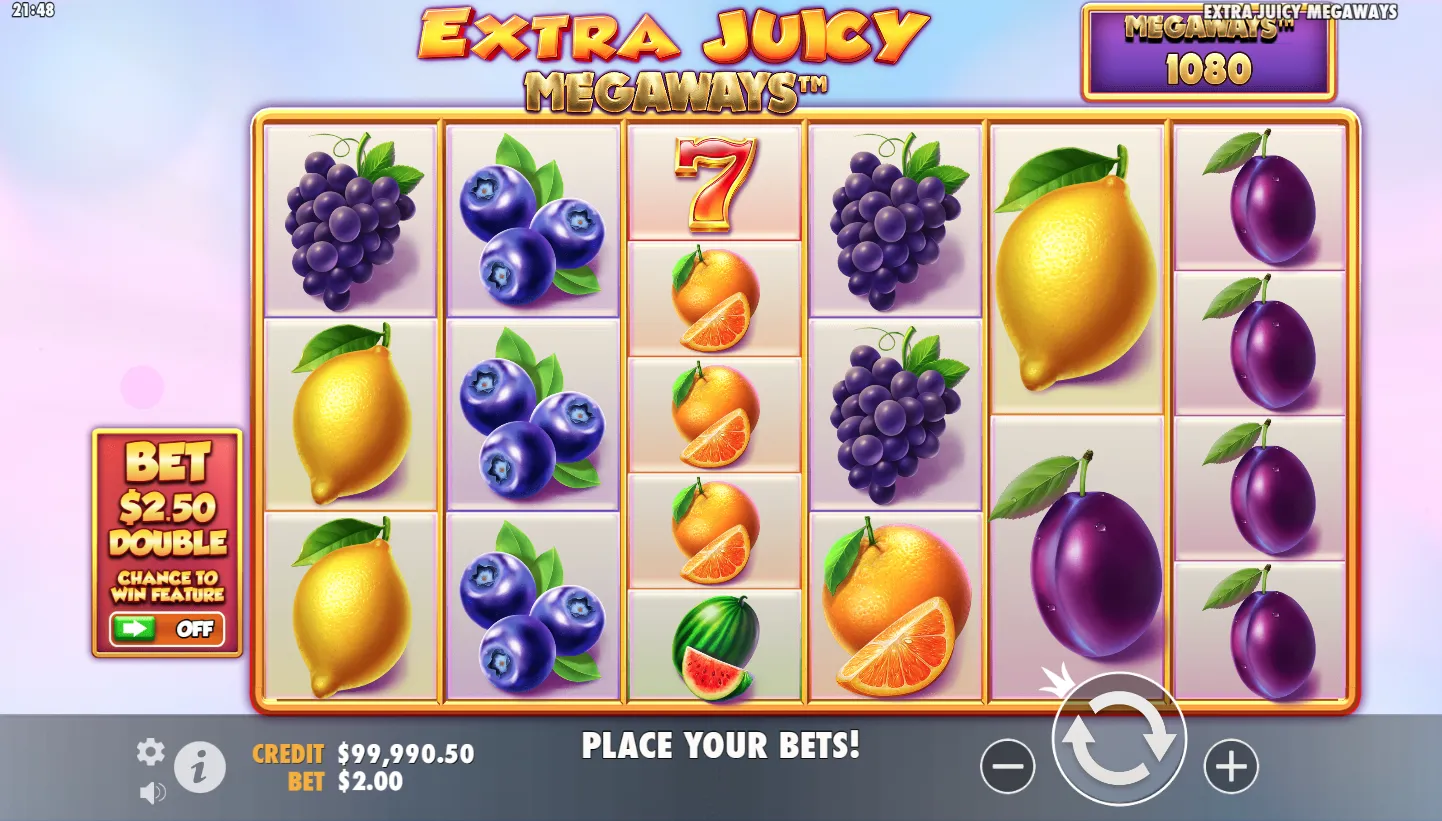
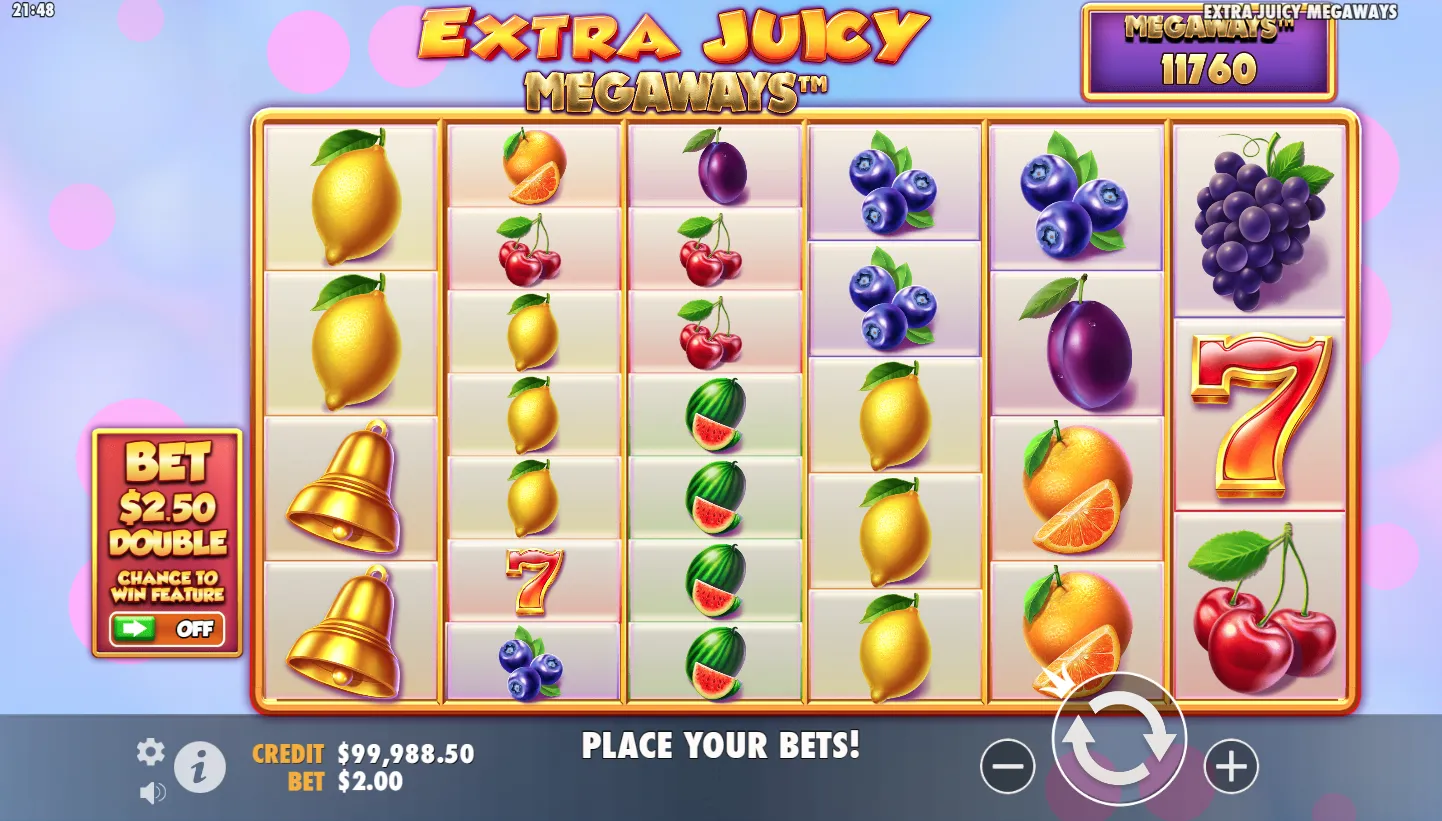
I count the difference any-reel ways make, and it is larger than it looks. On six reels a three-symbol run has four places to start instead of one, a four-symbol run has three and a five-symbol run has two. Only a full six-reel run is unaffected. Whole-reel tumbles push the same way. In the base game a win clears everything but diamonds from each reel it touches, so a three-reel win at full height redraws up to 21 symbols in one step, with the refill keeping the heights of the first drop. A winning spin changes a lot of screen.
The paytable does not keep up. I count 30 of its 40 single-way prizes below the stake. Every three-of-a-kind pays 0.75x or less on one way, the seven is the only symbol that beats the stake with four of a kind, and kiwi, grapes, lemon and cherry stay under it even with six. The top line of the whole table, six sevens on one way, pays 6x. With no wild to complete a way, all that movement mostly reshuffles fruit worth a fraction of the bet.
There is no multiplier in the base game either, so every coin of a base-game win comes from this table, and I find the arithmetic against the cap stark. Built from sevens alone, one drop would need 834 ways of six to reach 5,000x. Three sevens on every reel makes 729 ways and pays 4,374x, still short. A long chain can add more on top, but the base game's real job is to deliver four diamonds, and it does link events inside a spin: diamonds survive tumbles, so a spin that shows three can reach four during its chain. Inside a spin, things connect. Between spins, nothing does.
A free spin is worth its own chain times its own diamonds
In the round every diamond lands as a multiplier worth 3x, 4x, 5x, 6x, 8x, 10x, 12x or 15x. When the spin's chain ends, the values are added and the chain's total win is multiplied by the sum. A diamond on a spin with no win pays nothing, and none survives into the next spin.
I find the single-spin arithmetic harsh. The top line of the table under the top multiplier, six sevens at 6x times a lone 15x, pays 90x, less than the 100x buy price. For one spin to reach the cap by itself, a lone 15x needs a chain worth just over 333x and a lone 3x needs one worth nearly 1,667x. Stacked diamonds shorten that: two 15x add to 30x and bring the requirement down to just under 167x.
The round is the sum of those sealed spins. A bought round of 12 spins has to average 8.33x a spin to return its price and about 417x a spin to reach the cap. A strong first spin does nothing for the second, and a blank one costs the next nothing. Because diamonds in the round are multipliers rather than scatters, no spin can lengthen the round either. The round has no arc, only a count.
The gamble wheel is the best-designed part of the game
Before a round of 12 to 20 spins starts, the award sits on a ladder of 0, 8, 12, 16, 20 and 28. Moving up wins at 66.66% from 8, 50.00% from 12 and 16, and 33.33% from 20, and a loss drops one rung. Each step keeps the expected number of spins where it was. Gambled until it stops from the 12-spin start, the wheel finishes on 28 with a 3-in-7 chance, just under 43%, and on zero the rest of the time. The top rung matches the award for eight diamonds, and an award of 24 spins or more never sees the wheel.
Here I think the sealed spins earn their keep. Every free spin draws from the same reels and owes nothing to the one before, so the expected value of a round is its spin count times the value of one spin. A wheel that is fair in spins is therefore fair in expected value. The one bend is the cap, which forfeits whatever spins remain, and at 1 in 14,897,579 spins for the maximum that bend is too rare to change the decision. In a round where multipliers built up, later spins would be worth more than early ones and a spin-neutral wheel would reward gambling. Apart from the cap, this one neither rewards nor punishes it. It trades certainty for spread, which is exactly what a variance dial should do.
The edge is sharp on a purchase, because a bought round opens on the same wheel at 12. Two straight losses, a one-in-six chance for a player who takes two turns of the wheel, burn the full 100x before a single free spin. I count that as a real cost of the design, but a cost the player chooses.
Paying more buys speed, not return
Buy Free Spins costs 100x and returns 96.48%, 0.06 points above the standard bet and the best return at the default setting. I call the price fair against the base game. The ceiling is the problem: the best a purchase can return is the 5,000x cap, 50 times its own price, which is a low top for volatility of 5 out of 5. At the 12-spin rung each free spin costs 8.33x, gambled up to 28 it costs 3.57x, and gambled down to zero the 100x buys nothing.
I rate Ante Bet the weaker deal by some distance. It raises the stake from 20 coins to 25, a 25% surcharge, for 0.01 points of return, 96.43% against 96.42%. Because the return barely moves, the expected loss per spin rises by almost the full 25%. The cap falls to 4,000x the larger stake, which is 100,000 coins, the same cash as 5,000x the 20-coin bet, so the ceiling stays put as well. The surcharge buys denser diamond reels and a better chance of a trigger, and the buy switches off while it is on. At the 94.45% setting Ante Bet returns 94.40%, below the standard bet, so there it is a straight loss.
I weigh the casino settings above either button. The house edge is 3.58% at the default, 4.63% at the 95.37% setting, about 29% more, and 5.55% at the 94.45% setting, about 55% more. The rules screen shows the setting in use.
The right player wants to set the risk, not ride a build
I see this game fitting a player who likes a busy base game, finds a casino running the default setting, and wants to decide the shape of the bonus at the wheel, gambling a short round into a long one or banking the 12. Anyone after free spins that grow, a round that extends itself, or a ceiling well above 50 times a buy price should look elsewhere, because none of those exists here.
The honest parts are real, and so is the thinness around them. Any-reel ways and whole-reel tumbles give the base game more movement than most Megaways titles, and the wheel is a fair dial. Sealed spins, no retrigger, a 5,000x ceiling, a poor Ante Bet and two lower casino settings are why I hold it at 6.3: competent and fair, not memorable.