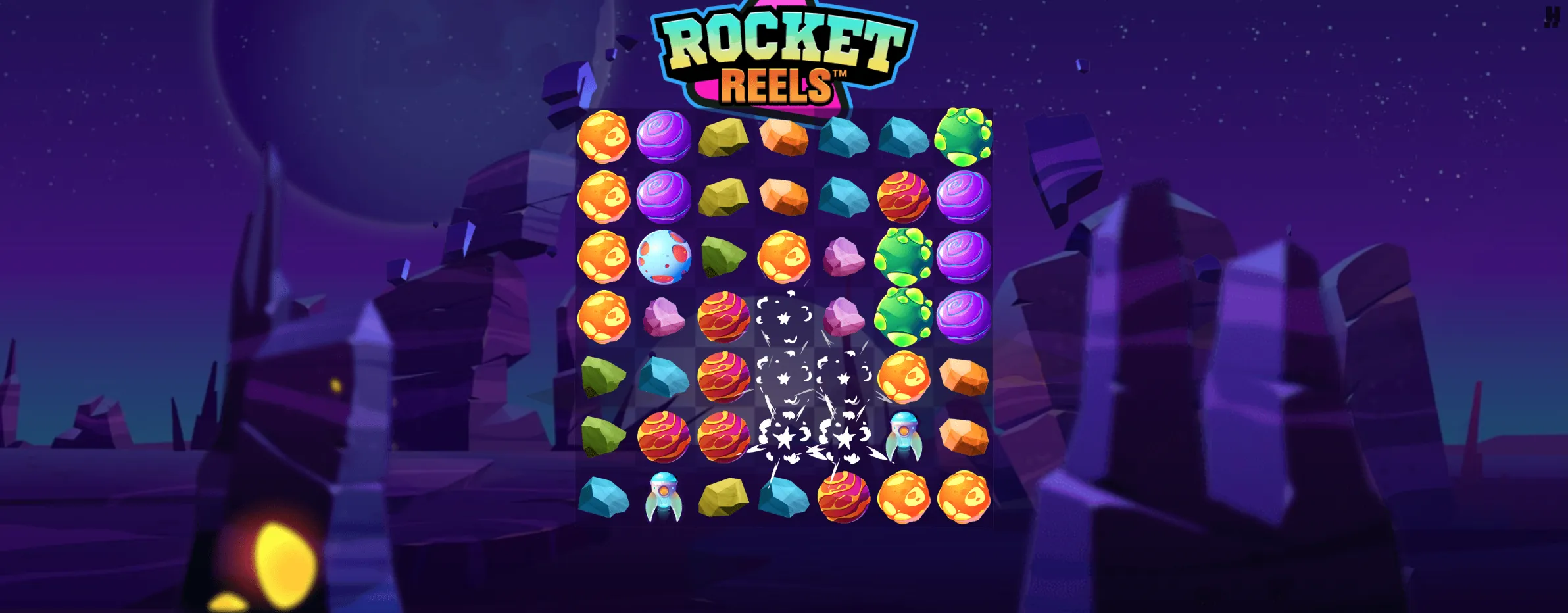
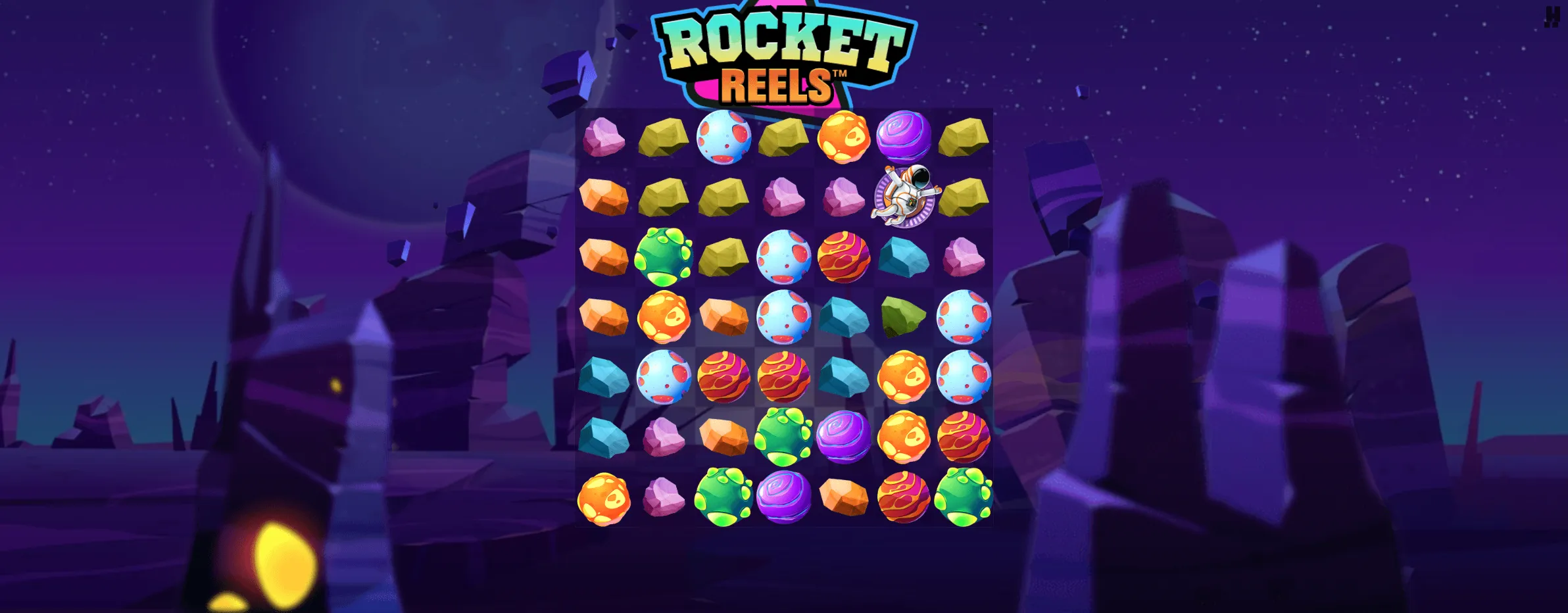
The rocket is the only new part, and the base game rations it
Rocket Reels has one genuinely good idea and a structure that keeps it locked away until the bonus. A rocket burns up its reel, destroys what it passes and leaves multiplier tiles on exactly the cells the next drop has to refill, so a fresh symbol over every tile is guaranteed and only the cluster is left to chance. That conditional is where the game's size lives, because no single cluster on its paytable pays more than 3% of the cap. The base game then gates the rockets behind three in view, withholds the Wild and wipes the tiles when each round ends. I read the result as a game whose real product is the 129× buy, and I find that buy fairly priced but only eight spins deep.
I place Rocket Reels in a format it shares rather than defines. Sugar Rush is the closest structural match, a 7×7 cluster grid with cascades where multipliers attach to grid positions and pay only when a later cluster re-forms over the marked cell. Candy Jar Clusters works the same size of grid and also carries its potential in multipliers dropped onto the board instead of in the symbol table, and Gronk’s Gems is one of Hacksaw Gaming's own connected-symbol grids with a buy on top. What this game changes is delivery. A cell gets marked by being destroyed, a whole trail at once, and the UFO can follow a launch by beaming away anywhere from 20 cells to all 49. That is a variation on how the multiplier arrives, not a new model, so I judge the game on whether it lets the delivery work.
No cluster here is worth much without a tile under it
The ceiling of the symbol table is 300×, for fifteen or more green planets. The table also stops counting at fifteen, so a fifteen-planet cluster and a board filled edge to edge with green planets pay the same 300×. Past that band, size adds nothing and only tiles scale a win.
The bottom of the table is where ordinary spins sit. I count all five rocks paying less than the stake for every cluster from five to eight symbols and exactly 1× at nine. A five-rock cluster pays 0.1×, so even the best Rocket 1 tile, 5×, lifts it only to half the stake. A lone 1× tile changes nothing at all and counts only as an addend to other tiles.
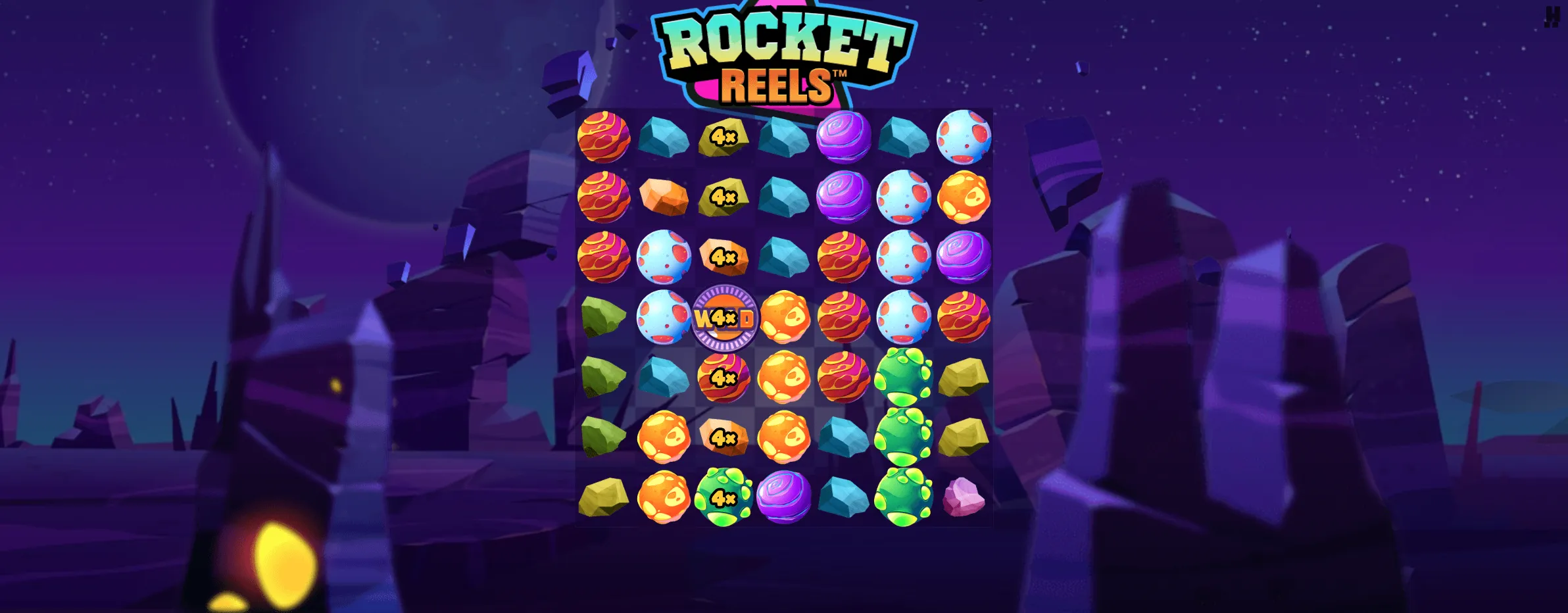
Going up, the best Rocket 2 tile of 20× under the best cluster makes 6,000×. A single 50× tile from Rocket 3 under the same cluster makes 15,000×, and the cap removes a third of it. Rocks need more help: a fifteen-rock cluster at 80× needs tiles summing to 125×, such as one 75× and one 50×, to land exactly on 10,000×. One cluster reaches the ceiling with a single 75× tile under any planet's top band. I therefore treat the maximum-win stop as a truncation the game's ordinary pieces run into rather than a remote figure.
Additive stacking is what keeps that legible. Two 75× tiles under one cluster give 150×. Compounded they would give 5,625×, enough for a seven-symbol green planet cluster at 2× to clear the cap, and the ceiling would be a formality. I rate summing as the most honest rule in the game.
The base game is locked three times
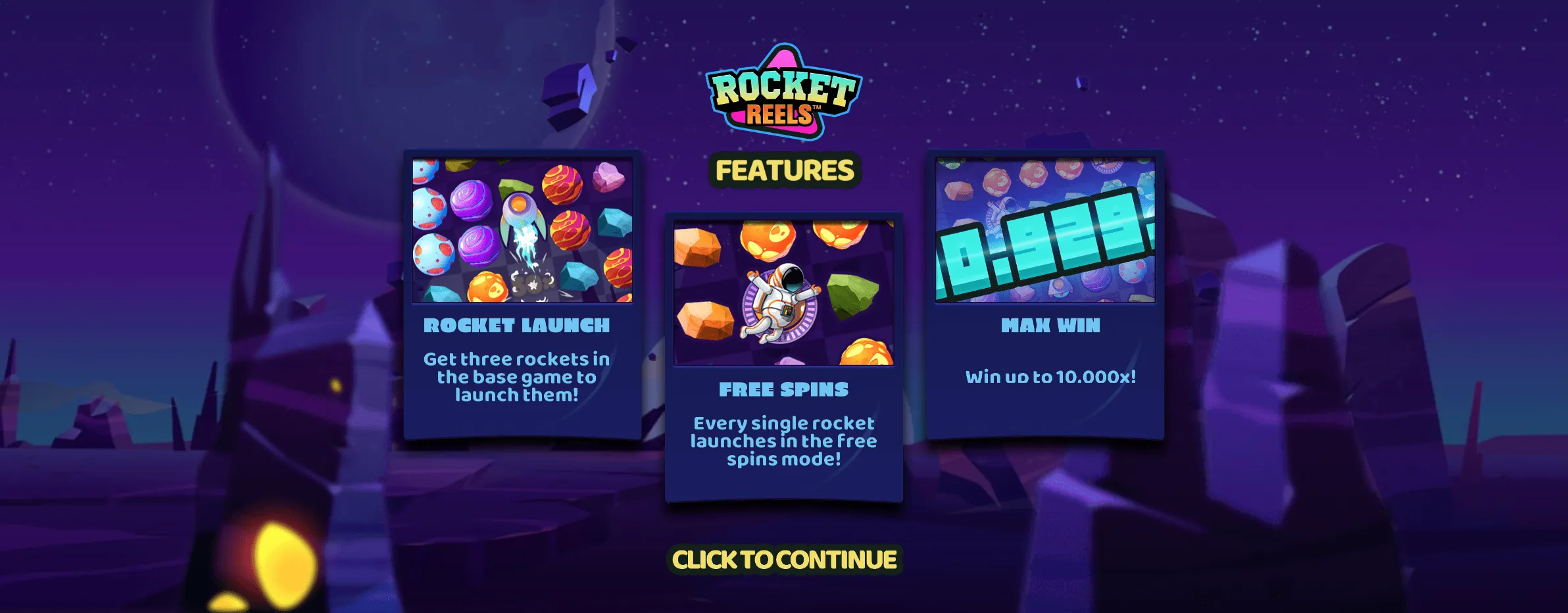
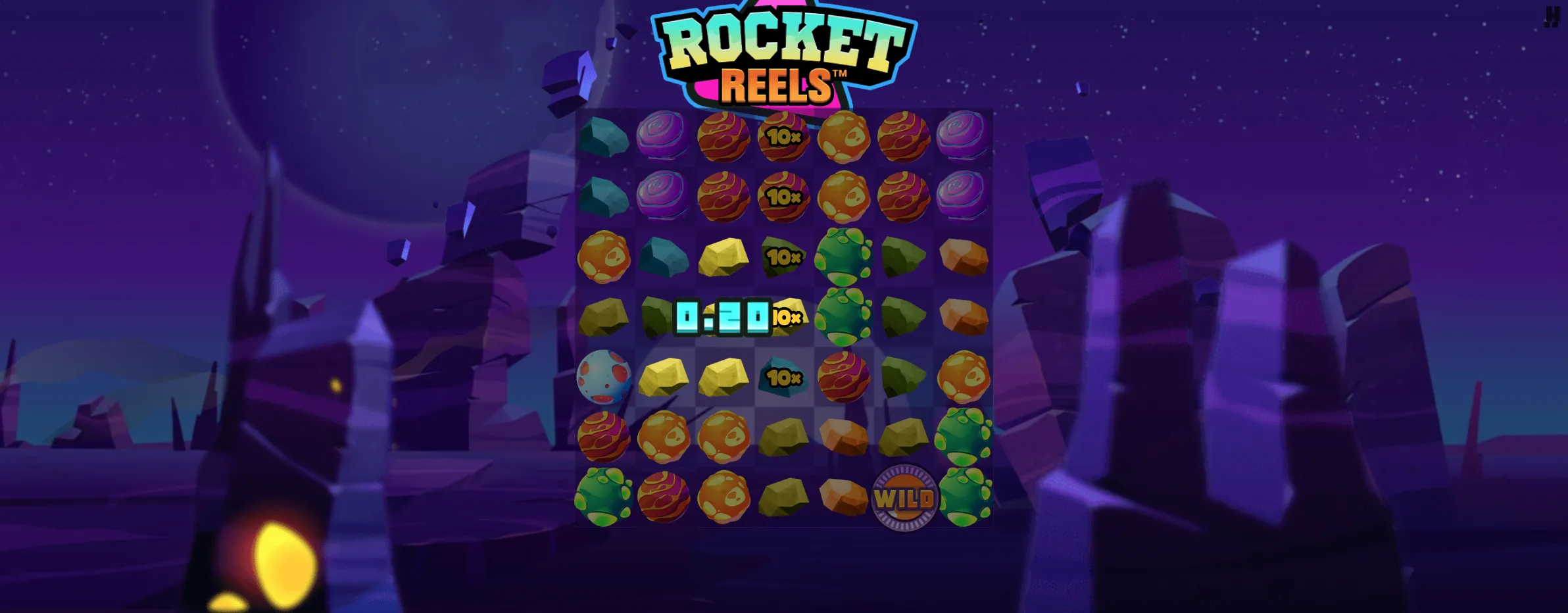
Rockets land at most one per reel, and in the base game nothing launches until three of the seven reels show one at the same time. The UFO appears only on spins where rockets have launched, so the base-game sweep sits behind the same three-rocket condition. The Wild never lands outside Free Spins, which leaves every base cluster to natural symbols. Whatever tiles are still on the grid when the cascade chain stops are wiped, so a base launch that fails to get a cluster over its trail before the board settles is lost.
Stack those and a base spin without three rockets is the paytable alone, where half the paying symbols return less than the stake until a cluster reaches nine. High volatility follows from the structure: the base game's return is concentrated in the spins that clear the gate and then build a cluster over a trail. I find no reason to spin it for its own sake. It exists to deliver three astronaut scatters, and it offers nothing else on the way.
At 129× the buy is fair, and eight spins are too few
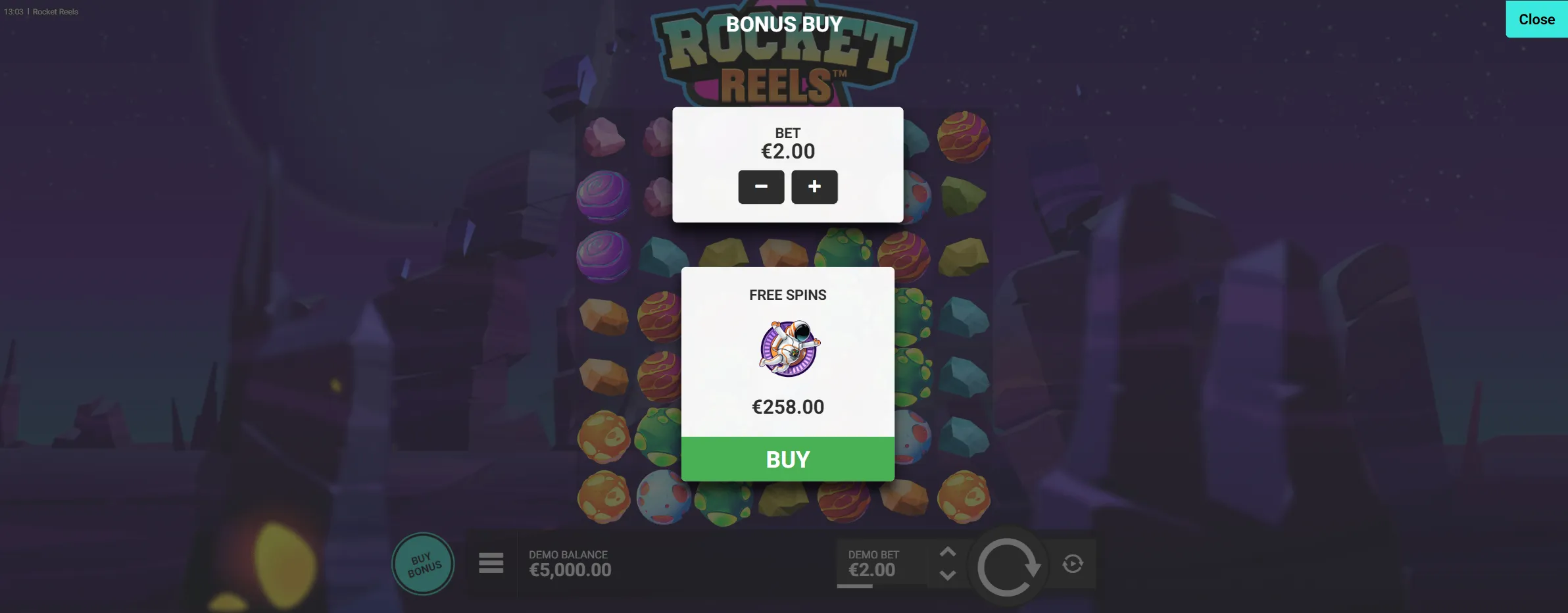
The Buy Bonus is the only purchase, with no cheaper tier and no feature-spin option. At 96.34% I put its average return at about 124.3× the bet, an expected cost of roughly 4.7× per purchase. Normal play at 96.30% keeps 3.70% of every stake and the buy keeps 3.66%, so buying carries no penalty. It is the same edge taken in one lump, fractionally cheaper. The best case is the cap, which is 77.5 times the price.
The price removes two of the three locks. Every landed rocket fires, the UFO becomes possible on any spin where one does, and the Wild can complete a cluster over a trail that natural symbols would have left one short.
Eight spins at 129× cost 16.125× the bet each. Without a tile under it, no cluster of nine or fewer symbols pays that much on any symbol, and at ten only the green planet does, at 25×. Of the 90 prices in the paytable, I count six above the full buy price, and all six belong to planet clusters of thirteen or more. The table's own prices sit far below the buy, so the bonus leans on the rocket conditional, and it gives that two-step event eight attempts: a rocket has to land, then a later drop has to build a cluster over its tiles. When that fails, the round pays small clusters back against 129×. The cap clips the other tail, since reaching 10,000× ends the feature and discards the spins still owed, so the upside stays at 77.5× the price however early it arrives.
It is a game for buyers, not spinners
I would point Rocket Reels at a player who has already decided to buy, wants a multiplier rule readable at a glance, and accepts a feature that resolves in eight spins. At the 0.20 minimum bet the buy costs 25.80, and at the 100 maximum it costs 12,900 wherever a casino allows that stake. Anyone who wants a base game that carries its own weight should look elsewhere, and so should anyone who wants a bonus that builds, because tiles do not outlive a base round, there is no upgrade path and there is one price. I see a competent and honest design with an idea worth studying, leaned on harder than eight spins can bear.