The board is borrowed, so the wheel has to earn the score
One wheel spin decides what Madame Destiny Megaways is worth. Its base game is a shared frame, its paytable is an owl and little else, and the free spins round, where the multipliers live, has its range set before its first spin by a wheel whose best result is worth thirty times its worst. The additive retrigger is the single mechanism that can overturn that draw once the round is running. One good idea on a board this game shares with two stablemates is why it sits at 6.4 and not higher.
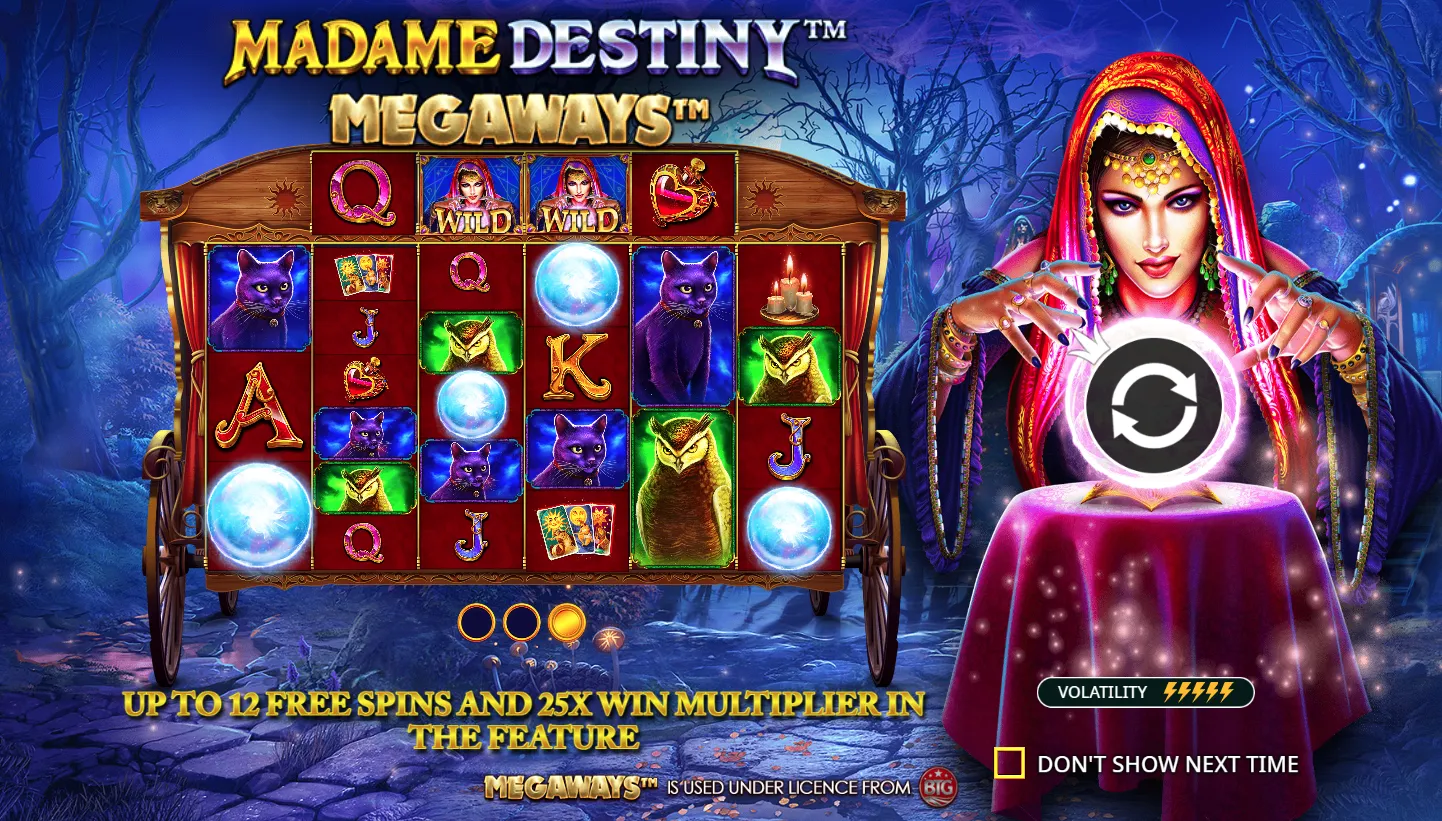
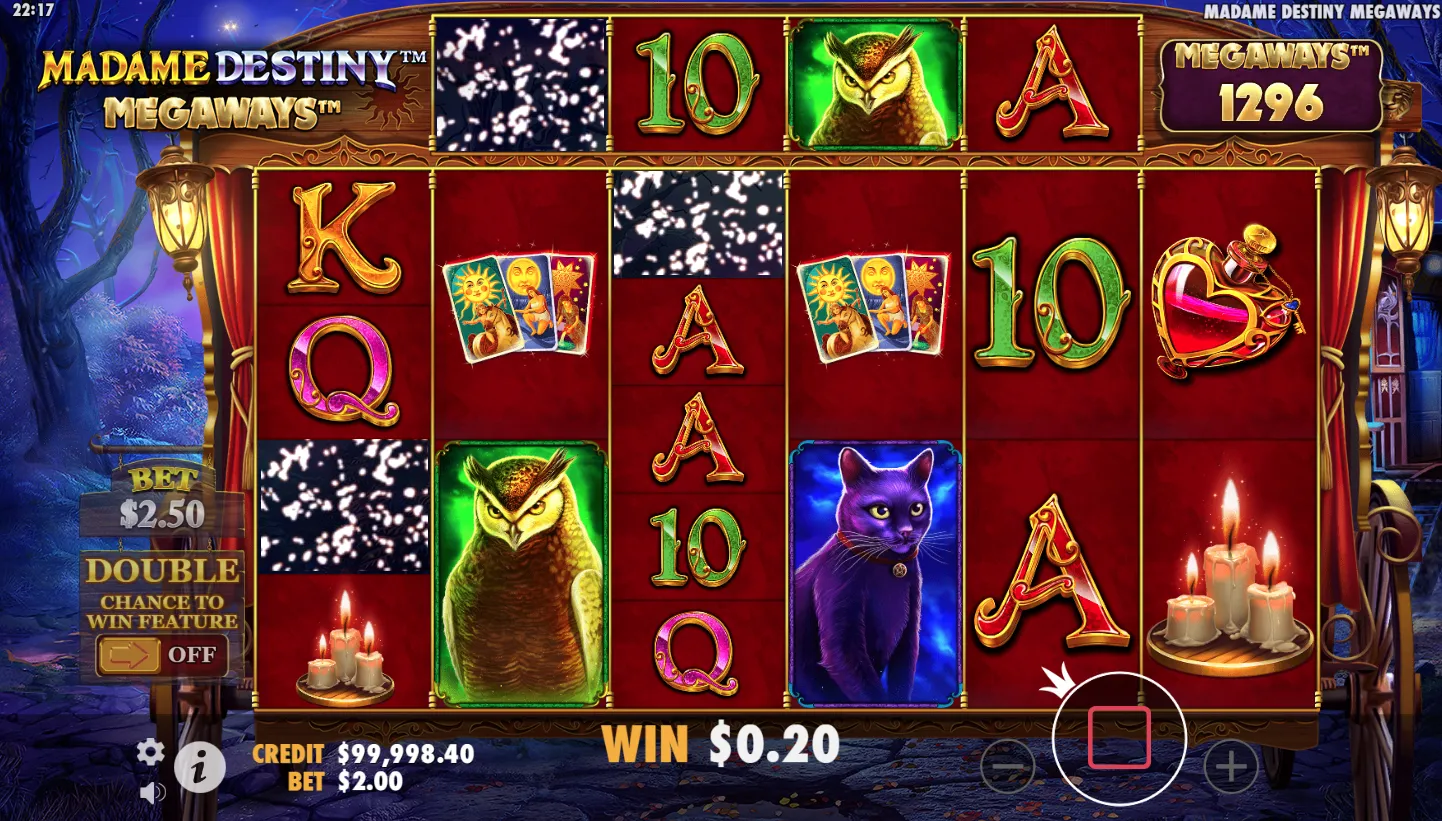
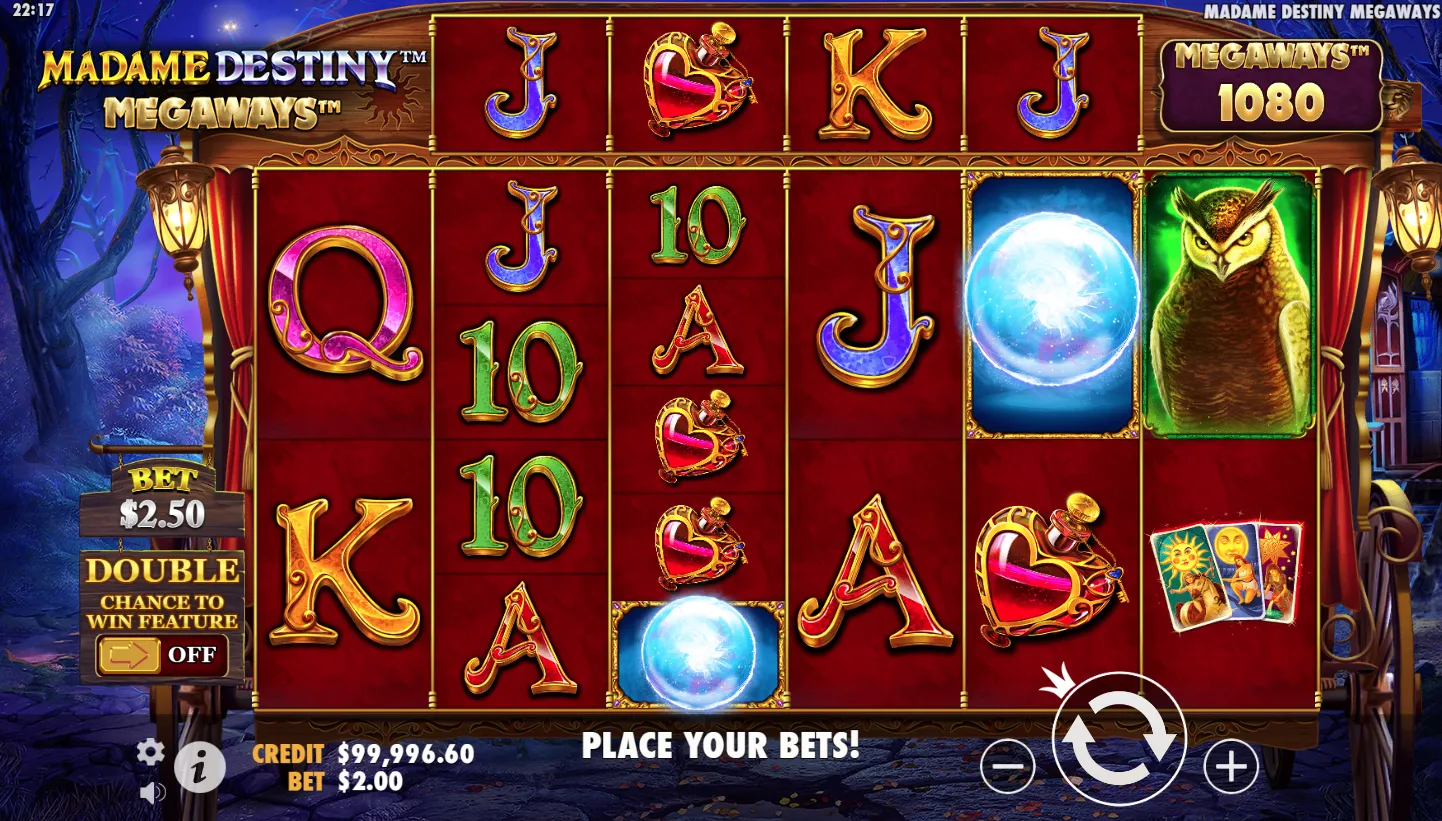
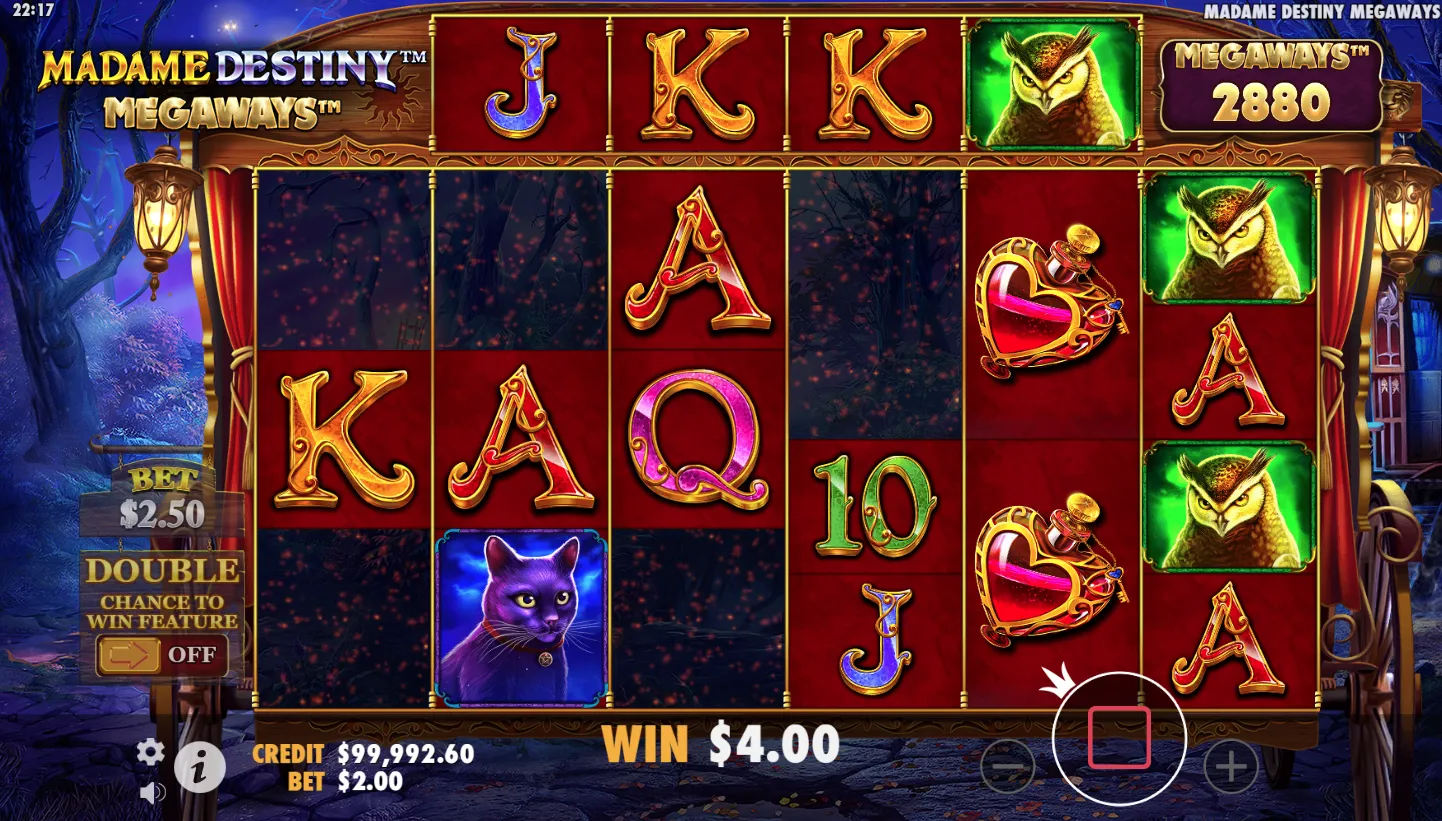
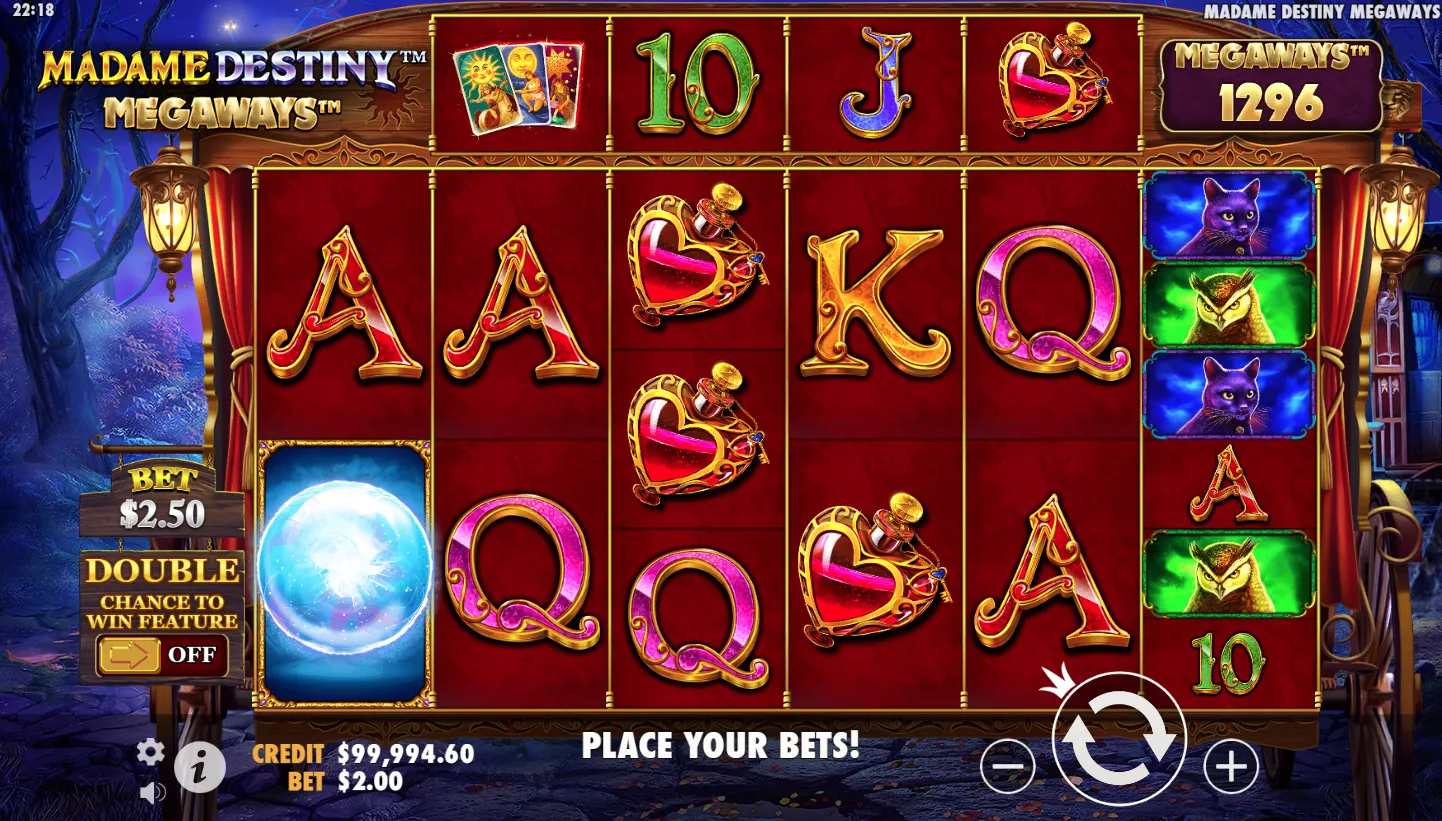
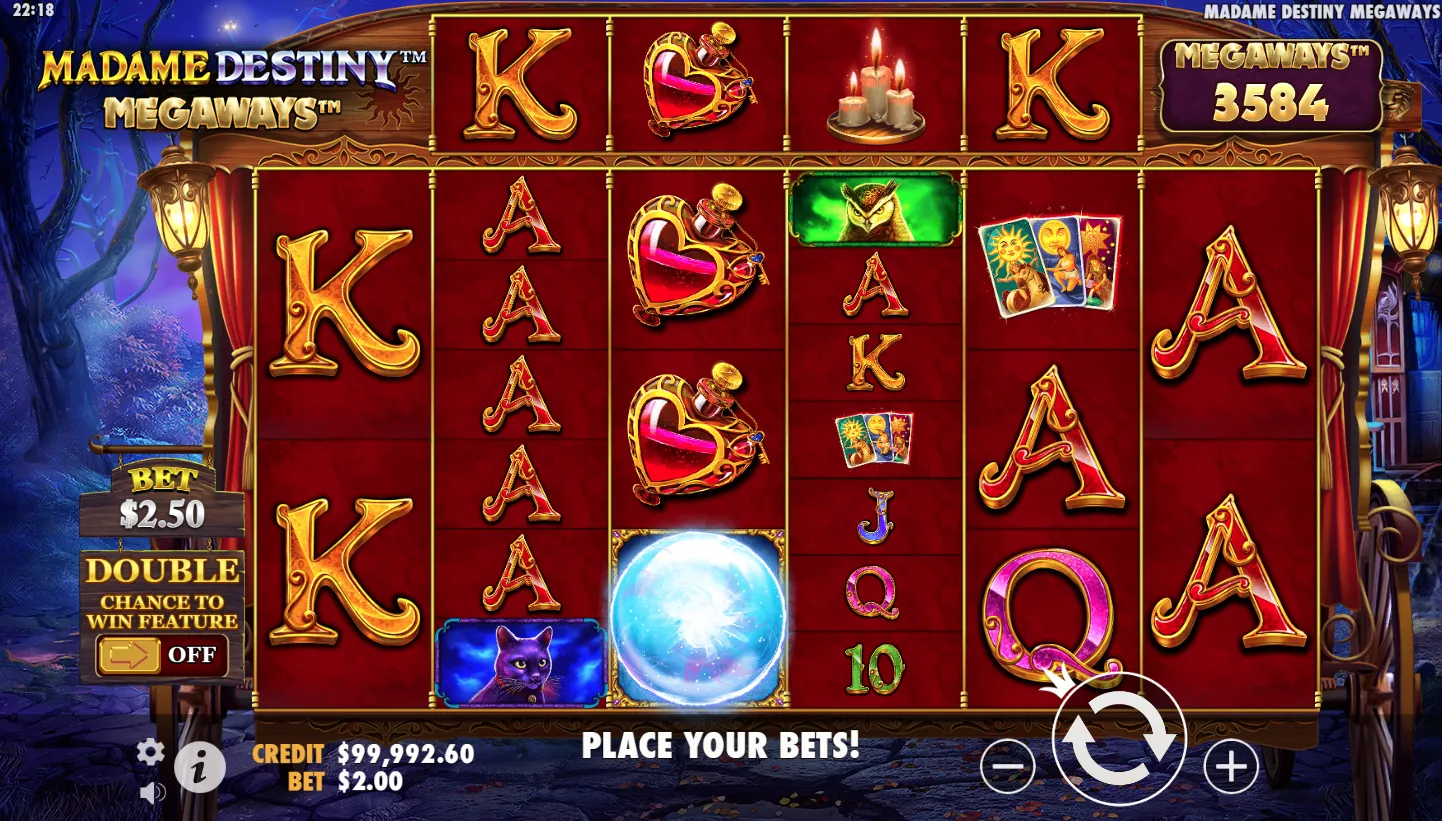
The frame is not new. Great Rhino Megaways and Buffalo King Megaways run the same Pragmatic Play tumble board: a horizontal row over reels 2 to 5 and up to 200,704 ways, which is 7 x 8 x 8 x 8 x 8 x 7 once the top row lifts each middle reel to eight symbols. Nothing in that frame belongs to Madame Destiny alone, so the case for choosing it rests on what sits on top: a wild and a wheel. The wild is the modest half. It doubles the combination it joins, and because the owl is the one symbol that pays for two of a kind, an owl on reel 1 beside a wild on reel 2 is already a paying way, doubled to 2x the bet.
The paytable is an owl and little else
Six of a kind is the longest a way can run, and at that length the owl pays 20x the bet. The black cat pays 3.75x. After that the drop is steep: potion 2x, candles 1.5x, tarot cards and ace 1.25x, and king, queen, jack and ten 1x each. Eight of the ten regular symbols return twice the bet or less for the longest way the board allows. The tarot cards count as a high symbol and pay exactly what the ace pays at every length, so below the top two the split between high and low is decoration.
The ways count is what rescues it on paper. Divide the 5,000x cap by the owl's 20x and the answer is 250: one spin's tumble chain needs 250 six-owl ways, or 125 if a wild doubles each of them, before the paytable reaches the cap on its own. A 1x symbol needs 5,000 ways. All of those counts fit inside 200,704, but each needs one symbol stacked deep across the whole board, and a total that would run past 5,000x stops at 5,000x. The chance of reaching the cap is 1 in 1,071,429 spins, and 5,000 divided by 1,071,429 is about 0.47% of stake, so less than half a point of the 96.56% default return comes from wins at the cap. The rest has to be built from smaller wins, and outside the multipliers of the round the paytable keeps most of them small.
The heaviest fixed pay in the base game is the scatter. Six crystal balls pay 100x, five times the owl's best, the same multiple the buy costs, and they open the round on top of it.
One wheel spin is worth thirty times another
The wheel sets the round before its first spin: 5, 8, 10 or 12 spins, and a multiplier of 2x, 3x, 5x, 8x, 10x, 15x, 20x or 25x that applies to the total win of every free spin and moves only when a retrigger adds to it. Multiply spins by multiplier and the spread is plain. The worst draw, 5 spins at 2x, is ten multiplied spins of value. The best, 12 spins at 25x, is 300. That factor of thirty is fixed before a single symbol falls.
Against the 100x buy price the same spread becomes a break-even line. On 5 spins at 2x, the round returns its price only if the reels average 10x of unmultiplied win per spin, the equivalent of a six-owl way on every other spin, or more than two and a half six-cat ways on every spin. On 12 spins at 25x, a third of the bet per spin covers the price, and a single three-cat way at 1x is three times that. The paytable I described above is adequate on the best draw and punishing on the worst, and nothing the player does picks between them.
The cap sharpens the split from the other end. At 25x, 200x of unmultiplied win across the round reaches 5,000x, and the round ends there with its remaining spins forfeited. At 2x the same cap takes 2,500x of unmultiplied win inside five spins, twelve and a half times as much board. The buy's best case is 5,000x, fifty times its cost, and short of a retrigger the wheel decides how far away that ceiling sits before the round begins.
The additive retrigger is the one idea that earns its place
Three or more scatters during free spins spin the wheel again, and the new spins and multiplier are added to the running totals instead of replacing them. That is what rescues a bad draw. A retrigger on 5 spins at 2x adds at least 5 spins and at least 2x, so the multiplier at least doubles for every spin that remains. On the best draw, a second 25x makes 50x. There is no limit on retriggers, so the running multiplier has no ceiling of its own, and what bounds its payout is the 5,000x cap on the round's total win.
At 50x, 100x of unmultiplied win reaches the cap, which is five six-owl ways, and a tumble chain that would pay past it stops at 5,000x. Retriggers are the only way a round stops being a single draw, and I still rate the retrigger as one strong idea rather than the whole case for the game. It needs the same three scatters as the trigger, on the round's own reels, so it is a correction the reels have to supply rather than one anyone can reach for. Every round still starts from its first wheel result.
Fair prices do not buy a better draw
Both extras return 96.67% against the 96.56% default, and both are fairly priced at that. The ante bet raises the bet multiplier from 20x to 25x and doubles the chance of a natural trigger. A quarter more stake for twice the chance means the stake spent per natural round falls to 62.5% of what it is without the ante, 37.5% less. Wins are still paid on the base bet, though, so a six-owl way worth 20x the base bet is worth 16 times the raised stake. If ways wins shrink against the stake while the overall return rises, the scatters and the round have to carry a larger share of that return. The ante makes the game lean harder on the wheel, not less.
Buy Free Spins costs 100x. At 96.67% the expected cost of a buy is 3.33x, a shade under the 3.44x that 100 bets of default play cost at 96.56%. Its best case is 5,000x, fifty times its price; its worst draw is 5 spins at 2x, which needs 10x of unmultiplied win per spin just to return the price. It is locked while the ante is on and offered only in some jurisdictions. The price is fair. What it buys is one wheel draw.
Casinos can also run the game lower. At 94.63% the house edge is 5.37%, and at 92.03% it is 7.97%, more than twice the default 3.44%, which is a different game to price. The rules screen shows the setting in use.
A game for players who only want the round
I would point this game at someone who wants a bonus round with its stakes set up front, and who accepts that the wheel fixes each round's range before it starts. That player gets a fair buy, a fair ante and a retrigger that can take the multiplier past anything the wheel shows. Anyone who values the base game should look elsewhere, because outside the owl the best six of a kind is 3.75x, and the board is the one Great Rhino Megaways and Buffalo King Megaways run. A player who wants a multiplier that grows through the round finds it here only when the reels supply a retrigger. That is competent Megaways design with one good idea, and 6.4 is what one good idea on a shared board is worth.