Beam Boys compounds inside one spin and nowhere else
My reading of Beam Boys comes down to one claim: the game multiplies its wilds inside a single spin and wipes them before the next. Within a spin, cats in different rows multiply each other through the ways count, and that multiplication is the engine of the whole game. Between spins nothing survives on the board, in the base game, in free spins or in any bought spin. The free spins round and all four buys therefore sell one product, more chances at a single good board, at different prices, and I judge the game on whether that product is worth the money.
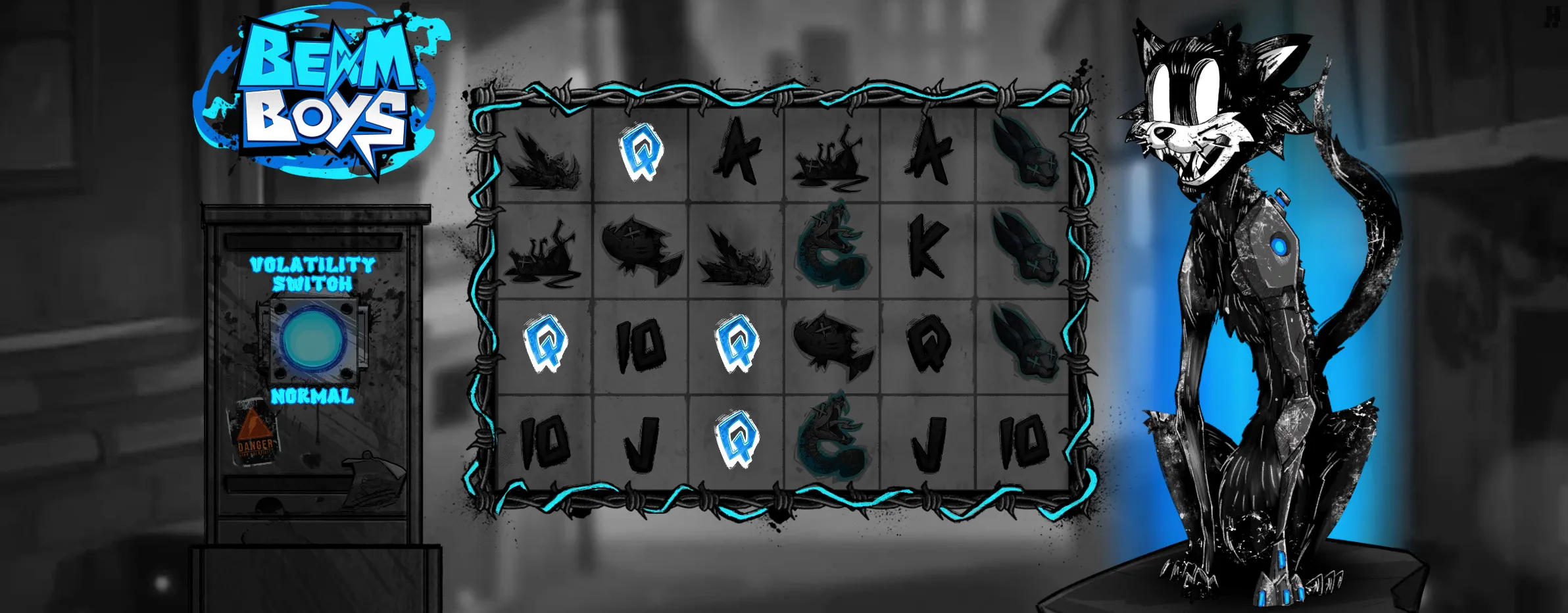
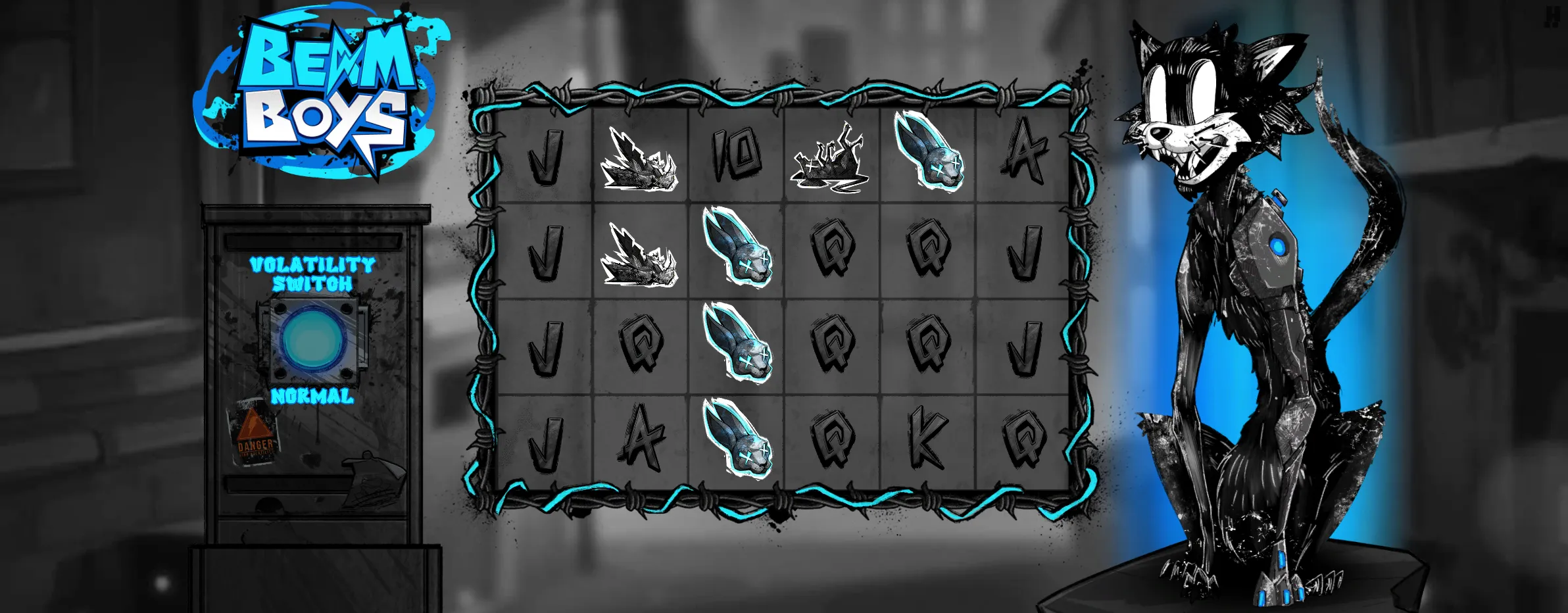
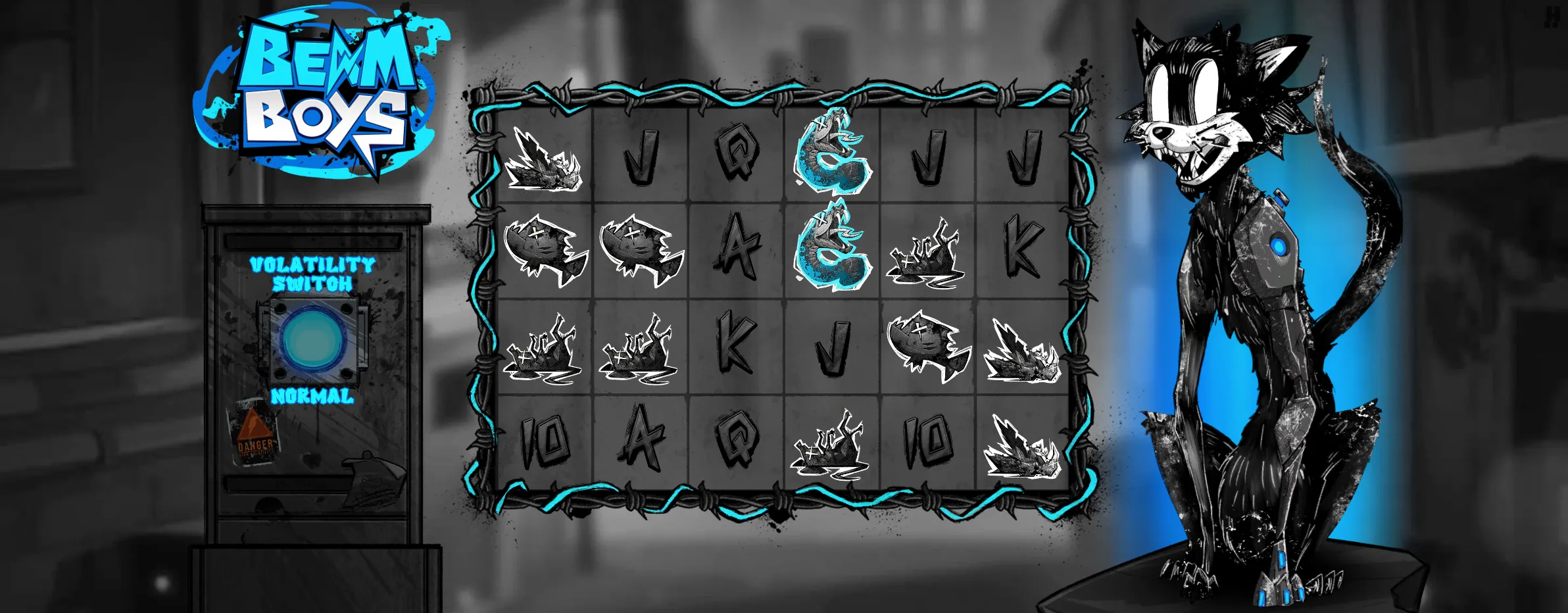
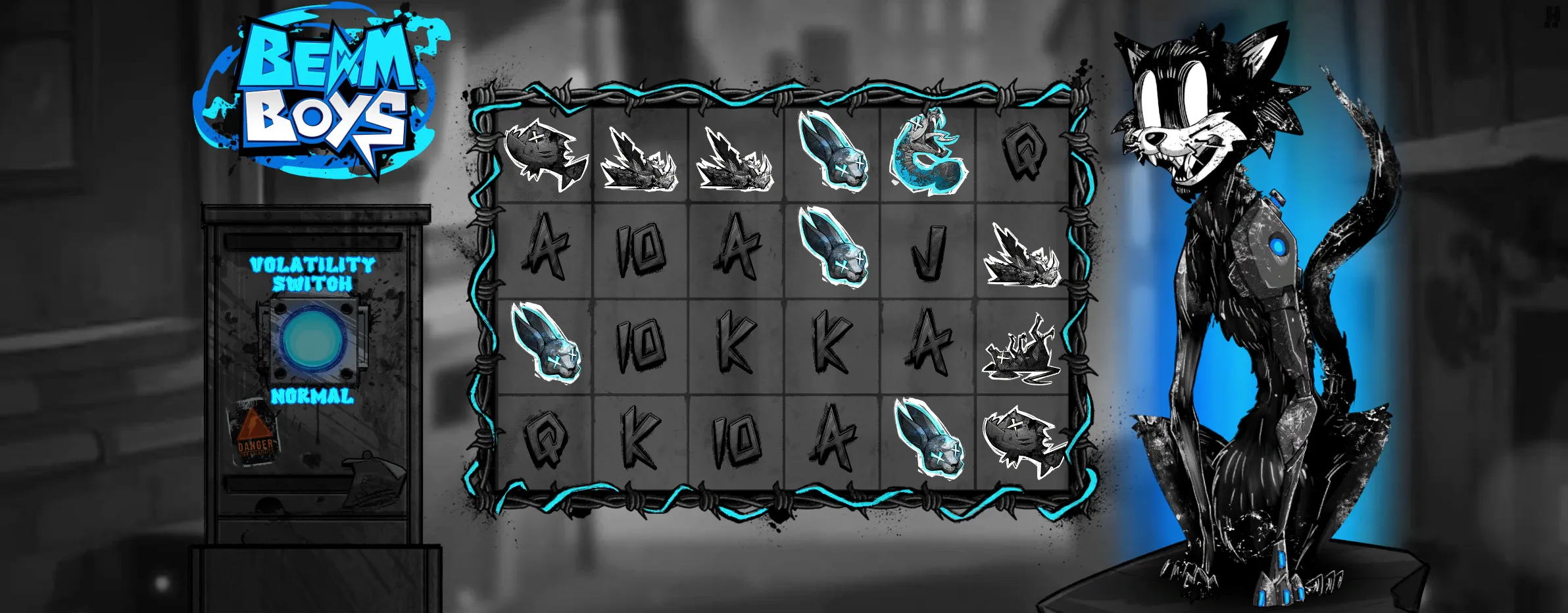
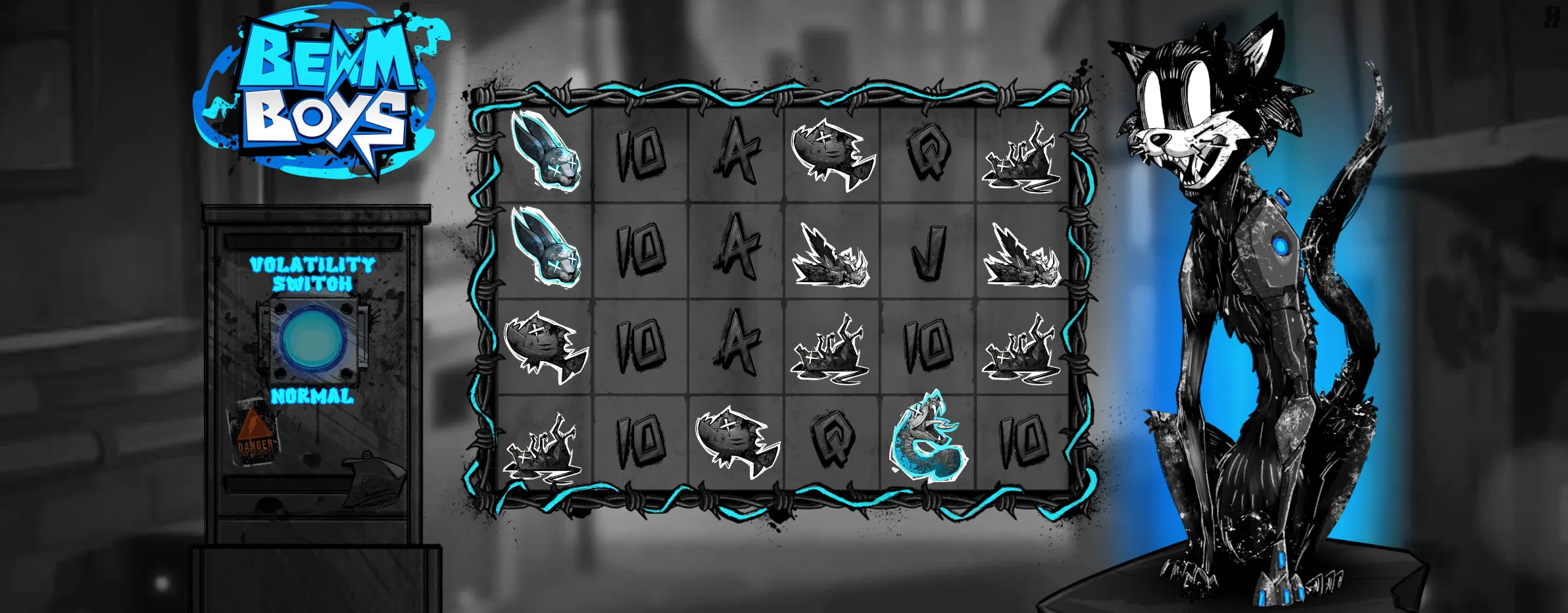
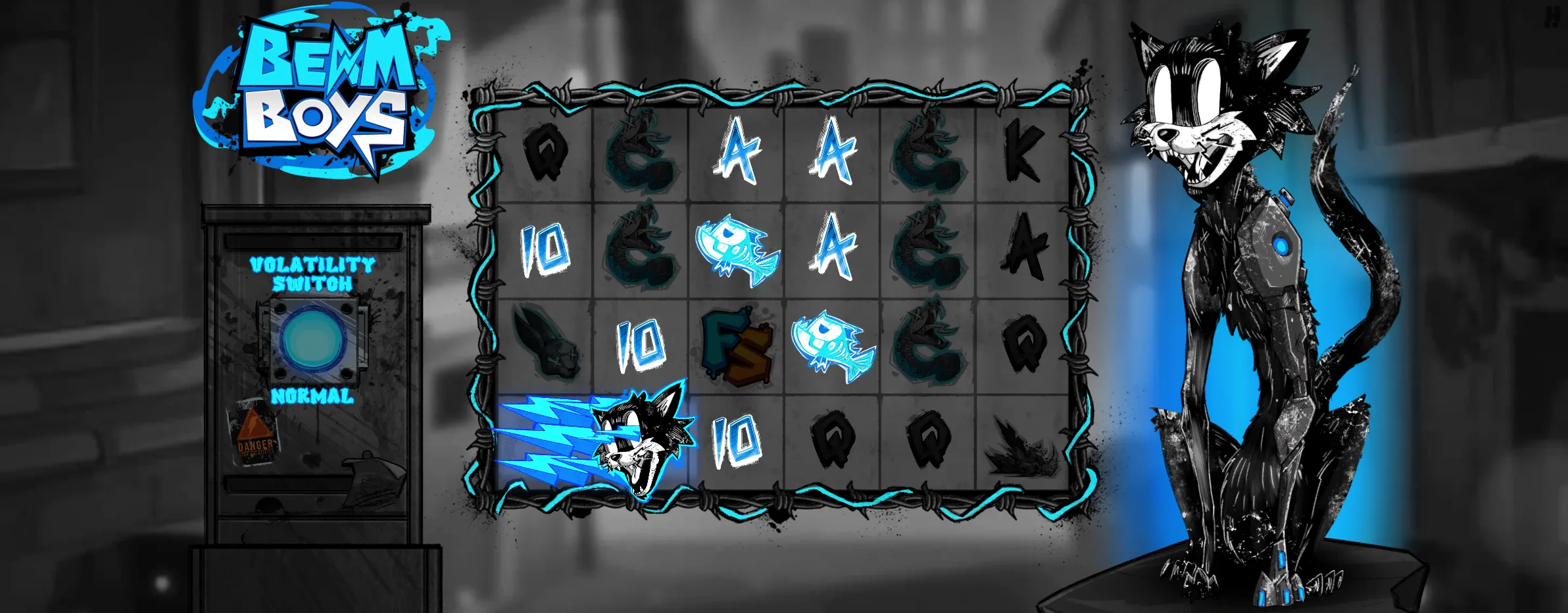
The frame is borrowed. Six reels, four rows and 4,096 ways paid from the leftmost reel is the grid Buffalo King plays on. The wild idea sits next to Wanted Dead Or A Wild, whose VS symbols expand into whole wild reels, while here the Wild Laser Cat fires a beam left along its own row. Turning the line on its side is the change that matters. A wild reel is the same size wherever it lands. A beam is as long as the cat's reel number, so a cat on reel 2 wilds two cells and a cat on reel 6 wilds six. Reel position becomes value, and that is the one idea Beam Boys brings of its own.
The paytable is small change until a cat reaches reel 6
I count ten paying symbols sharing four price rows. The five card ranks pay 0.1x for three of a kind and 0.5x for six, rat and bird top out at 0.8x, fish and rabbit at 1.2x, and six snakes pay 2x per way. Even 24 snakes would pay only 4,096 × 2 = 8,192x, about two-thirds of the 12,500x cap, which is the paytable's ceiling on its own. In Extreme mode 33.11% of spins win anything, so about two spins in three pay nothing.
The value sits in the wild, and its geometry is strict. The Wild Laser Cat pays only as six of a kind, at 5x per way, two and a half times the best snake way. A six-wild way needs a wild cell on reel 6, and because beams fire left, a reel-6 cell turns wild only where a cat lands on it. No cat on reel 6 means no 5x way, whatever else the board holds.
The number of six-wild ways is the product of the wild cells on each reel, and that product is where the game compounds. With cats on reel 6 and nothing else wild:
- one cat: 1 way, 5x
- two cats: 2⁶ = 64 ways, 320x
- three cats: 3⁶ = 729 ways, 3,645x
- four cats: 4,096 ways, 20,480x, paid at the 12,500x cap
Lower cats feed the same product. A reel-6 cat in one row and a reel-5 cat in another leave two wild cells on each of reels 1 to 5 and one on reel 6, which makes 2⁵ = 32 six-wild ways and 160x. The first reel-6 cat brings a single 5x way; the second multiplies the six-wild ways by 64. That jump is the game.
The cap sits where the ladder runs out. A full grid pays 20,480x and loses 7,980x of it, nearly two-fifths, to the 12,500x limit. On a single spin, the cap needs a cat in all four rows: three fully wild rows over a fourth row of six snakes pay 729 × 5 + 3,367 × 2 = 10,379x, the most a board with a cat-free row can reach. In Extreme mode the cap comes once in 400,000 rounds, and 12,500x at that rate is 3.125% of stake, so 3.1 of the mode's 96.26 points of return sit in capped rounds.
Free spins are the base game with more cats and a counter
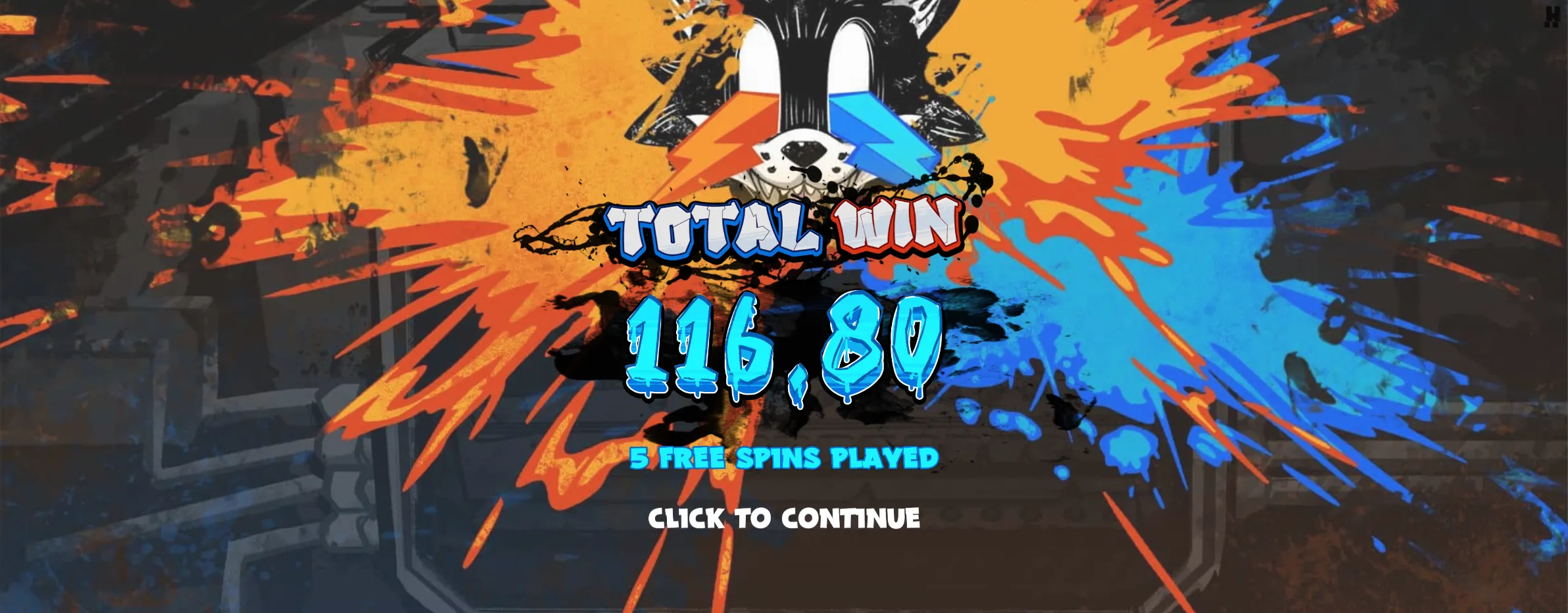
Apart from its retrigger rule, the round changes only the chance of landing Wild Laser Cats, and every wild cell still clears when its spin ends. Two things carry from one free spin to the next, the number of spins left and the running total. No board state does, so the round is a batch of independent spins at a better cat rate, and its value rides on how many spins it holds.
That makes the scatter count at the trigger the real prize. Three scatters give 5 spins, four give 10, five give 20 and six give 40. Retriggers barely close the gap between those tiers: two scatters add 2 spins and three add 4, so a five-spin round with one three-scatter retrigger reaches nine spins, still one short of what the ten-spin tier opens with.
The running total is also the one route to the cap that does not need a cat in every row on the same spin. Across a 40-spin round, 12,500x works out to 312.5x a spin, just under the 320x that two reel-6 cats pay from six-wild ways alone. A five-spin round needs 2,500x a spin, eight times as much. Length decides how reachable the cap is, which is why I call the round thin: it builds nothing of its own, only a longer or shorter run of the same spin.
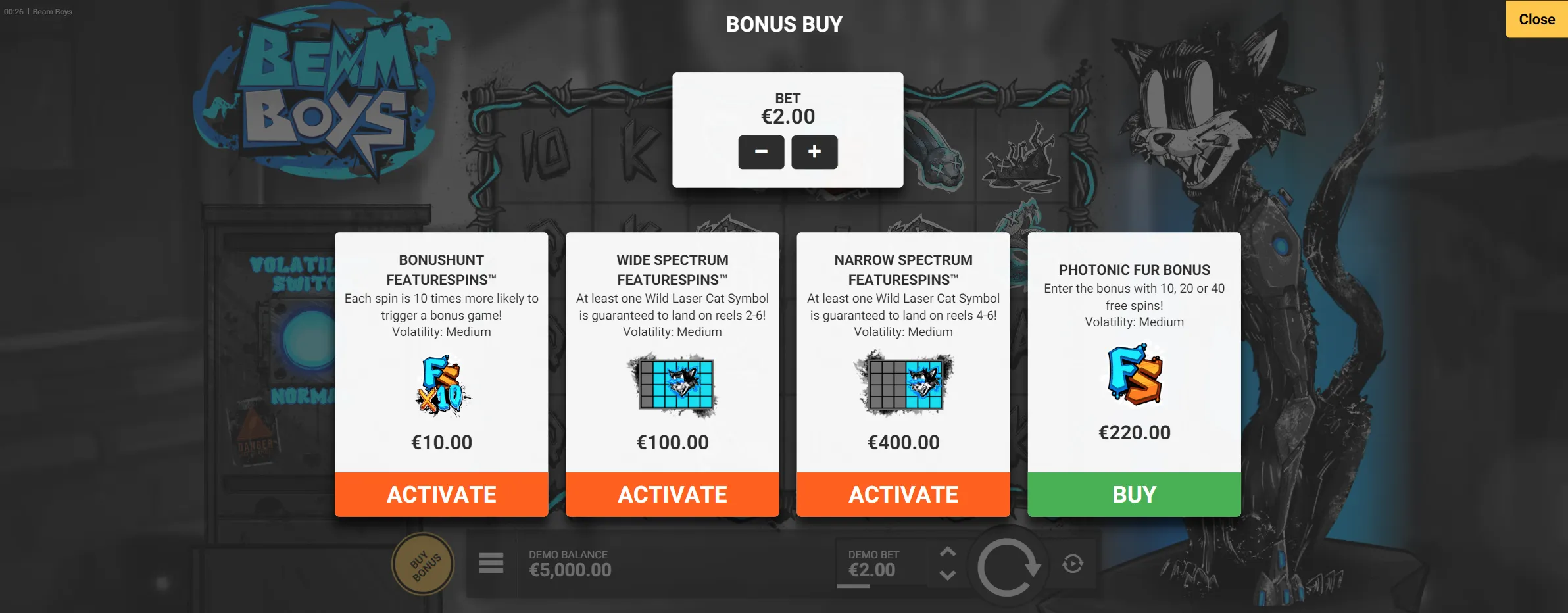
Photonic Fur Bonus prices that length directly. It costs 110x and always opens on ten spins or more, so before retriggers it charges 11x per spin at the ten-spin tier, 5.5x at twenty and 2.75x at forty. Its return, 96.32% in Normal mode and 96.33% in Extreme, sits within a tenth of a point of the base game, and the most it can pay is 12,500x, about 114 times its price. It is a fair way to skip the five-spin tier, and nothing more.
The buy menu is fairly priced, and its dearest spin is its worst
At the 96% setting every buy returns between 96.30% and 96.40%, against 96.35% and 96.26% for the base game in its two modes. Nothing on the menu is overcharged, so the useful comparison is what each price buys under the shared 12,500x cap.
BonusHunt FeatureSpins costs 5x a spin and makes free spins ten times as likely. Five times the stake for ten times the trigger rate halves the average stake spent per trigger, while the return, 96.32%, sits level with the base game's 96.35%. The option moves return into the bonus; it adds none. Its best case is 2,500 times its price, the best ratio on the menu.
Wide Spectrum costs 50x and guarantees a cat, but a cat on reel 2 satisfies the guarantee, and on its own that cat wilds two cells and cannot open a six-wild way. Its best case is 250 times its price.
Narrow Spectrum is the showpiece and the weakest buy. At 200x a spin, €20 at the €0.10 minimum stake, it guarantees a cat on reels 4 to 6, and only one of those three reels opens the 5x way. A single reel-6 cat's six-wild way returns a fortieth of the price, so the rest has to come from symbols lining up with the beam or from more cats. The best case is 62.5 times the price, the lowest ratio here, and the return edge is too small to matter: the whole 0.10-point spread of buy returns is worth 0.2x on a 200x spin. I read Narrow Spectrum as the largest stake per click the game sells, not as better value.
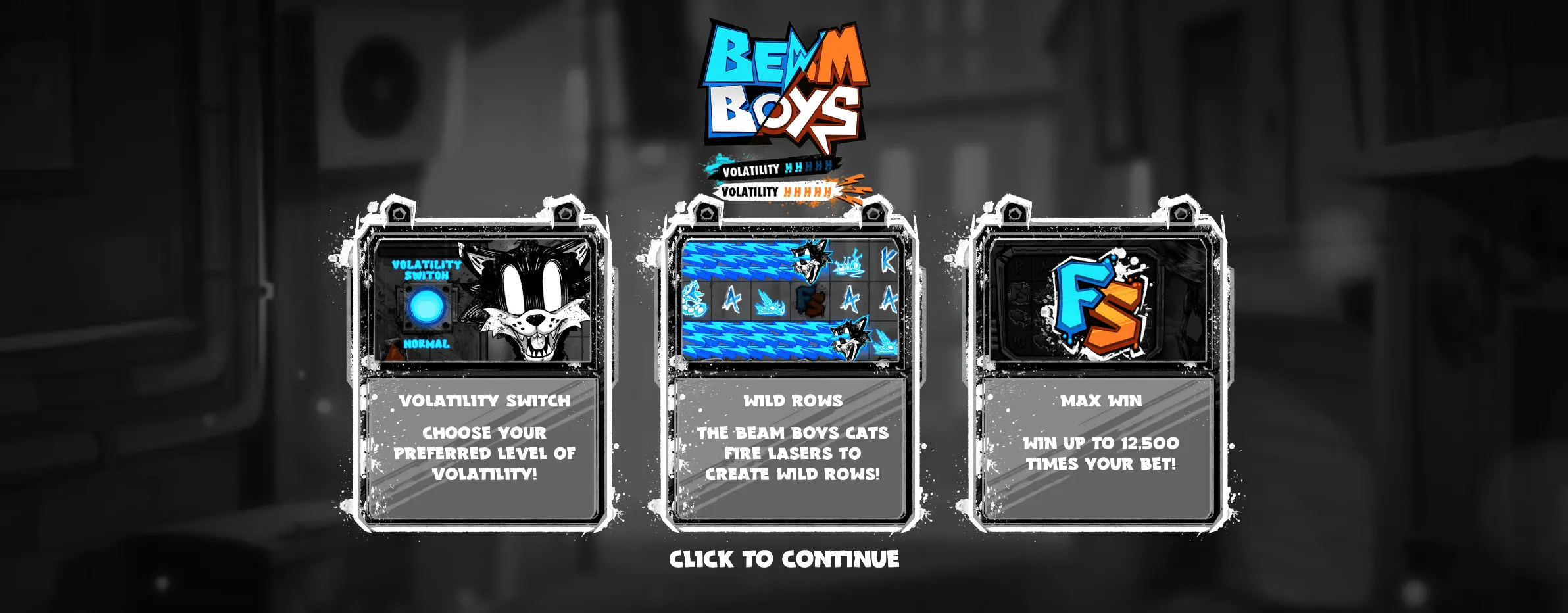
The Volatility Switch costs 0.09 points between Normal and Extreme, under a tenth of a bet per hundred bets. Both modes pay from the same table, so the switch changes what lands rather than what anything pays, and flipping it turns any FeatureSpins option off at once.
This suits a player who judges each spin alone
Beam Boys rewards a player who wants every spin to be a complete bet on geometry: where the cats land, how many rows they cover, whether one reaches reel 6. Normal mode gives that player the beam without the steepest swings at a cost of 0.09 points, and the menu gives a buyer fair prices across four options. It does not suit anyone who wants a round that grows as it goes, because no feature carries a board from one spin to the next.
The setting matters more than the switch. Casinos can run the game anywhere from 88.25% to 96.35%, a gap of 8.1 points, ninety times what the switch costs. The rules screen shows the setting in use.
The 6.8 is the beam's score held down by its frame: a flat paytable, a bonus with nothing to accumulate and a buy menu whose best quality is that it is fair.