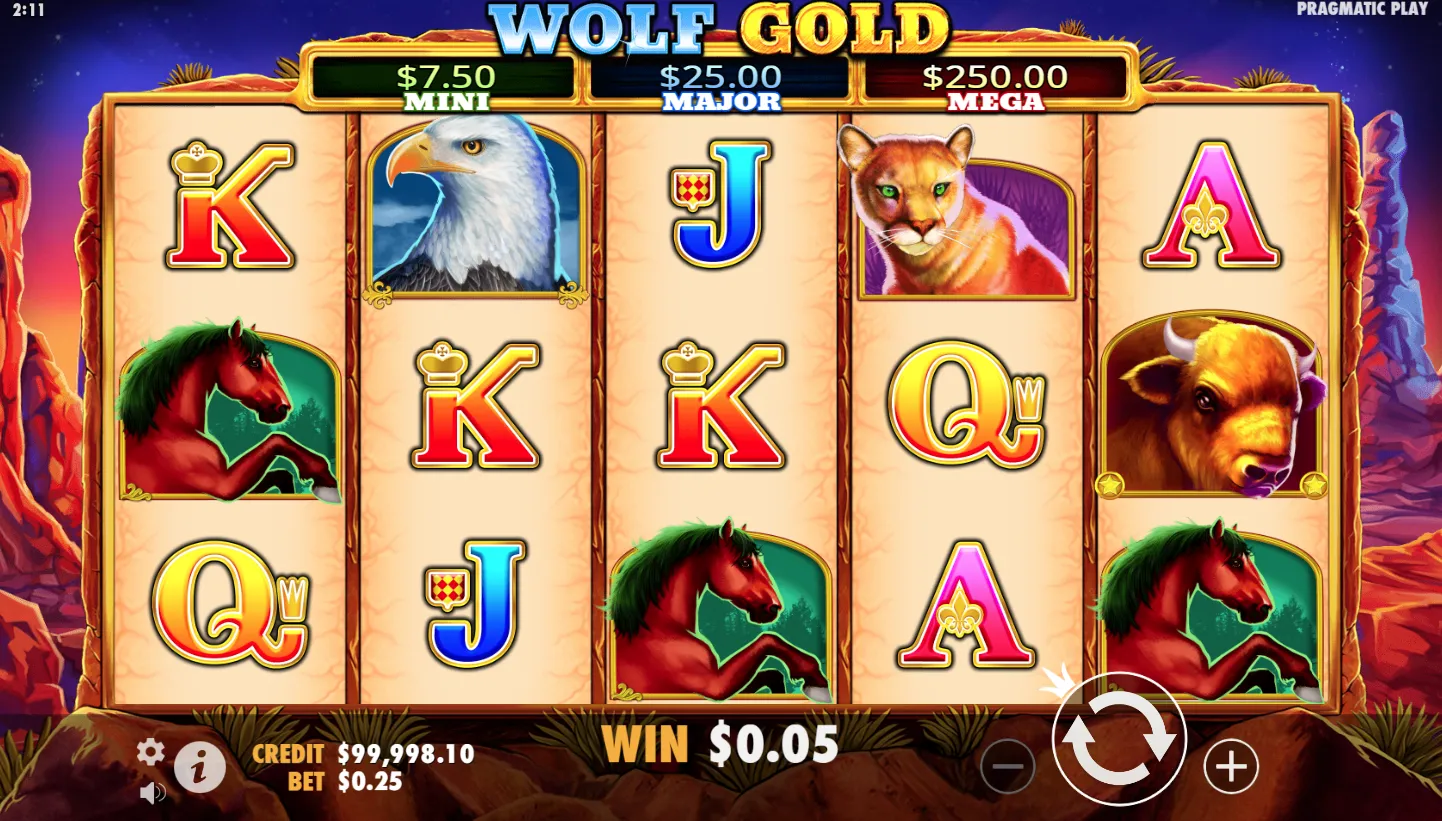
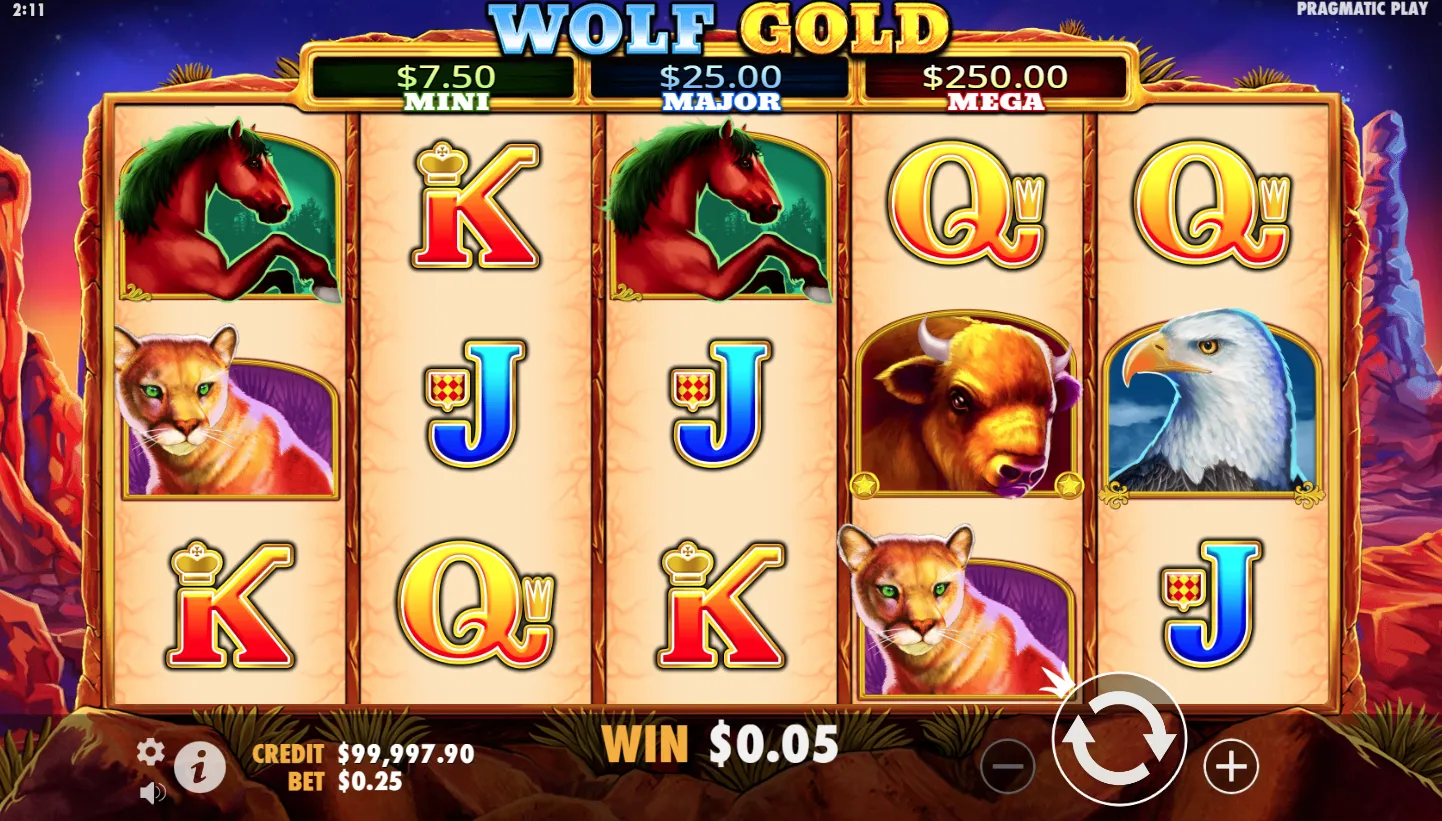
One board carries a thin 25-line frame
I read Wolf Gold as a 25-line slot built to deliver one event: a Money Respin board filled to all 15 positions, which adds the 1,000x Mega Jackpot to whatever the moons are worth. Every other part of the game I judge through that board. In my reading the lines pay too little to matter against it, the free spins are the strongest part of the frame and open with just 5 spins, and the 2,500x ceiling equals the top of a full board. One working idea inside a thin frame is what a 6.7 looks like to me.
That idea is not Wolf Gold's alone. Chilli Heat, Diamond Strike and Hot To Burn Hold And Spin run the same format: money symbols that stick, a respin counter that resets when a new one lands, and fixed jackpots. Since the feature exists in several games, I think the case for this one rests on what surrounds the respin, and the surroundings are where I take points away.
Only the Mega sits above the cash ladder
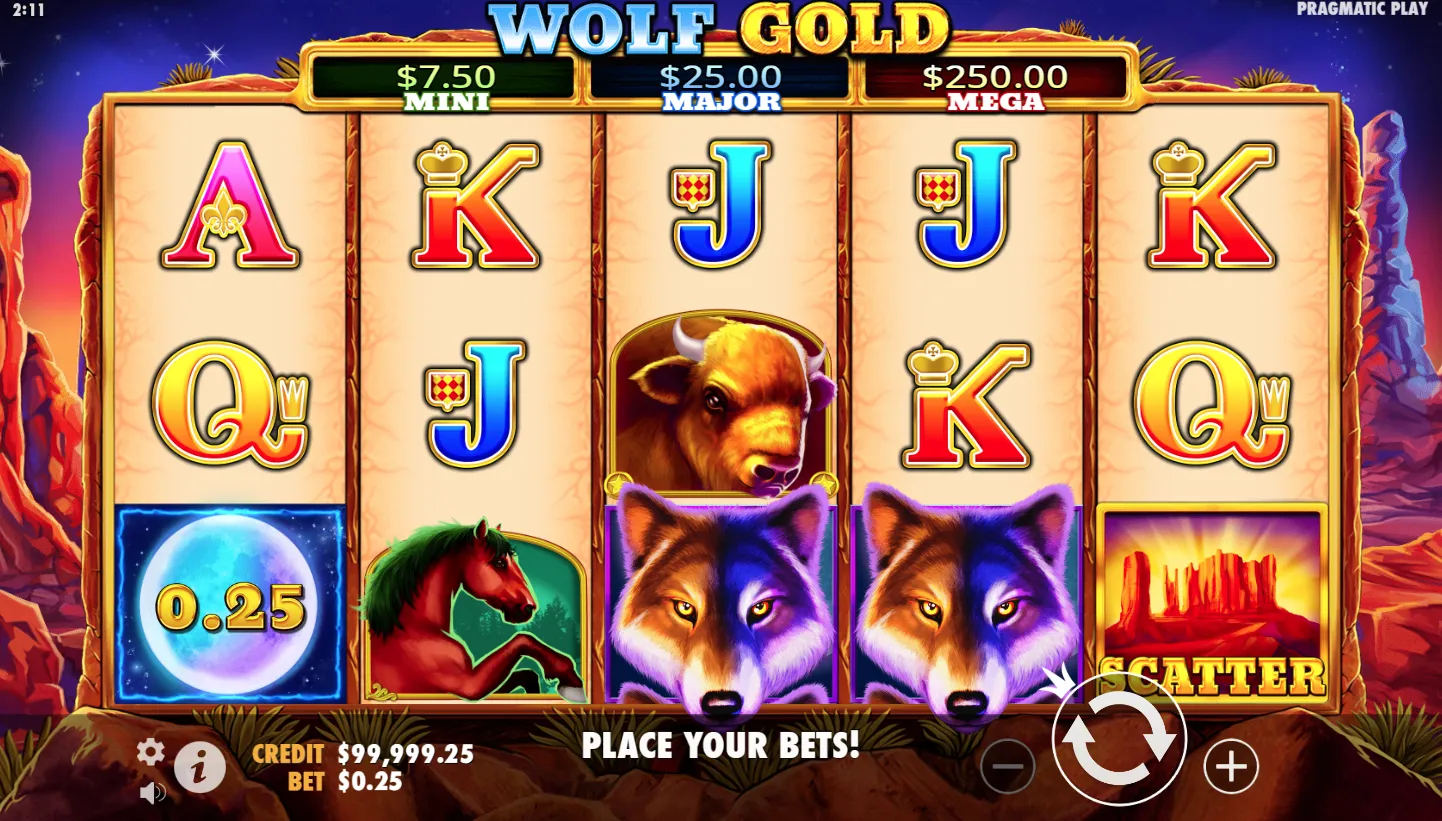
The sixteen cash values climb from 1x to 30x in steps of 6x or less, then jump straight to 100x. The Mini at 30x and the Major at 100x equal the two highest rungs, so a jackpot moon never lifts a board past what cash moons alone could reach. I treat them as named rungs, not extra prizes. The Mega is the one award that is not a moon value, and the arithmetic around it explains the whole game.
Fourteen moons at the 100x top come to 1,400x. The fifteenth adds its own value plus the 1,000x Mega, so filling the last position is worth at least 1,001x by itself. When eight or fewer of the first fourteen moons are 100x values, those fourteen sum to 980x at most, and the last position outweighs everything already locked. A full board pays between 1,015x and 2,500x. A board one moon short pays between 14x and 1,400x.
The upper part of that range is narrower than the 2,500x figure suggests. By my arithmetic, fifteen moons at 30x plus the Mega make 1,450x, so a full board above 1,450x needs at least one 100x moon, cash or Major, and the maximum needs all fifteen. Because the cap is the same number as the feature's own ceiling, a Money Respin by itself is never cut short by it. The cap does not limit the respin so much as describe its best case.
The counter decides whether a board gets that far. A minimum trigger of six moons leaves nine positions open, and unless the board fills first, the feature ends once three respins in a row add nothing. Each respin that lands a moon puts the counter back to 3, and that is the part of the format I think Wolf Gold executes well. The reward for that persistence is lopsided by design: the step from fourteen moons to fifteen is worth more than any other single moon on the board.
The base game is a waiting room
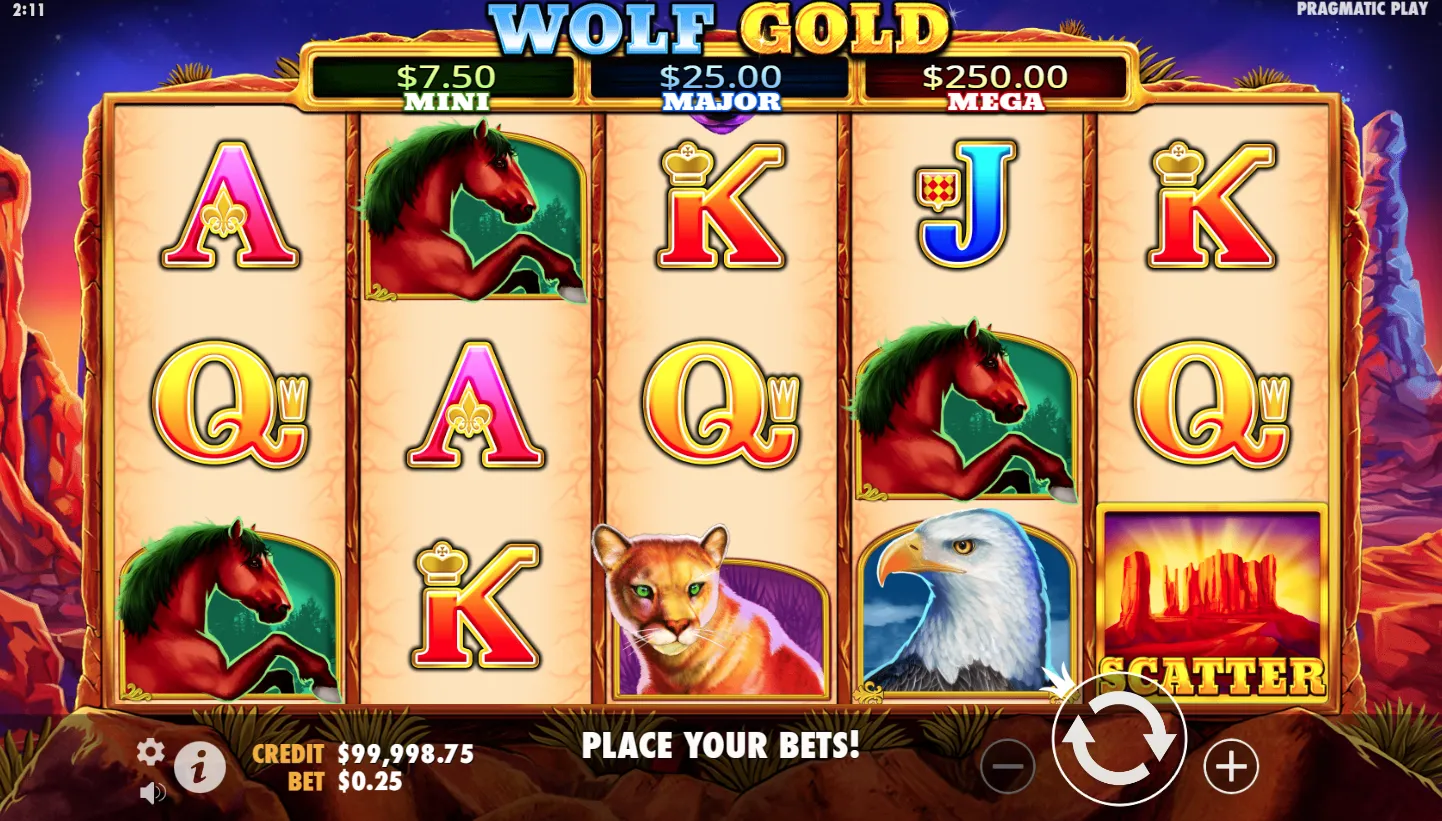
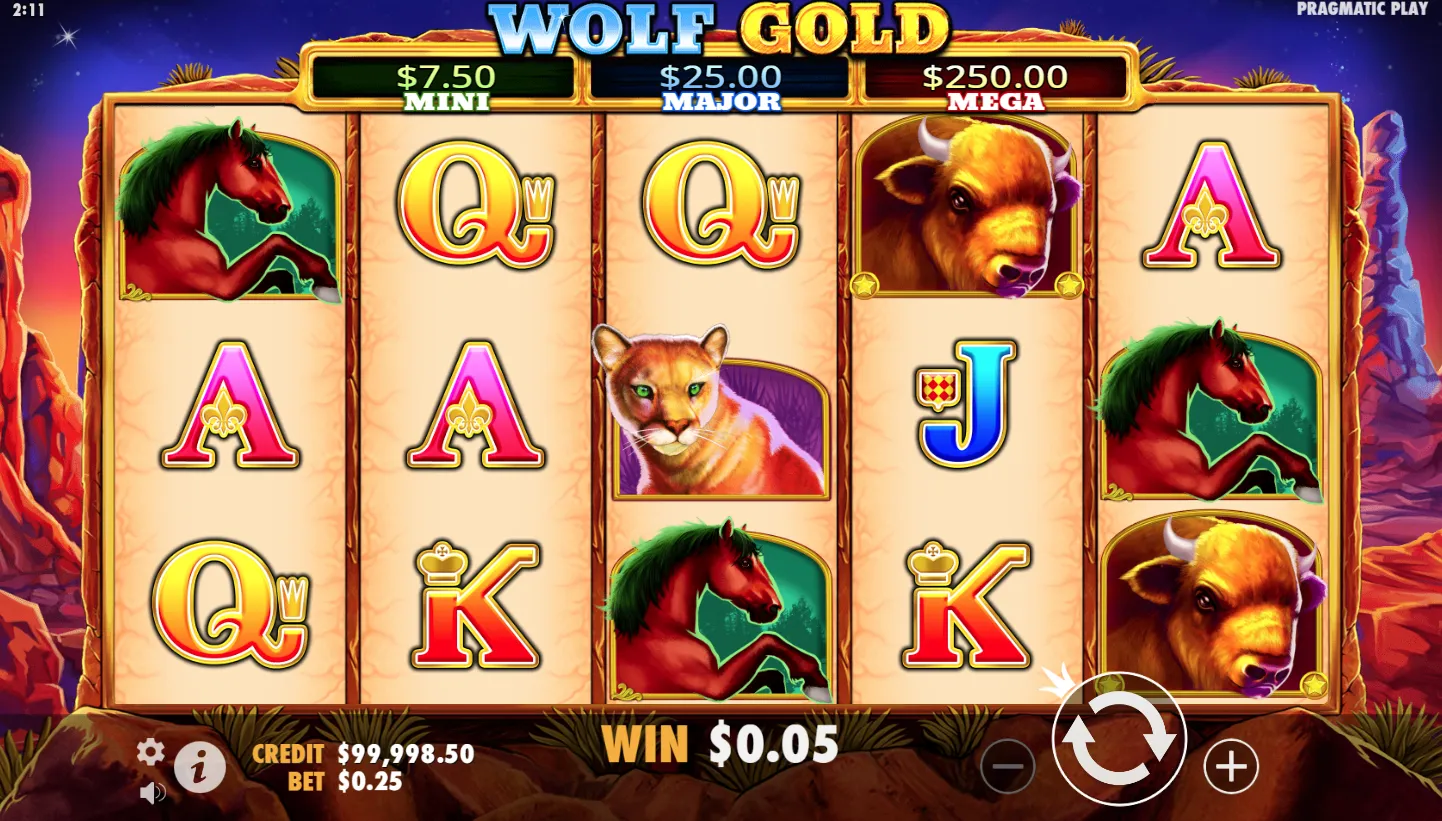
On the spins that land neither six moons nor three scatters, the paytable is all there is, and it is small. Five Bison or five Wolf wilds pay 20x on a line, so even a screen paying that on all 25 lines comes to 500x, one fifth of the ceiling. I count eight regular symbols, and three of a kind pays less than the total bet for every one of them except the Bison, which returns exactly 1x. The Ace, King, Queen and Jack each pay 0.8x for four of a kind, still short of the bet that landed them, and 2x for five.
Moons that stop short of six add nothing to this. A moon pays only through a respin, so one sitting in a line's run ends that run at its reel. Three scatters return 1x on top of starting the free spins, which is the stake back and no more. I see the base game as a feeder: its value lies in landing moons and scatters, and its three-of-a-kind hits return a fraction of the bet while it waits.
Free spins are the best of the frame, and they are rationed
The free spins round is better built than its spin count suggests. Reels 2, 3 and 4 spin as one block, and wins pay left to right from reel 1, so a reel-1 symbol that matches the block already spans four reels. Every line win in the round is therefore four or five of a kind. The smallest line pay rises from the base game's 0.2x to 0.8x, and when the block is a Bison each winning line pays at least 10x. With all three reel-1 positions matching a Bison block, all 25 lines win, which is 250x before reel 5 counts and 500x if all of reel 5 matches too.
That is the same 500x line ceiling as the base game, but here the block does most of the work and only reels 1 and 5 have to agree with it. Five starting spins at 500x each would reach 2,500x through lines alone, so I do not accept that the Money Respin is the sole road to the cap. Moons also keep landing in the round, so a respin can start inside it. With no limit on retriggers, the 2,500x cap rather than any spin count is what bounds a round.
The rationing is the flaw I weigh most heavily here. Five opening spins and 3 more per retrigger are a short allowance for the best mechanism in the frame, and a round that never retriggers gives the block five chances to line up with reel 1 and no more. A round built so that every line win is four or five of a kind deserves a longer run than this one gets.
The right player wants the respin and little else
I would point Wolf Gold at a player who wants a hold-and-win round with fixed prizes and a ceiling that can be worked out from the rules: sixteen cash values, three fixed jackpots, and a maximum equal to fifteen 100x moons plus the Mega. At medium volatility, that is a coherent shape.
It is the wrong game for anyone who wants the lines to hold up the game between features, or a top prize far above the main jackpot. The ceiling sits 1,500x over the Mega, and reaching it through the Money Respin takes a board where every moon is a 100x value.
The return setting is worth checking on the rules screen. At 96.01% the house edge is 3.99%. At the 93.99% setting some casinos run, it is 6.01%, half as much again, applied to a game whose frame gives little back outside its features. That setting is part of why my score stops at 6.7. The Money Respin is sound and the Mega on its fifteenth position is a real prize, but I find nothing around it that gives a strong reason to choose this game over the others running the same format.