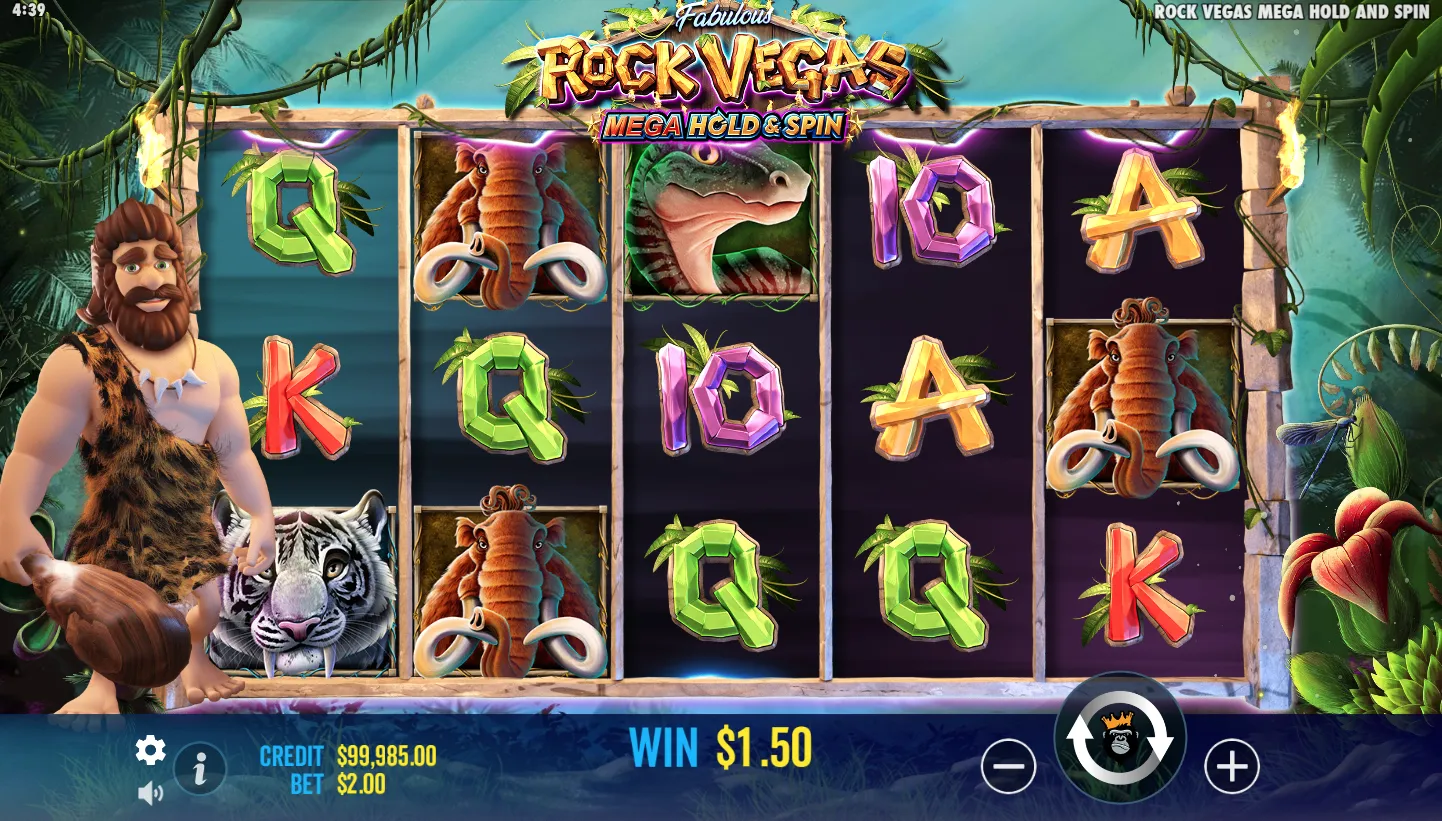
A house hold-and-spin with its arithmetic changed
The smallest numbers in Rock Vegas are the ones the game is named after. A rock is worth between 0.1× and 1× of total bet, so a 10×10 grid filled with nothing but golden rocks holds 100×, which is 1% of the 10,000× cap. The reels are not much of an alternative: with no wild and a 37.5× top line award, they cannot pay a tenth of it. Most of what lies between those figures and the cap is multiplication, from merged blocks, chest multipliers and the Mystery Multiplier, with chest cash of up to 500× the largest single addition. I read the game as a well-built multiplier engine inside a frame that contributes next to nothing, and 7.1 is the score for that split.
The frame is Reel Kingdom's house hold-and-spin. Hot To Burn Hold And Spin and Dragon Hot Hold and Spin both hand a bare payline game over to a respin round of fixed-value symbols that lock in place and pay out together, and Big Bass Bonanza Hold and Spinner replaces its reels with a collected-value round whose respins refresh on qualifying landings. Rock Vegas keeps all of that: three respins, a reset to three whenever a rock lands, sticky symbols with fixed values, one payout at the end. What it changes is the arithmetic on the board. A plain sticky-cash round adds values up. This one multiplies them twice, first through merged blocks and then through a general multiplier stack that compounds. That makes it a refinement of a house format rather than a new idea, and the refinement is where its whole case rests.
The reels cannot pay a tenth of the cap
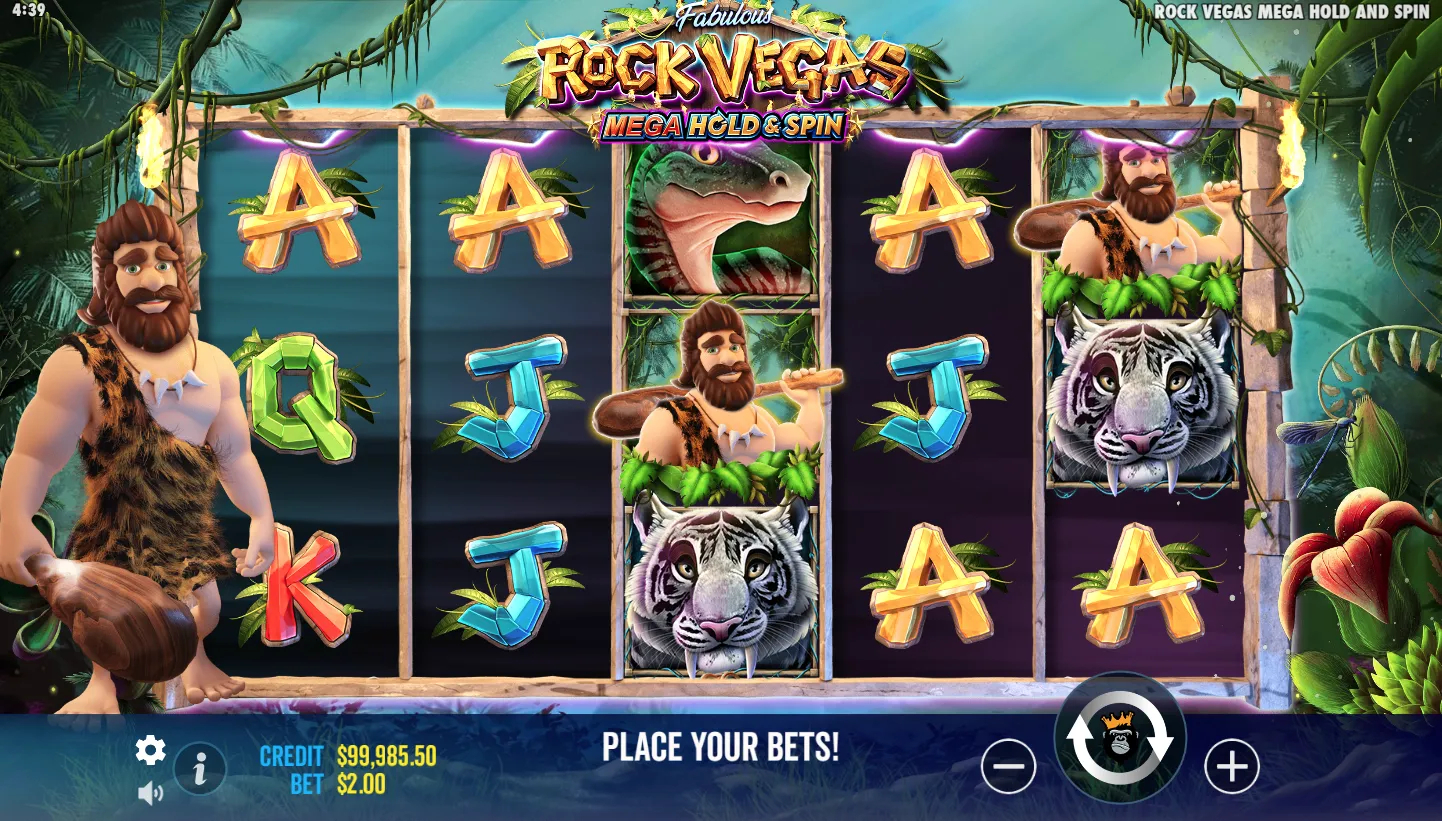
Twenty fixed lines run left to right on a 5×3 grid, nothing substitutes for anything, and the top award is 37.5× for five cavemen. The theoretical ceiling of a base spin is a screen of fifteen cavemen with all twenty lines paying that award: 20 × 37.5× = 750×, or 7.5% of the cap. That screen is arithmetic rather than a prospect, and even so it leaves 92.5% of the maximum to the feature.
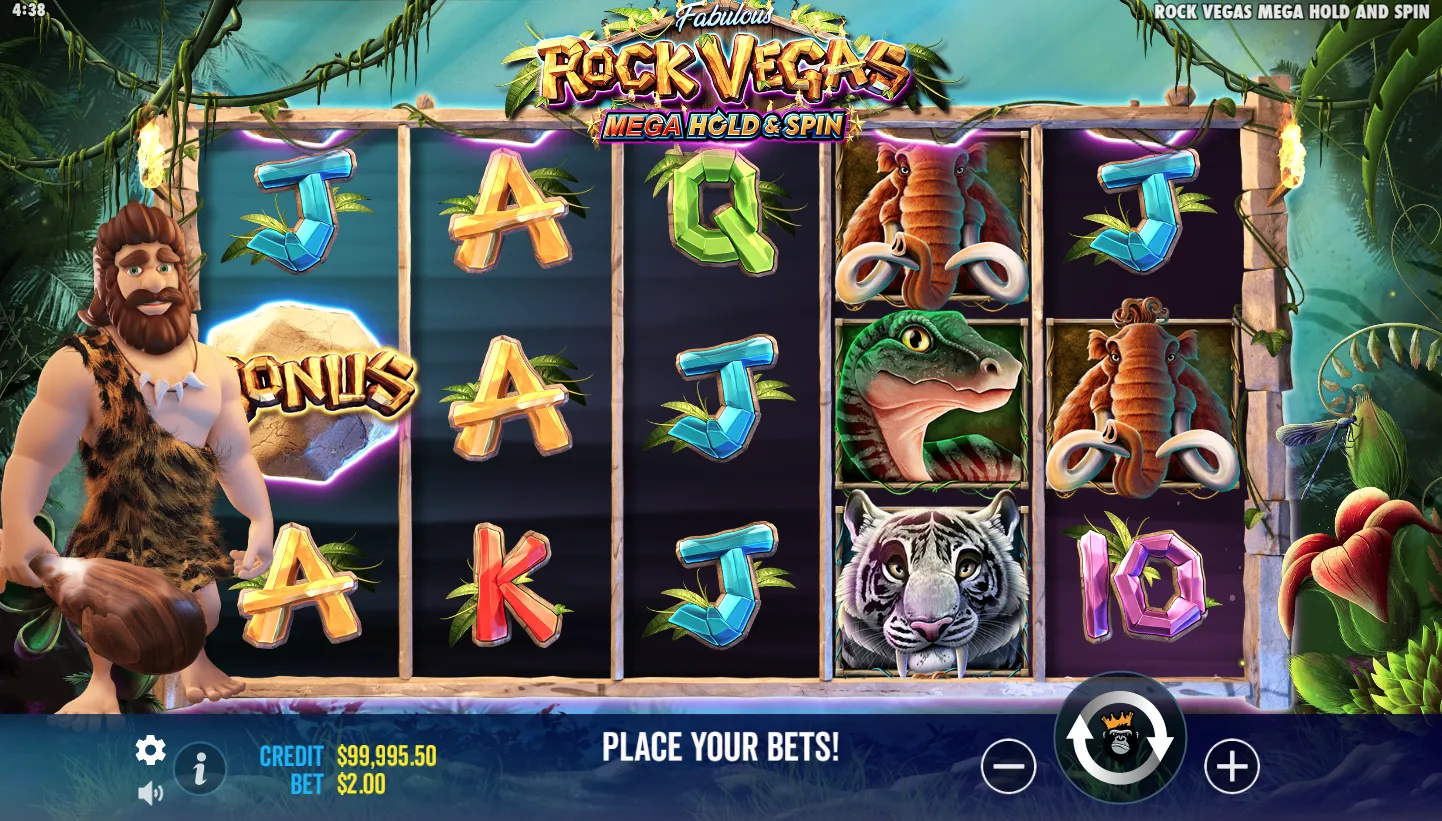
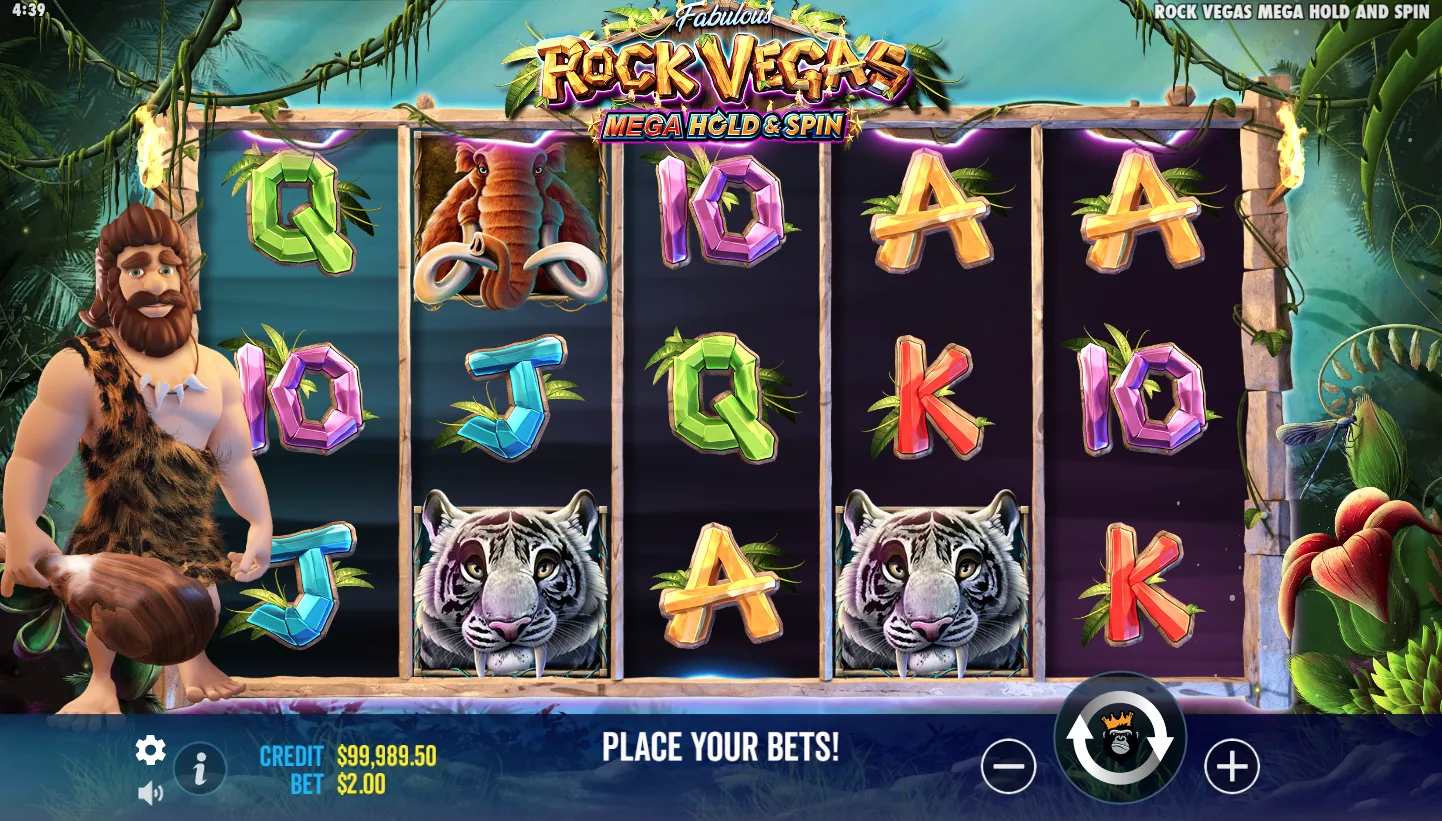
The working paytable is thinner. Five of the nine paying symbols are card ranks worth 6.25× or 3.75× for five, and queen, jack and ten pay 0.75× for three, under the stake. The sabretooth tiger and the velociraptor share 25× for five, and the woolly mammoth pays 12.5×. The caveman is the only symbol paid for two, at 0.75×, a consolation that returns less than the bet. Without a wild, every premium line has to land symbol by symbol from reel one, and I count no mechanic on the reels that raises a line win once it has landed.
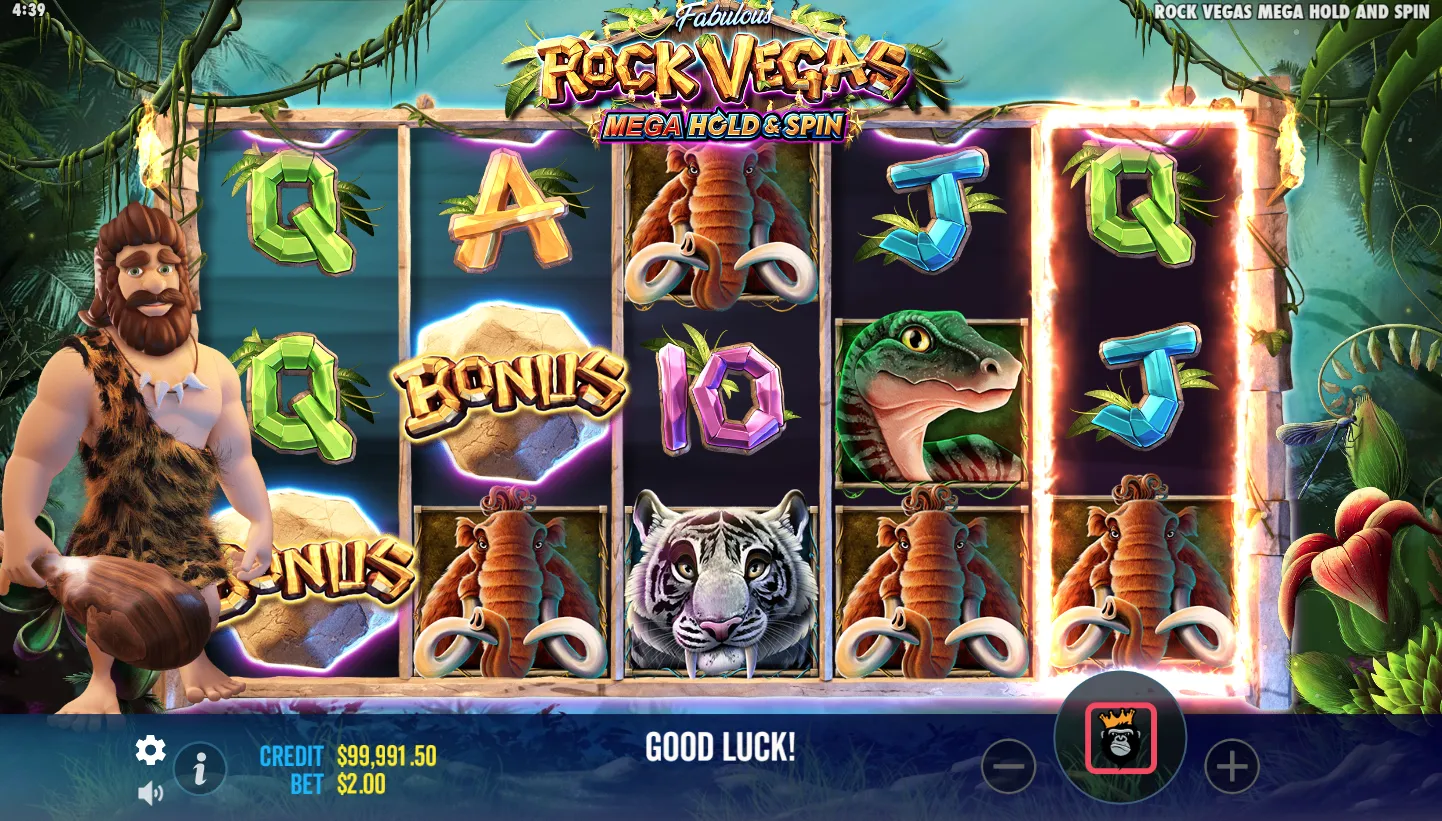
The base game's real job is delivering BONUS symbols, and its strips are lopsided about that. The third and fourth strips hold ten and eleven BONUS positions; the fifth holds two. A BONUS symbol can also be added at random once a spin resolves, which helps, but the reels exist to feed the round and the fifth strip feeds it least.
Block size outranks colour
This is where the argument lives. A 2×2 block of one colour takes 5× to 10× on its combined value, a 3×3 block takes 35× to 500×, and all five colours draw from the same pool. Colour spans a tenfold range, from 0.1× for blue to 1× for golden. Block size spans more: the lowest 3×3 tag is 3.5 times the highest 2×2 tag, and the 3×3 ladder alone runs 35 to 45, then 50, 100, 200, 300, 400 and 500, a spread of roughly 14 to 1.
In cash, the worst 3×3 block of blue rocks at 35× pays 31.5×, close to the best 2×2 block of golden rocks at 10×, which pays 40×. A blue 3×3 on the 45× step already passes it at 40.5×. A golden 3×3 climbs from 315× at the bottom of the ladder to 4,500× at the top, the most a single block can reach and still only 45% of the cap.
Trigger size works on the same product. Four BONUS symbols remove the 0.1× rock and five remove the 0.1× and 0.2× rocks, so the cheapest 3×3 block the strips can build rises from 0.9× to 1.8× to 3.6× before its tag. At the 500× tag those become 450×, 900× and 1,800×. A five-symbol trigger quadruples the worst merge the round can form without adding a single respin, and that is the right call for this design: more respins would mean more rocks, and rocks are the cheap part.
The same arithmetic explains the thin rounds. Take the merges and chests away and a round is a sum of rocks. A full board of blue rocks is 100 × 0.1× = 10×, less than one five-tiger line at 25×. A full board of pink rocks, 60×, is worth 1.6 five-caveman lines. A round that forms no block and opens no chest resolves as a pile of cheap rocks after its third blank respin, and nothing on the grid can change that.
Two chest multipliers outweigh a perfect board
Keys on rocks fill a trail of chests, and each chest draws one of five outcomes. Two of them pay during the round: direct cash of 10× to 500×, and a rock's value multiplied by 0.5× to 500×. The smallest cash chest equals a full board of blue rocks, and the largest equals five full boards of golden ones. A third outcome adds four to ten keys straight to the trail, which is worth only what the next chest turns out to be.
The general multiplier is the real top end. Each chest multiplier runs 2× to 100×, the Mystery Multiplier at the end of the trail draws the same 2× to 100×, and they multiply each other before being applied once to the round's total. Two top draws make 10,000× on their own, so a round worth 1× under two maximum general multipliers is already a maximum win, and a perfect golden board of 100× needs only one. The trail restarts after it is finished, so a long enough round can stack several.
That compounding is also where the cap bites. Two golden 3×3 blocks at the 500× tag come to 9,000×. The cheapest general multiplier a chest can draw, 2×, would make that 18,000×, and the game pays 10,000× and forfeits any respins left. The round is built to produce figures far above its own ceiling, so its top multipliers spend much of their range beyond a line they cannot cross. With the cap arriving about once in 2,578,648 rounds, the merge ladder and the chest draws are what shape the game, and the cap is a boundary very few rounds ever meet.
Retriggers pull the other way. A filled grid or a retrigger chest banks the rock values, clears the board and resets the respins to three. Each new pass starts empty and has to build its blocks again from a first rock, so a big board is never inherited.
The 94.5% setting cuts into the part that carries the return
The default return is 96.64%, and casinos can also run 95.6% or 94.5%. In house-edge terms the reduced setting keeps 5.5% against 3.36% at the default, about 1.6 times as much. A game whose base tops out at a 37.5× line award has little to absorb that, so the difference comes out of a round that already arrives rarely. The rules screen shows which setting is in use, and at 94.5% the round I have described returns less than at the default, and that cut is part of why the score stops at 7.1.
The audience follows from the maths. A high-volatility player who wants one event per trigger, and who treats the reels as a waiting room for it, gets a better-built round than the plain sticky-cash template offers. Anyone who wants the base game to do some of the work should look elsewhere, and not to Hot To Burn Hold And Spin, which hands the same kind of bare payline game over to its round.