The Scatter map is the only new part, and it is lopsided
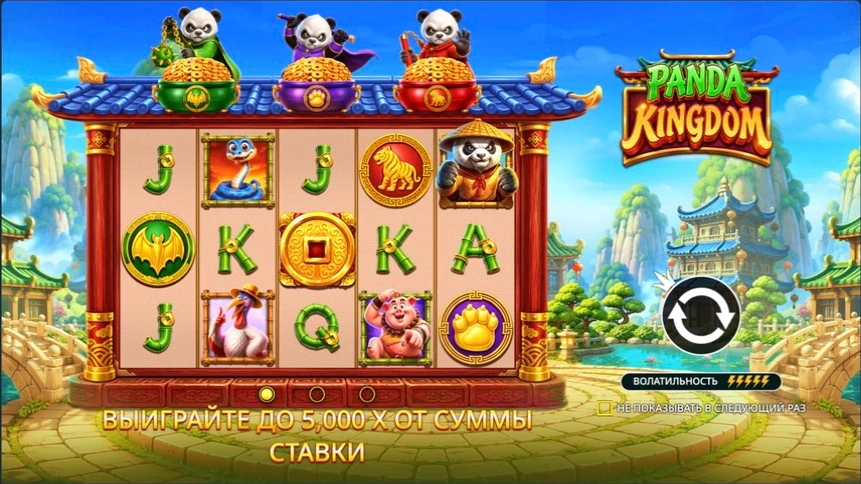
Panda Kingdom is a 243-ways game with one idea of its own, and the idea is less even than it looks. Bat, Bear and Tiger Scatters lay fixed reel multipliers over the free spins before the first of its six spins, and the layouts read as left, centre and right. The left-to-right ways rule turns that geography into a ranking. What the map multiplies is a paytable whose best way pays 15× the bet, while the largest single values sit in Money medallions that pay only when a Collect symbol lands. A sharp map over thin wins, with the largest values behind a gate, is why I rate this game competent and no more.
Everything around the map is the standard kit of its category: a 5×3 grid, 243 ways, a wild that substitutes for regular symbols, and a money-and-collect layer in the bonus. The Scatter draw is the game's own contribution. Instead of one multiplier rule for every bonus, the mix of Scatter types that opens the round decides which reels are multiplied and by how much. That makes Panda Kingdom a refinement of a crowded format rather than a new one, so the question is whether the refinement does enough work.
Paying from reel 1 makes Tiger the weakest draw
A ways win needs matching symbols on adjacent reels from reel 1, so every win of three or more crosses reels 1, 2 and 3. Only four- and five-reel wins reach reel 4, and only five-reel wins reach reel 5. Set that against the three layouts and the symmetry falls away.
Bat puts 2× on reel 1 and 3× on reel 2, so in a Bat round both of its multipliers sit under every ways win. Bear puts 3× on reel 2 and 5× on reel 3, which also touch every win, then adds 3× on reel 4 for the longer ones. Tiger puts 3× on reel 4 and 2× on reel 5, and a win that stops at reel 3 touches neither. On its own, Tiger multiplies nothing on the shortest wins, covers one reel of a four-reel win, and reaches two reels only when all five connect. Bat matches it on five-reel wins with the same two values in mirror order, puts two multiplied reels under a four-reel win where Tiger puts one, and is the only one of the pair that reaches a three-reel win at all.
The single draws rank Bear, Bat, Tiger. Bear's 5× centre is the largest single-Scatter value and sits under every win, while Tiger's pair sits under the fewest. Combined states follow the same logic. Bat with Tiger covers four reels, but neither layout covers reel 3, which every win crosses. All three active sets that reel to 10×, twice Bear's value, and only in that state does every ways win in the round cross a 10× reel.
Fifteen times the bet is a small thing to multiply
The map would matter more if the paytable gave it more to work with. Pandas, the best regular symbol, pay 2.5×, 5× and 15× for three, four and five of a kind. J and Q pay 0.25× for three and 1× for five, so a single five-reel J way returns the stake and nothing more. I count five of the nine regular symbols paying less than the bet for three of a kind, with snake paying exactly the bet.
The paytable's ceiling is simple to compute. A screen of pandas and wilds lights all 243 ways at 15× each, which comes to 3,645× the bet, and no other arrangement pays more. That is below the 5,000× cap, so no base-game screen can reach it. Between features, the practical scale is a lone five-panda way at 15×.
How far free spins lift that ceiling depends on the Scatter draw. Under Tiger alone, a three-panda way stays at 2.5×. Under Bear, the same way crosses the 5× centre and pays at least 12.5×. With all three active it pays at least 25×, a five-panda way pays at least 150×, and ways wins worth 500× before multipliers reach the cap through the centre reel alone. Counting the seven possible mixes of one, two or three Scatter types, reel 3 holds nothing in three of them, 5× in three, and 10× in one. The 15× top symbol stays modest in six of those seven mixes.
The Collect symbol can reach the ceiling without the map
Money medallions land on reels 1 to 4 during free spins with values from 2× to 500×, and those four reels hold twelve positions. Ten medallions at 500× make exactly 5,000×, the cap, so one Collect over a well-stocked screen can take a round to the ceiling without a single ways win. At face value, one top medallion is worth more than 33 unmultiplied five-panda ways.
That reach comes with two conditions. The first is the Collect symbol itself: medallions pay when Collect lands, and a round can end with medallions worth up to 500× never converted. The second is time. The round starts with six spins, and although it can extend, six is a short window for a gated event. The floor is thin as well, since a 2× medallion at face value pays less than three pandas.
This split is the centre of my reading. The Scatter map is the feature the game is built around, and it is the part I rate highest. The medallions are one route to the cap, and the Collect symbol decides whether they pay at all. The game's best idea and its largest single values live in different places.
Eighty times the bet buys a short ceiling
The Free Spins Buy costs 80× the bet, and the round it buys stops at 5,000×, so its best case is 62.5 times its price. One collected 500× medallion at face value returns 6.25 times the cost, and a five-panda way before multipliers returns less than a fifth of it. For a high-volatility game with the price paid up front, 62.5 times the outlay is a short top end. The free-spins round is also worth very different amounts across its Scatter mixes, from Tiger alone, where three-reel wins go unmultiplied, to the 10× centre. I would not pay 80× without knowing which of those rounds it opens.
The Ante Bet raises each spin to 1.25× the stake, a 25% surcharge on every spin, for a change in feature odds. I count that surcharge as cost and nothing else. The 96.02% return is not the only setting casinos can run, so the rules screen is where the setting in use shows.
It suits feature hunters who can live with a low roof
This game suits someone who values the feature above everything else and wants a round's character to be legible from its first screen. The map does that job well: an all-three draw is plainly the strong round, a Bear draw a good one, and a Tiger-only draw the thin one. It does not suit anyone who wants ordinary spins to hold interest, because a 15× top symbol leaves the base game with little to offer. Buyers are poorly served too, since 80× buys a capped round.
High volatility is a trade of rough stretches for a large top end. Here the top end is 5,000×, the medallion route to it runs through a Collect symbol, and the round that holds both starts with six spins. The Scatter map is a good idea placed on a frame that gives it too little to multiply, and that is what competent but unremarkable looks like.