A 2,500× ceiling is one jackpot marker tall
I read Le Sortudo's Clover ladder as belonging to a bigger game than its cap allows. The maximum win is 2,500×, exactly the value of one GRAND Jackpot Marker, and a single ×20 Clover passes that figure as soon as the Coin value beneath it tops 125×. Three 50× Gold Coins and that Clover do it on four of the nine cells. Past that point the Pots of Gold and the upper Clover rungs build value the game does not pay, so the maths that decides this game sits below the ceiling: in the 0.2× Bronze Coins that drag Rainbow Fortune down, and in how cleanly Rainbow Epic Drop removes them. I judge it a competent Hold & Win with a cramped top end, and it scores like one.
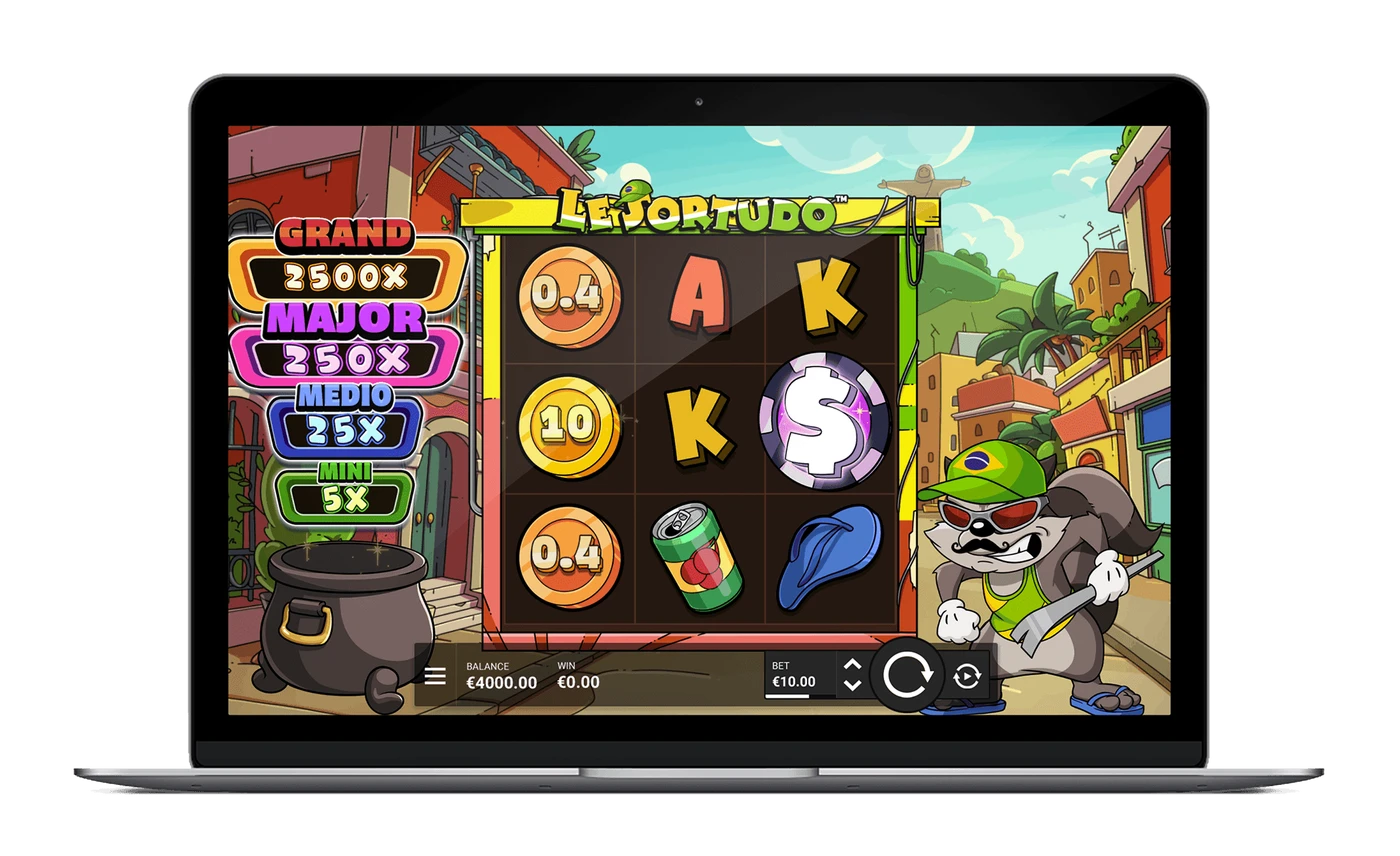
Rainbow Fortune is assembled from standard Hold & Win parts: three lives that refill whenever a new Coin, Jackpot Marker, Pot of Gold or Clover sticks, a four-rung fixed jackpot ladder, a collector and a multiplier. What sets Le Sortudo apart, as I see it, is the board and the second round. All of that machinery runs on a 3×3 grid, and Rainbow Epic Drop starts from the full grid that Rainbow Fortune has to build towards. The small board is also why the cap bites early. Nine cells hold few Coins, and the ×15 and ×20 rungs at the top of the Clover's eleven values are what turn a few Coins into a large number. They outrun 2,500× with very little underneath.
Three 50× Gold Coins and one Clover already outgrow the game
I need only a few lines of arithmetic to show it. One 50× Gold Coin under a ×20 Clover makes 1,000×, 40% of the cap. Two make 2,000×. Three make 3,000×, and the game pays 2,500×. At ×15, three 50× Gold Coins come to 2,250×; at ×10 it takes five of them to reach the maximum exactly. Fill eight cells with 50× Gold Coins and put a ×20 Clover in the ninth, and I get a board worth 8,000×, 3.2 times the cap, with 5,500× of it beyond what the game pays.
The Pot of Gold does nothing to change that. It collects Coin values into a stored total and clears the collected Coins off the grid, which frees cells for more, and a Clover multiplies an activated Pot's stored total as well. A collector exists to let a round grow past what a single grid can hold. Here a single grid already holds more than the cap. Once the value under a ×20 Clover passes 125×, every further Coin that Clover multiplies adds to a total the game will not pay.
The jackpot ladder sits outside the multiplication. Clovers act on Coins and Pot totals, while the Markers pay their fixed 5×, 25×, 250× and 2,500×. I count GRAND as the one symbol worth the cap outright, and a MAJOR is a tenth of it. In the base game, where Clovers and Pots take no part, a Coin-only win on nine 50× Gold Coins would come to 450×, and nine cells at MAJOR value would come to 2,250×. A base-game special-symbol win reaches the maximum only with a GRAND Marker in it.
Rainbow Fortune is only as good as its Coins
A multiplier multiplies whatever sits under it, and Rainbow Fortune's Coin table starts very low. Bronze Coins take 0.2×, 0.4×, 1× or 2×, so I count half the Bronze values below the stake. A full grid of nine 0.2× Bronze Coins settles for 1.8×. Swap one of them for a ×20 Clover and the board pays 32×, less than a single 50× Gold Coin with no Clover at all. The lowest Silver Coin, 3×, is fifteen times the lowest Bronze; the lowest Gold, 10×, is fifty times it.
That spread sets the shape of the round. Eight 9× Silver Coins, the richest all-Silver board, make 1,440× under a ×20 Clover, still short of the cap. Among Coins on a single board with one Clover, only Gold can push the total past 2,500×. Rainbow Fortune therefore runs from full boards worth under 2× the bet to boards that Gold Coins can take to the ceiling, and nothing raises the ceiling once they do. I find that consistent with a medium-volatility game. It also means the ×20 Clover, the biggest multiplier in the game, pays its full face value only on boards whose Coin and Pot value is 125× or less.
Rainbow Epic Drop raises the floor, not the roof
I rate Rainbow Epic Drop as the round worth wanting, and the reason is its floor. It opens on a full grid of special symbols with at least one Coin and one Pot of Gold in it, and its Coin values begin at 1×. That strips out the 0.2× and 0.4× Bronze values and lifts the Coin floor to five times Rainbow Fortune's. After the opening, the round runs on the same refilling-life, collection and settlement rules. It is Rainbow Fortune with its two weakest Coin values removed and a collector on the opening grid, and on a board where Bronze does so much damage I call that a real improvement.
Both rounds trigger from a single scatter, one Rainbow Scatter for Rainbow Fortune and one Epic Rainbow Scatter for Rainbow Epic Drop. Neither scatter can land alongside Coins or Jackpot Markers, so the spin that starts a round pays no Coin or Jackpot win of its own.
What Rainbow Epic Drop does not change is the cap. A round that opens on a full grid starts with Coin value already on the board, and 2,500× is still the most it can pay. The better round starts closer to the roof, and the roof stays where it is. That is the game's central problem in one line: its best design idea runs into the same low ceiling as everything else.
The bottom return setting is a different game
Casinos can run Le Sortudo at 96.27%, 94.29%, 92.23% or 86.28%. The top three sit about two points apart, 1.98 and then 2.06. I make the last step 5.95 points, about three times either of the others, and it takes the house edge from 3.73% at the top setting to 13.72% at the bottom, almost 3.7 times as much. Per 100 units wagered, the expected cost is 13.72 units instead of 3.73. At the top setting, the cap is the main reason this is not a better game. At the bottom setting it is the second reason, and I treat the 86.28% version as a separate, worse game that is worth checking the rules screen for.
It suits jackpot-ladder players, not multiplier chasers
The player I would point here wants Hold & Win for its visible structure: nine cells, three lives, a jackpot ladder whose top rung is the maximum win, and a second round that starts full. The ceiling equals the GRAND Marker's fixed value, so the top end is plain. Anyone drawn in by ×20 Clovers should look elsewhere. On this board the ×20 rung pays in full only while the value under it is 125× or less, and I see a multiplier that large under a cap this low as advertising more than the game can pay.