One symbol turns a stock grid into a menu of insurance
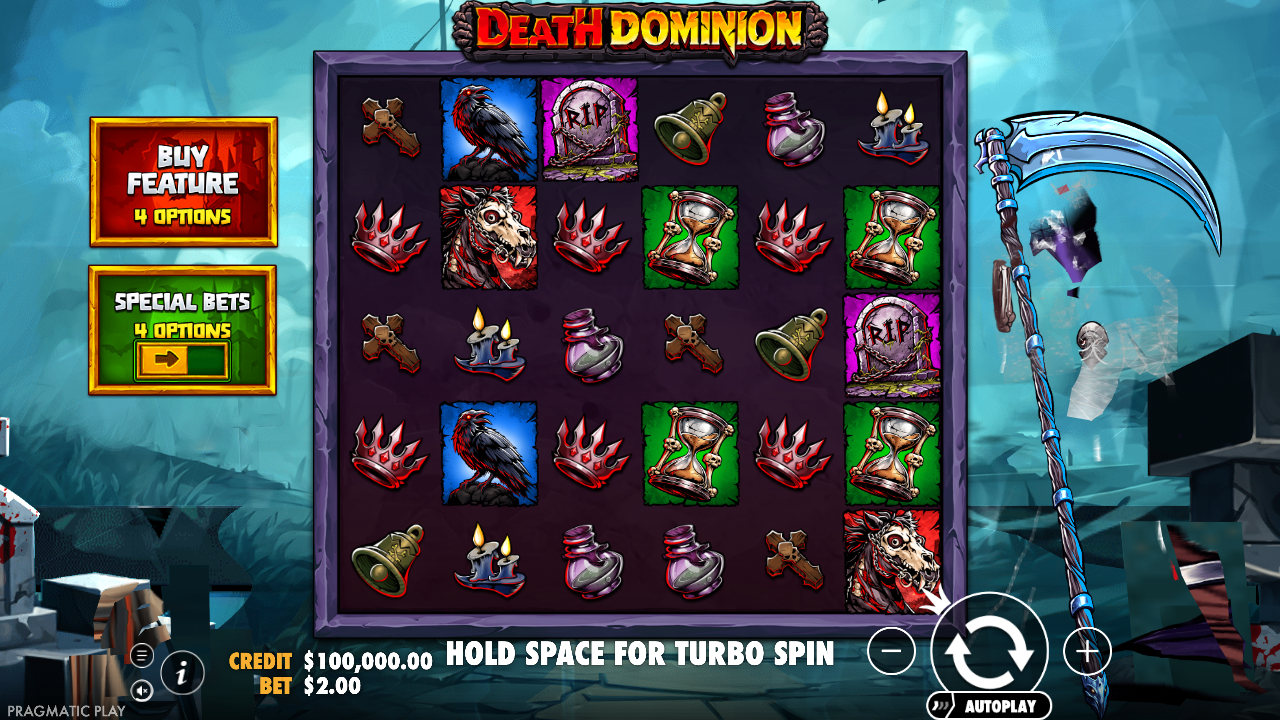
Death Dominion arrives in a format that is already familiar: a 6×5 board, wins for eight or more matching symbols anywhere, tumbles, and Multiplier symbols whose values are added together when the sequence ends. What I find new is Doom. When a tumble sequence or feature spin ends with Doom on screen, in normal play it either turns itself into a random Multiplier or removes every Multiplier present and cancels their effect on the win. That one rule is the game, and it is also what the game sells. Three of the four free-spin rounds are defined by how they rewrite Doom, the four special bets change how often Doom, Multipliers and the rounds turn up, and all nine ways to play return between 96.50% and 96.56%. I read that as a clear position: spending more here buys a different shape of risk around Doom and not a meaningfully higher return, since the best mode on the menu beats the 96.54% of normal play by 0.02 of a percentage point. I also think the 20,000× cap squeezes that shape harder the higher the price climbs.
The paytable is a rounding error beside the cap
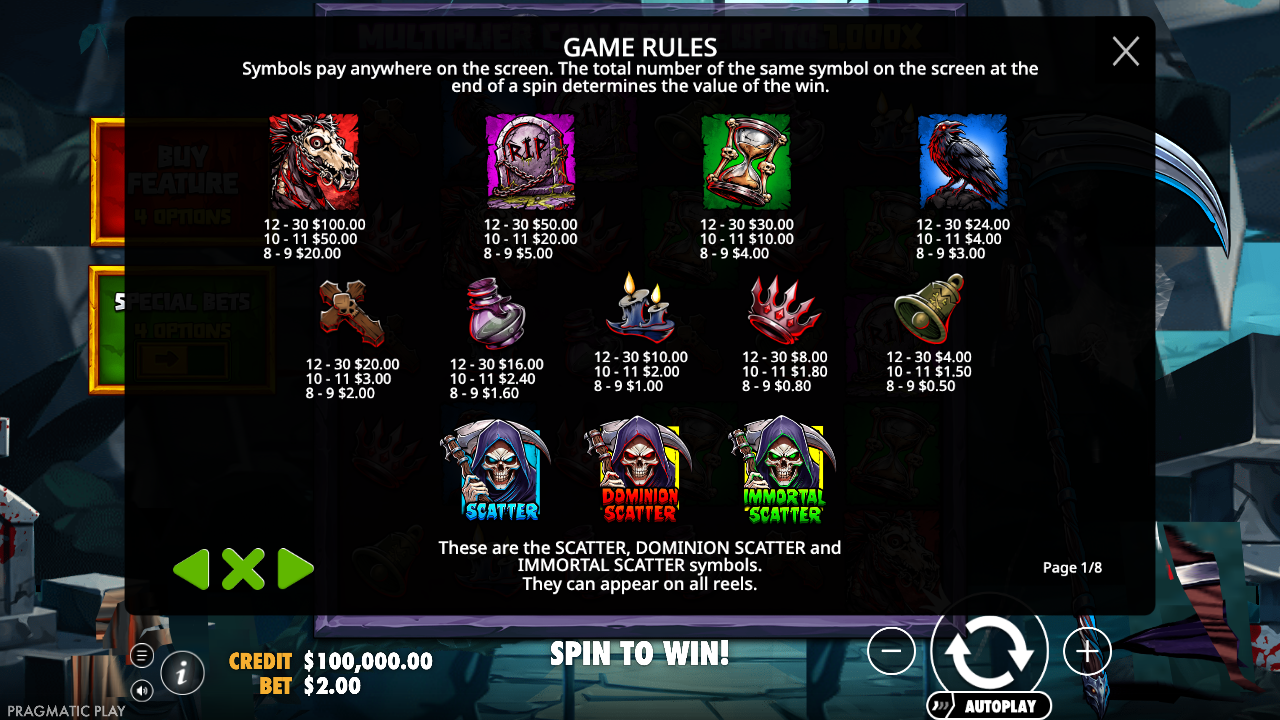
I count five of the nine regular symbols paying between 0.25× and 1× for eight or nine matches, and the best entry in the table, the skeleton horse, pays 50× for twelve or more. A 30-cell board holds two twelve-symbol groups at most, so I make the most one drop can pay from the table alone a horse group and a tombstone group together: 50× plus 25×, or 75×. That is under 0.4% of the 20,000× maximum, and reaching the cap on table wins would take 267 of those best-case drops in a single sequence. I treat the cap as a Multiplier figure. In the base game, when Doom takes the erase outcome, the sequence pays exactly this table.
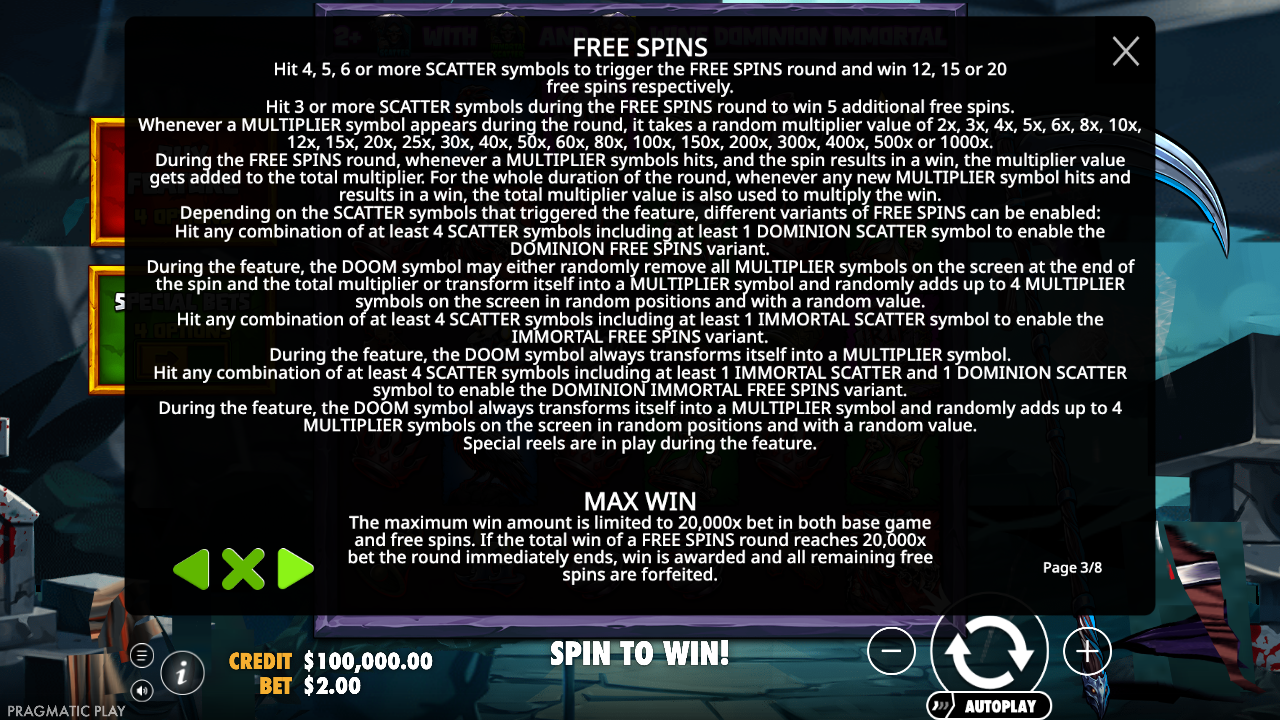
I can still take the base game to the cap on paper. Base-game Multipliers run from 2× to 100× and are summed, so three 100× values on a 75× sequence make 22,500×, which stops at 20,000×. The free spins get there far more easily. Multiplier values reach 1,000× in free spins, each one that lands on a spin that finishes with a win is added to a total that lasts the whole round, and that total applies whenever a new Multiplier lands and the spin wins. Once a single 1,000× is in the total, a 20× table win on a qualifying spin reaches the cap, and I count three table entries that clear 20× by themselves: the horse at 25× and 50×, and the tombstone at 25×. Even the bell's 0.25× would pay more than 250×. A free spin that wins without a new Multiplier gets none of that and pays the table flat, and in Standard and Dominion Free Spins Doom can still wipe the Multipliers on screen before they pay.
Dominion raises the stakes of Doom's gamble, and Immortal calls it off
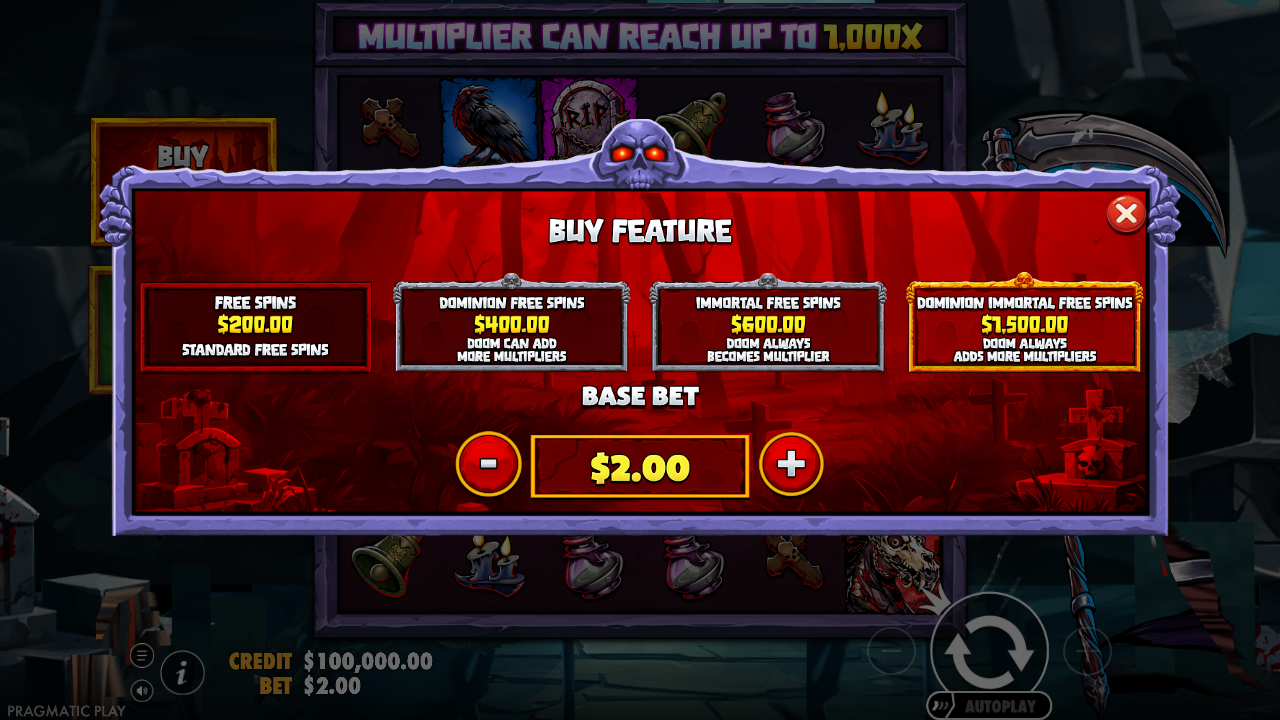
The four rounds share a skeleton. Four scatters award 12 free spins, five award 15, six or more award 20, and three or more scatters inside any of the rounds add five. The scatter type decides which round starts. Standard Free Spins leave Doom as it is in normal play. Dominion keeps the erase outcome but makes a transform add up to four random Multipliers, so one Doom can become as many as five Multipliers. In Immortal, Doom always becomes a Multiplier. Dominion Immortal does both.
I read those as opposite changes. Dominion widens the gamble: the losing side of Doom is untouched and the winning side grows. Immortal ends the gamble and keeps the standard payoff. I rate Immortal as the more important upgrade, because removing the wipeout decides whether a Multiplier that lands gets to pay at all, while Dominion's extra Multipliers arrive only on the spins where Doom transforms. The prices agree with my ranking. Dominion adds 100× to the 100× Standard price and Immortal adds 200×. Stacked at those rates, both upgrades together would cost 400×. The combined buy costs 750×, a premium of 350× for having the two at once.
A dearer buy is a bigger bet with less room above it
Return barely moves along the buy ladder: 96.51% for Standard, 96.55% for Dominion, 96.56% for Immortal and 96.50% for Dominion Immortal, which is the dearest round with the lowest rate. With the rate that flat, I treat the price as simply the size of the bet. By my arithmetic a Standard buy returns 96.51× on average and gives up 3.49× of the base bet, while a Dominion Immortal buy returns 723.75× and gives up 26.25×. The house takes about 7.5 times as much from the combined round because it costs 7.5 times as much, not because the rules inside it are worse value.
Headroom is what changes. I work the 20,000× cap out at 200 times the Standard price, 100 times Dominion's, about 67 times Immortal's and under 27 times the Dominion Immortal price. A Standard buy can lean on a rare result worth up to 200 times its cost. A Dominion Immortal buy cannot, because its largest possible result is less than 28 times what it returns on average. Paying for protection from Doom therefore buys a round whose best result sits much closer to its price, with less of the upside that makes a 20,000× game worth considering. I accept that as a legitimate thing to want, and I do not count it as an upgrade in return.
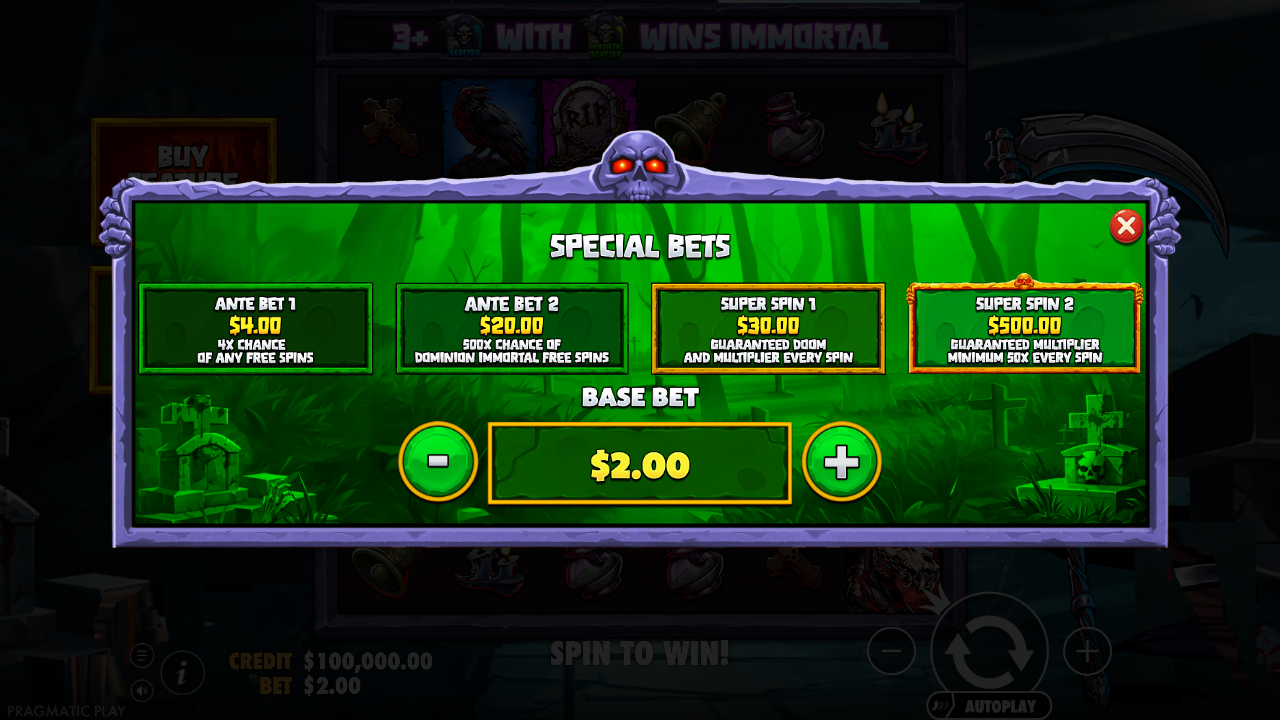
The special bets follow the same logic. Ante Bet 1 doubles the stake for more than four times the chance of a natural free-spin round, which is more than twice as many rounds per unit staked, at 96.53%. Ante Bet 2 costs 10× for a sixfold chance, so it produces 0.6 as many natural rounds per unit staked as normal play, but its more than 500-fold chance of Dominion Immortal makes that round more than 50 times as frequent per unit staked, at 96.54%. I read it as a Dominion Immortal hunting mode at an unchanged return. Super Spin 1 costs 15× and puts Doom's gamble on each spin, guaranteeing one Doom and at least one Multiplier, with up to four more if Doom transforms, and I put its ceiling at about 1,333 times its price.
I consider Super Spin 2 the clumsiest item on the menu. It costs 250× for one spin with a Multiplier of at least 50×, and 250 divided by 50 is 5, so a 50× Multiplier needs a 5× table win just to return the price. The bell tops out at 2× and the crown at 4× at any count, so on the minimum 50× neither gets there alone. A guaranteed Multiplier is not a guaranteed win, free spins cannot start in this mode, and the spin can return at most 80 times its price while 200× buys an entire Dominion round.
One strong idea, sold eight ways
I give Death Dominion its place on the strength of Doom. The base game underneath is stock, and between Multipliers it is thin, since five of the nine regular symbols pay the stake or less for their smallest win. The menu then turns one idea into eight priced options that all return between 96.50% and 96.56%, which I call clutter more than choice.
The game suits a player who wants to choose how Doom treats the Multipliers and understands that the choice is about shape. I would steer a player chasing the ceiling as a multiple of the outlay toward normal play, Ante Bet 1 or the Standard buy, where the cap is at least 200 times the price. A player who wants protection from the wipeout can pay 300× for Immortal and accept a ceiling of about 67 times the price. Players who want a base game with ideas of its own, or who expect a dearer buy to return more, should look elsewhere.