Where a round starts on the ladder is the decision that counts
Better Barn House Bonanza sells head starts. Its central idea is a cell ladder inside free spins, straw to wood to brick, and the gaps between those rungs are wide enough that the material a cell begins on shapes its final reveal more than anything else in the game. I read every other part of it through that. The base game exists to deliver Scatters and Wheel symbols, the Scatter-triggered round begins on the bottom rung, and the three wheels, with the three buy prices that open them, are a menu of better starting boards. On that reading the 200× Better Wheel is the fairest purchase here, and the ladder carries the score while a thin base game and a straw start hold it down.
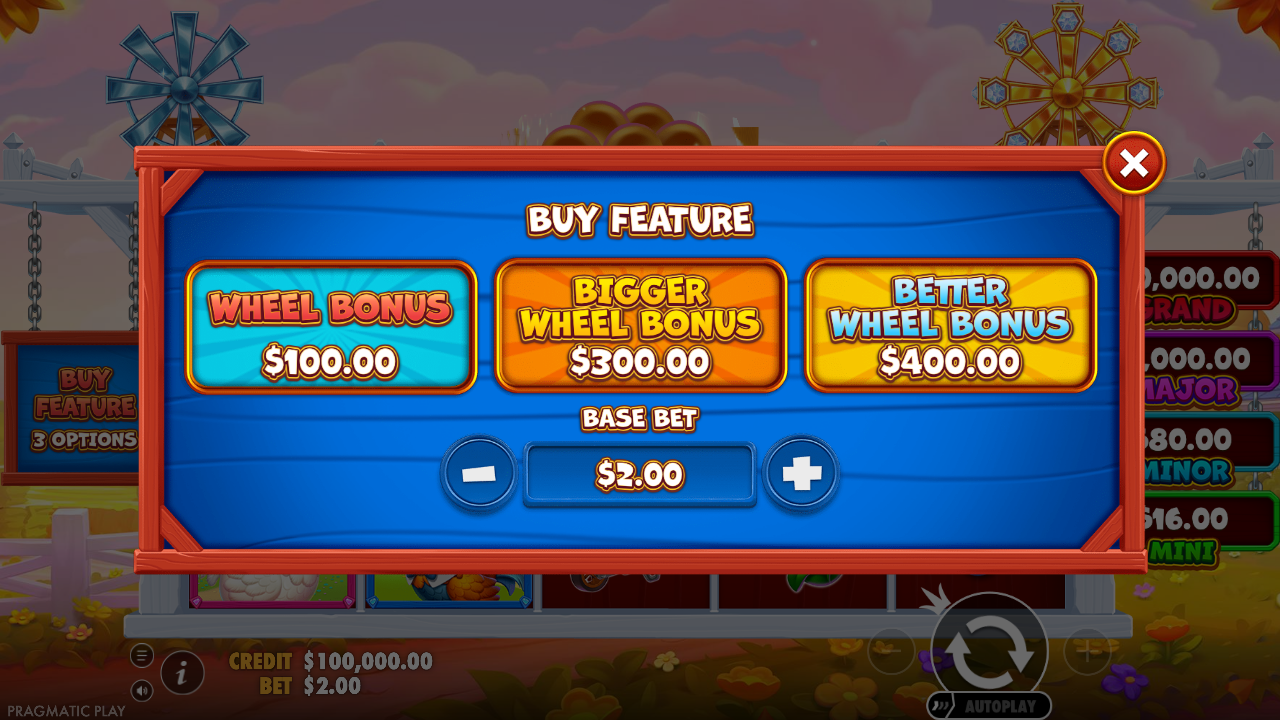
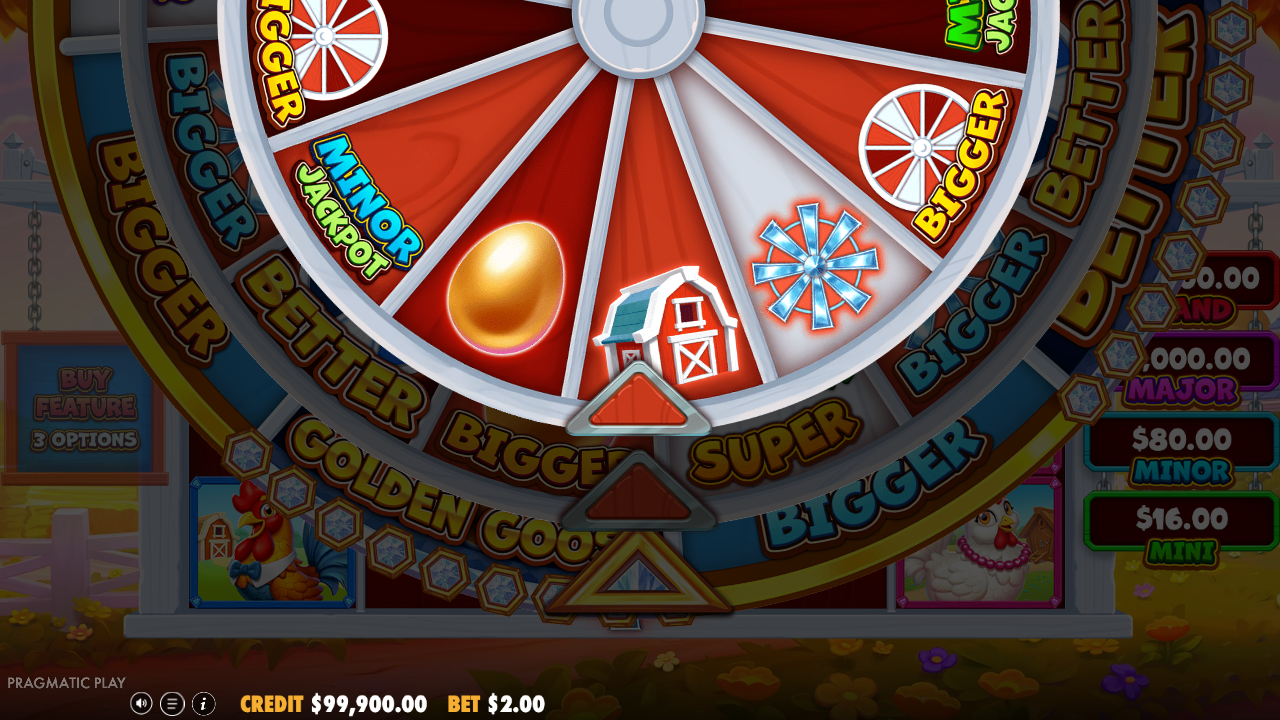
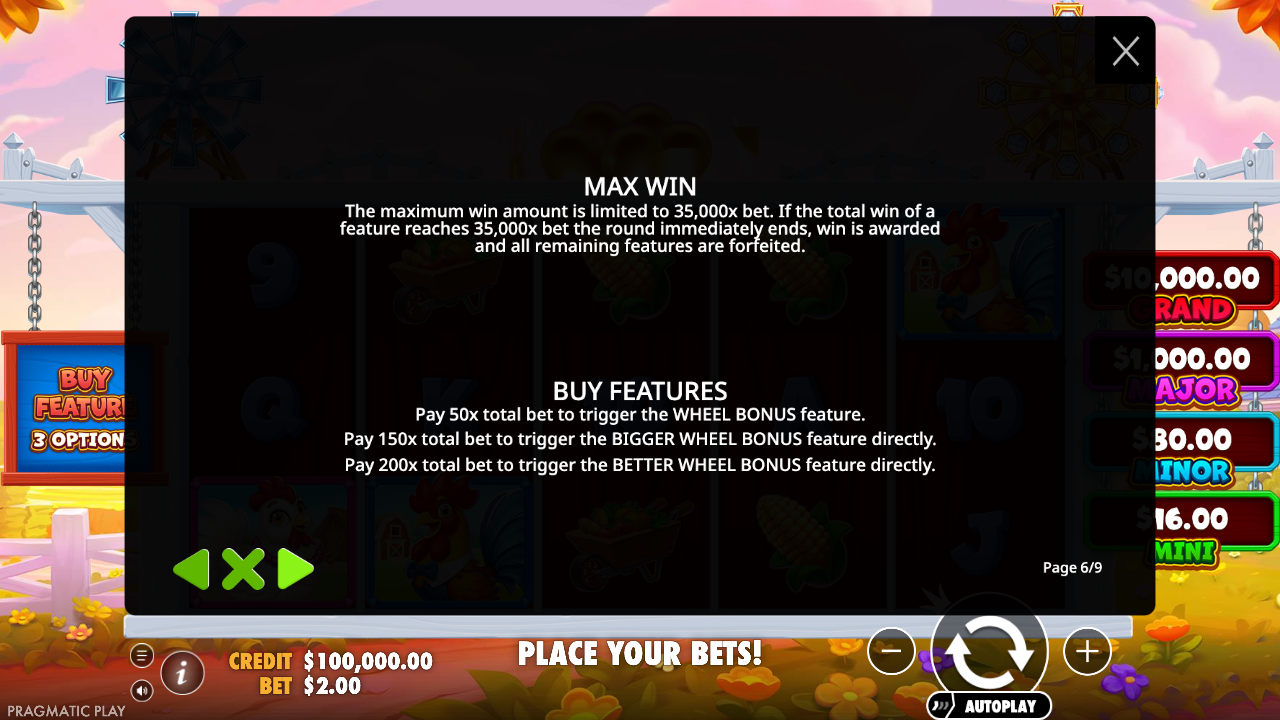
Structurally this is a 243-ways slot with two systems stacked on it rather than one. A three-tier wheel sits in front and routes into different free-spin starts, fixed jackpots or, below the top tier, the next wheel up. A mark-and-reveal round sits behind it. The buy menu mirrors the wheel exactly, 50× for Wheel, 150× for Bigger Wheel and 200× for Better Wheel, so a purchase does not skip to one bonus. It picks the branch of the tree to enter.
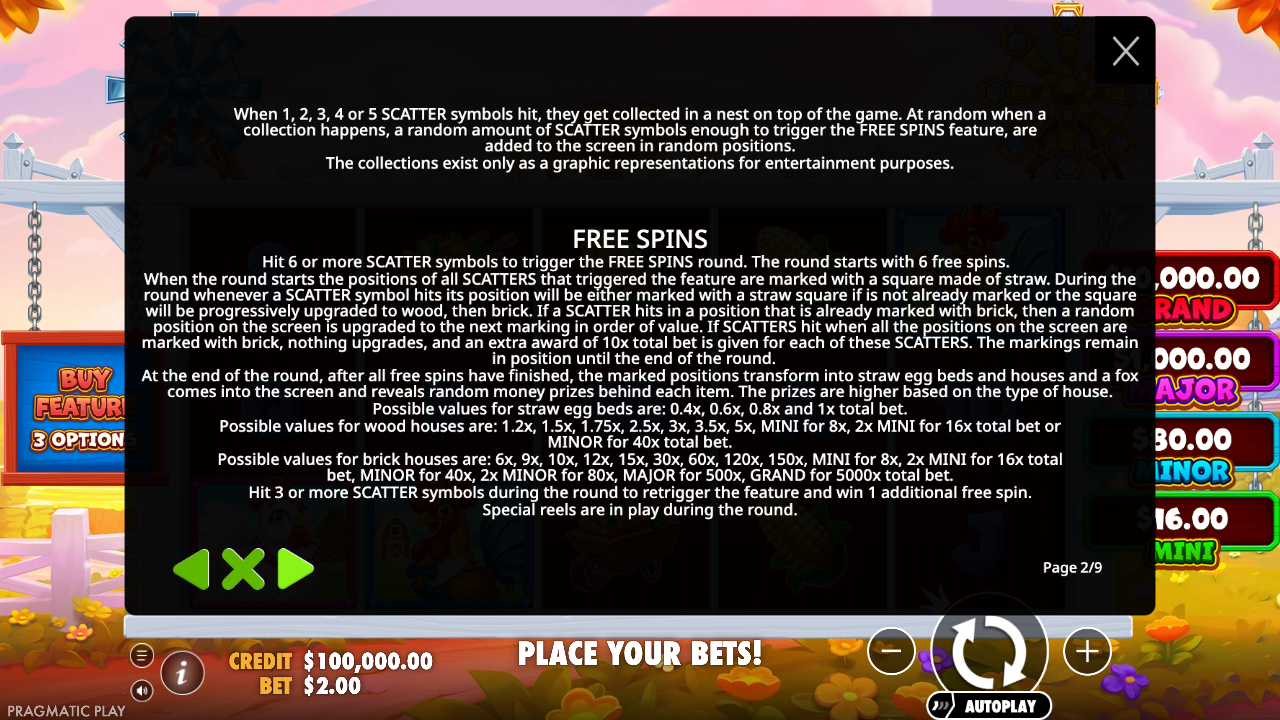
The rungs explain why that choice matters. Straw reveals 0.4× to 1×. Wood reveals 1.2× up to a 40× Minor. Brick reveals 6× up to the 5,000× Grand. One brick cell at its worst, 6×, pays what six straw cells pay at their best combined. By my arithmetic wood's floor is three times straw's, brick's floor is fifteen times straw's, and brick's ceiling is 125 times wood's. In the standard round an empty cell needs three upgrades to reach brick, and a cell marked by the trigger needs two more.
The standard round starts at the bottom and grows one spin at a time
Exactly six Scatters start six free spins with six straw cells. If no further Scatter lands, those six cells reveal between 2.4× and 6× in total. Scatters are what move the board, and the same Scatters feed the retrigger: three or more in a spin add one free spin, on top of what those Scatters do to the marks. A retrigger adds one spin whatever the Scatter count, so the round lengthens slowly.
The upgrade logic is at least efficient. In this round a Scatter on a brick cell upgrades another random position instead, and once all fifteen cells of the 5×3 board are brick, each further Scatter pays 10×. No Scatter in the standard round is wasted. Filling that board to brick still takes 45 Scatters, or 39 once the six trigger marks are counted, which is a great deal to ask of a round that grows one spin at a time.
The ceiling is not the problem. Seven Grand reveals come to 35,000× exactly, the maximum win, and the 5×3 board has fifteen cells, so the standard round has room for the cap on paper. Any round whose total would pass 35,000× stops there and forfeits whatever remains. The weakness is the distance between that ceiling and a 2.4× floor, with a bottom rung that limits each straw cell to 1×.
The base game is scaffolding, and its paytable is sized for it
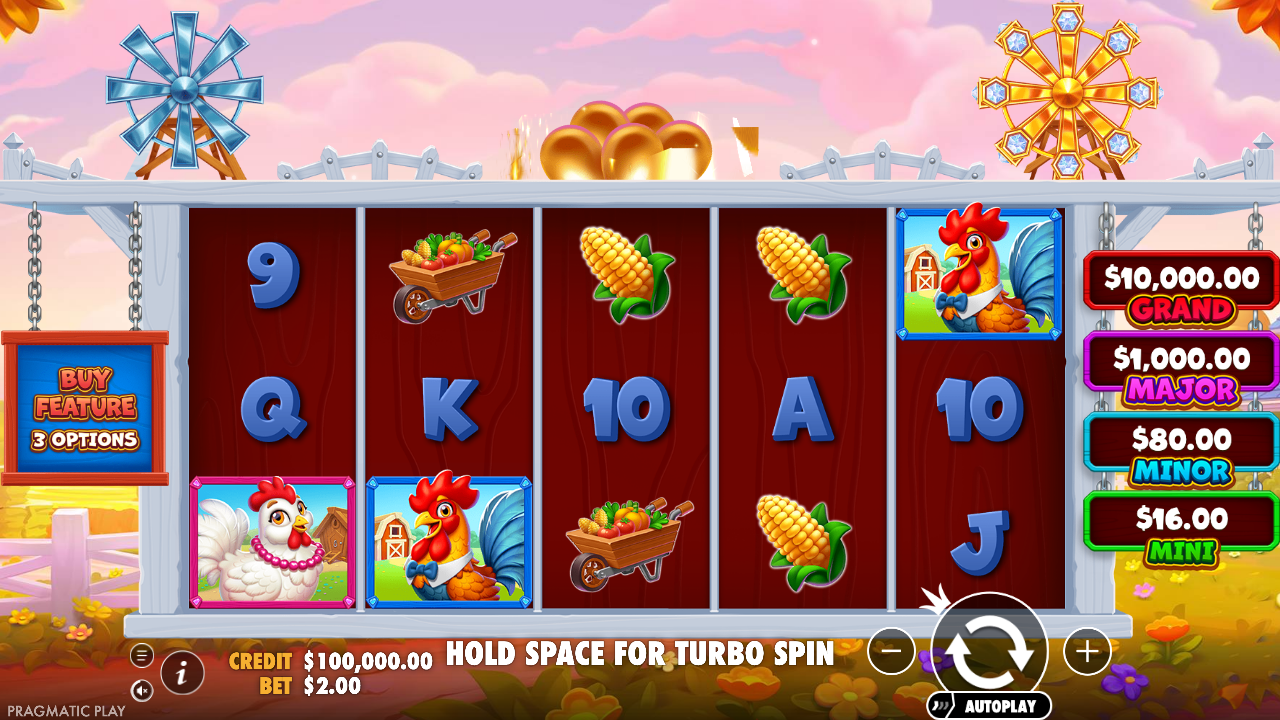
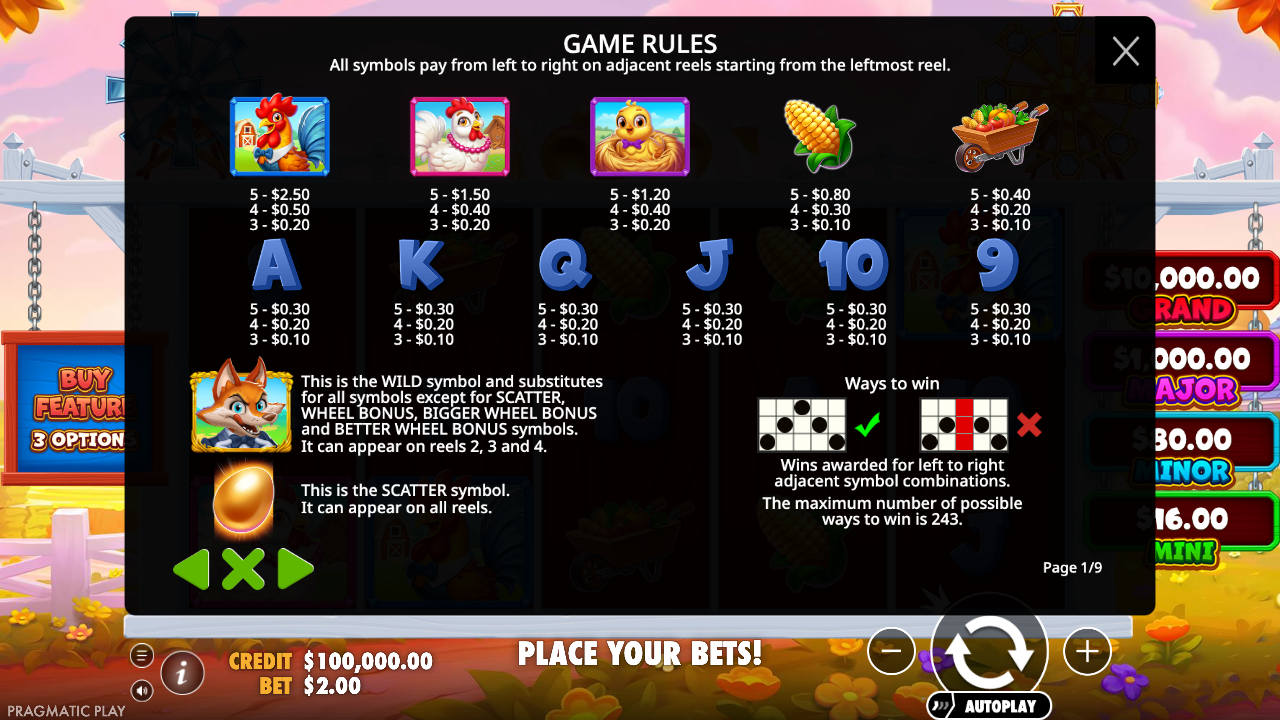
Five Roosters pay 1.25× the bet, and the Rooster is the only regular symbol whose top prize exceeds the stake. The six card symbols top out at 0.15×, and I count eight low symbols in all, each paying 0.05× for three, a twentieth of the bet. Even a screen of Roosters and Fox Wilds adds up to 243 ways at 1.25×, or 303.75×, under 1% of the cap. The Fox Wild substitutes for neither the Scatter nor any Wheel symbol, so it contributes nothing to the Scatter or wheel triggers.
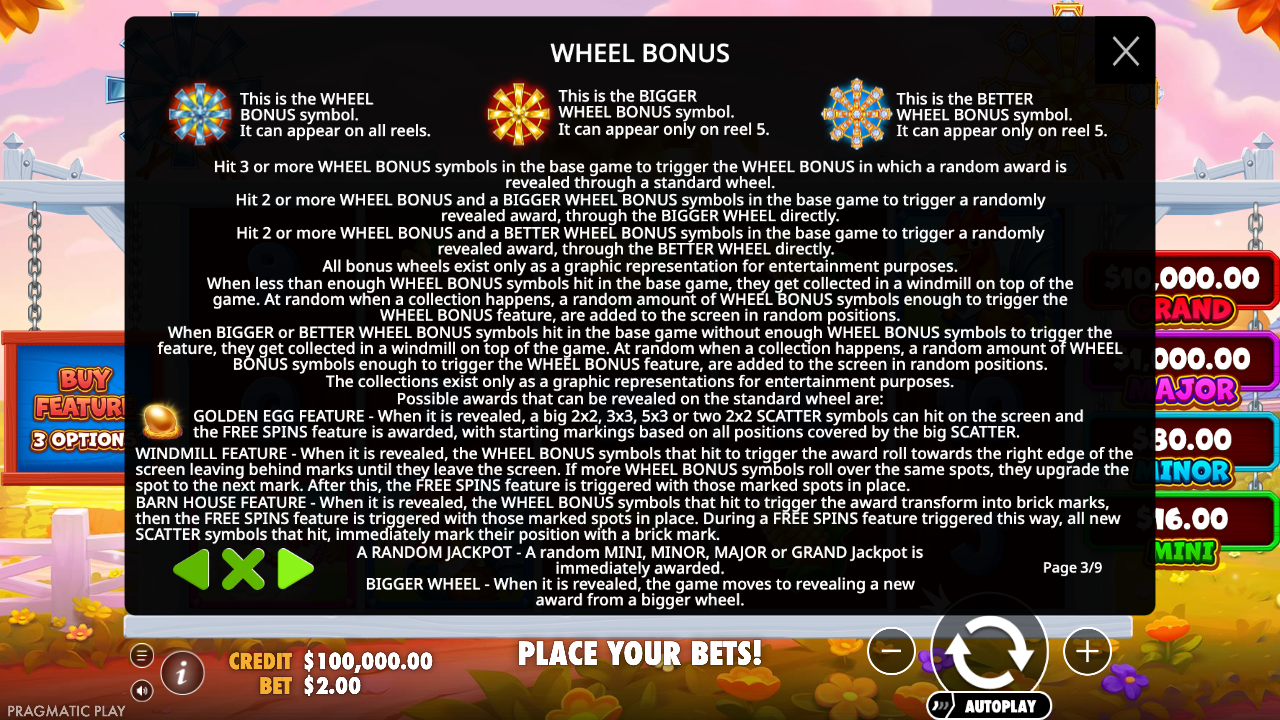
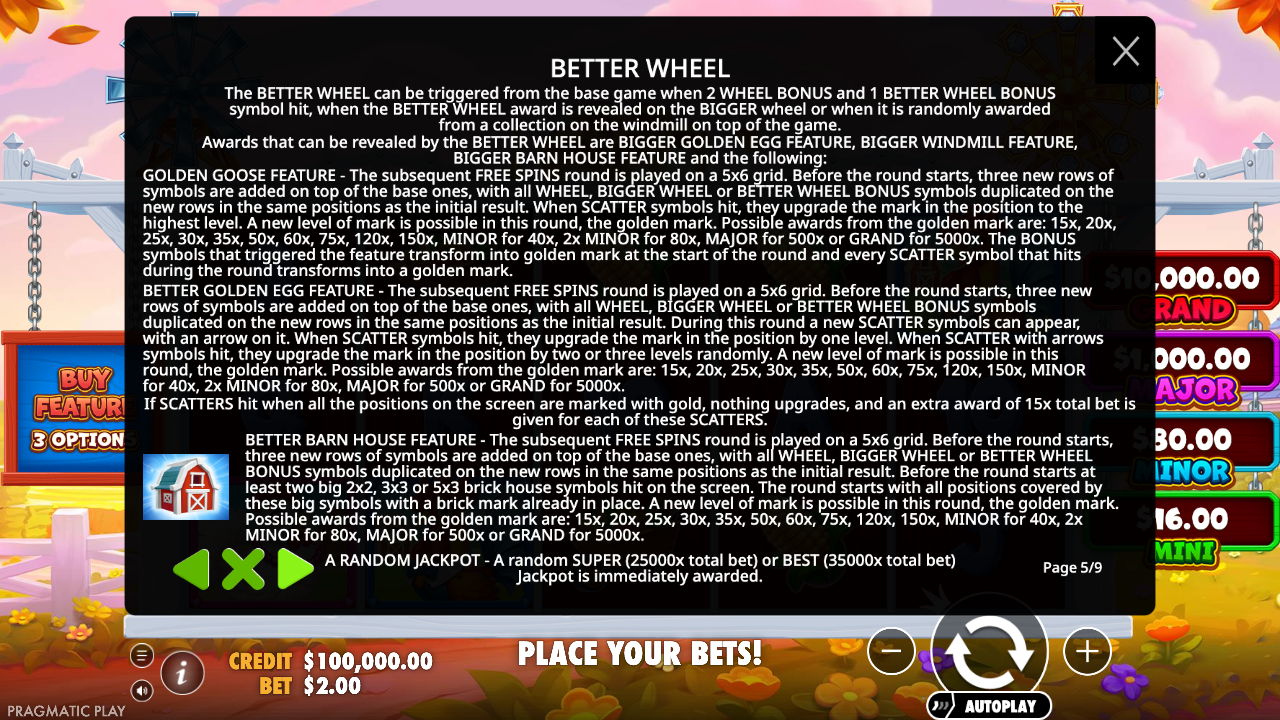
What the base game does well is route. A direct Better Wheel start needs at least two Wheel symbols plus a Better Wheel symbol, so three symbols can do it, the same minimum as a standard Wheel Bonus, with the third confined to reel five. The nest and windmill displays hold no progress between spins, and the random draw that completes a trigger works on the spin in front of it, so a display that looks nearly full is no reason to continue. Where feature purchases are unavailable, this scaffolding is the only way into the tiers, and the game is weaker for it.
Bigger and Better are worth more than their jackpots
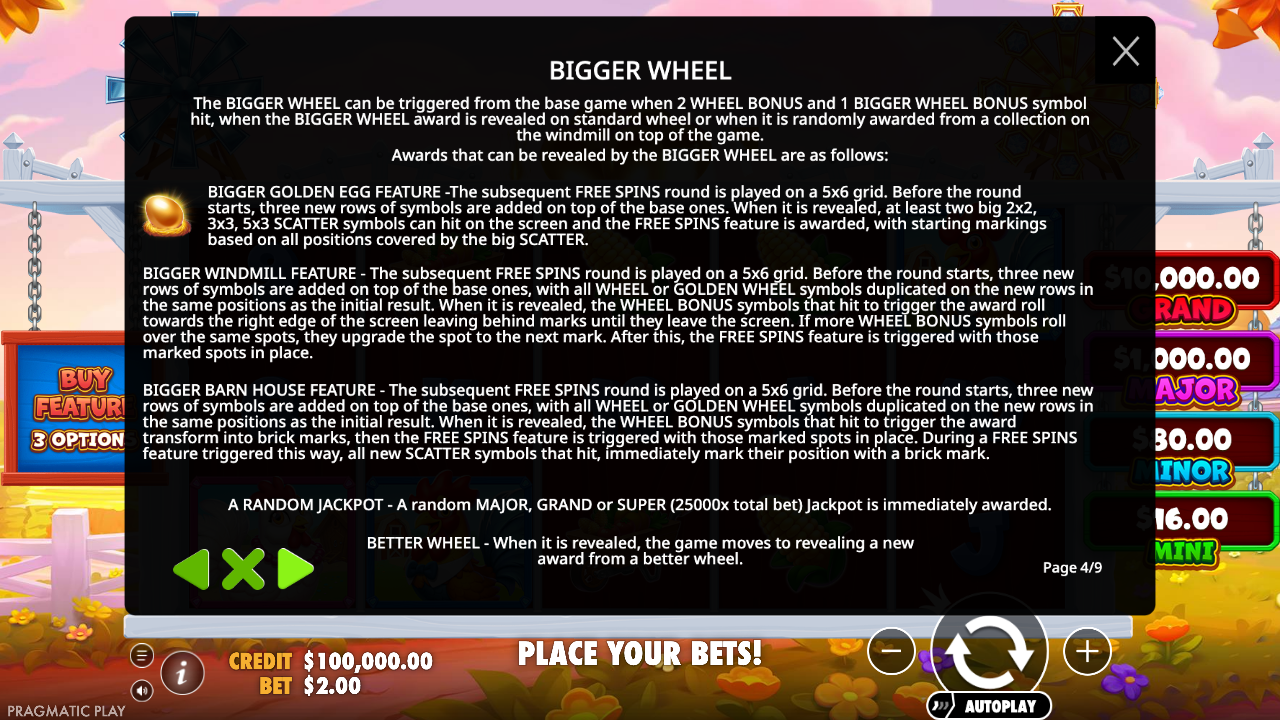
Bigger Barn House starts its trigger positions in brick and makes every later Scatter a brick mark at once, skipping two rungs. In the standard round one Scatter on an empty cell is worth at most 1× at the reveal. In Bigger Barn House the same Scatter on an empty cell is worth at least 6×. The 5×6 grid doubles the board to thirty cells, and thirty brick cells at the 6× minimum would reveal 180×, more than the 150× Bigger Wheel buy before a single cell reveals above its floor.
Golden marks go further in a specific direction. Only the Better Wheel's Golden Goose, Better Golden Egg and Better Barn House variants can create them. A golden cell's worst reveal is 15×, two and a half times brick's, and its best is the same 5,000× Grand. The golden list drops brick's 6× to 12× values and both Mini outcomes. That tier raises the floor, not the ceiling, and a floor is what a bought round is paying for.
At 200×, the top jackpot and the cap are the same number
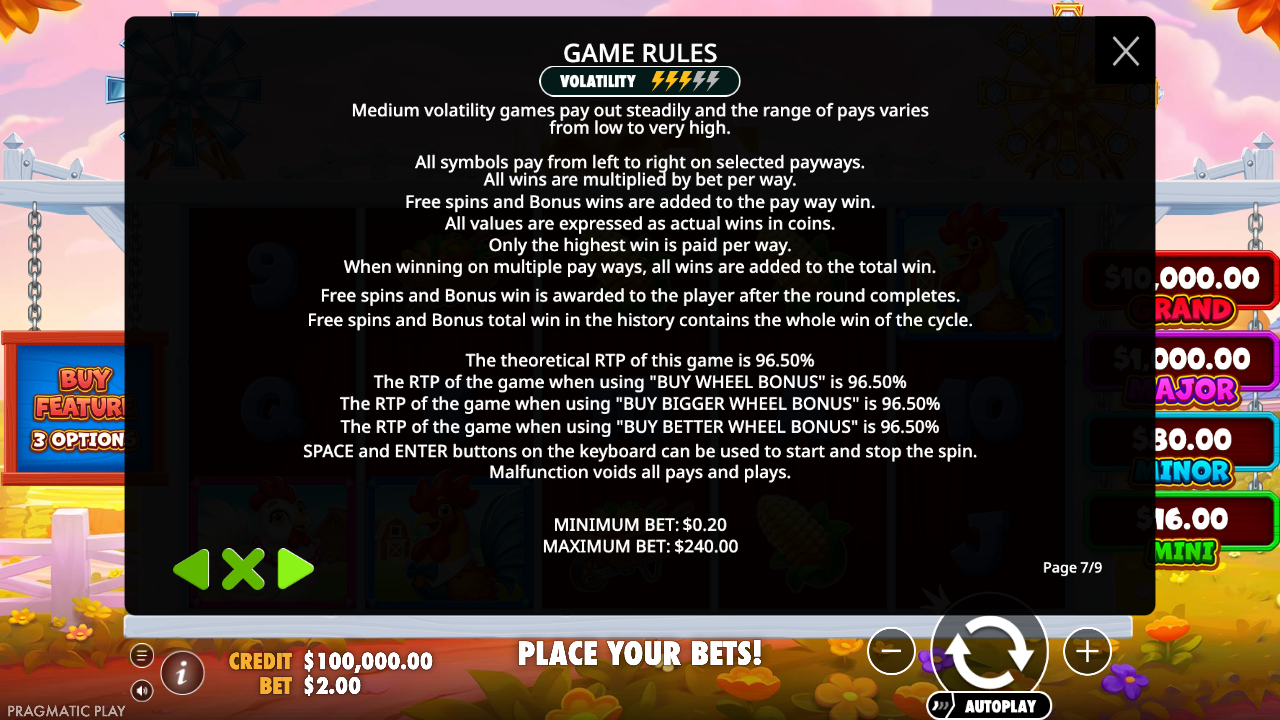
All three buys run at 96.50% RTP, the same as normal play, so a higher price buys a better starting position and not a better RTP. What changes is the shape of the best case against the cost.
The 50× Wheel Bonus has the tallest ceiling relative to its price, since the 35,000× cap is 700 times the buy. Its own jackpots run from the 8× Mini, under a sixth of the price, to the 5,000× Grand, 100 times the price. Reaching the cap from there takes either two advances, to the Better Wheel and its Best jackpot, or a free-spin round whose wins reach 35,000×. The 150× Bigger Wheel caps out at about 233 times its price, and its jackpot outcomes run from the 500× Major, a little over three times the price, to the 25,000× Super, about 167 times. The 200× Better Wheel caps at 175 times its price, and its jackpot outcome is 25,000× or 35,000×, so even the smaller one pays 125 times the buy.
Put side by side, the top jackpot climbs from 100 to about 167 to 175 times the price while the cap falls from 700 to about 233 to 175, and the two lines meet at the Better Wheel. Each step up also lifts the top jackpot faster than the price. Tripling the cost from 50× to 150× multiplies it by five, and the extra third from 150× to 200× adds 40%, from 25,000× to 35,000×, along with golden marks and a jackpot floor that jumps from 500× to 25,000×. The 700 figure on the cheap buy is a paper ceiling, because every branch between the standard wheel and the top tier is another outcome that sends the round somewhere else. I rate the 200× buy as fair access to the broadest outcome tree, not as the expensive option.
This is a buy-menu game with a base game attached
It suits someone who wants the reveal round and accepts paying 150× to 200× for a shaped start, where the 5×6 grid arrives at Bigger, golden marks arrive at Better, and the jackpot floor rises at both. It is a poor fit for anyone who wants base spins to do real work between features, because a 1.25× top symbol and a 303.75× full-screen ceiling cannot. It also loses a lot wherever purchases are switched off, since every tier then has to be reached through that base game. One real strength, fairly priced at the top and set in a thin frame, puts it in good territory rather than excellent.