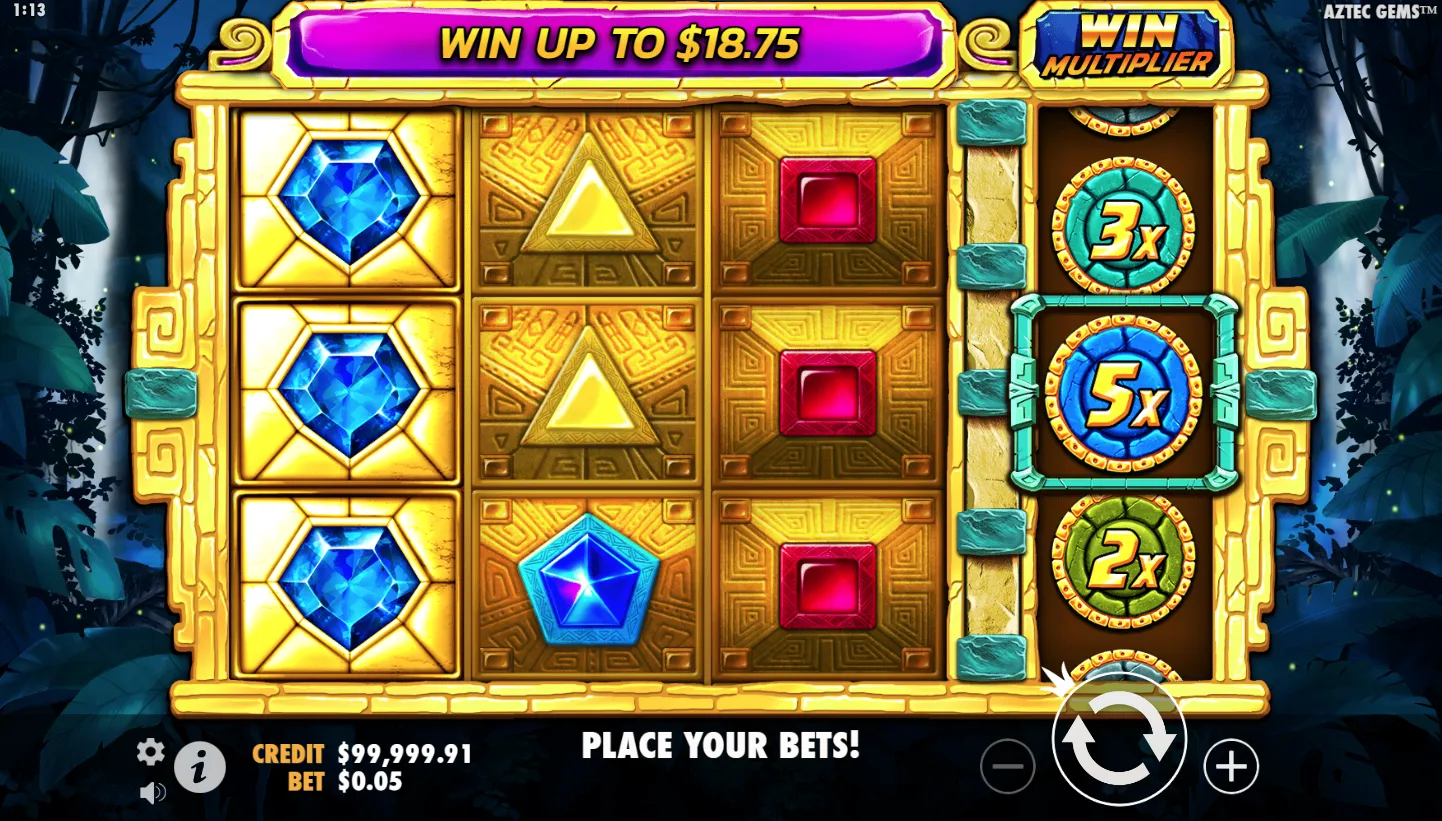
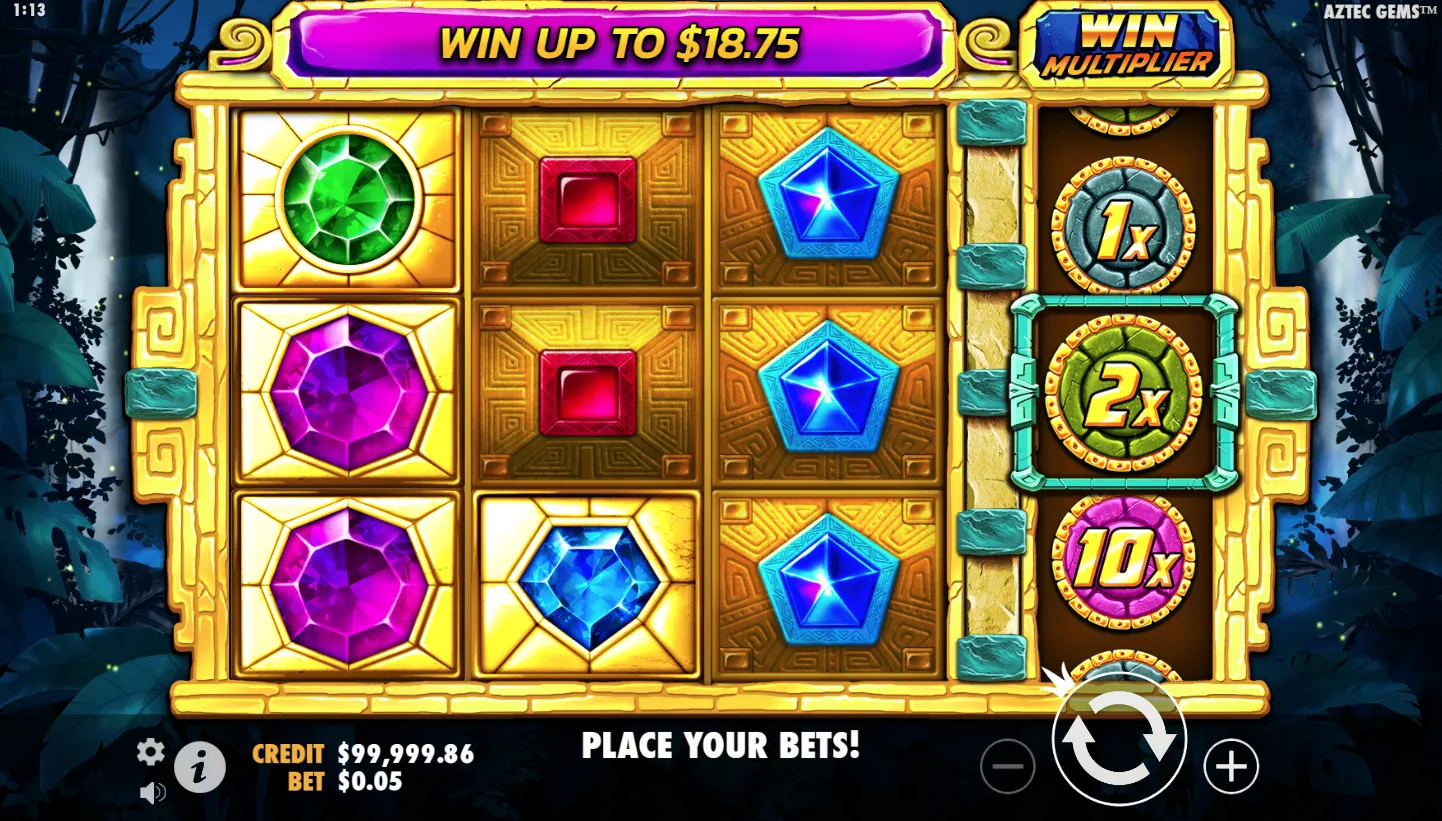
375x is two numbers multiplied together
Aztec Gems has no maximum win in the usual sense. Its 375x ceiling is not a limit clamped onto bigger maths: it is the most the nine cells can pay, 25x for a full screen of wilds, times the top value on the fourth reel, 15x. Everything the line game pays above 25x comes from that reel. That makes the game easy to read in full and hard to stay interested in, because the reel is a good idea with very little underneath it to multiply, and that is my case for a 6.1.
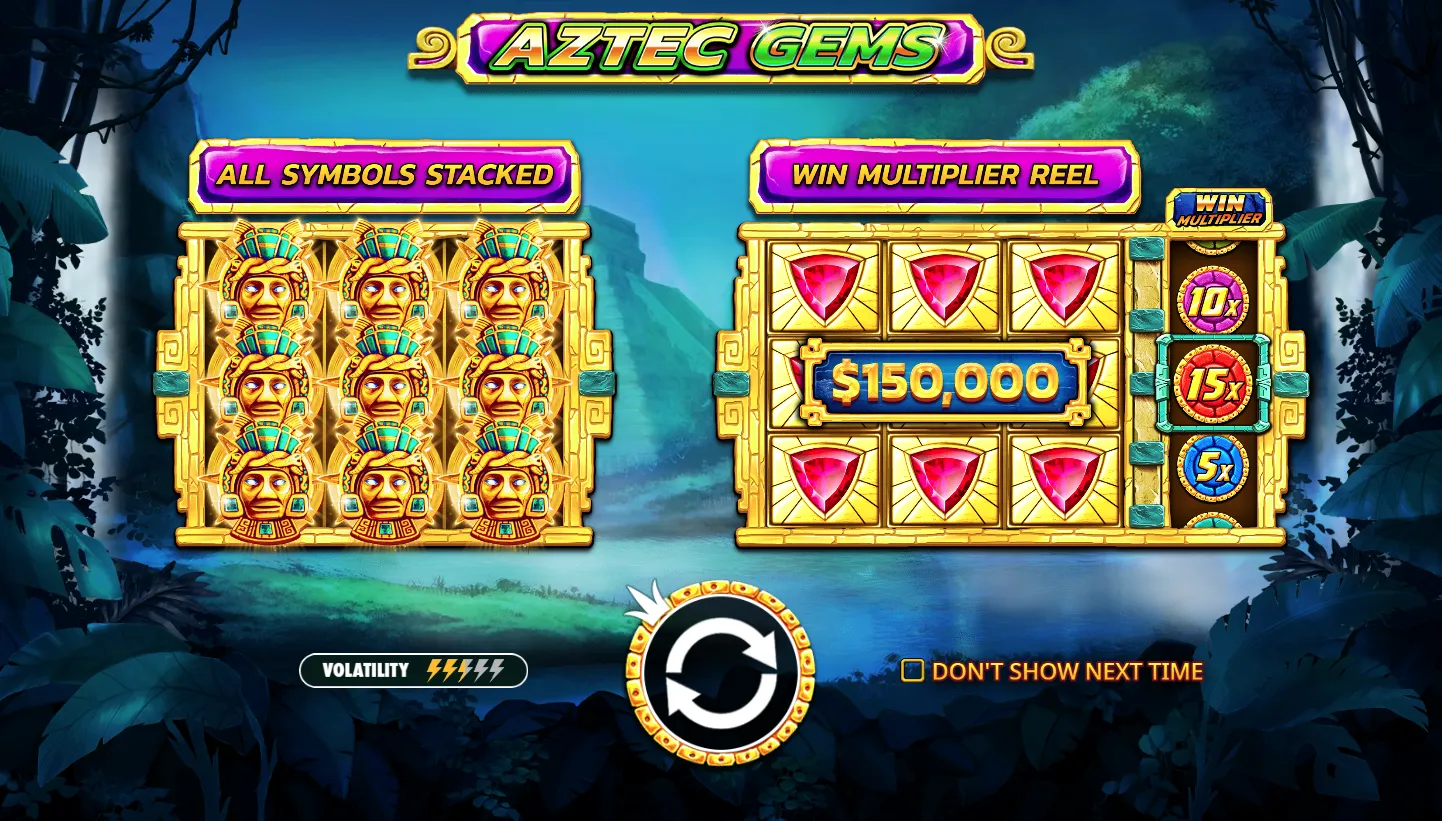
The frame around the reel is the plain five-line classic. Joker's Jewels is another fixed five-line Pragmatic Play game with no free spins, where every result settles on the spin, and Hot to Burn pays from line hits alone with no bonus round to chase. Aztec Gems keeps that frame, five fixed lines and every result settled on the spin, and bolts a fourth reel of multipliers onto it that stops after the line result. Aztec Gems Deluxe is built on the same 3x3 gem board with a win multiplier reel to its right, so in this family the reel is the idea and the gems are the setting. The game refines the three-reel format rather than inventing a new one, and I judge it on what one extra draw can add to a board this small.
Building the ceiling this way has one honest consequence. The board's best result is 25x and the ladder's best value is 15x, so every pairing of a board result with a multiplier fits under 375x. No line win runs into the cap and stops there. The cap is simply the corner where the two maxima meet.
The board alone is a 25x game, and a thin one
The line bet is one fifth of the stake: coin values from 0.01 to 50 across five lines give the 0.05 to 250 stake range. Three wilds pay 25 coins, which is 5x the total bet, and no other line pays as much. The red gem pays 4x, purple 3x, blue 2.4x and green 2x. The stones are where the paytable gives out. A red stone line pays 1.6x, a blue stone line pays exactly the stake, and a yellow stone line pays 0.4x, so under a 1x multiplier a lone yellow stone win hands back less than half of what the spin cost.
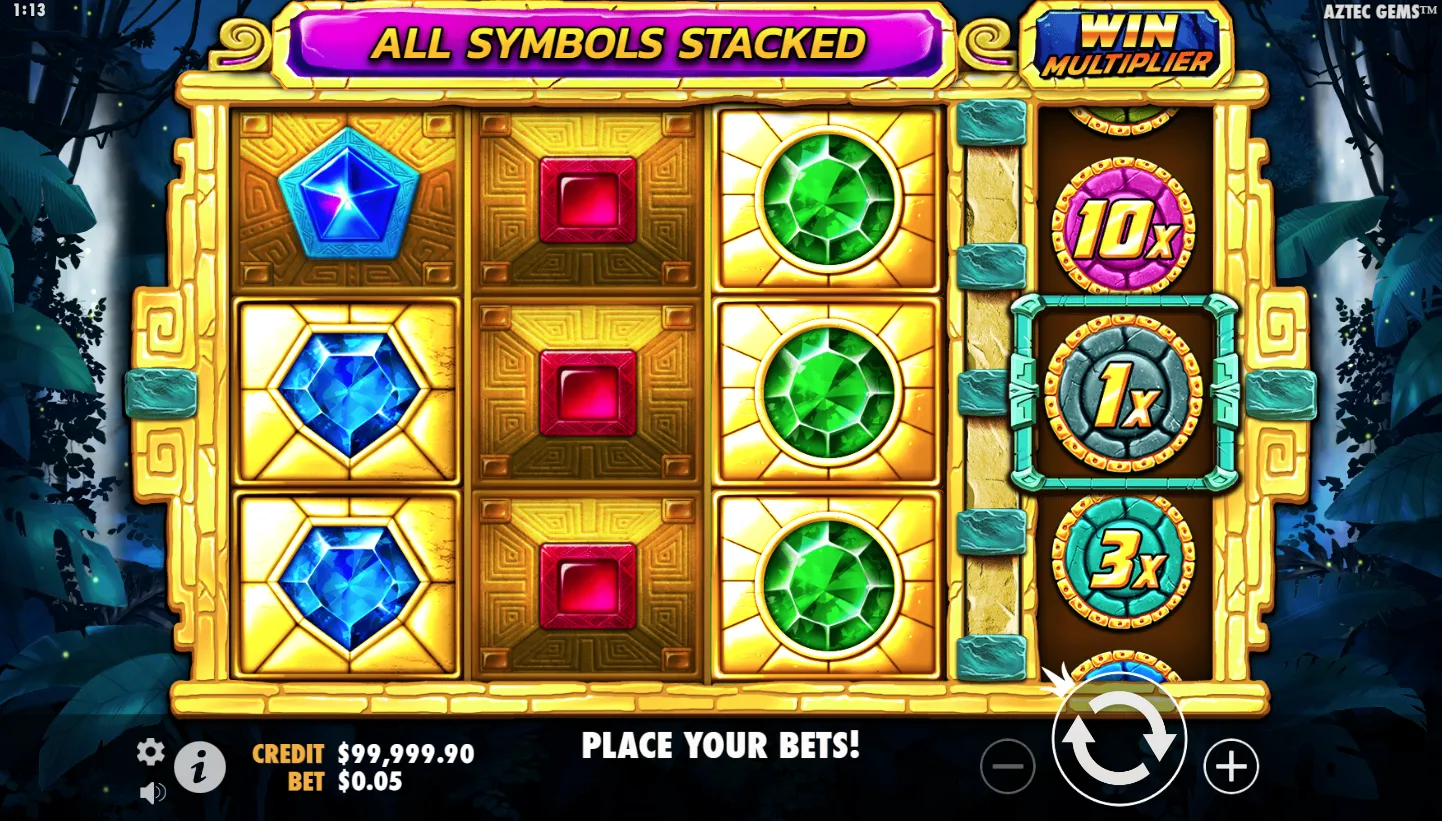
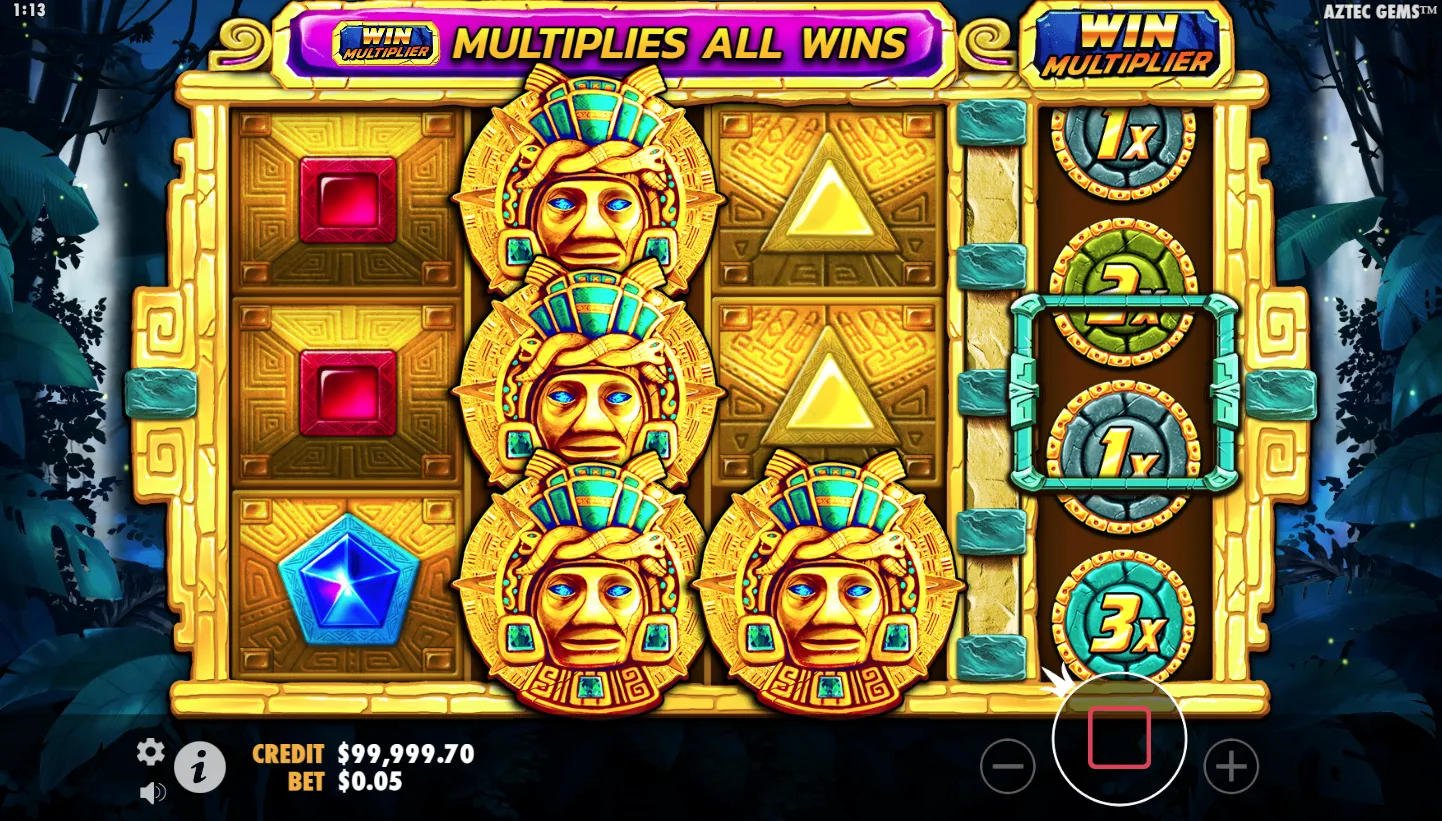
Stacks are the only source of range on the board. Every line crosses each reel once, so a reel stacked full of one symbol puts it on all five lines, and the other two reels decide how many of them pay. The cells are not equal. I count the centre on three lines, the middle row and both diagonals, each corner on two, and the four edge cells on one each. When one symbol fills all nine, all five lines pay, and five times its line value is the most that symbol can reach: 25x for wilds, 20x for red gems, 15x purple, 12x blue, 10x green, 8x red stone, 5x blue stone and 2x yellow stone.
That is the whole of the base arithmetic. A 3x3 board that pays three of a kind and nothing longer cannot hold much, and medium volatility, 3 on a scale of 5, is about what a board this size can support.
Fourteen fifteenths of the ceiling sits on one reel
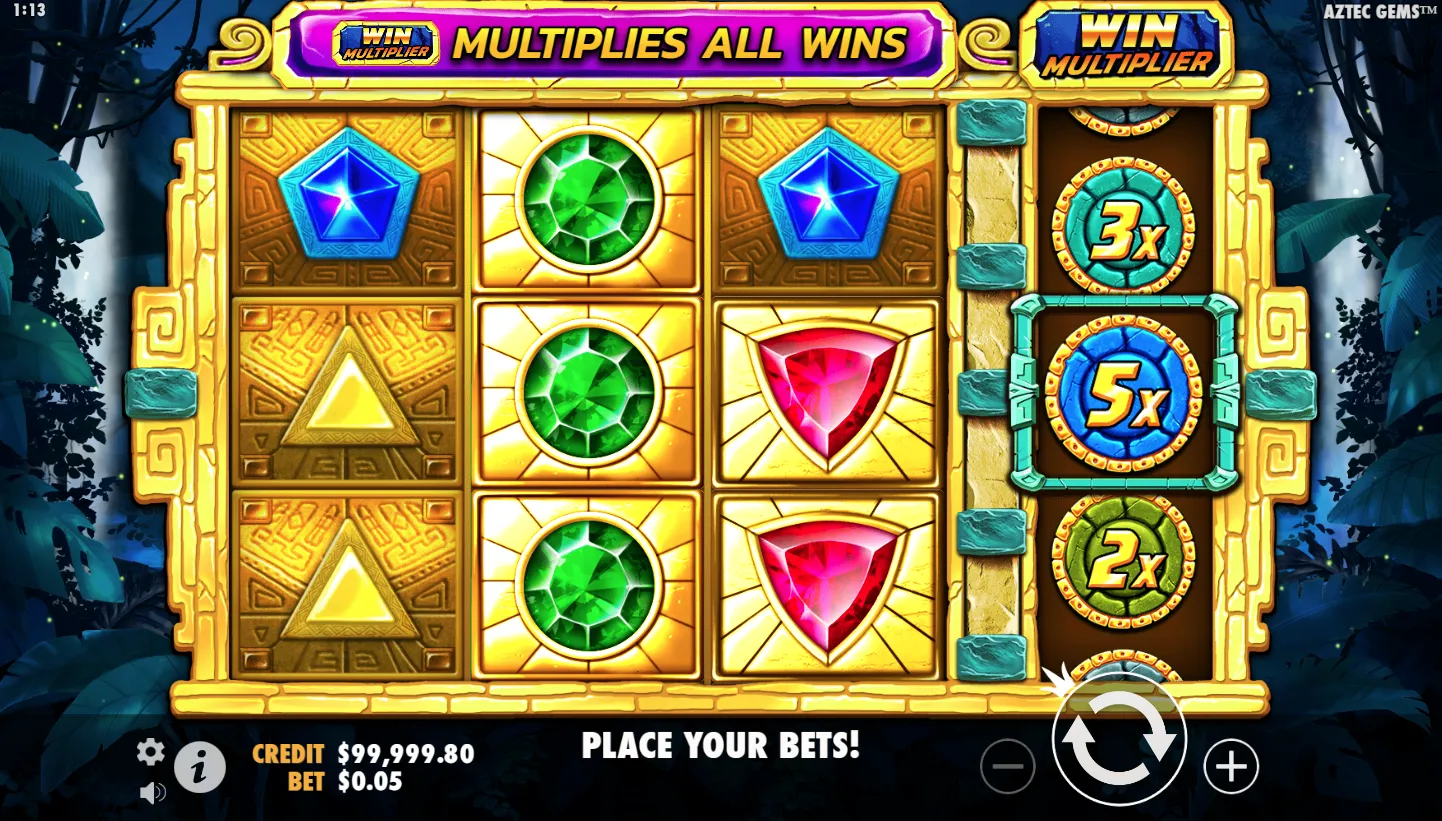
The fourth reel stops on 1x, 2x, 3x, 5x, 10x or 15x and multiplies every line win on the spin. Against a 25x board, I make its top value responsible for 350x of the 375x ceiling. Run a full screen of red gems up the ladder and it pays 20x, 40x, 60x, 100x, 200x and 300x; a full screen of wilds pays 25x, 50x, 75x, 125x, 250x and 375x. For any one symbol, filling the board instead of one line multiplies its pay by five. The reel can multiply it by fifteen. It moves a result further than the board can.
The top prize needs both at once. A single line of three wilds under 15x pays 75x, a fifth of the ceiling, and the best gem line under 15x pays 60x. A full wild screen under 10x pays 250x, two thirds of it. Reaching 375x takes nine wild cells and the 15x on the same spin. Nothing tells the player how often each value lands, so the odds of that corner cannot be read off the screen, and the ceiling works better as a boundary than as a target.
The reel does its most useful work at the bottom of the paytable. A yellow stone line returns 0.8x under 2x and first beats the stake under 3x, at 1.2x. A blue stone line, which only returns the stake at 1x, turns into a profit on every higher value. For two of the eight symbols the reel decides whether a win is a win at all.
Its weakness is that it cannot bank anything. The reel stops on every spin but only matters when a line pays, so a 15x beside an empty board is worth nothing, and nothing on the board survives into the next spin to use it. Every spin asks two draws to agree, and when they do not, the reel's best value goes to waste.
Nothing else is on offer, which makes 94.52% expensive
There are no free spins, no bonus round and no feature to buy. That removes the second layer most slots put their maths into: there is no bought round to price, no retrigger, no meter that saves value from one spin to the next. In the game's own maths, the return is paid in line hits under the reel and nowhere else.
The progressive jackpots are the exception, and they belong to the casino rather than the game. Where a casino switches the module on, a jackpot can drop at random at the end of any base-game spin and award one of up to four pools, with a minimum qualifying bet the casino sets and a better chance at higher bets. Without the module there is no jackpot, and I do not score the game on one.
The return setting matters more here than in a game with layers. At the standard 96.52% the house edge is 3.48% of every unit staked; at 94.52% it is 5.48%, more than one and a half times as much. A game with a bonus round at least changes the shape of what the lower setting sells. This one sells the same spin at a higher price. The rules screen shows the setting in use.
The reel is worth having, and the game around it is not enough
Aztec Gems suits a player who wants a three-reel game where every result settles on the spin and the ceiling is a sum anyone can do in their head. Next to a classic like Hot to Burn, whose wins come from line hits alone, the reel is a real improvement: it gives every paying spin a second number to watch and turns the two weakest stones from dead weight into occasional profits. Anyone after free spins, a round to buy or a ceiling in the thousands should look elsewhere, because nothing here is built for them.
That is why the score sits at 6.1, competent and unremarkable. The multiplier reel is clean, the stacks give it five lines to work with, and the arithmetic hides nothing. It is also a 25x board under a 15x ladder with no second act, and at the lower setting the price rises with nothing added.