The two levers a player can work both stop at 500×
9 Lions asks for a decision after every full draw, which most slots never do, and my reading of its maths is that both things a player can actually work at are aimed at a roof of 500×. The editable hold serves counts on the win table, and no count on that table pays more than nine Lions. The Lion matrix builds toward a round whose prize is that same Lion row. The other half of the 1000× maximum is decided inside a dragon egg, picked blind from three. That split, between the half of the game a player steers and the half that sets its ceiling, is why a thoughtful design lands in the middle of the scale rather than near the top.
None of the parts is unique to this game. Beauty Fruity runs the same nine single-symbol reels, pays four of a kind anywhere, and uses the same Block Symbols Mode hold. Fruit Mania Deluxe keeps the reels, the hold and a 1000× cap, but pays three identical symbols in a row or column instead of a count. Larry the Leprechaun spreads the kit over a bigger grid and adds bonus matrix tables that collect symbols toward its features. I read 9 Lions as Wazdan's nine-reel count game with a collection matrix fitted on top and tied to the highest-paying symbol. It is an assembly of house parts, so the question is what the assembly can pay, not whether it is new.
A held draw is priced by the stake, never by the step it chases
After a full draw, Block Symbols Mode blocks the set the game rates best, the player can change that selection, and the next draw refills only the open positions. That draw is a new game at a full stake, 60.00 at a 60.00 bet, exactly what a fresh draw costs. The hold buys direction. It never buys a discount.
A flat fee matters because the steps it pays for are anything but flat. Every row on the table is back-loaded. No symbol except the Dragon pays more than 14% of its full-screen value for six of a kind, and the King, Ace and Tiger pay exactly one-fifteenth: 8× against 120×, 10× against 150×, 12× against 180×. The Lion pays 50× for six against 500× for nine, the Turtle 40× against 350×. The money in each row sits at seven, eight and nine of a kind, and the step from seven to eight alone triples both the 10 (5× to 15×) and the Tiger (30× to 90×).
Set those steps against the fixed price. Every draw is scored, fresh or held, so a blocked paying count pays again on the held draw, and the step is what the hold can add on top of it. Pushing four 10s to five lifts the table value from 1× to 2×, a step worth exactly the 1× stake the held draw costs. Pushing seven Lions to eight lifts it from 150× to 300×, a step 150 times that same fee. The step a hold chases is large high on the table and small at the bottom, which is where the base game spends its time: four of a card symbol pays 1× to 4×, and there is no wild and no multiplier to lift those counts. The player can override the game's own selection, and that gap in step values is the whole reason the override is worth using.
The Lions Bonus prize is the base-game Lion row, number for number
The round's ladder runs 15×, 30×, 50×, 150×, 300× and 500× for four to nine Lions. Those are the Lion payouts on the ordinary win table, unchanged. The Lion prize adds no multiplier, and its best case is precisely what nine Lions pay on any base draw. What the round adds is persistence: every Lion on the reels at the start stays blocked, each new Lion joins them over nine bonus spins, and the prize is paid once after the ninth.
The build to reach it is long. Each Lion that lands lights the matching field of a 3×3 matrix that mirrors the reels, so a Lion has to have appeared on every one of the nine reels before the round is available, and a full matrix then waits for a draw with three or more Lions. A three-Lion trigger pays nothing on the table, since the Lion row starts at four. One more Lion in nine spins reaches the 15× floor, and a round that never finds it pays no Lion prize.
Read as steps, the ladder is steep. From a three-Lion start, the fourth, fifth and sixth Lions add 15×, 15× and 20×, which is 50× between them. The seventh, eighth and ninth add 100×, 150× and 200×, which is 450× of the 500× top. Nine-tenths of the round's value sits in its last three Lions, so a round that closes on six has collected one-tenth of what the whole matrix build was for. I count that as a sticky-symbol round with a demanding ladder, gated behind a nine-field collection, whose ceiling the base game already pays without any of it.
The ceiling hides behind the weakest symbol on the table
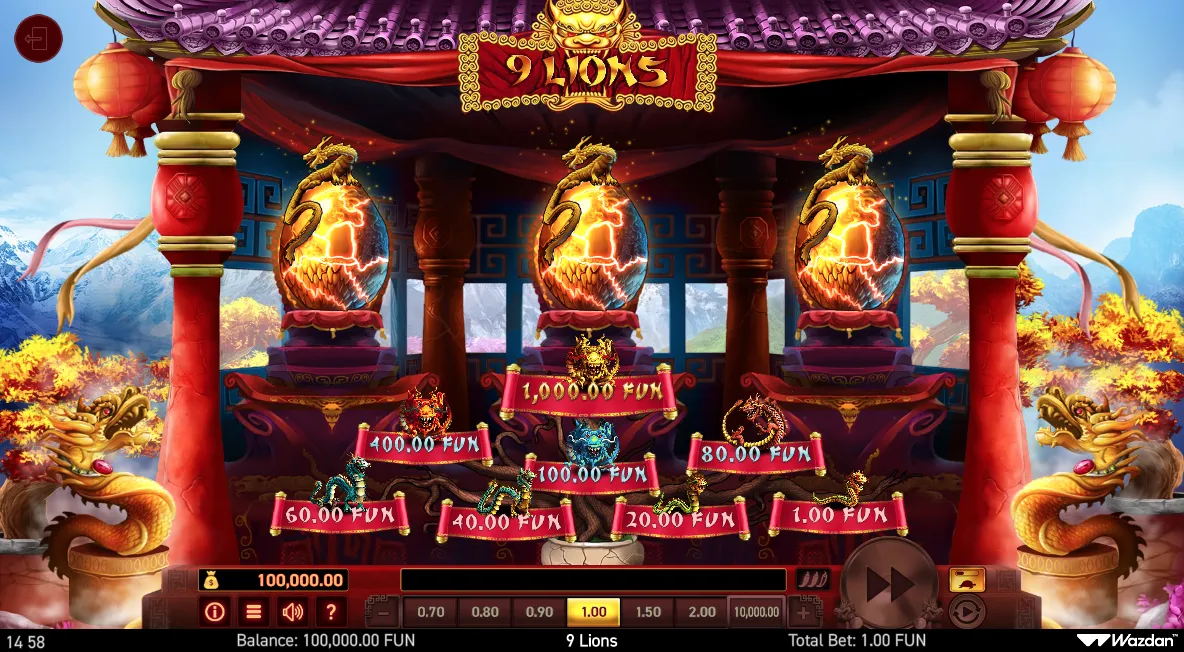
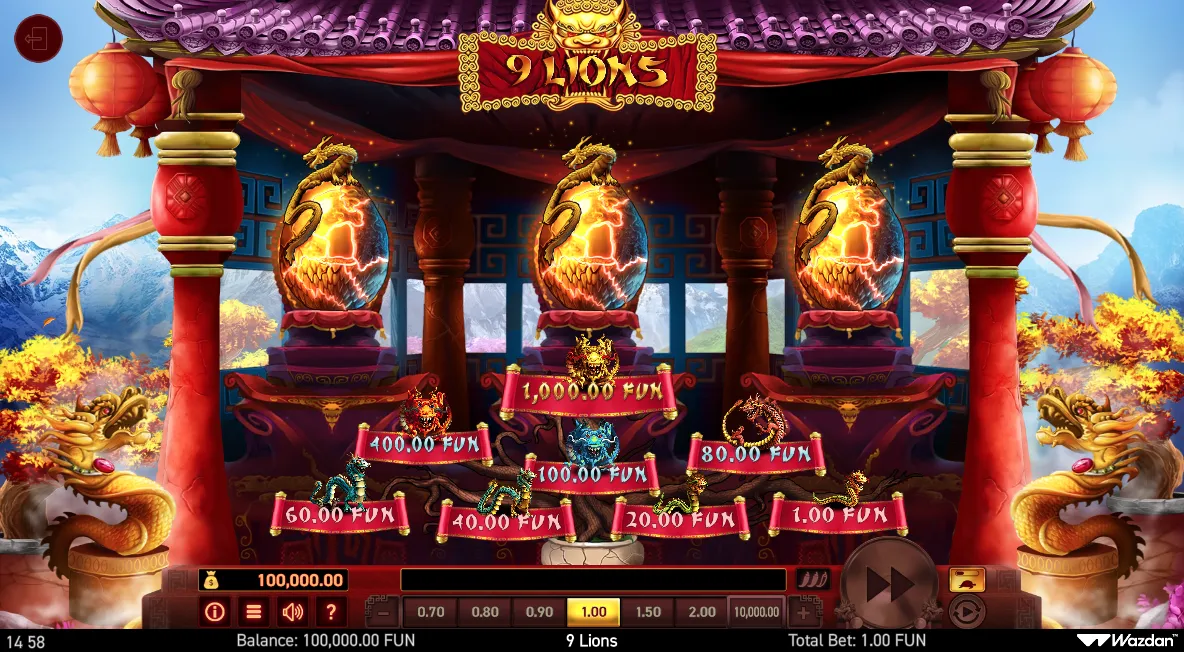
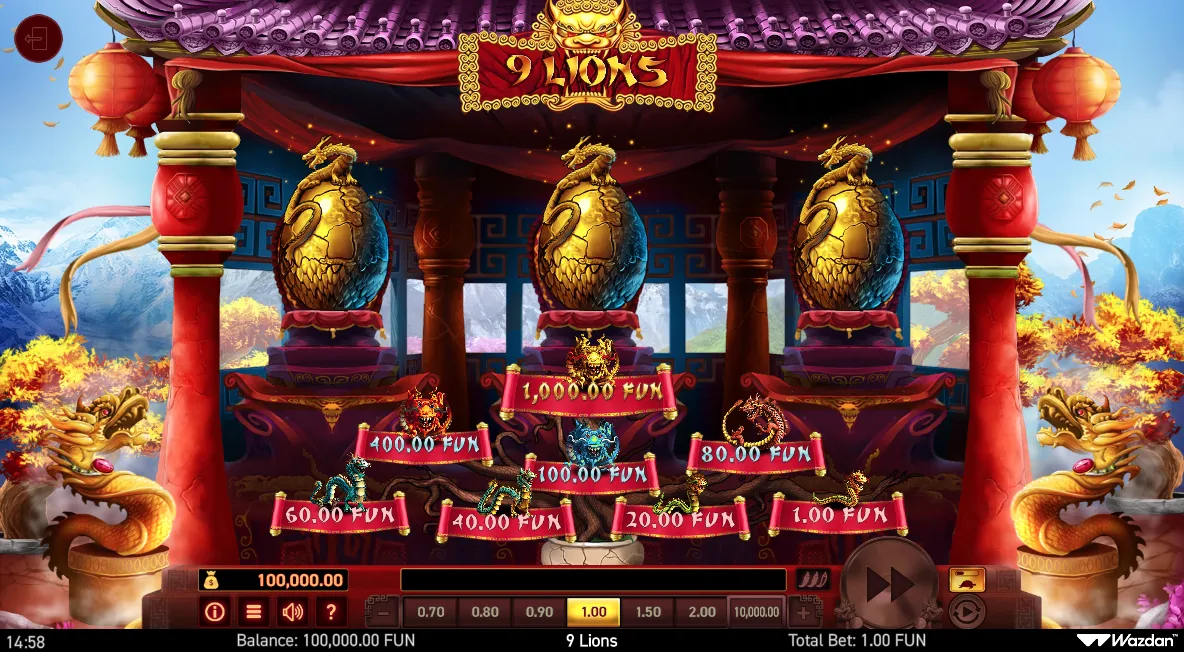
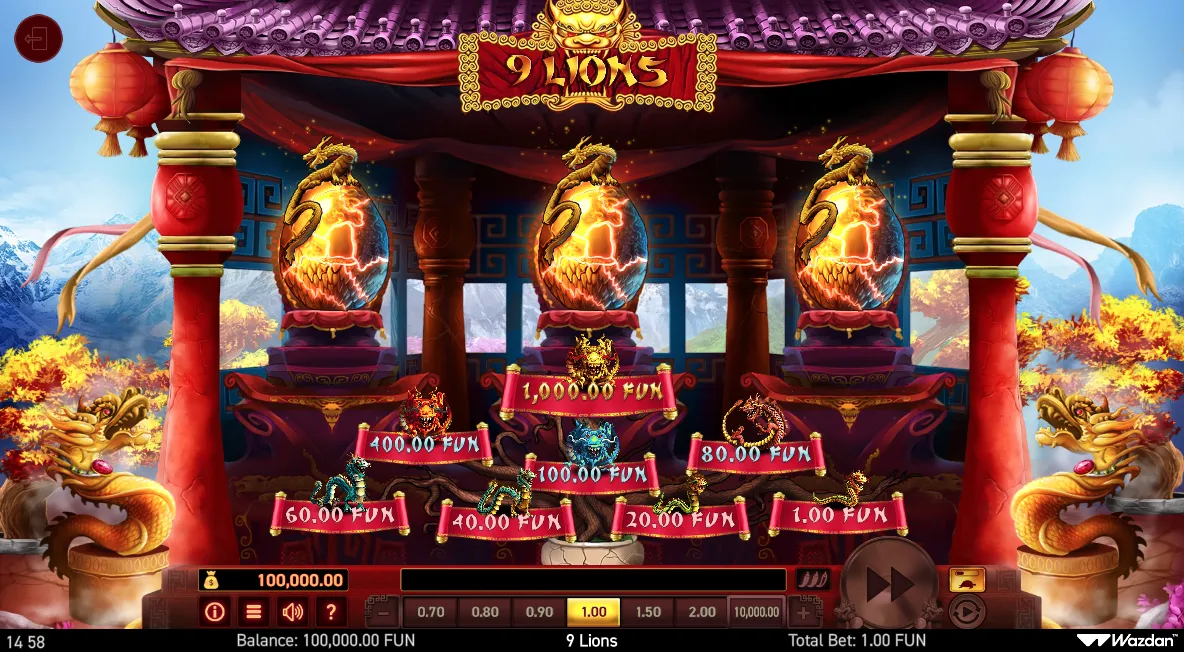
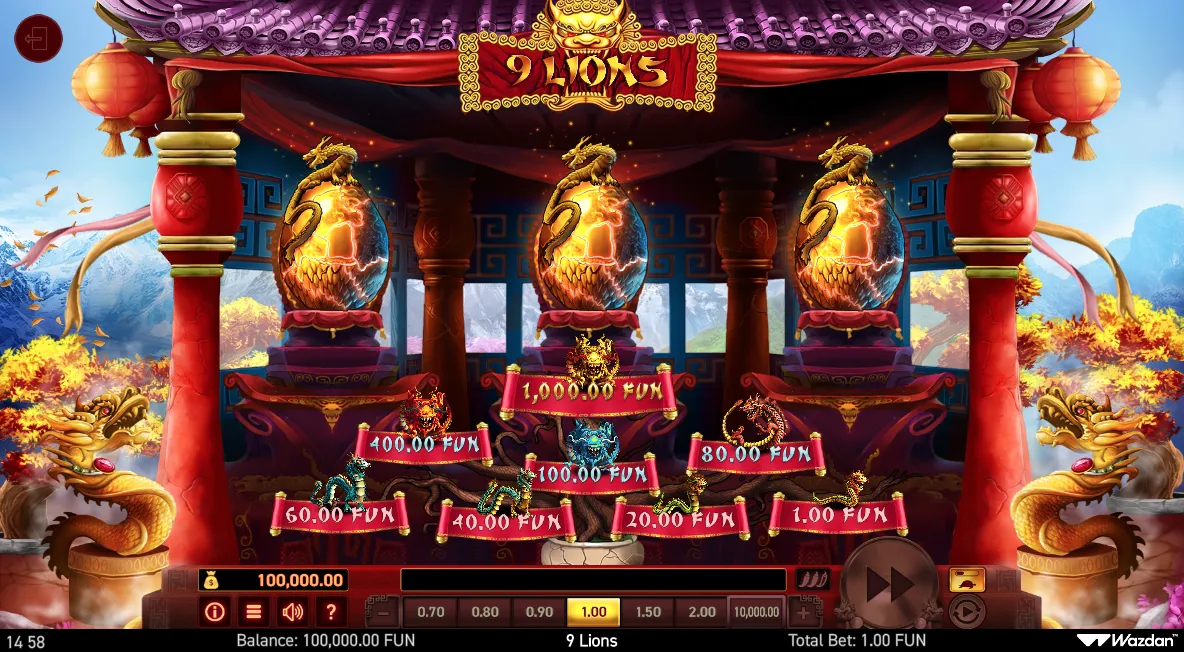
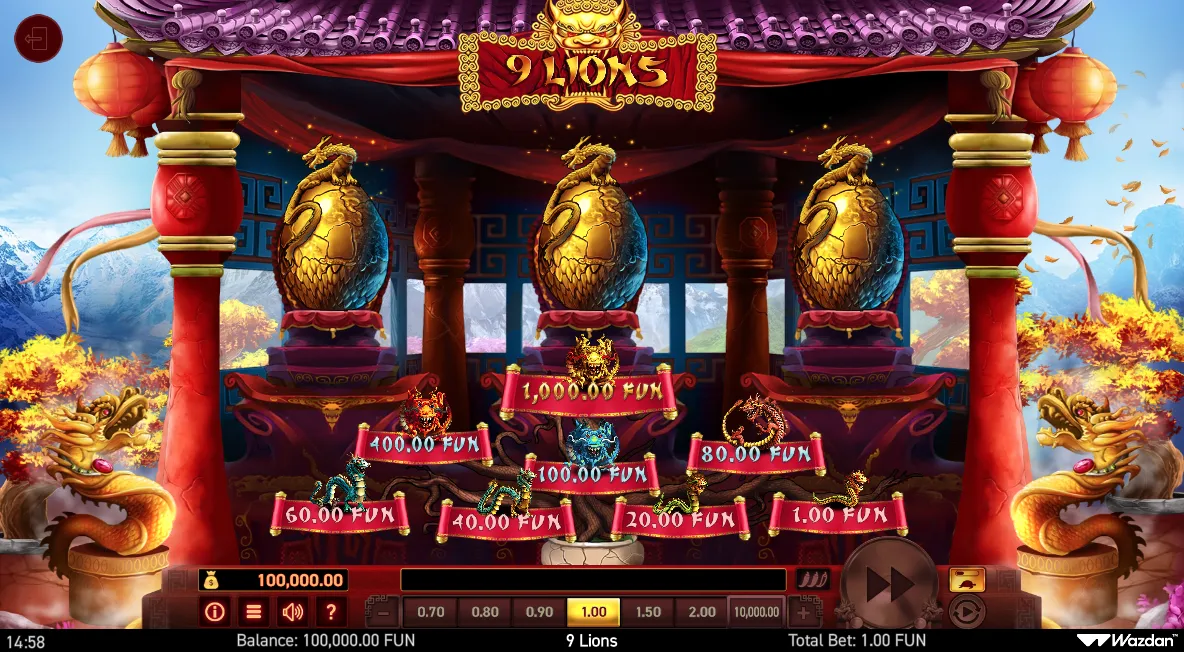
The Dragon is worth the least of any symbol at a full screen. Nine Dragons pay 15×, half of nine 10s, and three pay 1×. It is also the door to the cap. Three Dragons across the middle row start the Dragons Bonus, a pick of one egg from three, and the dragon inside pays from an eight-prize table: 1000×, 400×, 100×, 80×, 60×, 40×, 20× and 1×. In a game whose wins ignore position, the feature holding the maximum is the one that cares which row a symbol lands on.
That pick table is the main reason the score stops where it does. Seven of its eight prizes pay less than a full screen of Lions, and six pay 100× or less. The smallest, 1×, is 60.00 at a 60.00 bet: a bonus round that hands back the stake, the same as four 10s. The gold dragon at 1000× is two and a half times the red dragon and double the best Lions Bonus, and it is the only single prize anywhere in the game that reaches the maximum win. The base-game side panel shows only the top three, 60,000.00, 24,000.00 and 6,000.00 at a 60.00 bet, so the three largest dragons sit in view and the five that run from 80× down to 1× do not.
Here the hold's logic runs out. Everything a player learns from reading the count table applies to reels, and the top prize is decided by an egg with the dragon still inside it.
The design rewards a reader of paytables and shortchanges a chaser of multiples
The gamble is the other route above the table top, and it follows the same pattern of control sold at a price. Seven doubling rounds on one win multiply it by 128, which turns a 4× four-Ace count into 512× on paper, past the whole Lion row, with the full amount at risk in every round and the game's cash ceiling above it all. The three volatility levels trade frequency against size around a 96.59% return and a 1000× maximum win; they change the pace, not the shape of the argument above.
I would put this game in front of a player who wants a decision on every draw and will check the win table before overriding the hold. On a 3×3 window that is rare, and the step arithmetic gives the choice real content. Anyone who treats a slot as a route to a large multiple should look elsewhere. The cap is 1000×. Half of it is the Lion row's 500×, which a base draw pays for nine Lions and the Lions Bonus reaches only after a full matrix and a steep ladder. The other half sits in one prize out of eight. Moving across the family does not fix that on its own, since Fruit Mania Deluxe shares the same 1000× cap.
The credit here is earned on decisions and lost on the roof: a hold that never discounts, a bonus that pays the base table, and a ceiling locked in a single egg.